How Much Is The Reservoir, Horta de Ebro Worth?
Last updated: May 6, 2026
Quick Facts
- Methodology
- comparable analysis
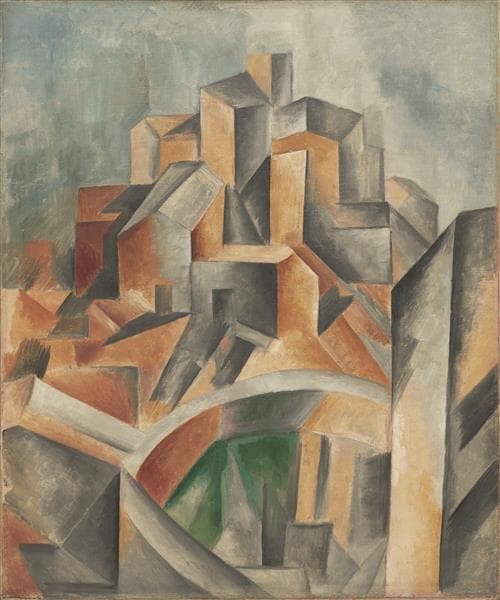
Hypothetical fair‑market value for Pablo Picasso’s The Reservoir, Horta de Ebro (1909, MoMA) is estimated at $120–170 million. The range reflects the painting’s canonical status in early Cubism, ironclad provenance, and the deep market for top‑tier Picassos, balanced by its modest scale and landscape subject.
Valuation Analysis
Conclusion: We estimate a hypothetical fair‑market value of $120–170 million for Pablo Picasso’s The Reservoir, Horta de Ebro (1909), assuming a marquee‑evening sale in New York or London under standard market conditions. This is a notional valuation for a museum‑held masterpiece; it is intended as an insurance or fair‑market proxy rather than a signal of actual deaccession.
Work identity and significance. Painted in summer 1909 at Horta de Sant Joan, The Reservoir is a textbook image of Picasso’s transition into Analytic Cubism, synthesizing Cézannean structure into a new, faceted language. The oil on canvas measures 24 1/8 × 20 1/8 in (61.5 × 51.1 cm) and is in the collection of The Museum of Modern Art, New York, by gift of David and Peggy Rockefeller, with a storied provenance back to Leo and Gertrude Stein [1]. Within Picasso’s oeuvre, the 1908–1911 Cubist canvases are foundational and exceptionally scarce outside museums.
Market anchors and comparables. True period comparables are rare. The strongest public benchmark for a 1909 Cubist oil is Femme assise, sold at Sotheby’s London in 2016 for £43.27m (~$63.6m then; materially higher in today’s dollars), underscoring the potency of this period on the open market [5]. At the top of Picasso’s broader market, nine‑figure results for later icons—Les femmes d’Alger (Version “O”), $179.37m (2015) [2], and Femme à la montre (1932), $139.4m (2023) [3]—demonstrate ongoing global willingness to pay for masterpieces. A closely related Horta‑series landscape deaccessioned by MoMA (Houses on the Hill, Horta de Ebro) reportedly sold privately for $12–15m in 2003; while far too dated to anchor price today, it confirms long‑standing demand for the series [4].
Derivation of the estimate. We start from the 2016 Cubist benchmark and apply: (i) a substantial scarcity and canonical‑status premium for a museum‑grade, frequently reproduced 1909 canvas; (ii) inflation and a trophy‑scarcity adjustment; and (iii) calibration against the current nine‑figure appetite evidenced by major 1932 portraits. These support a low‑nine‑figure floor. We then temper for two factors: the painting’s modest scale and its landscape/architectural subject (collector preference often tilts to major portraits). The result is a $120–170 million range that positions The Reservoir below Picasso’s absolute records yet squarely within trophy territory for works of foundational art‑historical importance.
Market context and timing. After a 2023 Picasso high at $139.4m, 2024 saw fewer mega‑lots and a pullback in headline prices; 2025–early 2026 indicated stabilization and selective strength, with buyers concentrating on blue‑chip Modern masters [3][6][7]. In such an environment, truly best‑in‑class Cubist works command outlier demand when fresh. If two or more top collectors prioritized Cubist primacy over subject preferences, this estimate could stretch toward the upper end of the range.
Practical note. As a MoMA collection object, The Reservoir is effectively non‑marketable; this valuation is a reasoned, hypothetical proxy grounded in public benchmarks, period scarcity, and Picasso’s durable market leadership [1–3].
Key Valuation Factors
Art Historical Significance
High ImpactPainted in 1909 at Horta de Sant Joan, The Reservoir occupies a critical juncture in Picasso’s advance into Analytic Cubism. It condenses Cézanne’s structural innovations into a fully faceted, proto‑Analytic vocabulary and is widely reproduced in surveys of Cubism. This moment (1908–1911) is the intellectual bedrock of 20th‑century modernism, and canonical examples rarely surface outside institutions. Within Picasso’s vast oeuvre, early Cubist canvases carry disproportionate scholarly weight and curatorial demand. That primacy endows the work with a strong qualitative premium over many later, more plentiful periods, even if certain later subjects (e.g., 1932 portraits) can outperform on pure market glamour. The art‑historical importance here is indisputable and central to value.
Rarity and Supply
High ImpactFoundational 1908–1911 Cubist oils by Picasso are essentially off‑market, with most in museums or the most long‑term collections. Public comparables are sparse; one of the few, Femme assise (1909), brought ~£43.27m ($63.6m) in 2016, a benchmark that highlights extreme scarcity. A related Horta landscape sold privately in 2003 for $12–15m, far below today’s trophy levels but confirming enduring demand for the series. With greatly diminished supply of museum‑quality Cubist pictures, competition among top collectors for a painting of this caliber—if hypothetically available—would be intense, supporting a low‑ to mid‑nine‑figure framework despite the broader market’s selectivity.
Subject, Scale, and Aesthetic Appeal
Medium ImpactAt 61.5 × 51.1 cm, the canvas is modest in size. The subject—landscape/architectural forms of Horta—has profound historical resonance but typically trails the commercial magnetism of iconic portraits (e.g., 1932 Marie‑Thérèse). That said, the crystalline planar construction and clear 1909 date strongly appeal to connoisseurs of Cubism. The image presents as a ‘textbook’ early Cubist picture, which enhances its desirability among curators and historically minded collectors even if broader, portrait‑led taste sometimes commands higher absolute prices. Net effect: positive, but not maximal, contribution to price versus equally canonical but larger or portrait‑format Picassos.
Provenance and Institutional Status
High ImpactThe chain from Leo and Gertrude Stein through Gertrude Stein’s estate and Alice B. Toklas to MoMA’s Syndicate, then David and Peggy Rockefeller, and ultimately gift to MoMA is exemplary. Such provenance confers unimpeachable authenticity and cultural imprimatur. The painting’s long exhibition and publication profile within a top museum ecosystem elevates its scholarly and reputational standing. While museum ownership makes any transaction highly unlikely, for valuation purposes institutional anchoring and Rockefeller‑level provenance strengthen the qualitative premium and buyer confidence, which would translate into competitive pricing in a hypothetical sale context or in setting insurance benchmarks.
Sale History
Private sale
Estate of Gertrude Stein to The Museum of Modern Art (Syndicate purchase); price undisclosed (date approximate per MoMA provenance).
Private sale
David & Peggy Rockefeller acquired from MoMA Syndicate; price undisclosed (date approximate per MoMA provenance).
Gift to The Museum of Modern Art
Gift of Mr. and Mrs. David Rockefeller (completing a prior fractional/promised gift).
Pablo Picasso's Market
Picasso’s market is among the deepest and most global in art. His auction record stands at $179.37 million for Les femmes d’Alger (Version “O”) in 2015, with consistent nine‑figure demand reaffirmed by the $139.4 million sale of Femme à la montre in 2023. While the most commercially sought‑after segment remains the 1932 Marie‑Thérèse portraits, major works across periods continue to command strong prices when fresh to market with first‑rate provenance. The market briefly contracted at the mega‑lot level in 2024 due to thinner supply, but depth across price bands—and especially for canon‑defining pictures—remains robust. Collectors prize condition, provenance, period importance, and image recognizability above all.
Comparable Sales
Femme assise (1909)
Pablo Picasso
Same artist and year (1909), landmark early Cubist oil on a similar small scale; benchmark public auction for Picasso’s 1908–11 Cubist phase.
$63.6M
2016, Sotheby's London
~$86.7M adjusted
Houses on the Hill, Horta de Ebro (1909)
Pablo Picasso
Same artist, same 1909 Horta de Ebro campaign, near-identical subject/format; a direct series comparator (price reported at $12–15m in 2003).
$13.5M
2003, Private sale (MoMA deaccession via Acquavella to Heinz Berggruen)
~$24.0M adjusted
Femme à la montre (1932)
Pablo Picasso
Same artist; a recent nine‑figure, museum‑grade Picasso trophy that sets current top‑end appetite for the artist, useful as an upper‑bound market anchor even if later period/subject.
$139.4M
2023, Sotheby's New York
~$149.4M adjusted
Femme assise près d’une fenêtre (Marie‑Thérèse) (1932)
Pablo Picasso
Same artist; a major 1932 portrait establishing sustained nine‑figure demand for blue‑chip Picassos, informing ceiling expectations relative to rarer 1909 Cubist material.
$103.4M
2021, Christie's New York
~$124.8M adjusted
Femme nue couchée (1932)
Pablo Picasso
Same artist; top‑tier 1932 work showing robust eight‑figure depth and helping to calibrate current Picasso trophy pricing versus earlier Cubist rarity.
$67.5M
2022, Sotheby's New York
~$75.4M adjusted
Les femmes d’Alger (Version “O”) (1955)
Pablo Picasso
Same artist; all‑time Picasso auction record that provides an absolute upper boundary for the artist’s market and context for nine‑figure potential of canonical works.
$179.4M
2015, Christie's New York
~$247.3M adjusted
Current Market Trends
Modern masterworks continue to benefit from a flight to quality. After a 2024 pullback in mega‑lot volume and headline Picasso prices, 2025 marked a rebound in global art sales with renewed focus on established names. Nine‑figure consignments remain scarce, amplifying competition when true trophies appear. The 2023 $139.4m Picasso result validated ongoing appetite for blue‑chip icons, while reports highlighted selectivity and disciplined bidding at the very top in 2024. Overall, the category shows stable to strengthening demand for canonical pre‑ and inter‑war works, with pricing power concentrated in best‑in‑class examples carrying museum‑grade provenance.
Sources
- The Museum of Modern Art – The Reservoir, Horta de Ebro (Object page and provenance)
- Christie’s – Post‑sale release: Les femmes d’Alger (Version “O”), $179,365,000 (May 11, 2015)
- Sotheby’s – Emily Fisher Landau Collection totals and Picasso’s Femme à la montre result ($139.4m, Nov 8, 2023)
- The Art Newspaper – MoMA Picasso on show in France (reporting $12–15m private sale of related 1909 Horta canvas, 2003)
- Sotheby’s London (summary) – Picasso, Femme assise (1909) sold for £43,269,000 (June 21, 2016)
- Artnet News – 2024 artist auction rankings and Picasso market contraction
- Artsy – Global art market rebounded to $59.6 billion in 2025 (Art Basel & UBS report)