How Much Is Arearea (Joyeusetés) Worth?
Last updated: May 4, 2026
Quick Facts
- Methodology
- comparable analysis
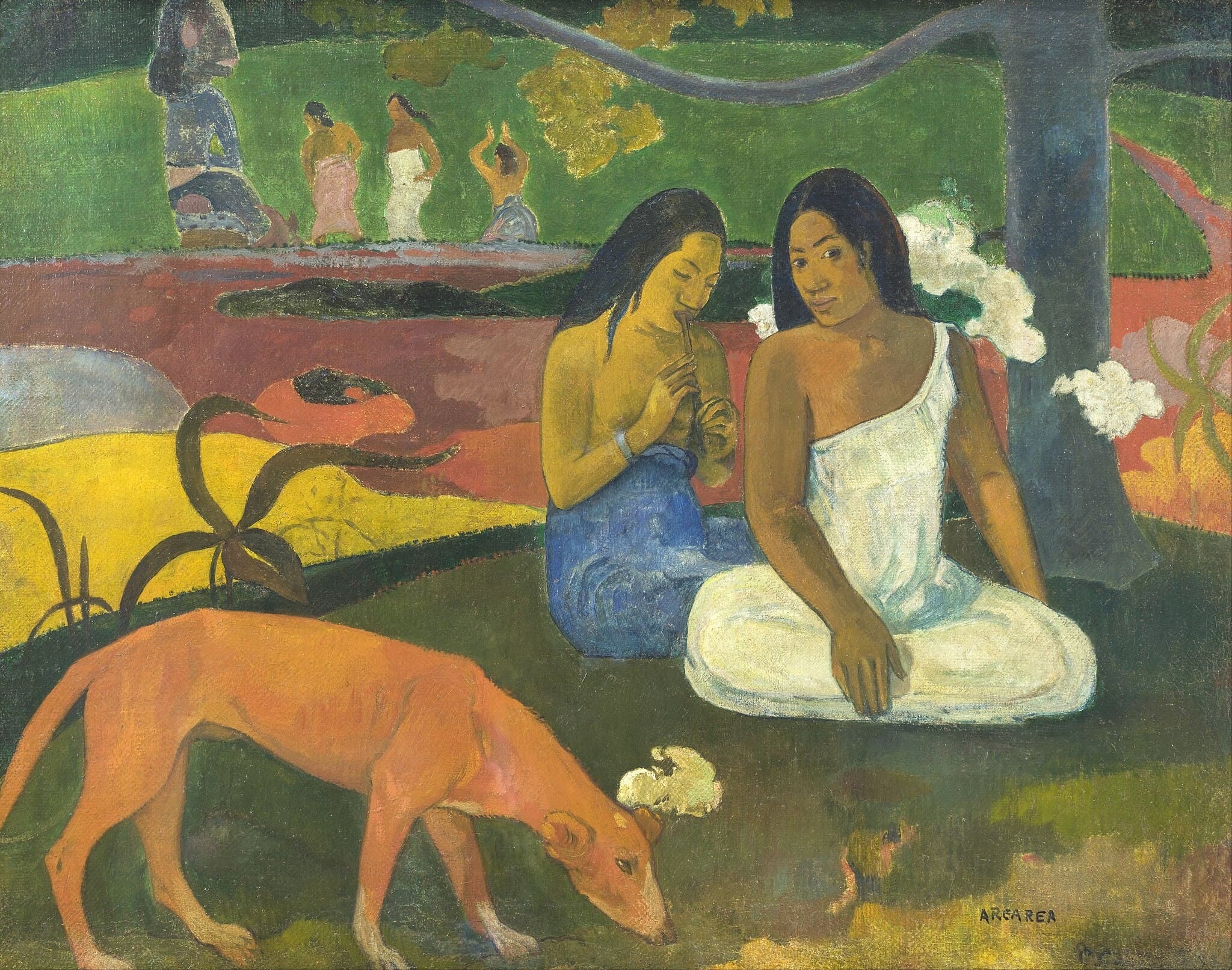
Arearea (Joyeusetés), 1892 by Paul Gauguin (Musée d'Orsay, RF 1961 6) is a museum-held, well documented Tahitian-period canvas. If legitimately offered today in good to excellent condition and with exportability cleared, a realistic market range is approximately $25M–$80M, with the final outcome driven by condition, provenance clarity and buyer competition.
Valuation Analysis
Valuation conclusion: Arearea (Joyeusetés), 1892, by Paul Gauguin is a museum-held, well documented Tahitian-period canvas currently in the collection of the Musée d'Orsay (accession RF 1961 6). Given its proven museum provenance, date and exhibition history, a defensible market range if the painting were to be legitimately offered for sale today is approximately $25,000,000 to $80,000,000 USD, assuming good to excellent condition and no legal encumbrances. The artwork's medium scale and strong provenance place it in the upper-mid tier of Gauguin Tahitian works rather than among the very few canonical masterpieces that achieve private-sale blockbusters [1].
Method and comparables: This estimate is based on a comparable-analysis approach, using recent auction and private-sale evidence for major Gauguin Tahitian canvases and adjusting for scale, iconographic importance, condition and provenance. Public auction ceilings for museum-quality Gauguins moved sharply following Christie’s Nov 2022 sale where Maternité II realized $105,730,000; that result establishes an upper auction reference for top masterpieces, while other important Tahitian canvases have sold in the low-to-mid tens of millions at auction [2]. Privately reported transactions (for example Nafea Faa Ipoipo) show a higher private-sale ceiling but are opaque and not direct auction precedents.
Drivers of value: Key positive drivers are the painting's placement in Gauguin's seminal first Tahitian period, a documented provenance including early exhibition and dealer handling, and the rarity of comparable museum-quality canvases coming to market. Key downside drivers are its medium scale (74.5 x 93.5 cm), the fact that it is not the single most iconic Gauguin composition, any undisclosed conservation or restoration issues, and the practical/legal barriers to selling works from national collections. In the commercially likely scenario where a comparable painting with these attributes reaches the market via private sale or deaccession, aggressive institutional interest could push the result toward the top of the range; absent such competition, a public auction result would more typically fall in the lower to middle part of the range.
Recommended next steps: To refine this valuation to market-grade precision: obtain high-resolution images and a full condition and technical report from Musée d'Orsay, confirm the complete provenance and exhibition citations in the catalogue raisonne and monographs, and commission a formal appraisal from a major auction house specialist. Note that because the painting is held in the French national collection, sale is unlikely without exceptional deaccession procedures; any contemplated market strategy must address export/patrimony rules and title clearance before realistic offers can be solicited.
Key Valuation Factors
Art Historical Significance
High ImpactArearea (Joyeusetés) dates to Gauguin's first Tahitian period (1891-1893), the pivotal phase when his synthetist vocabulary and Tahitian subjects coalesced into works that shaped his post-Impressionist reputation. The motif and composition are thematically central to his Tahitian production and demonstrate the stylistic simplification, color palette and symbolic intent collectors and museums prize. While not the singular icon in Gauguin's canon, this painting is a fully realized period composition and therefore commands high art-historical importance. That status supports institutional interest and positions the work above minor studio variants in market preference.
Provenance & Exhibition History
High ImpactThe painting has a strong, published provenance and exhibition record: offered in Gauguin's 1893 Paris showing, recorded in the 1895 Drouot sale (with the artist repurchasing), handled by Ambroise Vollard and later held in private collections before entering French national holdings in 1961 (accession RF 1961 6). Continuous provenance that includes important dealers and exhibitions materially reduces attribution risk, increases buyer confidence, and elevates marketability. Museum ownership historically suppresses immediate market availability but positively signals quality and authenticity when a sale is possible.
Condition & Technical State
High ImpactAs a museum-held work the painting is likely well conserved, a positive for collectors. Nonetheless the exact condition (presence of restorations, lining, paint losses, varnish discoloration, craquelure, and any structural work) is a primary determinant of price. Technical analysis such as X-ray, infrared reflectography and pigment testing can confirm authorship, uncover pentimenti, and document interventions; these results can add or subtract materially from value. A formal, current condition report is therefore essential to firming the estimate.
Market Comparables & Price Evidence
High ImpactComparables show a wide dispersion: auction record highs for Gauguin exceed $100M for top masterpieces, notably Christie's 2022 Maternite II; other significant Tahitian canvases trade in the low-to-mid tens of millions. Privately reported blockbusters illustrate the possible ceiling but are not transparent. Arearea's medium dimensions and strong provenance place it below uniquely iconic canvases but above studio variants, supporting an upper-mid tens of millions range in a competitive market context.
Marketability & Legal/Export Constraints
Medium ImpactBecause the painting is part of French national collections, deaccession and export rules materially affect marketability. Works in state ownership are rarely sold, and any deaccession would require legal and political clearance. Even for privately owned Gauguins, export licenses and patrimony classifications can delay or complicate sales, reducing immediate buyer competition. The buyer pool for a marketable Arearea would be concentrated (major museums, sovereign patrons, and top private collectors), which can increase realized prices but lengthen sale timelines.
Sale History
Paris exhibition (Gauguin)
Hôtel Drouot, Paris
Ambroise Vollard; private dealers
French national collections
Musée d'Orsay, Paris
Paul Gauguin's Market
Paul Gauguin occupies a blue-chip position in the market for late-19th-century modernism. His Tahitian-period paintings are particularly sought after by museums and high-net-worth collectors, generating strong demand when comparable works come to market. Auction results and private sales demonstrate a bifurcated market: a small number of canonical masterpieces achieve extraordinary prices (including public sales above $100M and opaque private transactions in the hundreds of millions), while a broader set of important works trade in the tens of millions. Provenance, condition and exhibition history remain decisive in distinguishing these outcomes.
Comparable Sales
Maternité II
Paul Gauguin
Same artist; high‑profile, museum‑quality late‑19th/early‑Tahitian period canvas that reset Gauguin's auction ceiling in 2022 — useful ceiling for top‑end market potential versus Arearea.
$105.7M
2022, Christie's, New York (Paul G. Allen sale)
~$114.9M adjusted
L'Homme à la hache (Man with an Axe)
Paul Gauguin
Auction precedent for an important early 1890s Gauguin (Tahitian period) painting at a high‑end but substantially lower level than the record sale — provides a mid‑range auction benchmark for comparable period works.
$40.3M
2006, Christie's, New York
~$63.6M adjusted
Nafea Faa Ipoipo (When Will You Marry?)
Paul Gauguin
Directly comparable by year (1892), subject (Tahitian women) and iconographic importance — a private‑sale blockbuster that illustrates the very top of demand for canonical Gauguin Tahitian works.
$210.0M
2014, Private sale (reported; buyer reported as Qatari/Qatar Museums)
~$282.1M adjusted
Current Market Trends
Post-2022, demand for blue-chip modernist canvases, including top Gauguins, remains robust though availability of high-quality Tahitian works is rare. Auction records have reset potential ceilings, but macroeconomic uncertainty, tighter lending and geopolitical factors introduce caution into bidding dynamics. Private sales continue to push top ceilings, while institutional budgets and sovereign collectors drive sporadic, high-value acquisitions. For Arearea, careful timing and a well-orchestrated sale strategy would be crucial.