How Much Is Nafea Faa Ipoipo (When Will You Marry?) Worth?
Last updated: May 4, 2026
Quick Facts
- Last Sale
- $210.0M (2014, Private sale (Rudolf Staechelin trustees to buyer via dealer Guy Bennett; disclosed in UK court proceedings))
- Methodology
- comparable analysis
Nafea Faa Ipoipo (1892) is a museum‑quality, canonical Gauguin and commands blue‑chip pricing. Based on the court‑disclosed 2014 private sale (USD 210,000,000) and auction comparables, a realistic market range today is approximately $150M–$300M, with most likely realizable outcomes in the low‑to‑mid‑hundreds of millions depending on provenance confirmation, condition and buyer competition.
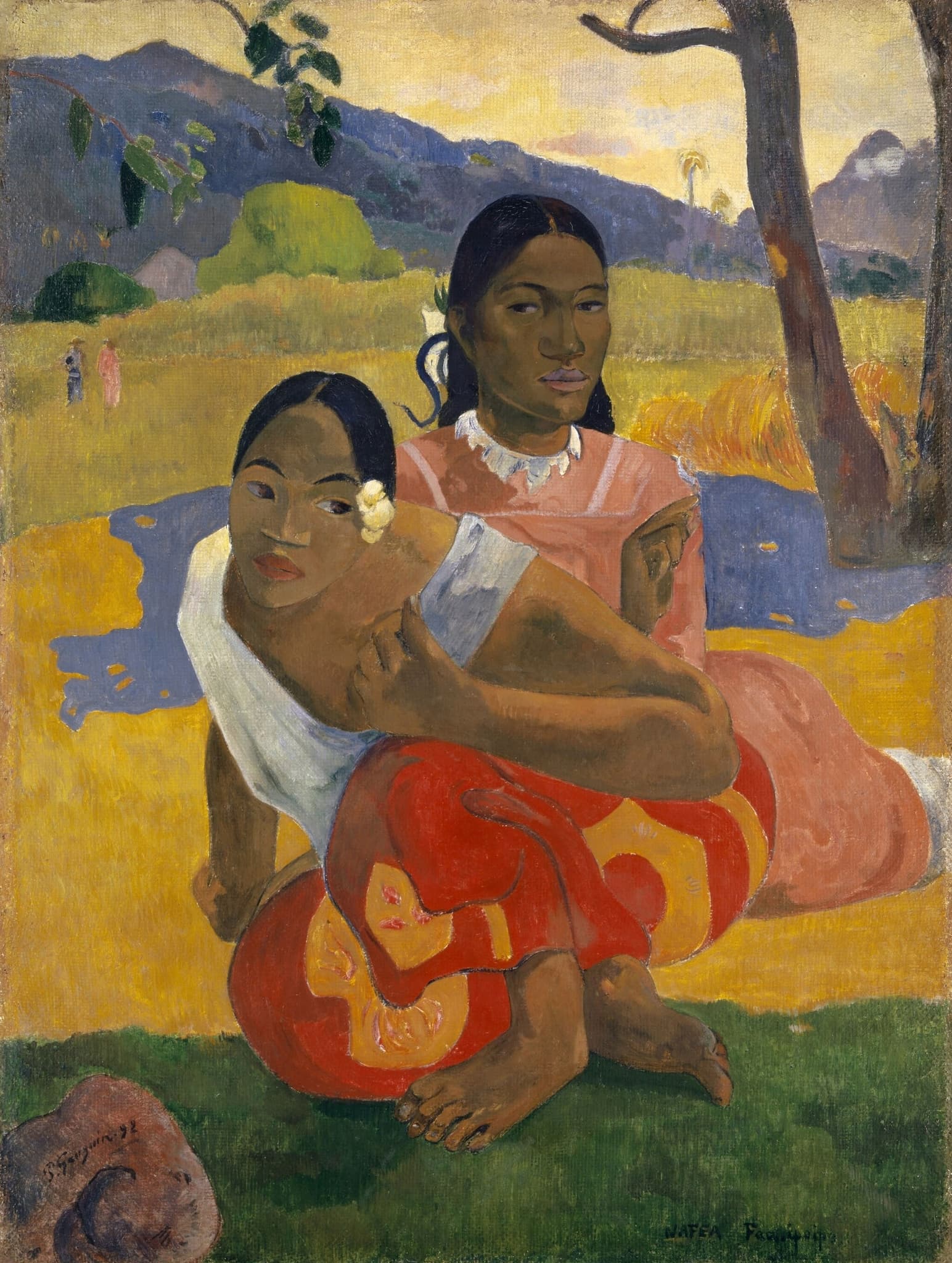
Nafea Faa Ipoipo (When Will You Marry?)
Paul Gauguin, 1892 • Oil on canvas
View more by Paul Gauguin →Valuation Analysis
Conclusion and headline rationale. Nafea Faa Ipoipo is one of Paul Gauguin’s most important Tahitian canvases and, when measured against private‑sale precedent and public auction comparables, commands a multi‑hundred‑million‑dollar valuation. The single best‑documented transaction is the September 2014 private sale disclosed in UK court filings at USD 210,000,000; earlier press coverage quoted a higher headline (~USD 300M) that established market perception of the work’s ceiling [1][2].
Benchmarks and methodology. This valuation uses a comparable‑analysis approach: (a) the court‑disclosed private sale of Nafea (USD 210M) as the direct anchor, (b) recent public auction performance for the artist (notably Maternité II at Christie’s, Nov. 9, 2022, USD 105.73M) as the auction benchmark, and (c) cross‑artist blue‑chip sales to test ceiling behavior among trophy modern masterpieces [2][3]. Private transactions involving sovereign/state buyers and ultra‑high‑net‑worth collectors routinely trade above public auction realizations; that dynamic explains the spread between the public auction ceiling (~USD 100–110M) and the private‑sale ceiling (USD 210M disclosed; press‑circulated higher figures) that justifies a $150M–$300M working range.
Provenance and marketability. Long, distinguished provenance (Rudolf Staechelin family trust) and repeated museum loans materially increase desirability and justify premium pricing. The painting’s removal from long‑term public loan and reports linking the buyer to Qatari collecting initiatives raised the public profile of the transaction, but no formal accession statement confirming institutional ownership has been published, so marketability depends on confirmed title and current location [5]. When provenance and title are incontrovertible, this painting becomes a trophy asset for the narrow buyer pool able to transact at the top end.
Risks and value modifiers. Key downside risks that can compress realizable value are unresolved title/export issues, any undocumented conservation work or condition problems, and the lack of a publicly available sale contract. Legal disclosures in related commission litigation provide strong evidence of the USD 210M figure, but absence of buyer/seller confirmation and the unknown current condition mean a prudent buyer will price for these uncertainties absent full documentation [2].
Practical selling outlook. If marketed today in a disciplined, competitive private process to vetted institutional and sovereign buyers, expect offers to cluster in the low‑to‑mid‑hundreds of millions; achieving toward the top of the range ($250–$300M) would require a demonstrable multi‑party bidding contest and clean title/condition. A public auction route would likely realize nearer the established auction benchmark (≈USD 100–120M) unless the sale were structured with guarantees or special pre‑sale conditions that shift risk away from bidders [3][4].
Next steps to tighten valuation. To refine this estimate a buyer or seller should obtain (1) the executed sale contract or an official accession statement from the current holder, (2) a full condition and technical conservation report, (3) an unbroken provenance/title dossier and clearance of any export/repatriation risk. With those documents the valuation band could be narrowed significantly upward and a more precise listing price determined.
Key Valuation Factors
Art Historical Significance
High ImpactNafea Faa Ipoipo is a canonical work from Gauguin’s Tahitian period (1892) and one of the artist’s most widely recognized compositions. Its scale, subject matter and stylistic maturity place it among the small set of Gauguin canvases that museums prize for exhibition and scholarship. That curatorial desirability translates into a distinct market premium — institutions and sovereign buyers prize these works for both cultural capital and exhibition draw. Because works of this stature rarely come to market, scarcity amplifies their trophy value and supports the upper end of the valuation range.
Provenance & Exhibition History
High ImpactLong ownership by the Rudolf Staechelin family trust and repeated loans to major museums materially enhance buyer confidence and institutional interest. Provenance clarity reduces perceived risk and expedites underwriting by insurers and buyers; conversely any provenance gaps or contested ownership would materially depress value or limit buyer appetite. The painting’s known exhibition history increases museum desirability, which is central to attracting the narrow pool of buyers who can transact at the high end.
Market Precedent & Comparable Sales
High ImpactThe most relevant market evidence is the court‑disclosed USD 210M private sale (Sept 2014), which provides a direct anchor for private‑sale pricing. The top public auction benchmark is Gauguin’s Maternité II (Christie’s, 2022, USD 105.73M), which shows where truly open market bidding has settled. Cross‑artist trophy sales indicate that when multiple deep‑pocket buyers compete, prices can move into the low‑to‑mid‑hundreds of millions. Private transaction dynamics therefore justify a significantly higher private‑sale ceiling than public auction records alone.
Liquidity & Buyer Pool
Medium ImpactLiquidity for a work of this magnitude is limited to a narrow set of buyers: sovereign/state museums, major philanthropy‑backed collectors, and a handful of UHNW individuals. That restricts frequency of sale but increases the ceiling when a motivated trophy buyer emerges. Realizing top prices typically requires a tailored private‑sale process or a single‑owner sale that assembles competitive bidders; open auction may be less efficient unless guarantees or pre‑sale arrangements shift risk.
Condition, Title & Legal Risk
Medium ImpactUnknowns around the painting’s current physical condition, any conservation interventions, and the clarity of legal title or export permissions are the principal dilutive risks. These factors affect insurability and buyer underwriting and can produce meaningful discounts if unresolved. A full technical report and clear title documentation would materially reduce buyer risk and is likely the single most impactful step to raise realizable value toward the high end of the range.
Sale History
Private sale (disclosed in UK court proceedings)
Christie's, New York (Paul G. Allen Collection)
Major auction house
Paul Gauguin's Market
Paul Gauguin occupies strong blue‑chip standing within late 19th‑century modernism. Museum‑quality canvases from his Tahitian period are highly sought after and scarce on the open market; the best examples attract sovereign/state acquisitions and UHNW collectors. Public auctions have historically produced high eight‑figure results (the 2022 sale of Maternité II set an auction benchmark at ~USD 105.7M), while private transactions — when they occur — can leap significantly higher, as demonstrated by the court‑disclosed USD 210M transaction for Nafea. Overall, supply constraints and institutional holdings concentrate value at the top end.
Comparable Sales
Nafea Faa Ipoipo (When Will You Marry?)
Paul Gauguin
Direct transaction of the subject painting; the most important single market benchmark (court-disclosed sale price).
$210.0M
2014, Private sale (disclosed in UK court proceedings; sale by Rudolf Staechelin trustees)
~$266.7M adjusted
Maternité II
Paul Gauguin
Artist's public-auction record and the best auction-level comparable for a museum-quality Gauguin canvas from his late/Tahitian period.
$105.7M
2022, Christie's, New York (Paul G. Allen Collection sale)
~$112.1M adjusted
L'Homme à la hache (Man with an Axe)
Paul Gauguin
Representative pre-2022 auction ceiling for Gauguin; shows historical public-market levels before later private-sale benchmarks and Allen sale reset.
$40.3M
2006, Major auction house (reported c.2006)
~$58.4M adjusted
Les Femmes d'Alger (Version O)
Pablo Picasso
Top-tier modern-art auction benchmark from the same cohort of deep-pocket buyers; useful cross-artist ceiling/comparable for museum-quality masterpieces sold in the same market period.
$179.4M
2015, Christie's, New York (May 2015)
~$215.2M adjusted
Current Market Trends
The global art market has been two‑tiered: a contraction in 2024 followed by selective recovery in 2025 concentrated at the high end. Top‑tier museum‑quality works remain resilient when matched with motivated deep‑pocket buyers, while mid‑market turnover is more constrained. Private sales and discreet dealer processes continue to play a decisive role for trophy works, and institutional exhibitions and scholarship can quickly influence demand and pricing for artists like Gauguin.
Sources
- Scott Reyburn & Doreen Carvajal, "Gauguin Painting Is Said to Fetch Nearly $300 Million," The New York Times (Feb 2015)
- Staechelin sale disclosures and UK court judgments (de Pury / commission litigation) — court record disclosing USD 210,000,000 sale
- Christie's press release, Paul G. Allen Collection (Maternité II sale; 9 Nov 2022)
- Art Basel & UBS Global Art Market Report (market trends 2024–2025 analysis)
- Swissinfo coverage — Gauguin masterpiece to leave Basel Art Museum (reporting on provenance and removal from loan)