How Much Is Johannes Wtenbogaert Worth?
Last updated: July 14, 2026
Quick Facts
- Last Sale
- $8.0M (1992, Sotheby's London)
- Insurance Value
- $120.0M (Comparable private-sale benchmarks (Louvre/Rijksmuseum acquisition of Maerten Soolmans and Oopjen Coppit; Netherlands State acquisition of The Standard Bearer).)
- Methodology
- comparable analysis
A signed and dated 1633 Rembrandt portrait of the leading Remonstrant theologian Johannes Wtenbogaert, held by the Rijksmuseum, sits in the top tier of the artist’s early Amsterdam portraiture. Based on scarcity, quality, and recent benchmarks for prime 1630s Rembrandts, we estimate a fair-market value of $60–110 million, with indicative insurance around $120 million.
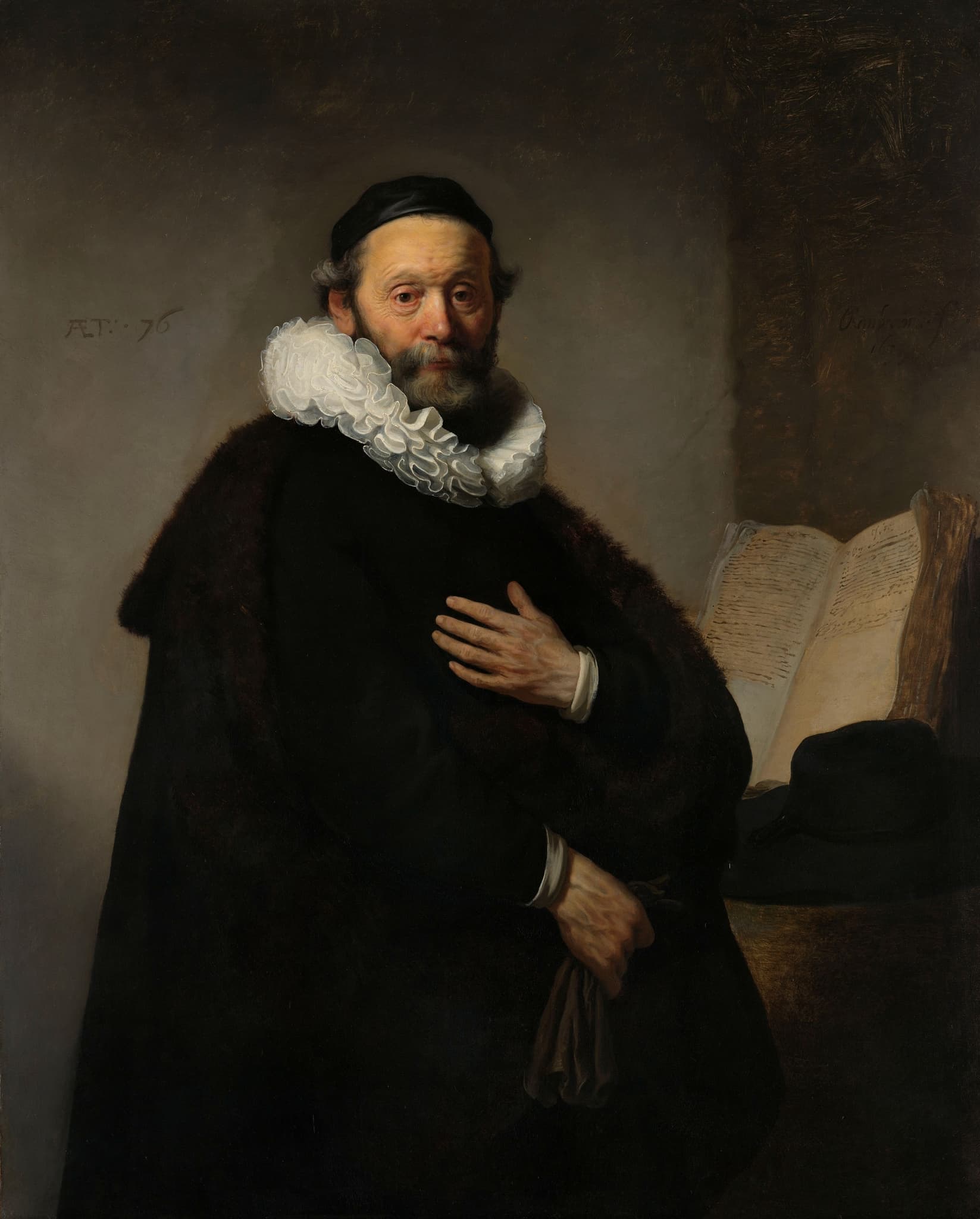
Johannes Wtenbogaert
Rembrandt van Rijn, 1633 • Oil on canvas
Read full analysis of Johannes Wtenbogaert →Valuation Analysis
Overview. Rembrandt’s Portrait of Johannes Wtenbogaert (1633) is a large-format, signed and dated work from the artist’s early Amsterdam prime, and it is securely accepted by the Rijksmuseum with full scholarly backing [1]. The sitter—Johannes Wtenbogaert, chief theologian of the Remonstrant movement—adds major historical gravitas. Few autograph 1630s oil portraits by Rembrandt are available to the market, and this painting’s scale, autograph status, and subject place it in the upper echelon of the artist’s portrait oeuvre.
Market evidence and positioning. Although museum-held and effectively non-marketable, the work’s last public transaction was Sotheby’s London, 8 July 1992, at £4.18m (c. $8m) before entering the Rijksmuseum [1]. To calibrate a 2026 fair-market estimate, we benchmark against: the Louvre/Rijksmuseum joint acquisition of the 1634 full-length pendant portraits of Maerten Soolmans and Oopjen Coppit at €160m for the pair (≈€80m each) [5]; the auction record Portrait of a Man with Arms Akimbo at £20.2m (2009) [4]; the small 1632 Self-Portrait at £14.5m (2020) [8]; and the rediscovered early panel The Adoration of the Kings at £10.9m (≈$13.8m, 2023) [2]. These results collectively show that small autograph works trade in the low to mid–eight figures, while top-tier, museum-grade 1630s masterworks can reach the nine-figure realm in private treaty.
Deriving the range. Wtenbogaert is more important than the small-scale works sold in 2020–2023 and sits below the singular status of the full-length Soolmans/Oopjen pair. Placing it between these poles, and considering its prime 1633 date, autograph signature, historical sitter, and museum-level quality, supports a fair-market range of $60–110 million. This is further underpinned by the Netherlands’ 2022 acquisition of Rembrandt’s The Standard Bearer (1636) at €175m—another 1630s masterpiece demonstrating today’s nine-figure appetite for pinnacle works by the artist [6].
Insurance/indemnity context. For international loans, major Dutch institutions typically use state indemnity, but market-consistent insurance surrogates for prime 1630s Rembrandts often sit in the high eight- to low nine-figure band. We therefore indicate a notional insurance value around $120 million, consistent with the painting’s stature and adjacent nine-figure private benchmarks [5][6].
Other considerations. The Rijksmuseum’s acceptance, signature and date, and the prestige of the sitter all weigh positively. As a Dutch public collection work, a sale is extraordinarily unlikely and export would be tightly controlled under cultural heritage law; our estimate represents what the work would fetch if freely tradable on the international market [7].
Key Valuation Factors
Art Historical Significance
High ImpactPainted in 1633, this portrait falls squarely within Rembrandt’s early Amsterdam prime, when his commissioned likenesses achieved a new level of psychological presence and painterly finesse. The sitter, Johannes Wtenbogaert, was the preeminent Remonstrant theologian—an intellectual and religious figurehead whose identity substantially elevates the historical importance of the work. The painting is signed and dated, which is uncommon enough to carry real weight in Rembrandt’s market. Together, the prime date, autograph status, and prominent sitter place the canvas among the upper tier of Rembrandt’s portraiture, conferring an enduring scholarly and cultural value that translates into a pronounced market premium for a hypothetical sale [1].
Rarity and Scale
High ImpactAutograph, large-format 1630s Rembrandt oil portraits are exceptionally scarce in private hands; most reside in major museums. Works of similar period and ambition rarely come to market, and when they do, they attract global institutional and top-tier private competition. By contrast, smaller early panels and later, more compromised works tend to set the auction rhythm in the low to mid–eight figures. Against that backdrop, a signed, full-scale 1633 portrait of a named, historically resonant sitter justifiably sits well above the recent smaller-format results and below the singular cachet of the 1634 full-length pendants acquired jointly by the Louvre and the Rijksmuseum for €160m [5].
Attribution and Condition
High ImpactThe painting bears Rembrandt’s signature and 1633 date and is accepted by the Rijksmuseum, which implies rigorous curatorial and technical scrutiny. Autograph certainty is the crucial driver of top-tier Old Master valuations; contested or workshop-involved attributions trade at deep discounts. While a current conservation report would refine the precise figure, the museum’s acceptance and the work’s post-acquisition conservation history support a major-estimate stance. In this segment, modest condition compromises can be price-tolerable if the autograph status, date, and quality are exceptional; a sound structural state and legible surface would sustain pricing toward the upper band of the range [1].
Provenance and Institutional Status
Medium ImpactDocumented provenance includes the 1992 Sotheby’s sale and the subsequent Rijksmuseum acquisition, ensuring transparent ownership history—an important de-risking factor for high-value Old Masters. Being in a Dutch national collection makes any disposal or export extraordinarily unlikely under the Netherlands’ cultural heritage framework; thus, our estimate is explicitly hypothetical, modeling what the work would fetch if freely tradable. Institutional stature can also amplify perceived importance and, by extension, insurance surrogates for loans, as signaled by recent state-backed acquisitions of major Rembrandts in the same decade, including The Standard Bearer [6][7].
Sale History
Sotheby's London
Old Master Paintings, lot 86; sold for £4,180,000; purchased by dealer Otto Naumann (reportedly for Alfred Bader); sold to the Rijksmuseum later in 1992.
Rembrandt van Rijn's Market
Rembrandt remains one of the most liquid and blue-chip names in Old Masters, with a vanishingly small supply of securely attributed oil paintings. The contemporary top end is defined by private-treaty acquisitions: the Louvre and Rijksmuseum’s purchase of Maerten Soolmans and Oopjen Coppit for €160m (2016) and the Netherlands’ €175m acquisition of The Standard Bearer (2022) demonstrate sustained nine-figure capacity for 1630s masterpieces [5][6]. At auction, the record stands with Portrait of a Man with Arms Akimbo at £20.2m (2009), while smaller prime works like the 1632 Self-Portrait at £14.5m (2020) and the rediscovered Adoration of the Kings at £10.9m (2023) evidence robust demand at lower price tiers [4][8][2]. Overall, flight-to-quality dynamics favor Rembrandt’s top-tier, scholarship-backed works.
Comparable Sales
Portrait of Jan Willemsz. van der Pluym and Portrait of Jaapgen Carels (pendant pair)
Rembrandt van Rijn
Autograph pendant portraits from 1635 (same artist/near period and same portrait genre). Much smaller panels and sitters of modest standing vs. Wtenbogaert’s large, formal commissioned portrait.
$14.3M
2023, Christie's London
~$14.8M adjusted
Self-portrait (1632)
Rembrandt van Rijn
Autograph early‑1630s work by Rembrandt with marquee subject (self‑portrait). Provides a strong benchmark for early‑1630s but in a small, easel format—far smaller than Wtenbogaert.
$18.7M
2020, Sotheby's London
~$22.8M adjusted
The Adoration of the Kings (c. 1628)
Rembrandt van Rijn
Autograph painting sold in 2023; near in date but a small religious panel (not a portrait). Useful as a current auction benchmark for authenticated Rembrandt paintings.
$13.8M
2023, Sotheby's London
~$14.4M adjusted
Portrait of a Man with Arms Akimbo (1658)
Rembrandt van Rijn
Autograph male portrait; long the auction record for a Rembrandt painting. Later style than Wtenbogaert but a prime, imposing portrait that indicates top-end auction appetite for the genre.
$33.2M
2009, Christie's London
~$49.5M adjusted
Portraits of Maerten Soolmans and Oopjen Coppit (pair)
Rembrandt van Rijn
Autograph full‑length pendant portraits from 1634; same portrait genre and prime decade, at the pinnacle of prestige. Implies roughly ~$88–90m per painting in 2016 (≈$115m each in 2025 dollars).
$176.0M
2016, Private sale via Christie's (Louvre & Rijksmuseum joint acquisition)
~$228.8M adjusted
The Standard Bearer (1636)
Rembrandt van Rijn
Autograph 1630s masterpiece; not a portrait but from the same prime decade and among the most publicized recent Rembrandt transactions, setting the contemporary top end for major works.
$199.0M
2022, Private sale to the Netherlands State (Rijksmuseum)
~$216.9M adjusted
Current Market Trends
Old Masters have benefited from a flight to quality and renewed institutional and private attention since 2024, with sector growth in 2025 and strong outcomes for rediscoveries and canonical names. Within this context, Rembrandt’s market shows a bifurcation: small, authenticated paintings transact reliably in the low to mid–eight figures, while singular 1630s masterworks achieve nine-figure private outcomes. Selectivity remains pronounced, but when attribution is secure, provenance is transparent, and scholarship compelling, buyers commit aggressively. This backdrop supports a confident valuation for a prime, signed 1633 Rembrandt portrait at a level well above routine category pricing and comfortably within a high eight- to low nine-figure fair-market band [9].
Study print
Study this painting as a print
Pair the full artwork with a museum-style study sheet focused on one meaningful detail.
Sources
- Rijksmuseum Collection: Rembrandt, Portrait of Johannes Wtenbogaert (SK-A-4885)
- Artnet News: Old Masters Week London 2023 anchored by a Rembrandt result
- Christie’s Press Release: Old Masters Part I, London, 6 July 2023 (pendant Rembrandt portraits)
- Christie’s Press Release: Old Masters, London, 8 December 2009 (Rembrandt auction record)
- The Art Newspaper: France and Netherlands finalise €160m Rembrandt treaty (2016)
- The Art Newspaper: Dutch government buys Rembrandt’s The Standard Bearer for €175m (2022)
- Government of the Netherlands: Heritage Act (Erfgoedwet) overview
- Sotheby’s: Record-Breaking Rembrandt to Richter sale summary (Self-Portrait, 1632)
- Art Basel & UBS Art Market Report 2026