How Much Is Self-portrait (with tousled hair) Worth?
Last updated: July 14, 2026
Quick Facts
- Last Sale
- $790K (1977, Rijksmuseum, Amsterdam (purchase from D. H. Cevat))
- Methodology
- comparable analysis
We estimate Rembrandt’s Self-portrait (with tousled hair), c. 1628 (Rijksmuseum, SK‑A‑4691), at $70–110 million in a current private-sale context. The range reflects its status as a canonical early self-portrait, the scarcity of autograph Rembrandt oils on the market, and a premium over recent public auction benchmarks for early panels.
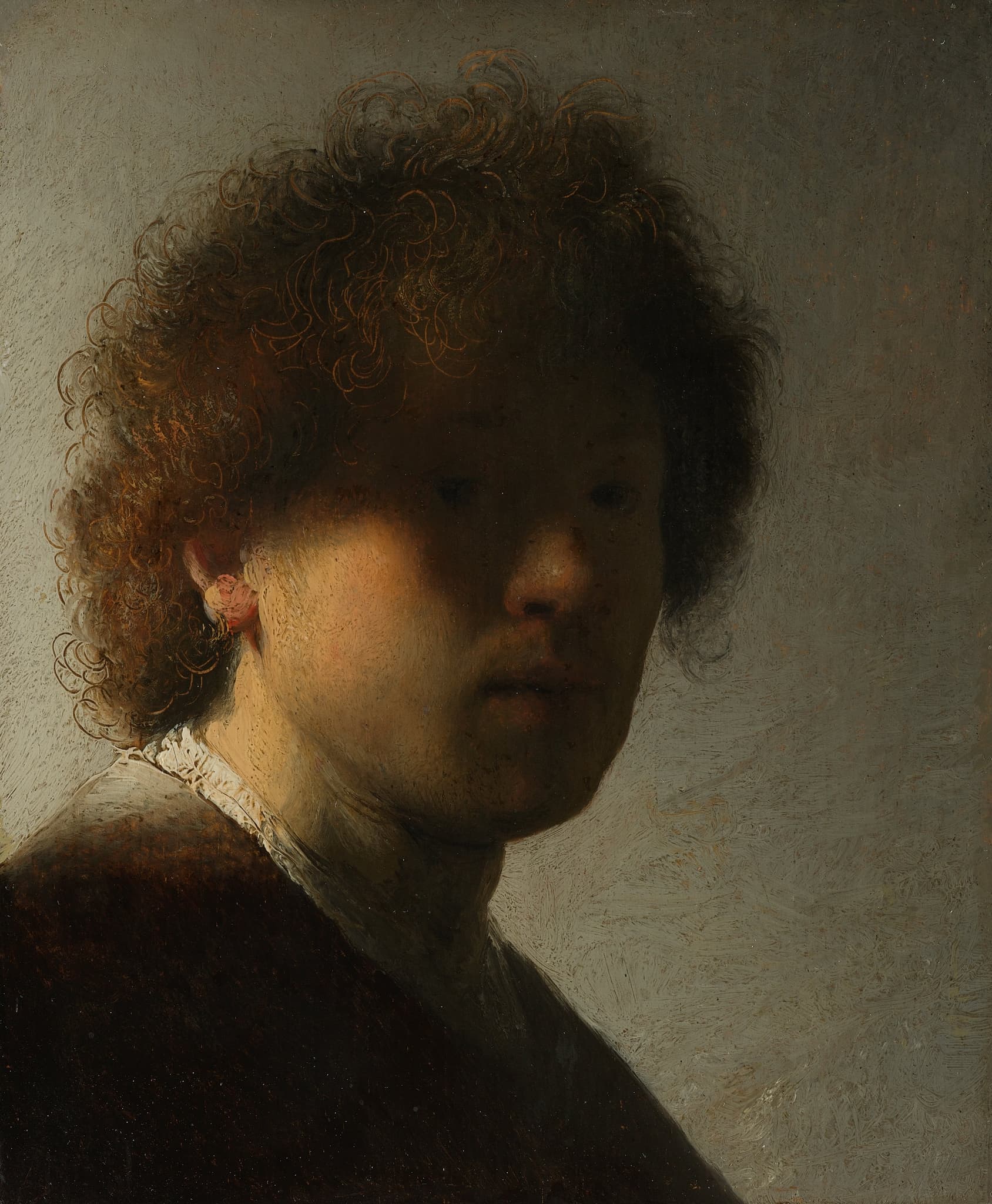
Self-portrait (with tousled hair)
Rembrandt van Rijn, c. 1628 • Oil on oak panel
Read full analysis of Self-portrait (with tousled hair) →Valuation Analysis
Conclusion: If hypothetically available today, Rembrandt’s Self-portrait (with tousled hair), c. 1628 (oil on oak, 22.6 × 18.7 cm; Rijksmuseum, SK‑A‑4691), would command approximately $70–110 million in a private-sale setting. This work inaugurates the artist’s sustained self-portrait practice and is among the most reproduced and discussed early images of the young Rembrandt, conferring exceptional art-historical and branding power [1].
Comparable anchors: Recent public auction prices for small, early Rembrandt oils cluster in the low-to-mid eight figures: The Adoration of the Kings (c. 1628) achieved about $13.8 million in 2023 [3], while the 1632 Self-portrait made roughly $18.7–$18.8 million in 2020 [2]. These are crucial direction-setters but sit below the subject and scholarly cachet of a canonical early self-portrait long enshrined in the Rijksmuseum. The public auction record for a Rembrandt painting remains $33.2 million (2009) [5], whereas the most relevant private ‘trophy’ signals—The Standard Bearer at ~$199 million in 2022 [4] and the Maerten & Oopjen pair at ~€160 million in 2016—demonstrate the multiple that connoisseur buyers and nations will pay for singular, brand-defining works.
How the range is derived: The estimate steps meaningfully above the $13–19 million band seen for recent early panels and portraits, reflecting the self-portrait premium, the image’s canonical status, and its unimpeachable museum provenance and scholarly literature [1–3]. At the same time, we calibrate downward from the national‑treasure tier (Standard Bearer; Maerten & Oopjen) given this panel’s modest scale and its tronie-like, exploratory character relative to mature, monumental icons [4]. The $70–110 million corridor bridges public-sale benchmarks and private trophy dynamics, consistent with how blue‑chip Old Masters price when their art‑historical importance and brand resonance are clear but the physical scale and period are more intimate and early.
Additional considerations: The Rijksmuseum’s acquisition in 1977 followed the painting’s earlier misattribution at a 1959 Sotheby’s sale, with subsequent scholarship re-establishing its autograph status—now a well-settled consensus and a value amplifier [1]. In today’s market, buyers reward conservation clarity, dendrochronology, and publication history; this picture’s deep scholarship, long institutional ownership, and sustained visibility check those boxes. The broader Old Masters backdrop has strengthened at the very top, with record results for works on paper and robust bidding for rediscoveries—conditions that support the upper half of the range for a self‑portrait of this caliber [2–4].
Bottom line: As a foundational, widely celebrated early self-portrait with stellar provenance, this work would trade as a trophy. Its value would clear smaller early panels and standard portraits by a wide margin and sit well below the unique, nationally prioritized masterpieces—landing credibly at $70–110 million in today’s selective but deep high-end Old Masters market.
Key Valuation Factors
Art Historical Significance
High ImpactPainted circa 1628, this is a foundational early self-portrait that foreshadows Rembrandt’s lifelong engagement with his own image. Its dramatic chiaroscuro and probing physiognomy make it a touchstone for the Leiden-period exploration of light, texture, and expression. The work is widely reproduced and taught, appearing frequently in scholarship and exhibition contexts, and it stands at the nexus of Rembrandt’s innovations in characterization and self-scrutiny. Because it effectively launches one of the most closely studied self-portrait series in Western art, it commands a premium not just as an autograph Rembrandt, but as a canonical image that helped define his artistic identity and public perception.
Rarity and Subject (Self-portrait)
High ImpactAutograph Rembrandt oils are exceptionally scarce on the market; self-portraits in oil are rarer still and trade only once in a generation, if at all. The most recent auctioned self-portrait (1632) brought nearly $19 million for a small panel, underscoring deep connoisseur demand even for modest formats. A self-portrait status adds a material premium over standard portraiture or early narrative scenes, particularly when the image is academically canonical. This scarcity-driven premium is magnified by the fact that most major examples reside in museums, meaning private collectors have vanishingly few opportunities to secure an institutional-grade self-portrait of this caliber.
Provenance, Scholarship, and Institutional Standing
High ImpactLong-term residence in the Rijksmuseum confers extraordinary credibility and visibility. The painting’s documented journey—from a 1959 sale misattributed as ‘after Rembrandt’ to authoritative acceptance and 1977 museum acquisition—has been consolidated by decades of scholarship, technical study, and publication. This arc strengthens buyer confidence on attribution, condition oversight, and art-historical placement. Works with such institutional imprimatur customarily price above their auction-only peers, as lenders and museums have effectively ‘vetted’ the object in public view. In any hypothetical sale, these attributes would be central to premium pricing and to the ease of cross-border museum loans post-acquisition.
Scale and Period Positioning
Medium ImpactThe panel is intimate in size and has a tronie-like, exploratory character typical of Rembrandt’s Leiden years. While this intimacy contributes to its charm and scholarly importance, it moderates its value relative to the artist’s grand, mature masterpieces and late iconic self-portraits. Collectors paying in the nine-figure range typically expect scale, late-date gravitas, or national-treasure status. Accordingly, the estimate calibrates below the ceiling established by state-priority acquisitions, while still recognizing the exceptional premium that attaches to an autograph, canonical self-portrait from the genesis of his practice.
Market Liquidity and Demand for Old Masters
Medium ImpactTop-tier Old Masters have enjoyed renewed momentum, with record prices for drawings and strong competition for rediscovered and well-provenanced works. Yet liquidity concentrates heavily at the apex of quality and brand recognition, and the buyer pool is narrower than for contemporary art. A canonical Rembrandt self-portrait is precisely the kind of blue-chip object that can mobilize cross-category, cross-border demand—especially from collectors and institutions seeking enduring cultural capital. This bifurcated market dynamic supports strong pricing for this painting while acknowledging that near-record outcomes rely on trophy-driven, highly selective demand.
Sale History
Sotheby's London
Catalogued 'after Rembrandt' at the time; later reattributed. Hammer £1,700.
Rijksmuseum, Amsterdam (private purchase from D. H. Cevat)
Acquired by the Rijksmuseum; definitive institutional attribution and publication thereafter.
Rembrandt van Rijn's Market
Rembrandt van Rijn remains an ultra–blue-chip Old Master with exceptionally limited supply of securely attributed paintings. Public auction records for his oils peak at about $33.2 million (Portrait of a Man, 1658; 2009), but recent private, nationally prioritized acquisitions have reached far higher—The Standard Bearer sold to the Dutch State for roughly $199 million in 2022, and the Louvre/Rijksmuseum jointly acquired the Maerten Soolmans and Oopjen Coppit full-lengths for around €160 million in 2016. Self-portraits are a marquee subgenre: even small, early examples can achieve high eight figures at auction. Concurrently, Rembrandt’s works on paper and prints have posted headline results, reinforcing broad, deep connoisseur demand when rarity, condition, and scholarship align.
Comparable Sales
Self-portrait of the artist, half-length, wearing a ruff and a black hat (1632)
Rembrandt van Rijn
Same artist; self-portrait subject; small oil on panel from the early 1630s; closest direct market signal for Rembrandt self-portraits.
$18.8M
2020, Sotheby's London (Rembrandt to Richter Evening Sale)
~$23.3M adjusted
The Adoration of the Kings (c.1628)
Rembrandt van Rijn
Same artist; same early Leiden period (c.1628) and small oak panel format; indicates current pricing for early, rediscovered Rembrandt oils.
$13.8M
2023, Sotheby's London (Old Master & 19th‑Century Paintings Evening Sale)
~$14.5M adjusted
Portrait of Jan Willemsz. van der Pluym and Portrait of Jaapgen Carels (1635, pair)
Rembrandt van Rijn
Same artist; small-scale portraits from the 1630s; while not self-portraits, they benchmark demand for portraiture by Rembrandt at auction.
$14.3M
2023, Christie's London (Old Masters Part I)
~$15.0M adjusted
Portrait of a Man, Half-length, with his Arms Akimbo (1658)
Rembrandt van Rijn
Same artist; late masterpiece and public auction record for a Rembrandt painting; sets an upper anchor for public-sale pricing.
$33.2M
2009, Christie's London
~$49.6M adjusted
The Standard Bearer (1636)
Rembrandt van Rijn
Same artist; iconic single-figure half-length acquired by a national institution; demonstrates private-sale 'trophy' ceiling for prime Rembrandt oils.
$198.9M
2022, Private sale to the Dutch State via the Rijksmuseum
~$217.4M adjusted
Pendant portraits of Maerten Soolmans and Oopjen Coppit (1634), pair
Rembrandt van Rijn
Same artist; ultra-rare full-length portraits jointly acquired by two top museums; signals the highest private-market tier for blue-chip Rembrandts.
$180.0M
2016, Private joint acquisition by the Rijksmuseum and the Louvre
~$239.9M adjusted
Current Market Trends
The top end of the Old Masters market has strengthened, with 2025 showing a sizable rebound and early 2026 delivering multiple records. Buyers are rewarding rediscoveries, fresh scholarship, and museum-vetted provenance—precisely the attributes that power trophy-level pricing. Masterpiece drawings and rare prints have achieved painting-like prices, signaling robust cross-category competition for canonical names. That said, liquidity remains selective: quality, attribution certainty, and condition are paramount, while scale and late-date gravitas can stretch ceilings. In this context, a canonical Rembrandt self-portrait—despite intimate size—sits squarely within the market’s most resilient segment and merits a significant premium over recent auction comparables for early panels.
Study print
Study this painting as a print
Pair the full artwork with a museum-style study sheet focused on one meaningful detail.
Sources
- Rijksmuseum object record: Self-portrait (with Tousled Hair), SK-A-4691
- Sotheby’s: Rembrandt, Self-portrait (1632), Rembrandt to Richter Evening Sale (2020)
- Sotheby’s: Rembrandt, The Adoration of the Kings (c.1628), Old Master Evening Sale (2023)
- Dutch State/Rijksmuseum purchase of The Standard Bearer (2022)
- Christie’s press release: Rembrandt painting auction record (2009)