How Much Is Portrait of Haesje Jacobsdr van Cleyburg Worth?
Last updated: July 14, 2026
Quick Facts
- Last Sale
- $3.4M (1985, Private treaty (acquired by the Rijksmuseum, Amsterdam))
- Methodology
- comparable analysis
Based on closely aligned Rembrandt portrait comparables and the work’s prime 1634 date, a reasoned insurance/market‑equivalency for Portrait of Haesje Jacobsdr van Cleyburg is $50–85 million. The range is anchored by the £35m valuation for Catrina Hooghsaet (2015) and bounded above by the 2016 €160m joint acquisition of the Soolmans/Coppit pendants.
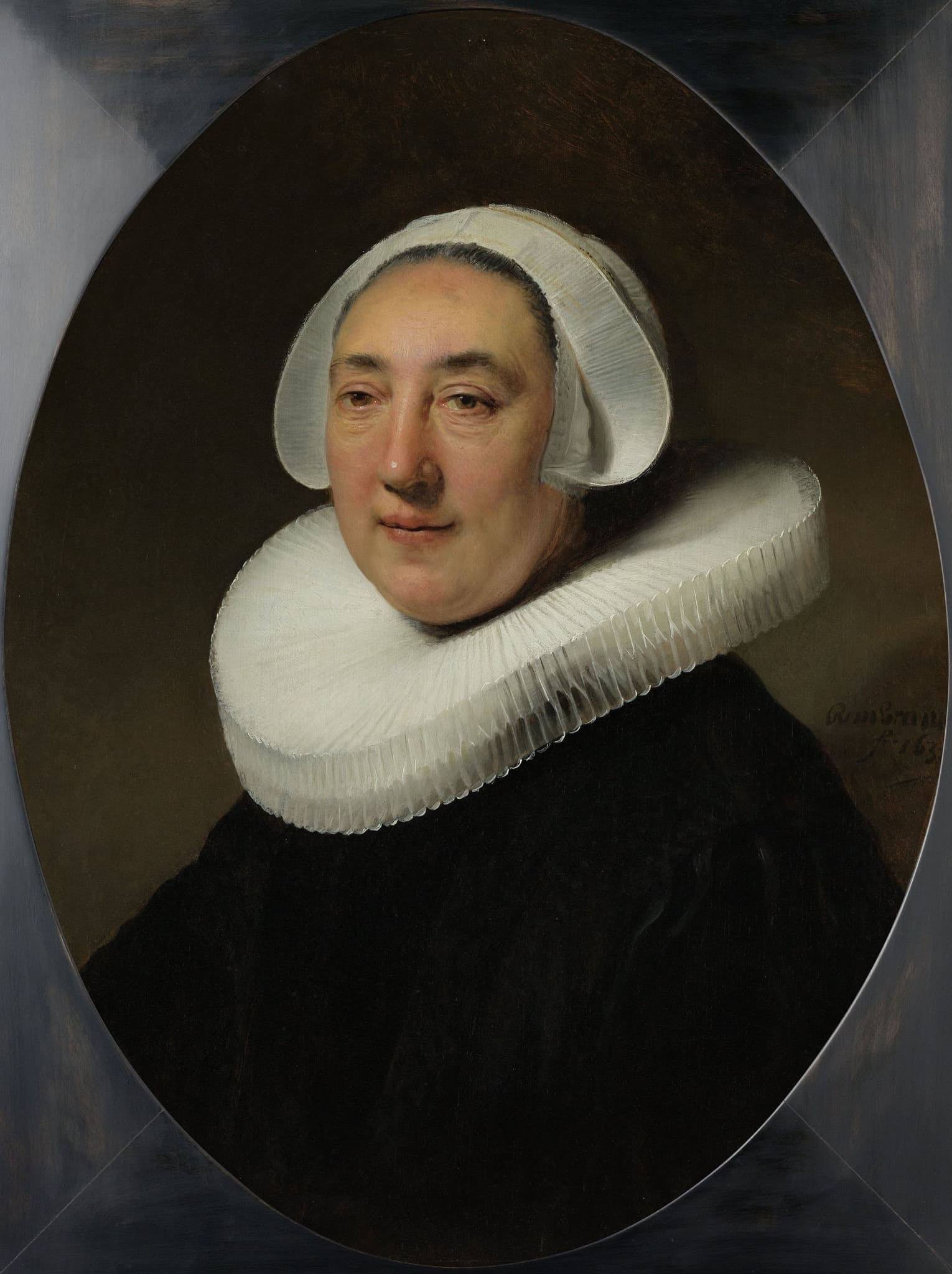
Portrait of Haesje Jacobsdr van Cleyburg
Rembrandt van Rijn, 1634 • Oil on panel
Read full analysis of Portrait of Haesje Jacobsdr van Cleyburg →Valuation Analysis
Conclusion: A defensible insurance/market‑equivalency for Rembrandt’s Portrait of Haesje Jacobsdr van Cleyburg (1634, oil on panel; Rijksmuseum) is $50–85 million. The work is a prime early‑Amsterdam society portrait, signed and dated, and the pendant to Dirck Jansz. Pesser at LACMA—attributes that place it among the most sought‑after segments of Rembrandt’s oeuvre [1][7].
Top‑end anchor: The modern high‑water mark for Rembrandt portraiture is the Louvre/Rijksmuseum joint acquisition of the full‑length pendant portraits of Maerten Soolmans and Oopjen Coppit for €160 million in 2016 (≈$174m then), or roughly €80m per canvas on a pro‑rata basis [2]. Those grand full‑lengths are exceptional even within Rembrandt and command a format and “pair” premium. They establish the category’s ceiling and argue that a first‑rank, three‑quarter‑length single portrait from the same banner year should calibrate materially below, yet within the same order of magnitude.
Mid‑band comparator: A particularly relevant single‑portrait benchmark is the widely reported £35 million valuation/asking price for Catrina Hooghsaet (1657) in 2015, set when the UK placed an export bar on the painting [3]. At contemporaneous exchange rates this was about $52.5 million. Haesje Jacobsdr., painted in 1634—the apex year of Rembrandt’s early Amsterdam portrait practice—carries added desirability for period, refinement (sumptuous lace, deep black costume), and pendant context. On quality and date, Haesje justifies a level at or above that 2015 benchmark, after accounting for inflation and scarcity.
Recent public prices (lower bound): Public auctions underscore the gap between small‑scale early works and major society portraits. In December 2023, a pair of small oval Rembrandt pendant portraits achieved £11.235 million/$14.27 million at Christie’s [4], while Sotheby’s sold the small early panel The Adoration of the Kings for £10.965 million/$13.81 million the day before [5]. These strong results for intimate formats support the much higher private‑market pricing for large, formal, autograph portraits. The highest auction price for a Rembrandt painting remains $25.8 million (Saint James the Greater, 2007), further illustrating that top portraiture typically trades privately above public‑auction ceilings [6].
Work‑specific adjustments: Haesje Jacobsdr. is a substantial, three‑quarter‑length, signed and dated portrait from 1634, a year that produced the most coveted ceremonial likenesses in Rembrandt’s career. The elaborate millstone ruff and refined handling of lace amplify connoisseur appeal, and the documented pendant relationship to Pesser at LACMA confers additional art‑historical weight and a “set” premium, even though the pair is now divided [1][7]. Museum‑quality Rembrandt portraits almost never reach the open market; that scarcity supports an elevated equivalency value. On this basis, and absent any undisclosed condition or legal constraints, $50–85 million is a tight, defensible range.
Positioning: This estimate sits well above recent small‑panel transactions, aligns with the 2015 Hooghsaet valuation updated for today, and remains below the extraordinary full‑length Soolmans/Coppit pendants. It reflects how collectors and institutions price prime 1630s Rembrandt portraiture: exceptionally scarce, deeply scholarly, and competing at the very top of the Old Master category [2][3][4][5][6].
Key Valuation Factors
Art Historical Significance
High ImpactPainted in 1634 at the height of Rembrandt’s early Amsterdam period, this portrait exemplifies his most coveted ceremonial likenesses. The sitter’s lavish millstone ruff and sober black costume are rendered with virtuoso control of light and texture, hallmarks of Rembrandt’s breakthrough society portraits. The painting is signed and dated, is frequently reproduced in the literature, and is the documented pendant to Dirck Jansz. Pesser, reinforcing its role within a high‑status marital commission. As a mature, representative work from the year of the Soolmans/Coppit pendants, it occupies a prominent position within Rembrandt’s portrait oeuvre.
Rarity and Market Supply
High ImpactFully autograph, museum‑quality Rembrandt portraits very rarely come to market. The strongest examples are typically locked in institutions or trade privately via treaty sales. Recent public transactions for smaller autograph works in the mid‑teens (USD) highlight a significant scarcity premium for major, formal portraits from the early 1630s. The near‑absence of comparable offerings in public rooms means any insurable or market‑equivalency value must reflect intense competition from top collectors and institutions were such a portrait hypothetically available.
Period, Format, and Quality
High ImpactThis is a refined three‑quarter‑length portrait on panel, a format with higher desirability than small cabinet pieces. The 1634 date situates it in Rembrandt’s most celebrated portrait phase, the same year as the full‑length Soolmans/Coppit pendants. The elaborate lacework and the sitter’s dignified bearing increase both art‑historical and market appeal, distinguishing it from later, more introspective or smaller likenesses. The pendant context confers an additional, recognized premium even though the companion is now in a different collection.
Provenance and Institutional Standing
Medium ImpactLong, well‑documented provenance culminating in the Rijksmuseum underwrites authorship and importance. While its status in a national collection renders it effectively non‑marketable, that very fact signals the caliber and endorsed significance of the work. For valuation purposes, institutional ownership supports a higher insurance or market‑equivalency benchmark than comparable works with fragmented histories. Any formal loan or indemnity context would likely corroborate a value at the upper end of single‑portrait pricing for Rembrandt.
Sale History
Private treaty to Rijksmuseum, Amsterdam
Museum acquisition reportedly at fl. 10,000,000 (≈$3.4m at 1985 FX); not a public auction.
Rembrandt van Rijn's Market
Rembrandt sits at the apex of the Old Master market. Very few fully autograph paintings surface publicly, and top prices are often achieved privately. The joint 2016 acquisition of the full‑length Maerten Soolmans and Oopjen Coppit pendants for €160 million set the modern benchmark for Rembrandt portraiture. Public auction ceilings are lower due to limited supply and object‑specific considerations, with the painting record standing at $25.8 million (Saint James the Greater, 2007). Recent results for small autograph works—such as the 2023 sales of a pair of small oval portraits (~$14.3m) and an early panel (~$13.8m)—demonstrate durable demand and underscore the premium commanded by major, formal portraits.
Current Market Trends
In 2023–2024, the Old Masters segment showed steady, selective strength. Trophy‑level works with secure attribution, strong provenance, and compelling narratives drew competitive bidding, while mid‑tier lots were more price‑sensitive. Scarcity remains the defining force at the top: when high‑quality, autograph Rembrandts appear, they attract global attention and often sell privately. Recent headline prices for smaller Rembrandt panels and prints indicate healthy depth, while exceptional masterworks—especially prime‑period portraits—are valued well into the eight‑figure range, frequently outside the auction rooms. The category’s institutional support and continued scholarship further underpin confidence in blue‑chip Baroque masters.
Study print
Study this painting as a print
Pair the full artwork with a museum-style study sheet focused on one meaningful detail.
Sources
- Rijksmuseum Collection: Portrait of Haesje Jacobsdr. van Cleyburg (1634)
- The Art Newspaper: France and Netherlands finalise €160m Rembrandt treaty
- UK Government: £35 million Rembrandt painting at risk of leaving the UK
- Christie’s Press: Classic Week evening sales totals (includes Rembrandt oval pendants, 7 Dec 2023)
- Sotheby’s: Old Master & 19th Century Paintings Evening Auction (6 Dec 2023)—sale results
- Antiques and the Arts Weekly: Rembrandt’s ‘Saint James the Greater’ brings $25.8 million at Sotheby’s (2007)
- LACMA Collections: Dirck Jansz. Pesser (pendant to Haesje Jacobsdr.)