How Much Is Drowning Girl Worth?
Last updated: June 26, 2026
Quick Facts
- Methodology
- comparable analysis
Drowning Girl (1963) is a canonical Roy Lichtenstein canvas in The Museum of Modern Art’s collection and has not appeared on the public market in decades [1]. Based on comparable auction evidence for early‑1960s Lichtenstein canvases and the work’s museum provenance, a realistic hypothetical sale range today is approximately $30–70 million, with the greatest probability in the $40–55 million band under normal auction or private‑treaty conditions [2].
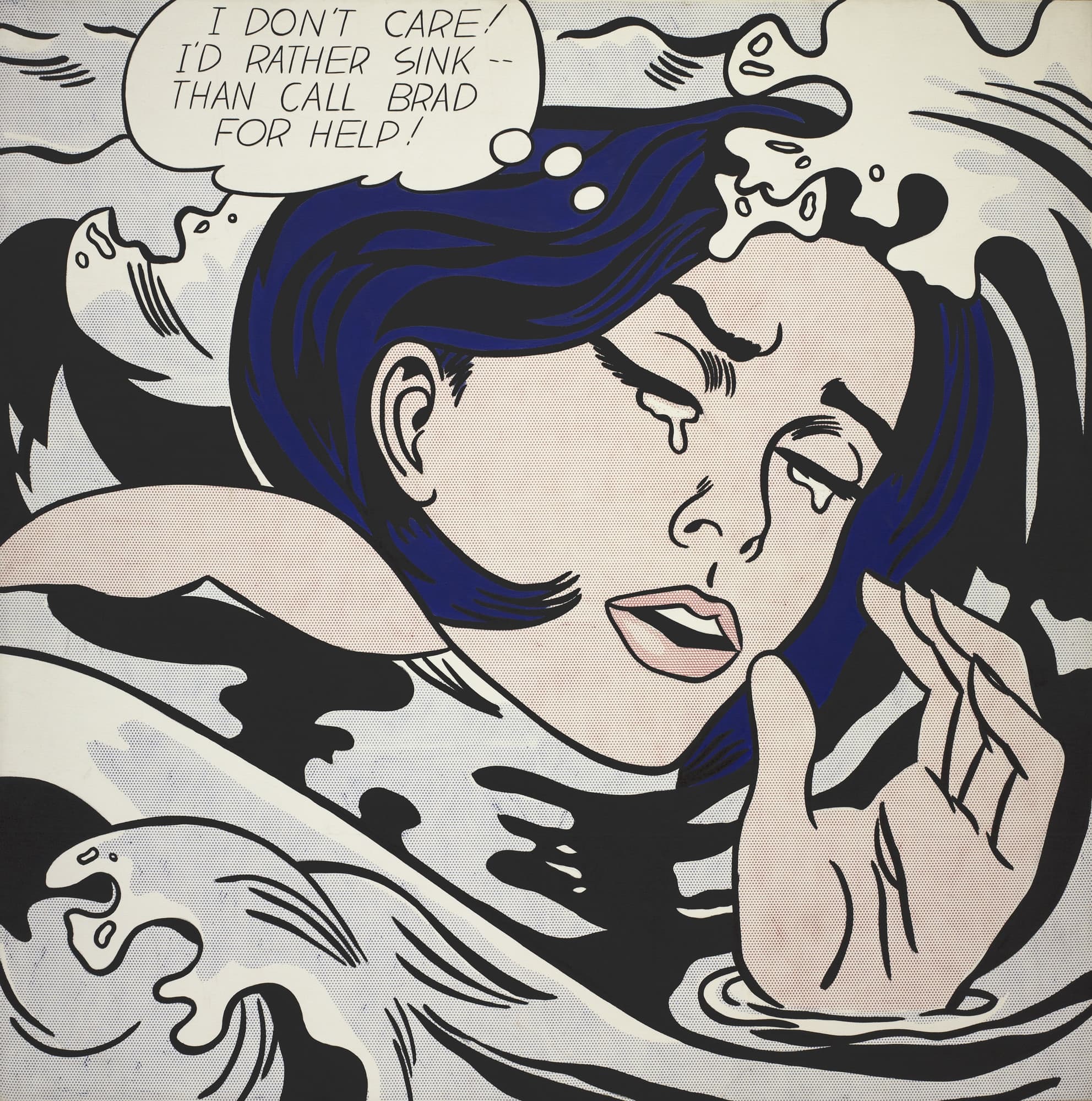
Drowning Girl
Roy Lichtenstein, 1963 • Oil and acrylic on canvas
Read full analysis of Drowning Girl →Valuation Analysis
Overview and headline estimate. Drowning Girl (1963) is one of Roy Lichtenstein’s most iconic Pop‑art canvases and resides in The Museum of Modern Art’s permanent collection, which means it has not been offered in the public auction market for many decades [1]. Using a comparables‑based approach that anchors the painting to realized prices for the artist’s early‑1960s canonical canvases, this hypothetical market valuation places Drowning Girl in a working range of $30–70 million, with the most probable outcome in the mid‑$40M to mid‑$50M band absent unusual sale circumstances.
Why comparables support this band. Major Lichtenstein canvases from the early 1960s set the anchor points: trophy examples have pushed well above the mid‑double‑digit millions (one outlier achieved a record result in the high‑$90M range), while a number of high‑quality “girls” images and other early‑1960s paintings have realized in the ~$40–50M neighborhood. The combination of canonical subject, early‑period date and large scale typically commands a premium; the record sale demonstrates the ceiling in a trophy contest, and the recurring mid‑$40M results define the market floor for premium, museum‑quality works [2].
Provenance, scarcity and sale mechanics. Museum ownership (MoMA) confers maximum cultural and curatorial validation but also effectively removes the work from routine market circulation, producing scarcity. If the painting were to be offered—whether by a rare institutional deaccession, private treaty from a prior owner, or a special high‑profile auction—the route will materially affect price. Evening sale listings with marketing campaigns, third‑party guarantees and competing collectors/museums present the best path to the upper end of the range. A constrained deaccession sold under institutional restrictions or a non‑competitive private sale could drive the final to the lower end.
Condition, size and documentation requirements. The painting’s large format and early‑1960s date are positive market attributes, but a formal valuation requires the exact dimensions, the museum conservation report and exhibition/provenance documentation. Condition issues, inpainting, or structural interventions materially reduce value; conversely, a pristine conservation history and stellar exhibition record add premium value. The present estimate assumes museum‑grade condition and established provenance; adjust downward if reports reveal significant restoration or structural compromise.
Conclusion and next steps. In short, while an actual transaction is improbable because the work is museum‑held, the comparables and the work’s stature support a hypothetical market range of $30–70 million, most likely $40–55 million in normal sale conditions. For a formal insured valuation or a sale strategy, obtain MoMA’s conservation file and exhibition/provenance dossier and request a written presale estimate from senior specialists at Christie’s or Sotheby’s who handle marquee Post‑War/Pop Art lots.
Key Valuation Factors
Art Historical Significance
High ImpactDrowning Girl is a signature entry in Lichtenstein’s early‑1960s ‘girls’ series and functions as a paradigmatic example of Pop Art’s appropriation of comic imagery. Its iconic composition and immediate recognizability ensure outsized cultural resonance and frequent inclusion in monographic exhibitions, academic texts and reproductions. That canonical status translates directly into market premium: collectors and institutions prize works that define an artist’s career, and the market routinely pays more for pieces that are widely recognized as seminal. Because the painting is both visually emblematic and historically central to Lichtenstein’s oeuvre, art‑historical significance is a primary upward driver of value.
Provenance & Museum Ownership
High ImpactThe work’s provenance—acquired for and held by The Museum of Modern Art since 1971—confirms its curatorial importance but also removes it from routine market supply. Museum provenance elevates prestige and can increase buyer confidence, but institutional ownership also complicates sale mechanics: deaccession policies, public scrutiny, and restricted buyer pools (often fellow institutions) can limit competitive bidding. A museum deaccession that is well marketed and permitted to enter the open market can produce premium outcomes; conversely, a constrained institutional sale or private transfer may realize a lower price despite the superior provenance.
Comparable Auction Prices
High ImpactAuction comparables are the primary empirical basis for the estimate. High‑profile Lichtenstein canvases from the early 1960s have realized in a wide band: several canonical ‘girls’ paintings and major canvases have settled in the mid‑$40M range, while an exceptional trophy sale pushed above $90M, demonstrating both a strong floor for high‑quality works and a high ceiling when market conditions and competition align. These realized prices create the bracket used here—a conservative low around $30M, a likely mid‑range in the $40–55M zone, and upside above $60M under trophy‑sale dynamics.
Condition, Size & Medium
Medium ImpactDrowning Girl is a large‑scale oil and acrylic on canvas from 1963 (MoMA lists the dimensions as a large, museum‑scale canvas), which is a market advantage. However, precise valuation requires a conservator’s report: any structural issues, inpainting, or extensive restorations materially affect marketability and price. Large format and original paint surface are positive; a documented, stable conservation history maintained by MoMA supports the higher end of the estimate. The current range assumes museum‑grade condition pending review of the conservation dossier.
Market Liquidity & Buyer Pool
Medium ImpactBlue‑chip Post‑War and Pop Art attract deep‑pocketed private collectors, foundations and institutions, but market liquidity at the top end is limited to well‑capitalized buyers. Competitive bidding, guarantees, and cross‑house interest can elevate prices; conversely, weak macro conditions, lessened collector appetite, or a sale that fails to attract international institutional bidders will compress results. The buyer pool for a museum‑quality Lichtenstein is global but selective—sufficient to support the estimate band when interest is strong, but fragile under constrained market conditions.
Sale History
Drowning Girl has never been sold at public auction.
Roy Lichtenstein's Market
Roy Lichtenstein is firmly established as a blue‑chip Post‑War/Pop Art master. His early‑1960s comic‑based canvases are the most sought‑after by collectors and institutions; major examples routinely achieve multi‑million to multi‑tens‑of‑millions outcomes at auction. The artist’s auction record demonstrates the potential for trophy results, while several recurring mid‑$40M realizations define a robust market tier for canonical works. Overall, institutional demand, strong provenance, and the cultural centrality of certain images keep Lichtenstein’s upper market active and competitive.
Comparable Sales
Nurse
Roy Lichtenstein
Same artist; early‑1960s comic‑strip/‘girl’ subject and large-scale canvas — a market trophy that sets the high end for Lichtenstein.
$95.4M
2015, Christie's, New York
~$128.0M adjusted
Sleeping Girl
Roy Lichtenstein
Same artist and subject matter from the 1960s 'Girls' series; similar period and collector appeal — a direct mid‑market comp for Drowning Girl.
$44.9M
2012, Sotheby's, New York
~$62.2M adjusted
Nude with Joyous Painting
Roy Lichtenstein
Major Lichtenstein sale in the $45–50M band; though a later work (1994) it demonstrates buyer demand and price levels for major canvases outside the immediate 1960s canon.
$46.2M
2020, Christie's (ONE sale)
~$56.8M adjusted
Anxious Girl
Roy Lichtenstein
Same artist, virtually identical subject ('girl' image) and the same early‑1960s period — a very close, recent market analogue to Drowning Girl.
$46.1M
2026, Christie's, New York
~$45.0M adjusted
Current Market Trends
High‑end demand for canonical 20th‑century and Pop Art works has remained resilient, with marquee lots continuing to attract global buyers. Pricing at the top end is sensitive to macroeconomic conditions, liquidity and the presence of guarantees, but museum‑quality works with clear provenance still perform strongly. The market rewards rarity, strong exhibition history and condition; sale venue and marketing strategy remain critical to achieving top outcomes.
Study print
Study this painting as a print
Pair the full artwork with a museum-style study sheet focused on one meaningful detail.