How Much Is Ohhh...Alright... Worth?
Last updated: June 26, 2026
Quick Facts
- Last Sale
- $42.6M (2010, Christie's, New York (Post‑War & Contemporary Art evening sale))
- Methodology
- recent sale
Anchored to the confirmed Christie's New York evening‑sale result of $42,642,500 (10 Nov 2010, RLCR 936), the current market valuation for Roy Lichtenstein's Ohhh...Alright... (1964) is approximately $50–80 million. The range reflects a CPI/market‑adjusted baseline (~$60–70M) with conservative and premium sale scenarios determined by condition, provenance/exhibition enhancement, and sale route.
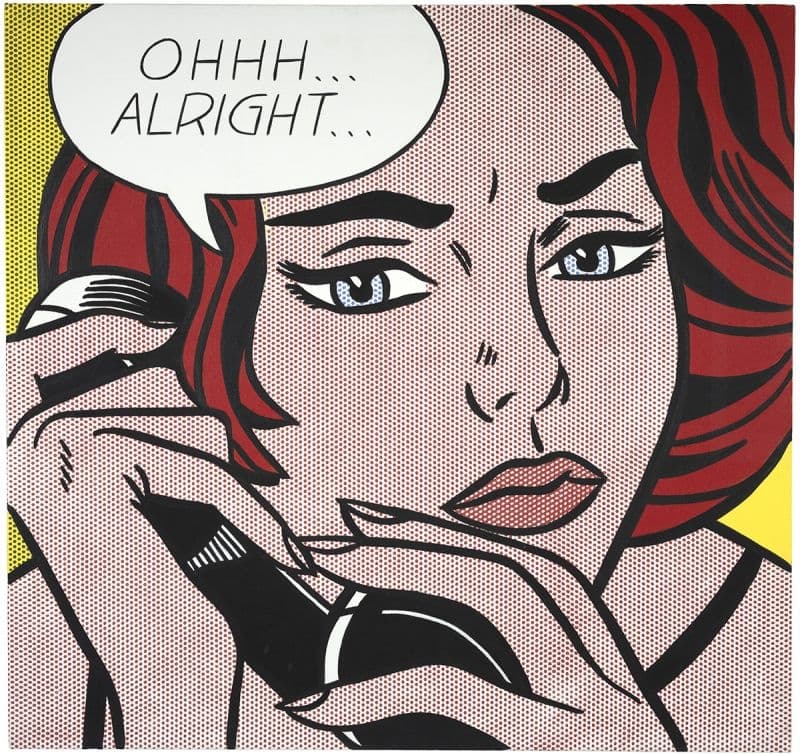
Ohhh...Alright...
Roy Lichtenstein, 1964 • Acrylic, oil, and graphite pencil on canvas
Read full analysis of Ohhh...Alright... →Valuation Analysis
Anchor and basis: This valuation uses the confirmed public sale at Christie’s New York (10 November 2010) as the primary anchor and the painting’s catalogue raisonné entry (RLCR 936) as authentication support [1][2]. The 2010 price realized was $42,642,500; because the lot was offered in a flagship evening sale and is fully documented, that result is the most reliable single datapoint for a contemporary reappraisal.
Method and adjustment: Starting from the 2010 realized price, I apply a straightline adjustment to reflect general inflation and the confirmed appreciation trajectory for top‑tier Lichtenstein works since 2010. A conservative CPI + market adjustment to mid‑2026 yields a baseline in the low $60 millions (≈$60–66M). Comparative sales for canonical 1960s Lichtensteins (e.g., the $95.4M ‘Nurse’ result and other $40–50M evening‑sale outcomes) define a market ceiling well above the baseline when buyer competition and exceptional circumstances are present [3][4].
Why $50–80M: The low end ($50M) reflects a conservative scenario where market access is via a non‑contested or private route, or where condition/provenance issues create buyer caution. The midpoint/baseline (~$60–66M) represents a straight CPI + market adjustment of the 2010 anchor combined with typical buyer demand for mid‑1960s comic/romance canvases. The high end ($80M) is achievable under optimal conditions — pristine, museum‑grade condition, refreshed and prominent exhibition/bibliographic exposure, and strong competition in a marquee evening sale (or a high‑profile private sale with guarantees).
Key sensitivities & practical implications: The largest value drivers are (1) condition and conservation history, (2) visible, unambiguous provenance and catalogue raisonné/authentication materials, and (3) sale route and timing (major evening sale with active bidding vs private treaty). With clean condition and high‑profile exhibition support, buyer competition can push the painting toward or above the stated high. Conversely, significant restoration or gaps in provenance would compress the value toward the low end.
Recommendation: Prior to marketing, obtain a professional conservation report, assemble full provenance/exhibition documentation (including catalogue raisonné citations), and solicit firm pre‑sale estimates from Christie’s and Sotheby’s specialists. If the objective is to maximize price, target an evening Post‑War & Contemporary sale with transparent pre‑sale estimates and, if necessary, consider a guarantee to attract aggressive bidding. Under those conditions the $50–80M range is a realistic and well‑supported market expectation.
Key Valuation Factors
Art Historical Significance
High ImpactOhhh... Alright... dates to 1964, at the height of Roy Lichtenstein's comic/romance period, and is fully catalogued (RLCR 936). The subject — a close‑up female figure with speech bubble — encapsulates the visual language that made Lichtenstein emblematic of Pop Art. Works from this exact period and motif are among the most collectible in his oeuvre because they exemplify his signature technique (Ben‑Day dots, heavy outlines, commercial palette) and cultural critique. That strong art‑historical provenance supports both institutional interest and deep collector demand, making this a high‑significance work within his market.
Provenance & Exhibition History
High ImpactThe painting benefits from a clear, high‑quality provenance: E. J. Power (c.1965), noted gallery appearances (Waddington), dealer passage (Andrew Crispo), ownership by notable collectors (Steve Martin; Stephen A. Wynn via Acquavella) and then a public evening‑sale appearance at Christie’s in 2010. That chain reduces ownership/forgery risk and increases buyer confidence. Additionally, reported loans and museum inclusions (retrospective citations) materially increase desirability. Strong, well‑documented provenance is a major positive — it both underpins the Christie’s headline result and supports higher present‑day bids.
Condition & Conservation
High ImpactCondition is a primary value lever for a mid‑century canvas executed in acrylic, oil and graphite. Any evidence of heavy restoration, over‑cleaning, relining, paint losses or inpainting will materially reduce competitive bidding and insurability. Conversely, stable original surface, documented minimal conservation and clear technical reports (pigment analysis, x‑rays where necessary) preserve buyer confidence and justify full market value. A current conservation report is essential and will be requested by major houses and institutional buyers prior to bidding.
Market Comparables & Demand
High ImpactTop‑tier Lichtenstein works from the 1960s have produced results ranging from high single‑digit millions to nine figures, depending on rarity and cultural prominence. The painting’s own 2010 evening‑sale result provides a strong empirical anchor; higher comparables (e.g., the record 'Nurse' sale) show the market ceiling when competition is intense. Demand for blue‑chip Pop Art remains concentrated among well‑capitalized collectors and institutions, so competitive sale dynamics at marquee houses will be decisive in realizing the upper end of the range.
Sale History
Waddington Galleries
Andrew Crispo Gallery
Acquired by Steve Martin
Acquavella — sold to Stephen A. Wynn (collection)
Christie's, New York (lot 5, Post‑War & Contemporary Art evening sale)
Roy Lichtenstein's Market
Roy Lichtenstein is a firmly established blue‑chip artist whose 1960s comic and romance canvases are among the most sought‑after Post‑War works. The market is characterized by high concentration of value in a relatively small number of canonical canvases; those with exemplary provenance, size and condition command premium prices, often in the tens of millions. Institutional interest and deep‑pocket private collectors sustain a robust top end, while less prominent examples trade at lower but still strong mid‑single‑digit million levels. Overall, Lichtenstein remains one of the highest‑performing names from the Pop Art era.
Comparable Sales
Ohhh… Alright…
Roy Lichtenstein
Primary anchor — identical work; definitive public evening‑sale result and documented provenance (RLCR 936). Use as the baseline for valuation.
$42.6M
2010, Christie's New York
~$62.3M adjusted
Nurse
Roy Lichtenstein
Same year (1964) and canonical comic/romance subject; record top‑end result for a canonical 1960s Lichtenstein — establishes market ceiling for the period.
$95.4M
2015, Christie's New York
~$124.0M adjusted
Nude with Joyous Painting
Roy Lichtenstein
Later‑period Lichtenstein sold in a strong market (2020); a recent mid‑40M result useful as a benchmark for large/significant but post‑1960s works.
$46.2M
2020, Christie's New York
~$51.8M adjusted
Current Market Trends
Through mid‑2026 the blue‑chip market (including marquee Pop Art) has been selective: broadly resilient for museum‑quality works but cautious for secondary or condition‑impaired examples. Auction houses continue to concentrate demand into evening sales for headline lots; guarantees and private‑sale activity remain tools to secure outcomes. Macroeconomic volatility can compress lower tiers but typically enhances competition for marquee works, which are viewed as store‑of‑value by large collectors.
Study print
Study this painting as a print
Pair the full artwork with a museum-style study sheet focused on one meaningful detail.
Sources
- Roy Lichtenstein Catalogue Raisonné — entry RLCR 936 (Ohhh... Alright..., 1964)
- Christie’s New York — Post‑War & Contemporary Art sale report / press (sale 10 Nov 2010) — price realized $42,642,500
- Bloomberg — coverage of Roy Lichtenstein 'Nurse' sale (record result, 2015)
- Christie’s — sale feature: 'Nude with Joyous Painting' (2020 sale results)