How Much Is I Can See the Whole Room...and There's Nobody in It! Worth?
Last updated: June 26, 2026
Quick Facts
- Last Sale
- $43.2M (2011, Christie's New York)
- Methodology
- recent sale
Anchored to the verified Christie’s sale on 8 November 2011 (realized $43,202,500 incl. premium) and supported by published catalogue‑raisonné provenance, I value Roy Lichtenstein’s I Can See the Whole Room...and There’s Nobody in It! at a market range of $35,000,000–$75,000,000. Final realization will depend principally on condition, sale venue/positioning and market timing.
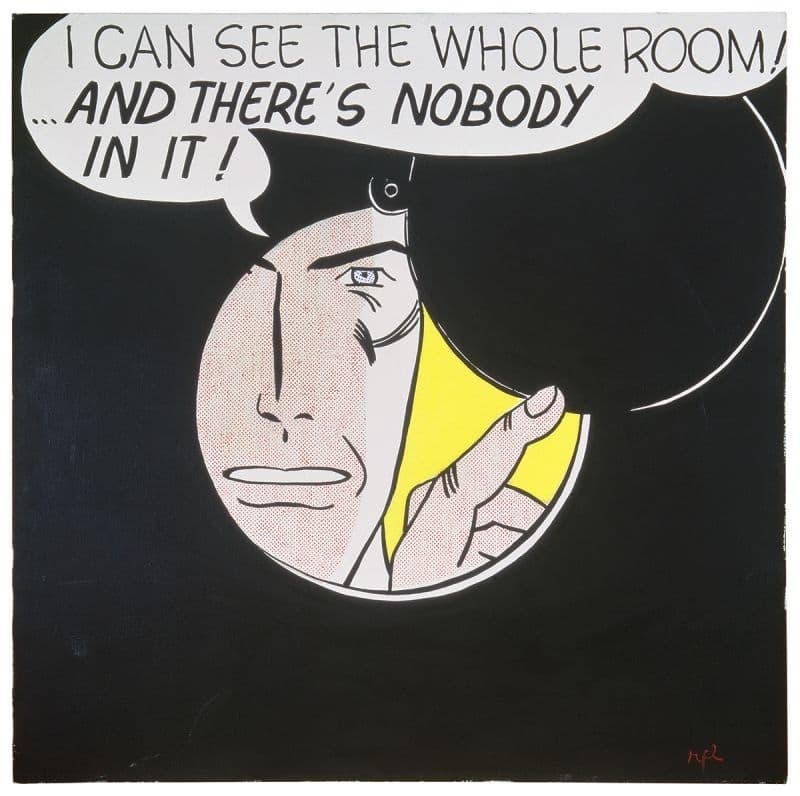
I Can See the Whole Room...and There's Nobody in It!
Roy Lichtenstein, 1961 • Oil and Magna on canvas
View more by Roy Lichtenstein →Valuation Analysis
Valuation basis: This opinion is anchored to the painting’s documented Christie’s sale on 8 November 2011 where it realized $43,202,500 (including buyer’s premium) — the single best hard comp for the exact object [1]. The work is entered in the Roy Lichtenstein catalogue raisonné (RLCR 639) and has a clear provenance (Tremaine Collection → Christie’s 1988 sale → private collection → Christie’s 2011 sale), which materially reduces attribution and provenance risk [2]. Recorded physical attributes (square, circa 48 x 48 in.; oil/Magna execution as described in the lot essay) and exhibition history support classification as a canonical early‑1961 comic‑period work.
Comparables and market context: Comparable early‑1960s Lichtensteins have traded in the mid‑tens to high tens of millions since 2011: Sleeping Girl (2012) and Woman with Flowered Hat (2013) produced mid‑$40–$56M outcomes, and Nurse (2015) demonstrated an upper market ceiling for top canonical works [3]. More recently, marquee Lichtenstein evening lots (for example Anxious Girl in 2026) have returned mid‑$40M results, confirming persistent demand but a more disciplined top‑end market versus the 2011–2015 run‑up [5]. These comparables affirm that the 2011 result is a valid baseline from which to calibrate today’s range.
Why $35M–$75M: The low end ($35M) embeds a conservative adjustment for sale friction (guarantees, reserve strategy, seller costs) and possible condition or market‑timing effects. The mid/high band ($50M–$75M) assumes a fresh‑to‑market evening‑sale presentation with institutional‑quality provenance, full marketing and competitive international bidding; a discreet private sale to a motivated collector can also realize a premium within or above this band. The ceiling presupposes no material attribution or conservation issues and active buyer competition, replicating the dynamics that have lifted other canonical 1960s Lichtensteins [1][3].
Risks and recommended next steps: Material downside drivers include structural or aesthetic conservation problems, contested ownership history, or classification as a lower‑tier studio variant. Before sale or formal appraisal, obtain a full conservator’s report, RLCR confirmation, and pre‑sale market opinions from senior evening‑sale specialists (Christie’s/Sotheby’s). For a formal insured or tax appraisal, engage a licensed appraiser. With those inputs a more tightly constrained reserve and sale strategy can be set.
Conclusion: Relying on the hard 2011 auction result, catalogue‑raisonné documentation and current comparable behavior, a reasoned market range today for this specific painting is $35–75M. Final placement within that band will be determined by condition, sale route and the competitive intensity at time of offering.
Key Valuation Factors
Art Historical Significance
High ImpactThis painting dates to 1961, squarely within Roy Lichtenstein’s formative ‘comic’ period when he developed the speech‑bubble/Ben‑Day dot vocabulary that defines his canonical reputation. Works from this year are widely regarded as pivotal to his career and to Pop Art broadly; they feature prominently in scholarly literature and museum exhibitions. The painting’s compositional inventiveness (the peephole/room device) and early date make it a curatorial and collectible priority. Because collectors and institutions prize early canonical examples, art‑historical significance is a primary value driver and justifies a marked premium relative to later or derivative works.
Provenance & Exhibition
High ImpactThe painting carries an institutional/private provenance trail — notably the Tremaine Collection — and is recorded in the Roy Lichtenstein catalogue raisonné (RLCR 639). Documented exhibition history and provenance reduce attribution risk and increase institutional buyer confidence. Well‑provenanced works from named collections typically attract stronger bidding and higher guarantees at evening sales. Conversely, gaps, disputed ownership, or ambiguous exhibition records materially depress market value. For this work, the clear provenance is a strong positive that materially supports the higher end of the market range.
Condition & Conservation
High ImpactCondition is a determinative factor for price. Structural issues (lining, canvas distortion), extensive inpainting, or visible restoration will reduce the market by multiples, particularly at the top end where museum buyers demand pristine surfaces. Conversely, original surface, minimal retouching and an authoritative conservator’s report can unlock competitive bidding. A professional condition survey should precede any marketing; findings will inform reserve strategy, seller disclosures, and whether the work should be marketed as a fresh evening‑sale lot or via private treaty.
Market Comparables & Liquidity
High ImpactHard comparables — including this exact painting’s 2011 sale and several early‑1960s Lichtenstein evening‑sale results — provide the strongest valuation anchor. Top Lichtenstein paintings have demonstrated the capacity to clear mid‑to‑high tens of millions when marketed successfully, though results fluctuate with cycles. Liquidity for canonical works remains high among established collectors and institutions, but the market is disciplined: guarantees and private placements are common. The presence of strong comps supports both the mid and upper bands of the estimate, subject to sale execution.
Sale Venue & Timing
Medium ImpactSale format (major evening sale vs. private placement) and timing relative to market appetite materially affect price realization. Evening sales with full marketing campaigns and international travel dates typically maximize competitive bidding; private sales can deliver speed and confidentiality and sometimes a premium for strategic buyers. Market conditions (auction calendar, competing works, macroeconomic sentiment) also matter — a headline week with several marquee works can push results higher, while thin seasons compress outcomes. Strategy should be chosen after condition and provenance confirmation.
Sale History
Christie's New York (Contemporary Art from the Tremaine Collection)
Christie's New York (Post‑War & Contemporary Evening Sale)
Roy Lichtenstein's Market
Roy Lichtenstein is a blue‑chip, highly collectible post‑war and contemporary artist. His early 1960s comic‑strip paintings form the core of institutional and top‑collector demand; auction records demonstrate a price ceiling in the high tens to low hundreds of millions for the rarest canonical works (Nurse, 2015). While prints and later works sell at much lower entry points, original oil/Magna paintings from 1960–64 remain the market’s most valuable category. The artist’s catalogue raisonné, foundation activity and museum placements continue to underpin long‑term market confidence.
Comparable Sales
I Can See the Whole Room...and There's Nobody in It!
Roy Lichtenstein
Exact object — same painting and the single best hard comp (benchmark historical auction result; strong provenance).
$43.2M
2011, Christie's New York
~$61.5M adjusted
Sleeping Girl
Roy Lichtenstein
Early‑1960s Lichtenstein, large single‑figure/comic subject — similar period, market audience and price band.
$44.9M
2012, Sotheby's New York
~$62.6M adjusted
Woman with Flowered Hat
Roy Lichtenstein
Early‑1960s portrait by Lichtenstein with museum‑quality provenance; close in period and collector demand.
$56.1M
2013, Christie's New York
~$77.1M adjusted
Nurse
Roy Lichtenstein
High‑value, canonical mid‑1960s Lichtenstein masterpiece — establishes the ceiling for top works from the period.
$95.4M
2015, Christie's New York
~$128.8M adjusted
Nude with Joyous Painting
Roy Lichtenstein
Later‑career Lichtenstein that demonstrates sustained demand across periods; useful cross‑period price context.
$46.2M
2020, Christie's (ONE global sale)
~$57.2M adjusted
Current Market Trends
Since the post‑pandemic volatility the blue‑chip Pop market has recalibrated: demand remains strong for museum‑quality, fresh‑to‑market masterpieces, but bidding is more disciplined and guarantees/private placements are common. Mid‑tier segments (prints, works on paper) show liquidity growth. For top Lichtensteins this means reliable interest but fewer runaway price outliers; sale presentation and provenance increasingly determine whether a work reaches its potential high.
Sources
- Christie’s lot page: I Can See the Whole Room...and There's Nobody in It! (2011 sale)
- Roy Lichtenstein Catalogue Raisonné (RLCR) entry for the painting
- Christie’s 2011 sale results & press (aggregate reporting on realized prices)
- Washington Post coverage of the Tremaine Collection sale (1988)
- Coverage of recent Lichtenstein market activity (Anxious Girl and 2026 season overview)