How Much Is Look Mickey Worth?
Last updated: June 26, 2026
Quick Facts
- Methodology
- comparable analysis
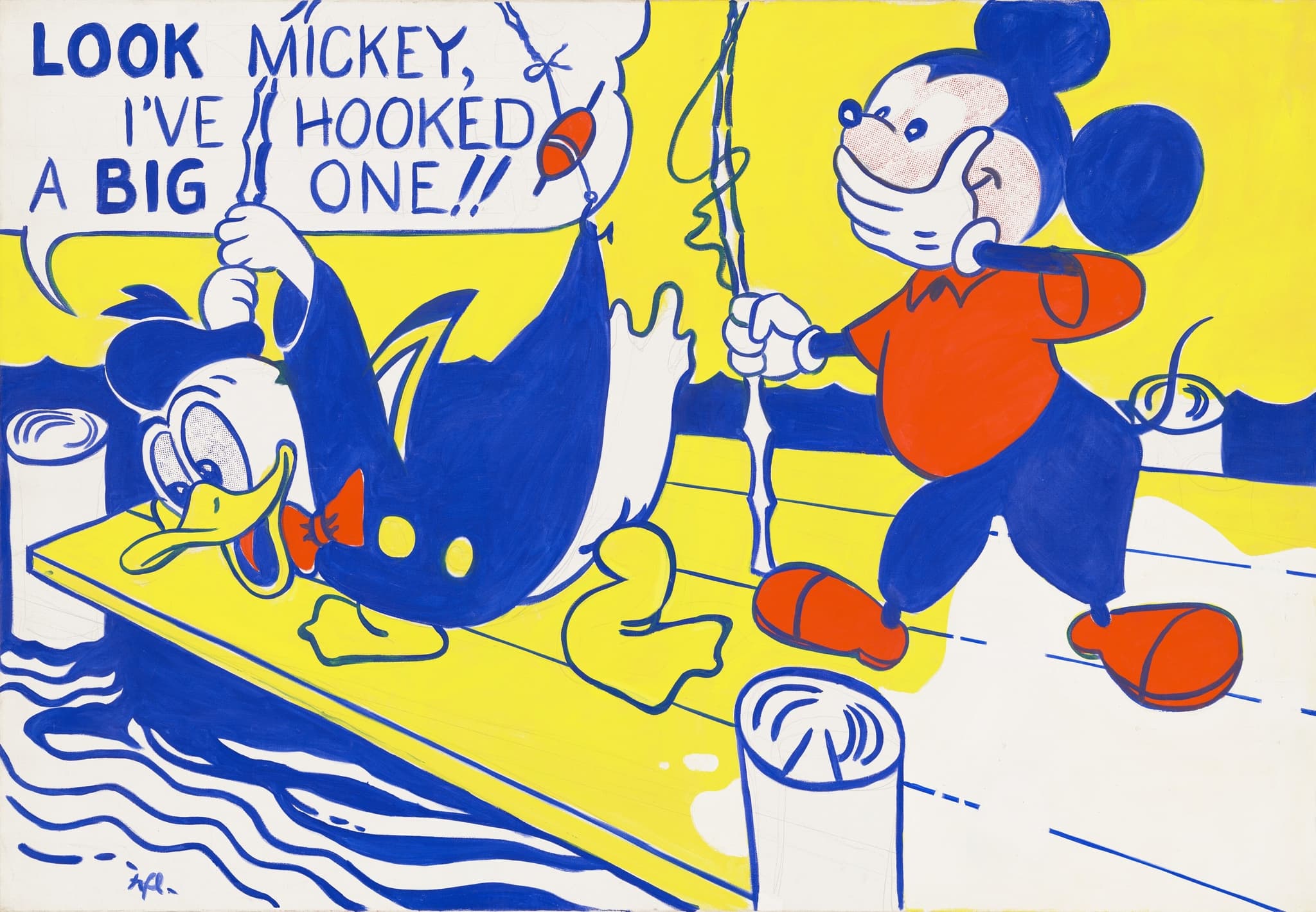
Look Mickey (1961) is a canonical early Roy Lichtenstein painting in the National Gallery of Art; its art‑historical importance places it among the artist’s museum‑quality blue‑chip works. Assuming clear title and good condition, a hypothetical fair‑market range is approximately $30–80M, with the final figure sensitive to condition, provenance restrictions and the sale mechanism (auction vs private treaty).
Valuation Analysis
Overview: This valuation is a hypothetical market appraisal for Roy Lichtenstein’s Look Mickey (1961), presently accessioned in the National Gallery of Art (NGA). The NGA accession and catalogue information anchor the work’s authenticity and institutional status [1][2]. Using public auction benchmarks for early, canonical Lichtensteins and adjusting for museum ownership and marketability, the reasonable fair‑market range is estimated at $30,000,000 to $80,000,000 under competitive sale conditions.
Why this range: Look Mickey is among Lichtenstein’s earliest fully realized comic‑strip canvases and is widely cited in scholarship as materially important to his development of Ben‑Day dot technique and Pop formal strategies [2]. Comparable early‑1960s works that have come to market provide the primary anchors: I Can See the Whole Room... (1961) at major auction realization in the low‑to‑mid $40M range and several other 1961–64 comic canvases realized in the $40M–$95M band, including Sleeping Girl and Nurse, which demonstrate the market ceiling for exceptional, museum‑quality pieces [3][4][5]. Because Look Mickey shares the same chronology and cultural importance as those lots, it is reasonable to place its hypothetical market expectation in the mid‑to‑high tens of millions. The lower bound ($30M) is conservative — reflecting potential discounts for any unresolved condition, donor restrictions, or less aggressive marketplace placement — while the upper bound ($80M) represents a buyer‑competition scenario in which this seminal early work trades as a marquee lot.
Institutional ownership and marketability: The painting’s presence in the NGA collection is a double‑edged value driver. Institutional ownership confirms pedigree and promotes scholarly recognition, but it also means the work has not circulated on the open market and may be subject to deaccession restrictions or donor conditions that would materially affect marketability and sale process [1]. Were the NGA to permit sale (an exceptional and unlikely scenario) or if a comparable work from a private collection were offered, top international buyers and museums would create competitive tension that could push results toward the higher end of the range.
Concluding assessment and contingencies: This estimate presumes a clean legal title, typical market demands for blue‑chip postwar art, and a formal condition report reflecting stable, generally good condition. A confirmed conservator’s report, review of donor restrictions, and direct auction‑house pre‑sale estimates would materially narrow the range. In short: $30–80M is the defensible hypothetical fair‑market window for Look Mickey today; the precise result would be determined by venue, timing, institutional/legal constraints and buyer competition [1][2][3][4][5].
Key Valuation Factors
Art Historical Significance
High ImpactLook Mickey is widely regarded as one of Roy Lichtenstein’s formative comic‑based canvases (1961) and is regularly cited in scholarship as foundational to his mature Pop vocabulary. Its early date and clear demonstration of Ben‑Day dot technique give it outsized curatorial and scholarly importance compared with many later or studio works; that significance directly supports premium pricing because museum‑quality, historically pivotal works attract institutional and private buyers seeking canonical examples. In market terms, significance reduces supply (few true early canonical Lichtensteins exist on the market) and increases buyer competition, both of which elevate potential sale outcomes.
Condition & Conservation
High ImpactCondition is determinative for price at the top end of the market. A recent, professional condition report showing stable paint, original surface, and no major conservation interventions will support high estimates; conversely, evidence of significant restoration, major inpainting, or structural instability will materially reduce market value and buyer confidence. Conservation history also affects insurability and export permits in cross‑border sales. Because Look Mickey has been in an institutional collection, it is likely well cared for, but a formal, current condition assessment is required to move from a broad hypothetical range to a prescriptive estimate.
Provenance & Institutional Ownership
High ImpactThe NGA accession and the gift from Roy and Dorothy Lichtenstein provide exemplary provenance that confirms authenticity and enhances curatorial provenance; however, institutional ownership typically removes works from the market and often carries donor‑imposed restrictions or deaccession rules. If the work were to be sold, it would likely either come via an exceptional deaccession or from a private owner whose provenance traces to the NGA/artist. Institutional provenance increases purchaser confidence and can raise price, but the sale probability and timing are heavily constrained by deaccession policy and donor terms.
Market Comparables / Auction Record
High ImpactPublic auction outcomes for early‑1960s Lichtensteins provide the quantitative anchors used here: several canonical works from 1961–64 have realized in the mid‑tens to high‑tens of millions, with an auction record set by a larger mid‑1960s canvas. These comparables define both floor and ceiling expectations and explain the chosen $30–80M range. Adjustments are needed for size, subject, condition, and freshness to market; a work fresh from a major museum could command a premium relative to a comparable that has been traded already, but donor/legal constraints will apply.
Legal/Restrictions & Marketability
Medium ImpactLegal and contractual factors — donor restrictions, museum deaccession policies, any lien or title encumbrances, and potential copyright/character‑use issues relating to source imagery — affect marketability. Copyright does not typically prevent sale of an original painting, but it can limit merchandising or reproduction rights, which sophisticated buyers price in. Donor restrictions or institutional policy are the most significant legal factors; they can remove the work from circulation entirely or require special governance to permit sale, creating uncertainty that investors tend to price conservatively.
Sale History
Look Mickey has never been sold at public auction.
Roy Lichtenstein's Market
Roy Lichtenstein is a blue‑chip Postwar/Contemporary artist whose major museum‑quality canvases reliably attract top‑tier collectors and institutions. Auction records for early canonical works and mid‑1960s canvases have set multi‑million to nine‑figure ceilings for exceptional lots, demonstrating robust demand for historically important pieces. The market contains tiers — prints and studies trade in lower bands, while museum‑quality narrative canvases command the highest prices. Lichtenstein’s standing is resilient: museum recognition, scholarly attention, and collector demand combine to sustain strong pricing for primary works.
Comparable Sales
Nurse (1964)
Roy Lichtenstein
Large, canonical mid-1960s Lichtenstein; set the artist's auction record and therefore indicates the market ceiling for museum-quality canonical works.
$95.4M
2015, Christie's, New York
~$125.7M adjusted
Woman with Flowered Hat (1963)
Roy Lichtenstein
High-profile early-1960s, museum-quality painting by Lichtenstein; demonstrates strong demand and pricing for important works from this period.
$56.1M
2013, Christie's, New York
~$78.2M adjusted
Sleeping Girl (1964)
Roy Lichtenstein
Early-1960s comic-image painting; a strong realized price for a Pop‑Art cartoon work and a useful mid-market benchmark for canonical imagery.
$44.9M
2012, Sotheby's, New York
~$64.3M adjusted
I Can See the Whole Room...and There's Nobody in It! (1961)
Roy Lichtenstein
Same year (1961) and similar comic/Ben-Day-dot technique — the closest direct market comparable to Look Mickey in terms of chronology and stylistic importance.
$43.2M
2011, Christie's, New York
~$63.6M adjusted
Nude with Joyous Painting (1994)
Roy Lichtenstein
Demonstrates sustained collector demand and ability of high-quality Lichtensteins to realize strong prices even in hybrid sale formats; useful for market depth perspective.
$46.2M
2020, Christie's, New York (ONE relay sale)
~$53.1M adjusted
Current Market Trends
The market for blue‑chip 20th‑century names remains relatively resilient, with top works still attracting global bidders despite macro volatility. Recent years saw intermittent record results for marquee lots while mid‑market activity has been more variable. Supply of fresh, canonical Lichtenstein canvases is limited, which supports pricing for high‑quality offerings; however, timing, sale venue, and broader collector appetite for Pop Art will influence final outcomes.
Sources
- National Gallery of Art — Look Mickey (object page / accession information)
- Roy Lichtenstein: A Catalogue Raisonné — Look Mickey (RLCR entry)
- Christie’s — press/results (Nurse sale and artist market context, Nov 2015)
- Christie’s / press reporting — I Can See the Whole Room... (2011 sale reporting)
- Sotheby’s / press reporting — Sleeping Girl (2012 sale reporting)