How Much Is Swans Reflecting Elephants Worth?
Last updated: February 15, 2026
Quick Facts
- Methodology
- extrapolation
Swans Reflecting Elephants (1937) is a museum-caliber, prime-period Dalí double-image painting with no recorded public auction, long held in a major private collection. Extrapolating from period-true comparables and the current strength of Surrealism, we estimate a $60–90 million result in a marquee auction with a strong third-party guarantee. Private-sale asks could exceed this range, but realized prices would likely cluster around auction mid-estimates under normalized terms.
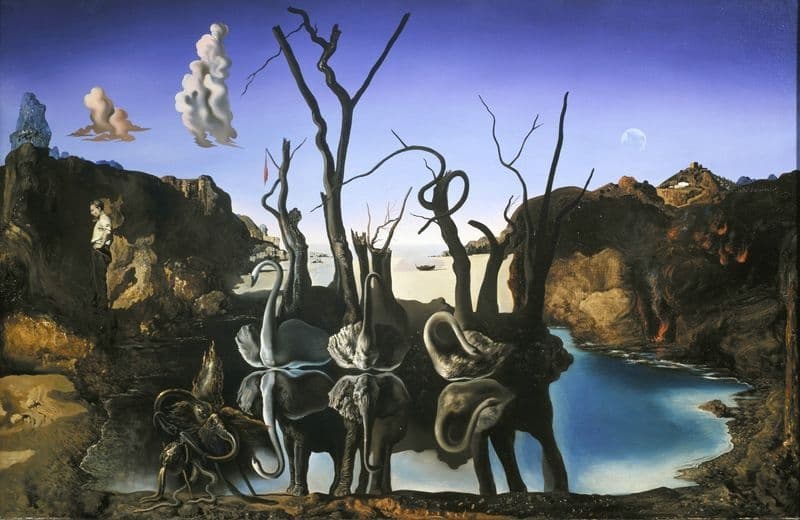
Swans Reflecting Elephants
Salvador Dali, 1937 • Oil on canvas
Read full analysis of Swans Reflecting Elephants →Valuation Analysis
Work and standing. Swans Reflecting Elephants (1937, oil on canvas, 51 × 77 cm; cat. rais. P 454) is one of Salvador Dalí’s definitive double‑image compositions from the peak Surrealist decade. The Fundació Gala–Salvador Dalí lists the work in a private collection [1], and the Kunstmuseum Basel exhibited it in 2019–2020 from the Esther Grether Family Collection—confirming recent museum lending and top‑tier private ownership [2]. Its period, subject, and widespread reproduction place it in the first rank of Dalí paintings still in private hands.
Market benchmarks. The original has no public auction record. Dalí’s standing auction record is Portrait de Paul Éluard (1929), sold for about $21.5 million in 2011 [3]. The closest late‑1930s comp at auction is the 1937 diptych Couple aux têtes pleines de nuages, which achieved £8.17 million with fees in 2020 [4]. Recent marquee‑cycle sales for early Dalí oils cluster lower—e.g., The Birth of Liquid Anguish (1932) at £1.976 million in 2024 [6] and Symbiose de la tête aux coquillages (1931) at $4.198 million in 2025 [7]—while the late but recognizable Rose méditative (1958) made €3.9 million in Paris (2024) [5]. These data illustrate both the scarcity of prime 1937 masterpieces and the gap between routine Dalí offerings and canonical pictures.
Category context. Surrealism remains one of the market’s most dynamic segments, with deep bidding in dedicated evening sales. René Magritte’s L’empire des lumières realized $121.2 million in 2024, demonstrating nine‑figure appetite for iconic Surrealist imagery and resetting expectations for the category’s ceiling [8]. Dalí’s public prices trail this apex largely due to limited availability of best‑in‑class 1930s oils and the dilutive effect of a vast multiples market—not a lack of global brand recognition.
Valuation. Extrapolating from Dalí’s record and the 1937 Bonhams comp, and applying premiums for canonical status, period, and image recognition, we estimate $60–90 million in a marquee New York or London evening sale with a robust third‑party guarantee. The upper bound assumes excellent condition, ironclad provenance and literature/exhibition coverage, and at least two determined bidders (including cross‑category collectors). This range would decisively reset Dalí’s auction record while remaining credible relative to the broader Surrealist price architecture.
Private placement and sensitivities. In a discreet private sale, asks could credibly run to $90–120 million, though outcomes typically track auction mid‑estimates once fees and terms normalize. Factors that could shift value include technical condition and restoration history, export/jurisdictional constraints, and completeness of provenance and publication. Conversely, fresh‑to‑market positioning, exemplary surface, and active institutional interest—especially amidst ongoing Surrealism centenary programming—could catalyze competition toward the high end of our estimate.
Key Valuation Factors
Art Historical Significance
High ImpactPainted in 1937, Swans Reflecting Elephants epitomizes Dalí’s paranoiac‑critical method and ranks among the most recognizable double‑image works of his prime Surrealist period. It is widely reproduced in art‑historical literature and exhibitions, and its conceptually crisp mirroring of swans and elephants captures the cerebral wit that defines Dalí at his peak. Few Dalí paintings offer this combination of period, innovation, and global familiarity. Because art-historical centrality drives cross‑category appeal and museum interest, this factor strongly supports a valuation that materially exceeds routine Dalí auction bands and justifies a step‑change above the artist’s historic record.
Rarity and Supply
High ImpactPrime 1930s Dalí masterpieces—especially iconic double‑image compositions—surface extremely rarely. The work has no public auction history and has been long held in a blue‑chip private collection, underscoring its scarcity. Scarcity premiums are amplified in Surrealism, where top‑tier material is tightly held by museums and a small number of collectors. When such works appear, they can attract cross‑category bidders and aggressive third‑party guarantees. The absence of close, recent comparables for a painting of this quality argues for meaningful headroom over historical prices and provides the structural basis for our $60–90 million estimate.
Provenance and Exhibition History
High ImpactThe painting is catalogued by the Fundació Gala–Salvador Dalí (CR P 454) and was exhibited by the Kunstmuseum Basel from the Esther Grether Family Collection (2019–2020), attesting to institutional‑grade ownership and recent scholarly visibility. Such provenance and loan history help mitigate typical Dalí-market risks tied to authentication confusion in lower tiers and increase buyer confidence at the top end. Robust publication/exhibition records and clean title are critical for nine‑figure‑adjacent valuations; here, the documented private holding and museum loans are positive signals that support strong bidding and the feasibility of a third‑party guarantee.
Image Recognizability and Brand Power
High ImpactSwans Reflecting Elephants is among the most famous Dalí images still in private hands. High recognizability expands the bidder pool beyond specialist Surrealist collectors to include trophy‑hunting Modern buyers and cross‑collectors who value cultural resonance. Dalí’s global brand is exceptionally strong, spanning fine art, design, and popular culture, which helps underwrite competitive tension when a canonical image appears. Recognizability is a proven catalyst for price outperformance in marquee evening sales, and in this case, it is a key driver of the upward extrapolation from Dalí’s historical auction record.
Market Depth and Auction Dynamics
Medium ImpactSurrealism’s market has expanded markedly, with robust dedicated evening sales and record‑level outcomes for canonical works. However, Dalí’s very top‑end buyer base is thinner than Magritte’s, and pricing at this level will likely depend on securing a strong third‑party guarantee and orchestrating global outreach to activate at least two principal bidders. Under these conditions, competition can unlock prices far beyond legacy records; absent such dynamics, results may revert toward the midpoint. This factor tempers the top of the range but still supports a decisive reset of the artist’s auction record given the work’s caliber.
Sale History
Swans Reflecting Elephants has never been sold at public auction.
Salvador Dali's Market
Salvador Dalí is a blue‑chip 20th‑century Surrealist with one of the widest global audiences in Modern art. His market is bifurcated: deep liquidity for prints and later works, and a scarce, high‑value segment for prime 1930s oils. The long‑standing auction record is Portrait de Paul Éluard (1929) at roughly $21.5 million (Sotheby’s London, 2011). Since then, few top‑tier 1930s oils have surfaced publicly; a key period comp, the 1937 diptych Couple aux têtes pleines de nuages, brought £8.17 million in 2020. In 2024–2025, strong but non‑iconic Dalí oils generally realized $2.5–4.2 million, reflecting steady demand but also the lack of true masterpieces at auction. This supply dynamic suggests substantial headroom for a canonical 1937 work.
Comparable Sales
Couple aux têtes pleines de nuages
Salvador Dalí
Prime 1937 Surrealist oil, same year as Swans; major double-image composition and a strong period benchmark for late-1930s Dalí at auction.
$10.6M
2020, Bonhams London
~$12.9M adjusted
Portrait de Paul Éluard
Salvador Dalí
Artist auction record; museum-caliber 1929 portrait from Dalí’s prime Surrealist period. Establishes the historical ceiling for Dalí at auction.
$21.5M
2011, Sotheby's London
~$30.1M adjusted
Symbiose de la tête aux coquillages
Salvador Dalí
1931 oil on canvas from Dalí’s core Surrealist decade; recent marquee New York result indicating current demand for early-1930s Dalí oils.
$4.2M
2025, Sotheby's New York
The Birth of Liquid Anguish (Naissance des angoisses liquides)
Salvador Dalí
1932 Surrealist oil, prime-period Dalí. Useful for scale/quality calibration of early-1930s paintings in the current cycle.
$2.5M
2024, Christie's London
~$2.6M adjusted
Rose méditative (Meditative Rose)
Salvador Dalí
Late (1958) but widely recognized Dalí oil; top Dalí lot in a white-glove Surrealism sale, anchoring recent upper-range pricing for Dalí oils.
$4.2M
2024, Sotheby's Paris
~$4.4M adjusted
Current Market Trends
Surrealism has been a standout category, with white‑glove dedicated sales, expanding global participation, and headline records that validate deep demand for canonical images. Magritte’s L’empire des lumières reached $121.2 million in 2024, and major results for Carrington, Kahlo, and others have reset expectations for the field’s ceiling. Against a backdrop of a recovering marquee auction market, collectors are prioritizing historically pivotal Modern works. Supply of top‑tier Surrealist masterpieces remains tight, amplifying scarcity premiums when they appear. For Dalí, this means that when a prime 1930s, image‑driven painting surfaces with strong presentation and guarantees, it can credibly leapfrog the artist’s historical record by a wide margin.
Study print
Study this painting as a print
Pair the full artwork with a museum-style study sheet focused on one meaningful detail.
Sources
- Fundació Gala–Salvador Dalí Catalogue Raisonné (P 454)
- Kunstmuseum Basel – Esther Grether Family Collection (2019–2020)
- Dalí auction record: Portrait de Paul Éluard (2011) – ABC News report
- Bonhams London (2020) – Couple aux têtes pleines de nuages achieves £8.17m
- Artsy – Sotheby’s Paris 2024: Rose méditative at €3.9m
- Christie’s London (Mar 2024) – Sale results incl. The Birth of Liquid Anguish
- Observer – Sotheby’s Nov 2025 results incl. Symbiose de la tête aux coquillages
- Forbes – Magritte’s L’empire des lumières sells for $121.2m (Nov 2024)