How Much Is The Elephants Worth?
Last updated: February 14, 2026
Quick Facts
- Methodology
- comparable analysis
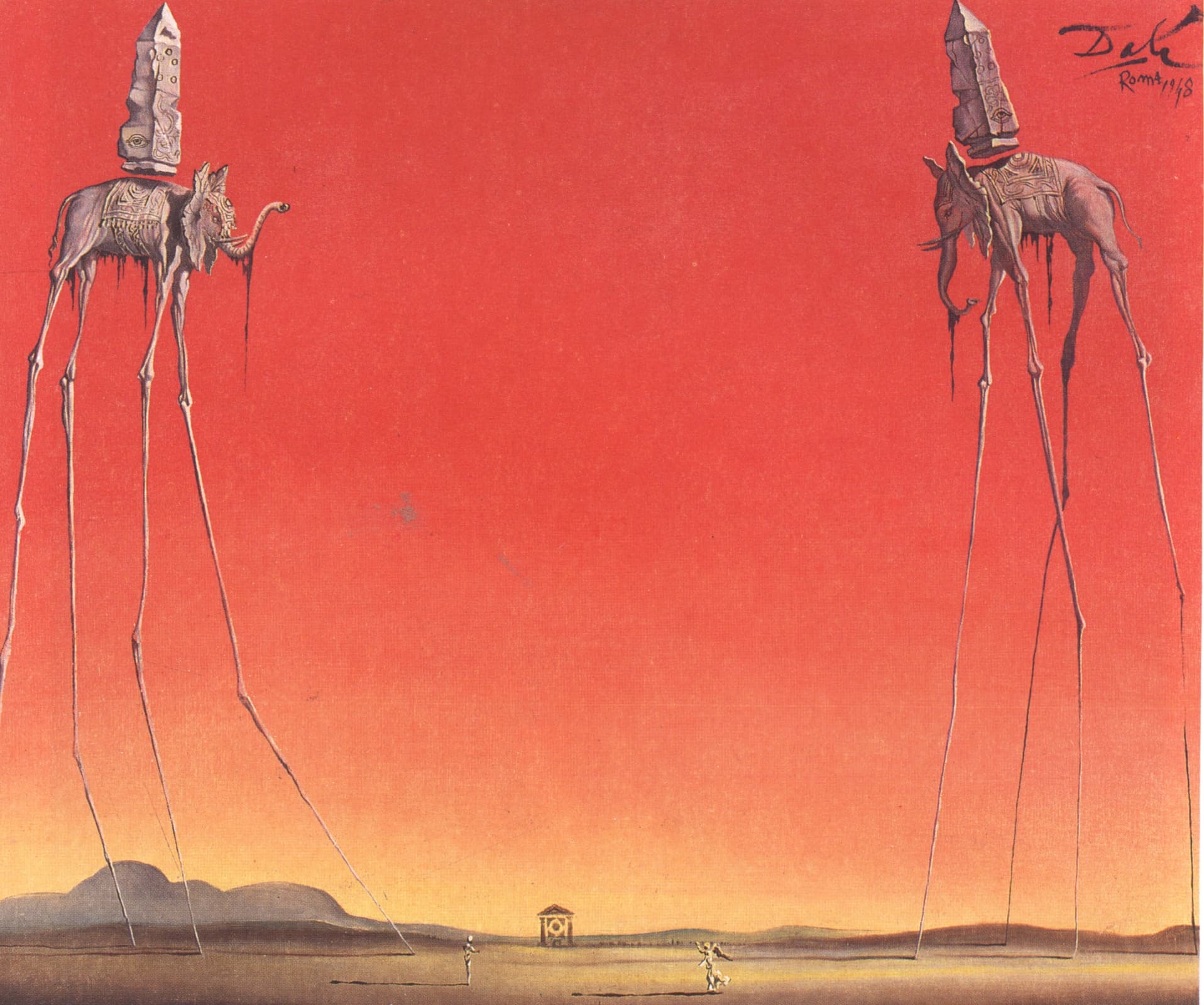
We estimate Salvador Dalí’s The Elephants (1948, oil on canvas) at $20–40 million in auction terms. As one of Dalí’s most iconic postwar images and a work rarely seen on the market, it has a credible path to setting a new Dalí auction record under optimal sale conditions.
Valuation Analysis
Conclusion: The Elephants (1948) by Salvador Dalí would command $20–40 million at auction today. The work is a canonical image from Dalí’s immediate postwar period—his long‑legged, obelisk‑bearing elephants are among the artist’s most recognizable motifs—and the 1948 canvas is consistently recorded in a private collection, with no public auction history. At the upper end, this painting can credibly challenge or exceed Dalí’s standing auction record, established in 2011 by Portrait de Paul Éluard at approximately $21.5–$21.7 million [1]. The estimate assumes the canonical 1948 oil, excellent condition, robust provenance, and first‑tier literature/exhibition history, as reflected in the Fundació Gala–Salvador Dalí’s catalogue‑raisonné resources [2].
How the estimate was derived: We anchor the high end to Dalí’s auction ceiling—Portrait de Paul Éluard (1929) at ~$21.7m [1]—and triangulate using recent, high‑quality Dalí oil results. On the postwar side, an emblematic 1958 canvas, Rose méditative, achieved roughly $4.2m at Sotheby’s Paris in 2024, the headline of a tightly curated Surrealism sale [3]. At the early‑1930s end, a jewel‑scale 1932 oil, Naissance des angoisses liquides, brought about $2.5m and was acquired by the Dalí Foundation in 2024—evidence of institutional conviction and depth of connoisseur demand [4]. For celebrated late‑1930s imagery, the widely reproduced diptych Couple aux têtes pleines de nuages realized about $10.5m in 2020 [5]. Taken together, these comparables define a multi‑tiered market in which truly emblematic images with broad brand recognition—like The Elephants—can justify a high‑eight‑figure bracket.
Positioning within Dalí’s oeuvre: While collectors generally pay a premium for Dalí’s interwar masterpieces (c. 1929–1936), The Elephants is a signature, heavily published postwar image with outsized cultural visibility. It sits near the apex of Dalí’s post‑1945 output and benefits from the market’s preference for instantly recognizable motifs. The Fundació’s catalogue confirms the work’s date and characteristics; the widely cited format is approximately 49 × 60 cm (oil on canvas) [2]. A pristine state of preservation, comprehensive provenance, and inclusion in major exhibitions/publications would propel the work toward the upper half of the range.
Market context and sale strategy: The Surrealism segment has shown renewed momentum, with tightly curated sales in 2024 achieving white‑glove outcomes and strong prices for celebrated images [3]. Coupled with institutional acquisitions of Dalí in 2024 [4], the category is drawing broader global participation. Under optimal conditions—New York or London evening sale, first‑tier marketing, an irrevocable bid/guarantee, and multiple international underbidders—The Elephants could plausibly reset Dalí’s auction benchmark into the mid‑to‑high thirties. In a standard presentation or with modest condition/provenance limitations, a result in the low‑to‑mid twenties would remain well supported by the comparables and the artist’s brand power.
Key Valuation Factors
Art Historical Significance
High ImpactThe Elephants represents one of Dalí’s most enduring and broadly recognized motifs—long‑legged elephants bearing obelisks—condensed into a single, emblematic postwar image. While not as historically pivotal as interwar icons like The Persistence of Memory, the 1948 canvas is a flagship of Dalí’s ‘classical’ period and has been widely reproduced in scholarship and popular culture. That level of recognition expands the potential bidder pool beyond core Surrealist specialists to cross‑category collectors seeking brand‑defining images. In today’s trophy‑driven market, this kind of image power is a critical price accelerator, effectively narrowing the gap to Dalí’s interwar masterpieces and justifying a high‑eight‑figure auction bracket for the canonical oil.
Rarity and Liquidity of Top-tier Dalí Oils
High ImpactCanonical Dalí oils with landmark imagery appear infrequently at public auction, and the 1948 The Elephants has not surfaced publicly. Scarcity at the very top end heightens competition when such works are offered, especially when accompanied by a complete provenance and strong literature/exhibition history. This rarity premium is amplified by the visual fame of The Elephants, which makes it both a trophy target and a branding asset for major collectors or institutions. In practice, the confluence of rarity and image power supports a valuation that can credibly test—and, with optimal sale engineering, exceed—the artist’s longstanding auction record.
Period Premium/Discount
Medium ImpactDalí’s market places a structural premium on interwar (1929–1936) Surrealist masterpieces, reflected in his record price. Postwar works often trail, but iconic post‑1945 images can buck this discount. Recent auction comparables show small early‑1930s oils trading in the low‑to‑mid seven figures and a famed late‑1930s diptych surpassing $10 million. Against that backdrop, The Elephants—despite its 1948 date—commands a valuation more consistent with blue‑chip, widely published Dalí subjects. The market’s readiness to reward emblematic images narrows the usual period gap, placing this painting firmly in a high‑eight‑figure bracket rather than the mid‑single‑digit millions typical for non‑iconic postwar works.
Condition, Provenance, and Literature/Exhibition
High ImpactAt this price tier, buyers demand pristine or well‑stabilized condition, unbroken and well‑documented provenance, and deep footprints in the scholarly literature and exhibition record. The Fundació Gala–Salvador Dalí’s catalogue‑raisonné entry is a core reference point for confirming identity and details. Clean, well‑documented histories and notable museum loans can lift demand and justify bidding into the upper half of the range. Conversely, structural issues (e.g., unstable craquelure, overpaint), gaps in provenance, or thin literature may compress pricing. Assuming the canonical 1948 oil with exemplary documentation and conservation, the work merits presentation as a sale‑defining trophy with record‑setting potential.
Sale Strategy and Timing
Medium ImpactOutcome is highly sensitive to venue, timing, and financial structuring. A New York or London evening sale slot, during a peak week, with an irrevocable bid/guarantee and robust pre‑sale global marketing, tends to maximize competitive tension. The Surrealism category’s strong recent performance in curated sales underscores the benefit of context and narrative. Aligning with a Surrealism‑focused evening sale or a modern evening sale with a strong Surrealist spine, coupled with museum‑level catalogue treatment, would help drive The Elephants toward the top of its estimated range. Private treaty could achieve similar net outcomes but typically emphasizes certainty over price discovery.
Sale History
The Elephants has never been sold at public auction.
Salvador Dali's Market
Salvador Dalí commands a broad, global collector base and deep cultural recognition. The market is sharply quality‑tiered: interwar Surrealist masterpieces (c. 1929–1936) lead at the top, anchored by the artist’s standing auction record for Portrait de Paul Éluard at roughly $21.5–$21.7 million (2011) [1]. In recent seasons, strong Dalí oils have typically transacted in the low‑to‑mid seven figures, with emblematic postwar images (e.g., Rose méditative, 1958) around $4 million and jewel‑scale early‑1930s works in the $2–4 million zone [3][4]. Abundant prints/multiples require careful authentication, but demand for blue‑chip, well‑documented paintings remains resilient. Scarcity of A‑tier trophies has limited new public records, which is precisely why a canonical painting like The Elephants could re‑price the upper end.
Comparable Sales
Portrait de Paul Éluard
Salvador Dalí
Record-setting Dalí oil; museum-caliber early Surrealist benchmark that anchors the upper bound for Dalí paintings. Same artist; different subject/period but critical for ceiling-setting.
$21.5M
2011, Sotheby's London
~$30.1M adjusted
Printemps nécrophilique
Salvador Dalí
Top-tier 1936 Surrealist dreamscape; same artist and quintessential Surrealist language. Strong market proxy for blue-chip Dalí imagery (though earlier than 1948).
$16.3M
2012, Sotheby's New York
~$22.4M adjusted
Couple aux têtes pleines de nuages (diptych)
Salvador Dalí
Famous late‑1930s diptych widely reproduced in Dalí literature; same artist, iconic Surrealist subject matter with strong brand recognition—helpful benchmark for celebrated images.
$10.5M
2020, Bonhams London
~$12.8M adjusted
Rose méditative
Salvador Dalí
Iconic postwar Dalí oil (1958) with a signature motif; same medium/artist and close in era to 1948. Useful for gauging demand for emblematic postwar Dalí images.
$4.2M
2024, Sotheby's Paris
~$4.3M adjusted
Symbiose de la tête aux coquillages
Salvador Dalí
Early‑1930s small-format Surrealist oil; recent sale showing live demand and pricing for strong but less monumental Dalí subjects. Same artist/medium; period premium evident.
$4.2M
2025, Sotheby's New York
Naissance des angoisses liquides (The Birth of Liquid Anguish)
Salvador Dalí
1932 Surrealist oil acquired by the Dalí Foundation; institutional validation and a clean, recent price signal for early, smaller Dalí paintings.
$2.5M
2024, Christie's London
~$2.6M adjusted
Current Market Trends
Surrealism has enjoyed renewed momentum, with tightly curated sales in 2024 delivering white‑glove outcomes and standout prices for celebrated images, including Dalí [3]. Institutional participation—such as the Dalí Foundation’s 2024 acquisition of a 1932 oil—signals connoisseur confidence and underpins depth at the serious end of the market [4]. Macro auction volumes have been selective at the very top, but cross‑category buyers continue to compete for iconic, widely reproduced images. In this context, The Elephants aligns with what is selling best: instantly recognizable, literature‑rich Surrealist paintings with clear provenance, presented in marquee evening sales with robust global marketing and, ideally, a guarantee to catalyze bidding.
Study print
Study this painting as a print
Pair the full artwork with a museum-style study sheet focused on one meaningful detail.
Sources
- Sotheby’s: Salvador Dalí, Portrait de Paul Éluard (record price, 2011)
- Fundació Gala–Salvador Dalí: Online paintings catalogue (catalogue raisonné portal)
- Artsy: Jean Dubuffet and Salvador Dalí lead Sotheby’s Paris with seven‑figure sales (Oct 18, 2024)
- Christie’s: 20th/21st Century London sale results (Mar 7, 2024) – Dalí Foundation acquisition
- Bonhams: Dalí’s Couple aux têtes pleines de nuages sets auction record for work at Bonhams (Oct 15, 2020)