How Much Is The Great Masturbator Worth?
Last updated: February 16, 2026
Quick Facts
- Methodology
- comparable analysis
In an unconstrained, international sale, Salvador Dalí’s The Great Masturbator (1929) would be expected to realize $80–120 million. Its canonical status within Dalí’s oeuvre, breakthrough date, large scale, and extraordinary image recognition position it to reset the artist’s auction record and trade in the top tier of Surrealist masterpieces.
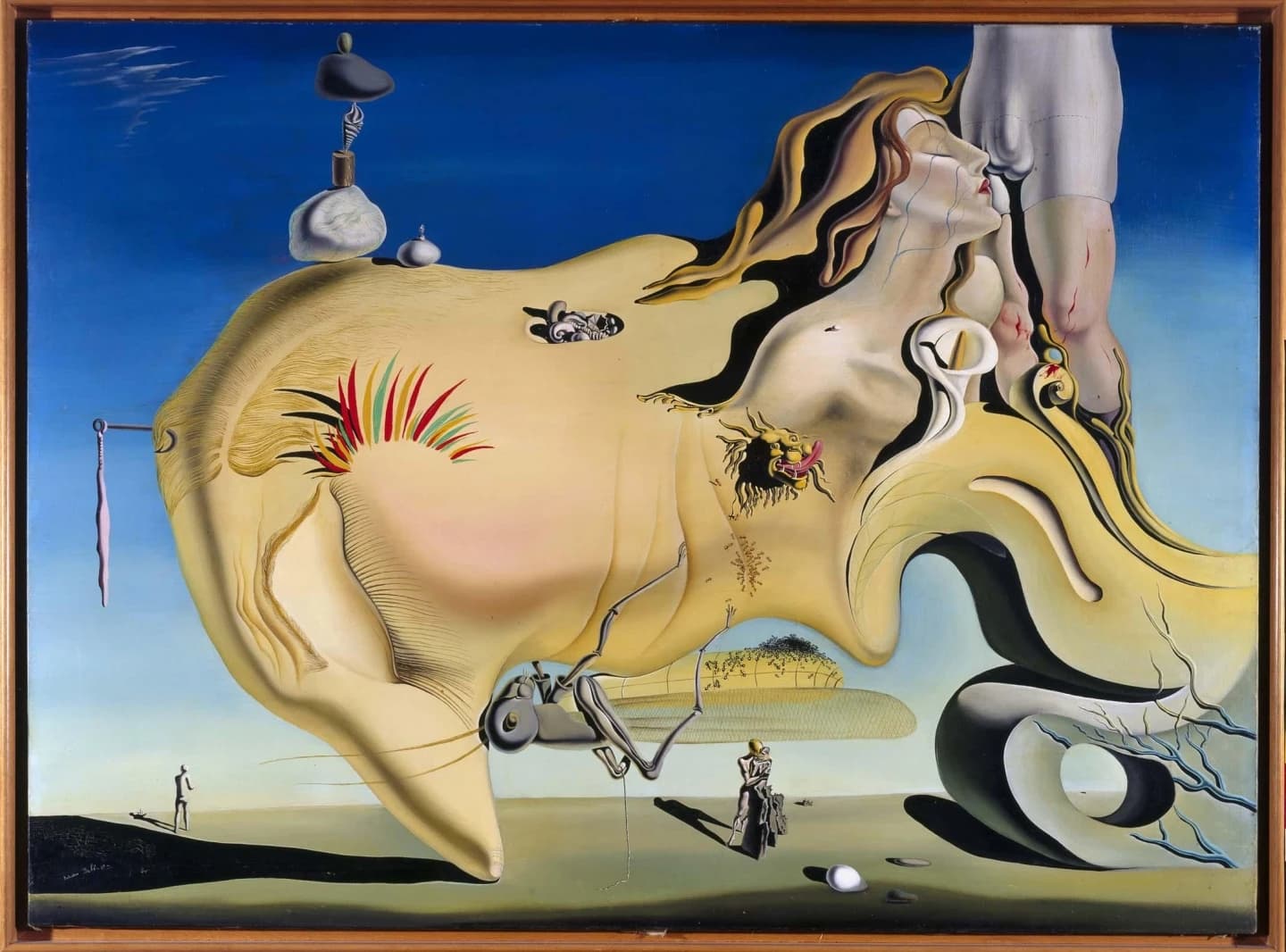
The Great Masturbator
Salvador Dali, 1929 • Oil on canvas
Read full analysis of The Great Masturbator →Valuation Analysis
Conclusion: Based on a synthesis of artist-specific comparables, category benchmarks, and the work’s exceptional art-historical standing, The Great Masturbator is valued at $80–120 million in a hypothetical, fully international sale (New York/London), with broad global marketing and no export constraints. The painting is a museum-grade, canonical Dalí from 1929—his breakthrough Surrealist year—of substantial scale (110 × 150 cm) and among the most reproduced images in his corpus, after The Persistence of Memory. It is held by Spain’s Museo Nacional Centro de Arte Reina Sofía and entered the collection by bequest in 1990 [1].
Artist comparables and auction precedent: Dalí’s all-time auction record remains Portrait de Paul Éluard (1929) at approximately $21.7 million (Sotheby’s London, 2011) [2]. Prime 1930s Surrealist oils have traded in the low eight figures—e.g., L’Àngelus (c. 1934–35) at $10.7 million (Sotheby’s New York, 2021) [4]—while smaller early-1930s works can make mid-seven figures (e.g., Symbiose de la tête aux coquillages (1931) at $4.20 million, Sotheby’s New York, 2025) [5]. Relative to these, The Great Masturbator is rarer, earlier, larger, more academically central, and has far greater image recognition. On artist-specific grounds alone, it would be expected to exceed Dalí’s adjusted record by a multiple.
Category ceiling and cross-collector demand: The Surrealism category’s demonstrated ceiling has moved materially higher in recent seasons, led by René Magritte’s L’empire des lumières at $121.2 million (Christie’s New York, 2024) [3]. Trophy-level Surrealist works now attract deep, cross-collector participation spanning Modern, Post-War, and global trophy buyers. This category context supports a step-change valuation for an undisputed, A+ Dalí masterpiece, making an $80–120 million band defensible for The Great Masturbator.
Market conditions and positioning: Recent auction cycles have rewarded blue-chip, museum-provenanced material with strong narratives. Dalí’s prime 1929–31 Surrealist oils are extraordinarily scarce on the market; many key works are institutionally held. The Great Masturbator’s art-historical weight, scale, and publication/exhibition profile position it at (or just below) Dalí’s absolute apex, with Persistence of Memory likely the only Dalí that would command more.
Legal and practical constraints: As a Spanish state museum holding, the painting is treated as inalienable cultural patrimony with export tightly controlled under Spain’s Historical Heritage Law [6]. This valuation explicitly assumes a hypothetical, unconstrained international sale. A sale confined to Spain or encumbered by export uncertainty would likely compress the realized price by reducing the effective buyer pool and risk appetite.
Key Valuation Factors
Art Historical Significance
High ImpactPainted in 1929, The Great Masturbator is a touchstone of Dalí’s breakthrough Surrealist period, embedding many of his signature motifs and the Paranoiac–Critical method. It is among the two or three most discussed and reproduced Dalí paintings, integral to the scholarly narrative alongside The Persistence of Memory and Metamorphosis of Narcissus. The work’s scale (110 × 150 cm), formal ambition, and literary-psychoanalytic content make it a museum-defining image. Within Dalí’s oeuvre, it sits at the highest echelon of quality and influence, materially elevating demand from both Surrealism specialists and trophy collectors who seek historically pivotal, widely recognized icons.
Rarity and Supply Constraints
High ImpactEarly, first-rate Surrealist oils by Dalí (circa 1929–1931) are exceptionally scarce in private hands; many landmark works are held by institutions in Europe and the U.S. and seldom, if ever, come to market. This structural scarcity amplifies competition when museum-grade pictures surface and supports step-change pricing above Dalí’s historical band. The Great Masturbator, already in a national collection, exemplifies the pinnacle tier of Dalí’s output that private buyers virtually never have the opportunity to acquire. Valuing such a work therefore requires an upward extrapolation from lesser but still significant comparables that have set the public price band.
Comparable Sales and Category Ceiling
High ImpactDalí’s auction record is about $21.7 million for a 1929 portrait, with strong 1930s oils achieving $10–11 million and smaller 1931 works around $4–5 million. These results establish the public price band for good-to-excellent Dalí oils but understate the value of truly canonical masterworks. Meanwhile, the Surrealist category’s apex has expanded—Magritte’s $121.2 million underscores trophy-level headroom. Factoring in The Great Masturbator’s superior significance, scale, and fame, a range of $80–120 million is justified by applying a premium multiple to Dalí’s record and anchoring to the broader category ceiling evidenced by top-tier Surrealist comparables.
Image Recognition, Scale, and Exhibition History
High ImpactThe Great Masturbator enjoys extraordinary image recognition, appearing widely in scholarship, exhibitions, and popular culture, which materially increases its desirability and confidence among trophy buyers. At 110 × 150 cm, it has the wall power and presence expected of nine-figure-caliber Modern icons. Its sustained institutional exhibition and publication history further de-risk the work for top-end collectors, reinforcing provenance quality and long-term cultural relevance. All else equal, the combination of scale, visibility, and a deep scholarly footprint supports a valuation near the apex of the Dalí market and within the top tier of Surrealism more broadly.
Legal/Marketability Context (Spain’s Patrimony Law)
Medium ImpactThe painting is held by Spain’s Museo Nacional Centro de Arte Reina Sofía and is subject to Spain’s Historical Heritage Law, under which state-held cultural assets are effectively inalienable and export is strictly controlled. Practically, a sale is highly unlikely. For valuation, we assume a hypothetical, unconstrained international offering; if instead a transaction were restricted within Spain or entailed export-license uncertainty, realized proceeds could be meaningfully lower due to a narrower buyer pool and elevated execution risk. This factor tempers, but does not negate, the high-end open-market estimate used for insurance or benchmarking purposes.
Sale History
The Great Masturbator has never been sold at public auction.
Salvador Dali's Market
Salvador Dalí commands global name recognition and a deep, stratified market. While editions and later works are abundant, prime Surrealist oils from the late 1920s–mid 1930s are scarce and draw intense competition. Dalí’s auction record stands at roughly $21.7 million for Portrait de Paul Éluard (1929; Sotheby’s London, 2011). In recent years, strong 1930s oils have realized around $10–11 million, with early-1930s small-format works at $4–5 million. Works on paper can exceed $1 million, and design/jewelry has approached $1 million with top provenance. Relative to peer Surrealists, Dalí’s public ceiling remains lower than Magritte’s, but demand for undisputed masterpieces is robust and positioned to reset records upon the appearance of a canonical, large-scale work.
Comparable Sales
Portrait de Paul Éluard (1929)
Salvador Dalí
Same artist; same breakthrough year (1929); prime Surrealist oil with top-tier provenance; still Dalí’s auction record and the closest auction benchmark in period and importance.
$21.7M
2011, Sotheby's London
~$30.4M adjusted
L’Àngelus (c. 1934–35)
Salvador Dalí
Same artist; mid‑1930s Surrealist oil engaging a core Dalí theme; strong seven‑figure result that anchors demand for documented 1930s oils.
$10.7M
2021, Sotheby's New York
~$12.6M adjusted
Couple aux têtes pleines de nuages (diptych) (1937)
Salvador Dalí
Same artist; major Surrealist oil from the 1930s; one of the highest public prices for a substantial Dalí Surrealist composition in the last decade.
$10.6M
2020, Bonhams London
~$13.1M adjusted
Symbiose de la tête aux coquillages (1931)
Salvador Dalí
Same artist; early‑1930s Surrealist oil with signature biomorphic/Paranoiac‑Critical imagery; current-market indicator for small‑format 1930s Dalí oils.
$4.2M
2025, Sotheby's New York
Rose méditative (1958)
Salvador Dalí
Same artist; later, emblematic Surrealist oil; helpful for brand‑level pricing context though later period and less directly comparable to a 1929 masterpiece.
$4.2M
2024, Sotheby's Paris
~$4.3M adjusted
Current Market Trends
Surrealism has enjoyed renewed momentum, with top-tier evening sales delivering high sell-through and standout results. The category ceiling was redefined by Magritte’s $121.2 million in 2024, and Sotheby’s staged a record Surrealist night in 2025, reflecting deep cross-collector engagement. Institutional centenaries and major exhibitions have kept Surrealism front-of-mind, while market selectivity has favored blue-chip, well-provenanced icons. Against this backdrop, scarcity of early, museum-grade Dalí oils strengthens pricing power at the very top. Although broader auction markets remain disciplined, the combination of trophy scarcity, category visibility, and diversified global demand supports elevated valuations for canonical Surrealist masterworks.
Study print
Study this painting as a print
Pair the full artwork with a museum-style study sheet focused on one meaningful detail.
Sources
- Museo Reina Sofía collection entry: The Great Masturbator (Dalí Bequest, 1990)
- Dalí auction record: Portrait de Paul Éluard (Sotheby’s London, 2011)
- Christie’s: Magritte’s L’empire des lumières achieves $121.2m (2024)
- Sotheby’s Modern Evening Sale (2021): Dalí, L’Àngelus at $10.7m
- Observer: Sotheby’s 2025 Surrealist session; Dalí, Symbiose de la tête aux coquillages at $4.198m
- UNESCO summary: Spain’s Historical Heritage Law (Ley 16/1985)