How Much Is Woman and Bicycle Worth?
Last updated: June 8, 2026
Quick Facts
- Methodology
- comparable analysis
Woman and Bicycle (1952–53) is a large, museum‑quality 'Woman' canvas by Willem de Kooning held by the Whitney (accession 55.35) and therefore off‑market. Based on private‑sale and auction comparables for canonical early‑1950s 'Woman' paintings, a reasoned hypothetical market range is $100–150 million, with private negotiation and sale structure determining whether the work reaches the top of that band.
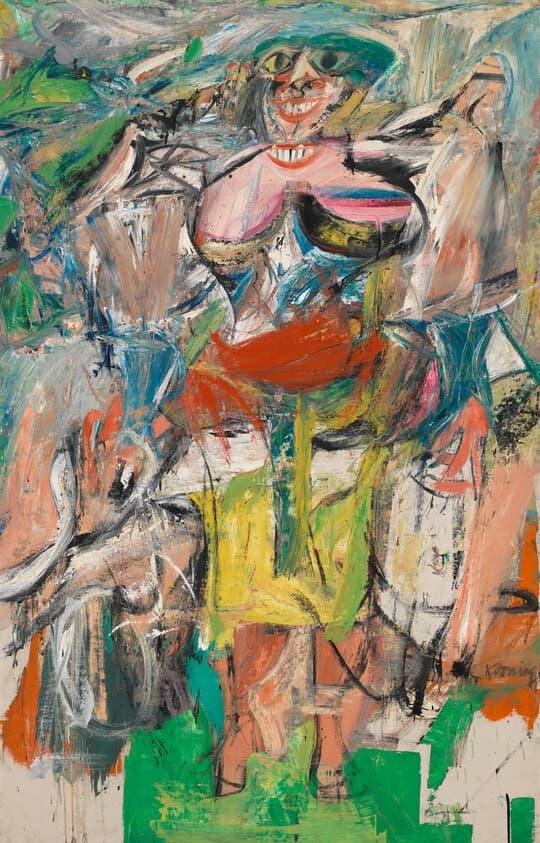
Woman and Bicycle
Willem de Kooning • Oil, enamel and charcoal on linen
View more by Willem de Kooning →Valuation Analysis
This valuation provides a hypothetical market estimate for Willem de Kooning’s Woman and Bicycle (1952–53). The original oil/enamel/charcoal canvas is in the Whitney Museum collection (accession 55.35) and is therefore effectively off‑market; there is no public auction record for the original canvas [1]. Because it is museum‑held, any commercial offering would most likely be a carefully structured private sale or an extraordinary deaccession, both of which carry procedural constraints and potential premiums.
Valuation is driven by direct comparables: major private‑sale anchors include Woman III (reported 2006 private sale to Steven A. Cohen, circa $137.5M) [2] and Interchange (reported 2015 private transaction, widely cited at roughly $300M) [3]. Public‑auction anchors are lower but still significant: Christie’s 2016 sale of Untitled XXV realised $66.33M (with buyer’s premium) and other 'Woman' canvases have sold in the high tens of millions, which establishes a visible auction ceiling [4]. Applying these anchors — private‑sale ceilings and public‑auction visibility — frames a realistic market band for a museum‑quality, early‑1950s 'Woman' canvas.
Woman and Bicycle's scale (approximately 194.3 × 124.8 cm) and date place it within de Kooning’s central, market‑driving phase. The Whitney acquisition provides authoritative provenance and accrues an institutional premium for prospective buyers; however, institutional ownership also suppresses immediate liquidity, so a sale—should it ever be proposed—would be subject to institutional policy, donor restrictions and public scrutiny [1]. Given these constraints, a private sale to a major collector or institution is the most likely route to achieve the painting’s full market potential.
Price conclusion: on a hypothetical market offering I place a conservative fair market range of $100–150 million. The floor of this band reflects the visible auction ceiling adjusted for museum provenance and sale friction; the ceiling reflects achievable private‑sale outcomes when a prepared buyer pool and sale structure compress risk. In an auction context without an extraordinary guarantee or matching private interest, the painting would be more likely to trade at or below the low end of this range [4][5].
Caveats and next steps: this estimate is conditional — it assumes the painting's attribution, extent of original surface and lack of unresolved title or export impediments. The Whitney’s curatorial and provenance files (access to acquisition correspondence, exhibition loans, and catalogue references) and a detailed conservation report are necessary to produce a transaction‑ready valuation. If you need an insurance or sale‑ready figure I recommend commissioning a condition survey and contacting a senior specialist at Christie’s or Sotheby’s (or an independent de Kooning authority) to produce a formal appraisal and to advise on likely sale channel and timing [1][5].
Key Valuation Factors
Art Historical Significance
High ImpactWillem de Kooning's early 1950s 'Woman' paintings are seminal to postwar American art and drive the artist's trophy market. Woman and Bicycle dates to this pivotal period, so its attribution to the 1952–53 'Woman' group markedly increases its scholarly and collectible importance. Scale, the aggressive painterly handling and the figural motif place it within the most sought‑after segment of de Kooning's oeuvre. Even if not as ubiquitously cited as Woman I–III, a museum‑quality early 'Woman' canvas commands a premium over studies, later works and prints, because it is central to canonical narratives and exhibition programming.
Provenance & Exhibition
High ImpactThe Whitney Museum's ownership (accession 55.35) provides one of the strongest possible provenance credentials: institutional acquisition, exhibition history and curatorial oversight materially increase buyer confidence and price potential. Museum provenance tends to raise buyer willingness to pay but simultaneously reduces immediate liquidity because deaccession of cornerstone works is rare and regulated. If the Whitney's provenance files show early acquisition documentation, exhibition loans and bibliography, those elements add demonstrable value and reduce attribution risk, supporting the upper end of any hypothetical price band.
Condition & Medium
Medium ImpactThe work's medium (oil with enamel and charcoal on canvas) and age make condition analysis essential. Layered media can present conservation complexities — instability, overpainting or surface abrasion — which materially affect realizations. In the absence of a current conservation report, buyers will apply contingencies or discounts. Condition risk therefore moderates value and justifies conservatively positioning the painting toward the lower end of a hypothetical range until a professional survey confirms a stable original surface and no major restorative encumbrances.
Market Liquidity & Comparables
High ImpactLiquidity for top de Kooning 'Woman' canvases is concentrated: a small pool of global collectors and institutions competes for the best examples. Public auction anchors (mid‑to‑high tens of millions) represent visible ceilings, while selective private transactions show that multi‑hundred million outcomes are possible for the very few masterpieces. Sale structure (private negotiation, guarantees, or matched bids) is decisive. For a Whitney‑held canonical 'Woman', a negotiated private sale can approach the upper portion of the range; a conventional auction placement without extraordinary guarantees is likely to produce a lower visible price.
Sale History
Woman and Bicycle has never been sold at public auction.
Willem de Kooning's Market
Willem de Kooning is a blue‑chip postwar master whose top works occupy the trophy tier of the global market. A small number of monumental canvases by de Kooning drive headline prices — private sales have set multi‑hundred million benchmarks while public auctions typically clear in the high tens to low hundreds of millions depending on period and provenance. The market is bifurcated: a concentrated high end for canonical, large‑scale works and a more liquid mid‑market for studies and later paintings. Provenance, scale and date (early 1950s 'Woman' works) are the principal determinants of top‑tier value.
Comparable Sales
Woman III
Willem de Kooning
Same artist and part of the canonical early‑1950s 'Woman' series — a primary market anchor for the period and scale relevant to Woman and Bicycle.
$137.5M
2006, Private sale (reported: David Geffen → Steven A. Cohen)
~$218.6M adjusted
Interchange (aka Interchanged)
Willem de Kooning
Major mid‑1950s de Kooning — large, museum‑quality Postwar canvas and the headline private‑sale anchor for the artist's market. Sets an upper bound for premier 1950s works.
$300.0M
2015, Private sale (reported: David Geffen Foundation → Kenneth C. Griffin)
~$381.0M adjusted
Untitled XXV
Willem de Kooning
High‑profile public‑auction result for de Kooning that demonstrates the visible auction ceiling at that time; useful for auction‑channel benchmarking even though it's a later‑period work (1977).
$66.3M
2016, Christie's New York (15 Nov 2016; hammer $59,000,000 / $66,327,500 with premium)
~$81.6M adjusted
Woman as Landscape
Willem de Kooning
Another 'Woman'‑subject canvas sold at public auction — closer in subject/period to Woman and Bicycle and useful as a public‑market comparable for Women series canvases.
$68.9M
2018, Public auction (reported Nov 2018)
~$80.6M adjusted
Current Market Trends
The post‑war and contemporary art market saw a pullback in 2023–24 followed by selective recovery in 2025–2026; trophy‑tier sales are increasingly managed through private negotiations and guarantees, making visible auction records more conservative than private outcomes. Institutional exhibitions and renewed scholarship have supported demand for canonical works. Selling a museum‑held de Kooning today therefore depends strongly on sale structure, timing and buyer appetite; without those favorable conditions, a public auction is unlikely to achieve the painting's maximum private‑sale potential.
Sources
- Whitney Museum of American Art — Woman and Bicycle (accession 55.35)
- Woman III — reported private sale (widely cited summary)
- Interchange — reported private sale coverage (market anchor)
- Christie’s — Untitled XXV sale (2016 public auction result)
- Sotheby’s editorial and market coverage — 2026 spring season and market context