Willem de Kooning
Biography
Themes in Their Work
Most Expensive Willem de Kooning Paintings
Explore ranked valuations of Willem de Kooning's most valuable works →
Featured Artworks
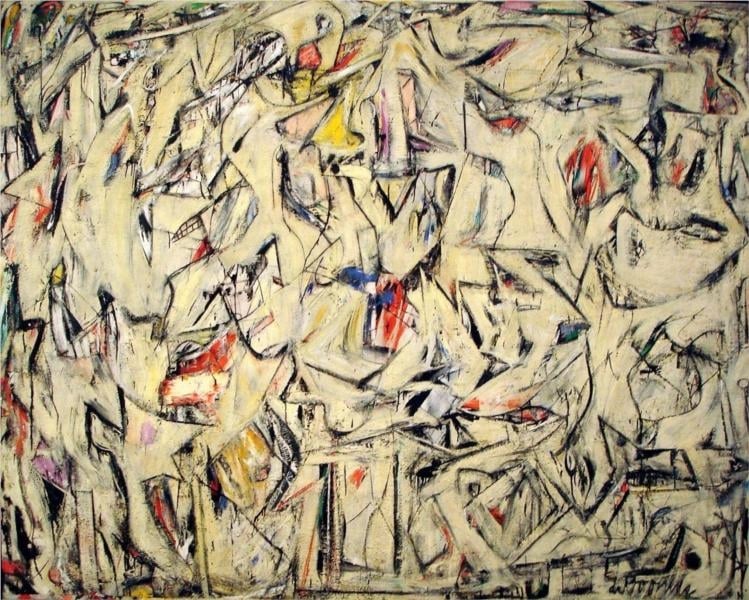
Excavation
Willem de Kooning (1950)
<strong>Excavation</strong> is a 1950 oil-on-canvas by <strong>Willem de Kooning</strong> whose all-over mesh of black, hooked lines rides a chalky, bone-colored ground, flaring with cadmium reds, yellows, and blues. Forms surface—beaklike profiles, teeth, fish, limbs, tool-shapes—then sink back into fragments, staging a <strong>simultaneous making and unmaking</strong> that turns the whole canvas into an active field. The work crystallizes de Kooning’s late-1940s abstractions and foreshadows the Women paintings, marking a pivot in postwar American art <sup>[1]</sup><sup>[3]</sup><sup>[4]</sup>.
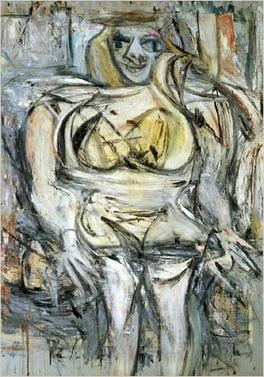
Woman III
Willem de Kooning (1952–53 (often dated 1953))
Woman III stages a face‑off between <strong>figuration and abstraction</strong>: a looming, front‑facing body whose breasts and hips jut forward even as limbs smear into eddies of paint. The mask‑like eyes and toothy grin toggle between <strong>seduction and menace</strong>, while the scraped, turbulent surface asserts painting as a <strong>combat zone</strong> rather than calm depiction <sup>[1]</sup>.
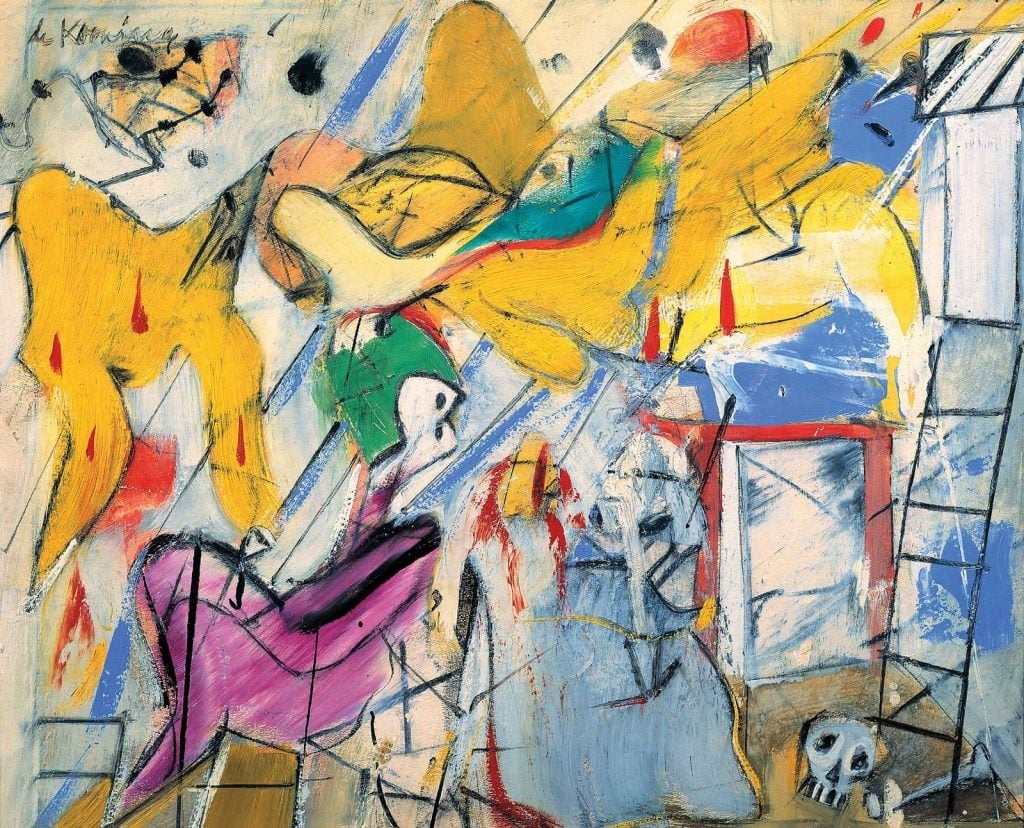
Interchange
Willem de Kooning (1955)
Interchange condenses the city’s churn into an arena of <strong>figure–ground flux</strong>, where mustard yellows, lilac, and sea‑blue collide and are corralled by black, calligraphic lines. De Kooning turns scraping, repainting, and slashing gestures into a living map of <strong>exchange</strong> between flesh and architecture, motion and arrest <sup>[2]</sup><sup>[3]</sup>.
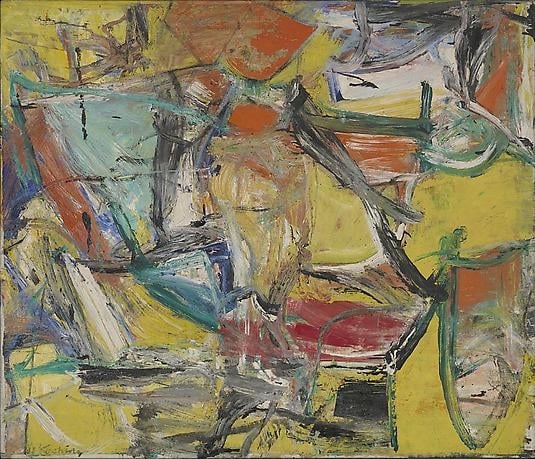
Police Gazette
Willem de Kooning (1955)
<strong>Police Gazette</strong> converts tabloid scandal into a field of charged marks: acidic yellow grounds, slashed blacks, and jolts of teal and coral collide like headlines in motion. De Kooning’s scraped, reworked surface turns the city’s noise into <strong>gesture-as-event</strong>, where half-hinted limbs and curb-like edges surface, then dissolve. As a key mid-1950s canvas, it anchors his shift to the so-called <strong>abstract urban landscapes</strong> within Abstract Expressionism <sup>[1]</sup><sup>[2]</sup>.