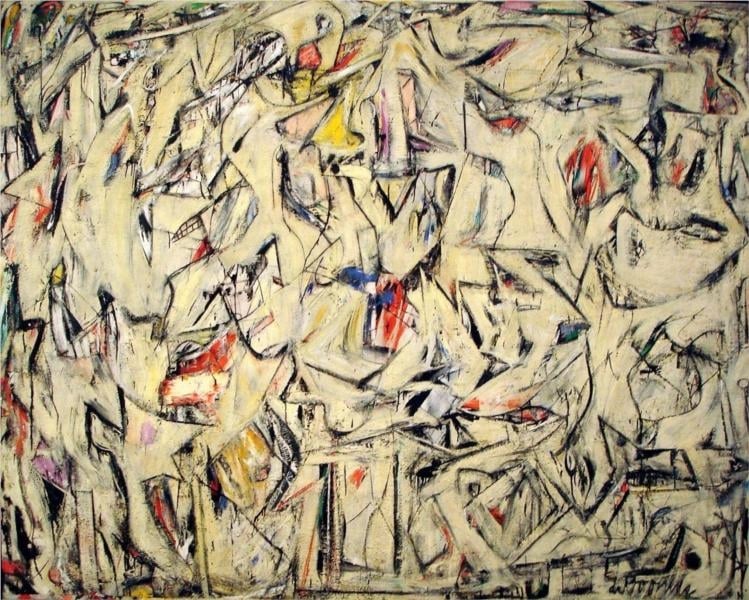
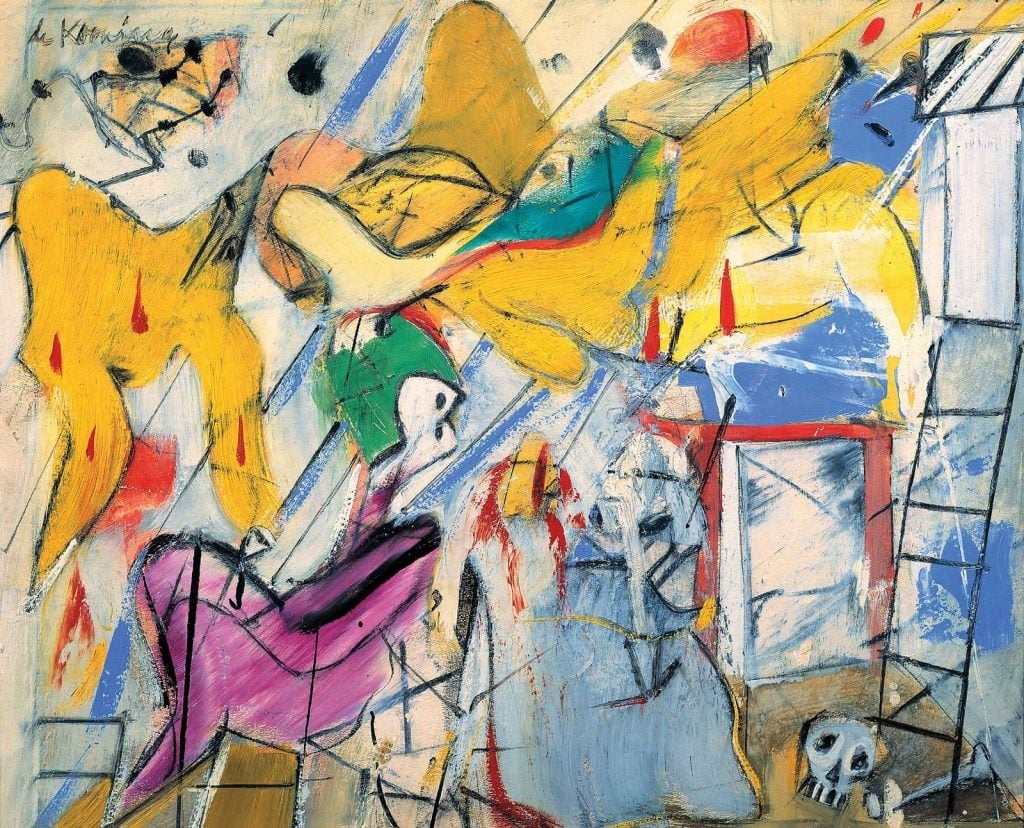
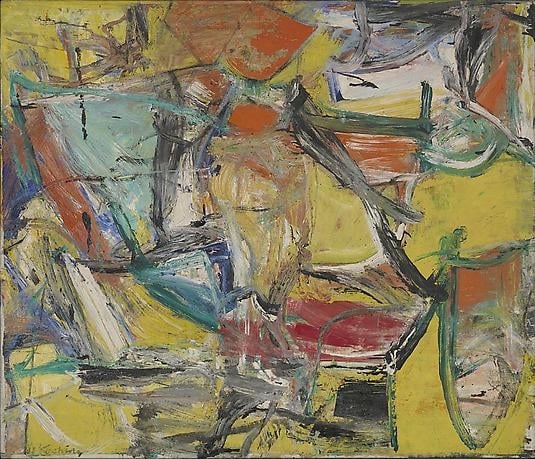
Woman III
Woman III stages a face‑off between figuration and abstraction: a looming, front‑facing body whose breasts and hips jut forward even as limbs smear into eddies of paint. The mask‑like eyes and toothy grin toggle between seduction and menace, while the scraped, turbulent surface asserts painting as a combat zone rather than calm depiction [1].
Study Print Studio
Create a personal study print
Build a companion study sheet around the part of this painting that speaks to you most. Choose a detail, shape an interpretation, and walk away with something personal and display-worthy.
Fast Facts
- Year
- 1952–53 (often dated 1953)
- Medium
- Oil on canvas
- Dimensions
- 172.7 × 123.2 cm (68 × 48.5 in)
- Location
- Private collection (Steven A. Cohen)
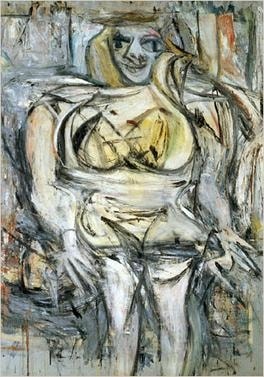
Click on any numbered symbol to learn more about its meaning
Meaning & Symbolism
Across the surface, Woman III refuses a single reading of the female body. The frontal pose, pressed up against the picture plane, evokes idol‑like frontality; the emphatic breasts, braced by looping, armored strokes of cream and ocher, recall the outsized markers of fertility long associated (rightly or not) with prehistoric figurines 13. But the painting immediately unsettles that archetype. The thighs are carved by quick, descending scrapes that shear away contour, and the right hand frays into hooked ribbons, as if the limb were both declared and revoked in the same breath. The face clinches this ambivalence: two oversized, mask‑like eyes and a fixed, tooth‑baring smile sit like pasted emblems in a churn of gray and smoke‑black drag marks. Contemporary accounts and later scholarship tie such eyes and smiles to magazine sources and pin‑up tropes, which de Kooning studied and sometimes collaged in preparatory work; here they read as mass‑culture clichés melted into viscous paint, swinging between invitation and aggression 14. The result is a body assembled from signs that the brush then contests, so that every assertion of form is also a scuffle with it.
That scuffle is literal in the facture. De Kooning reworked these canvases wet‑in‑wet over long durations, scraping back and repainting until the surface reads like a palimpsest of attempts; reports even note his use of added oil to keep passages open, which helps explain the dragged, syrupy look of the grays and the smeared outlines that overrun figure–ground boundaries 18. In Woman III the background never recedes: it crowds forward in the same agitated rhythm, denying the figure any restful niche. Those dirty whites and ash‑gray swathes surge through the torso and limbs, so the woman is not seated in space but suspended in painterly turbulence. This is the canvas as arena—a core Abstract Expressionist premise—where meaning emerges from the visible record of decisions and reversals rather than from a concluded design 14. The painting therefore stages a double bind: figuration is necessary to invoke the cultural image of “woman,” but abstraction is necessary to reveal how unstable—and coercive—that image can be.
The iconography compounds that bind. The breasts and hips project like armor, but they are cross‑cut by darts of line that look more like edits than ornaments; the toothy grin performs desire as performance, a mass‑media smile that cannot quite belong to a living face 134. In mid‑century New York—saturated with advertising and pin‑up imagery yet also gripped by postwar disquiet—such a figure was bound to spark controversy: too monstrous for idealization, too seductive for pure negation. De Kooning leans into that contradiction. By letting the operative marks of painting gouge, blur, and reassemble the body, he exposes the projective fantasies that culture lays upon women and refuses to endorse any single myth, whether goddess or glamour girl 13. That refusal, enacted at monumental scale, is the painting’s ethical and historical charge. Woman III is not a portrait; it is a battleground where the claims of archetype, commerce, and painterly freedom clash—and where viewers must watch the image they expect to see unmade before their eyes 14.
Explore Deeper with AI
Ask questions about Woman III
Popular questions:
Powered by AI • Get instant insights about this artwork
💬 Ask questions about this artwork!
Interpretations
Reception History & Gender Politics
When the Women debuted at Sidney Janis in 1953, the shock wasn’t merely formal—it was a cultural provocation. Formalists like Greenberg balked at the “return” to figure, while Harold Rosenberg reframed de Kooning’s surface as an existential arena of decisions, thereby shifting attention from “what the woman means” to “what painting does” 16. That split set the terms for later gender‑focused readings: some saw misogyny in the toothy, monstrous visage; others argued the painting lays bare the coercive scripts that pin‑ups and classic nudes impose on femininity. The controversy is instructive: Woman III behaves like an X‑ray of mid‑century American culture, where mass‑media desire collided with postwar disquiet—hence the work’s refusal of an ideal, its push‑pull between seduction and threat 14.
Source: MoMA; Willem de Kooning Foundation; Washington Post
Appropriation & Mass Media
De Kooning’s studies for the Women involved literally collaging magazine smiles; in Woman III those grins and eyes are liquefied into paint, turning commercial motifs into unstable signs 2. Read through the lens of appropriation, the picture imports pin‑up and ad clichés only to corrode them, interrogating authorship and the originality myth central to Abstract Expressionism. The result is a feedback loop: mass‑culture images of women enter “high art,” but the medium answers back by mangling legibility and agency. Recent historiography urges weighting these popular sources over speculative “archaic goddess” analogies, which can re‑essentialize the female body; de Kooning’s target is nearer at hand—the postwar image economy itself and its scripted, toothy smile 13.
Source: MoMA; MDPI Arts (historiography on pin‑up vs. icon)
Process, Materiality, and Time
Woman III’s surface is a palimpsest of revision: wet‑in‑wet layers dragged, scraped, and repainted over long spells. Accounts even note de Kooning adding oil (the infamous “salad oil” story) to keep passages open, producing those syrupy grays and smeared contours that refuse stable edges 5. This is medium reflexivity at work—process made visible as subject. The paint’s rheology becomes metaphor: viscosity equals resistance; scraping equals negation; re‑painting equals insistence. In this temporal drama, figural “facts” (breasts, grin, eyes) appear, are attacked, and reassert themselves, so the figure exists as a record of choices rather than a finished depiction. Meaning, here, is not illustrated; it coagulates in the residue of decisions 15.
Source: Los Angeles Times; MoMA
Geopolitics, Censorship, and the Female Image
Woman III’s post‑1979 life in Iran turns the canvas into a case study of image politics. At Tehran’s Museum of Contemporary Art, it went unexhibited after the revolution due to restrictions on figural/erotic imagery; in 1994, it left Iran in a high‑profile swap for pages from the Shahnameh of Shah Tahmasp—an exchange literally trading a modern female nude for a national epic 78. This trajectory reframes the painting as a site where gendered representation, religious policy, and cultural patrimony collide. The work’s later sale into a U.S. private collection underscores how contested images of women circulate through power structures—state, market, and museum—amplifying the painting’s own critique of ideological images 789.
Source: The Independent; El País; New York Times
Series Comparison: Tonality, Space, and Pressure
Compared with the chromatic punch of Woman I, Woman III leans into ashy whites and smoke‑grays, tightening spatial pressure so background and body grind in the same key 1. This compression differs from the more open, bicycle‑framed play of Woman and Bicycle (Whitney), where color and line ventilate the field. In Woman III, the grays surge through the torso, creating a low‑contrast battlefield where figure–ground bleed intensifies the sense that the body is being made and unmade in real time. The tonal register isn’t just mood; it’s an armature for de Kooning’s argument that no stable niche—no pictorial pedestal—remains for the modern nude 110.
Source: MoMA; Whitney Museum of American Art
Psychoanalytic Lens: Desire and Threat
The hybrid of invitation and aggression—oversized eyes, rictus teeth, armoring strokes over breasts—aligns the work with theories of the “monstrous feminine,” where desire’s object is simultaneously abject and enthralling. Read alongside postwar bodies “under abstraction,” Woman III figures the female as a site where libido, fear, and cultural scripting condense into unstable form 11. De Kooning’s incessant reworking literalizes ambivalence: the body is produced by the very marks that undo it. Rather than psychologizing the artist, this lens treats the image as a cultural symptom, registering anxieties about sexuality and control in a media‑saturated milieu that demands the smile even as it dreads its power 411.
Source: Art History (Oxford University Press); Washington Post
Related Themes
About Willem de Kooning
Willem de Kooning (1904–1997), a Dutch‑American leader of Abstract Expressionism, moved between abstraction and figuration, treating painting as an arena of active decision. The Woman paintings (1950–53) became a flashpoint for debates about modernism, mass culture, and the female image, culminating in the 1953 Sidney Janis Gallery show [1][2].
View all works by Willem de Kooning →