Police Gazette

by Willem de Kooning

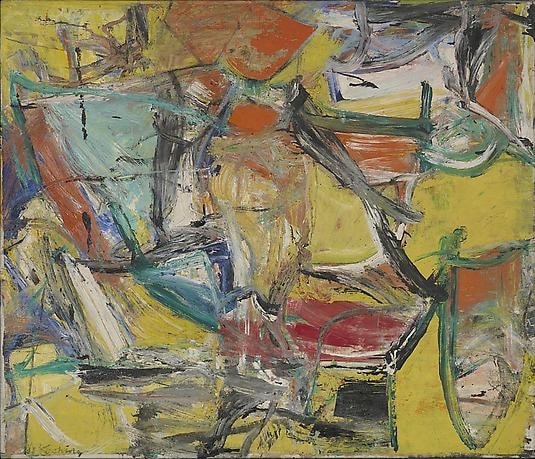
Police Gazette converts tabloid scandal into a field of charged marks: acidic yellow grounds, slashed blacks, and jolts of teal and coral collide like headlines in motion. De Kooning’s scraped, reworked surface turns the city’s noise into gesture-as-event, where half-hinted limbs and curb-like edges surface, then dissolve. As a key mid-1950s canvas, it anchors his shift to the so-called abstract urban landscapes within Abstract Expressionism [1][2].

Study Print Studio

Create a personal study print

Build a companion study sheet around the part of this painting that speaks to you most. Choose a detail, shape an interpretation, and walk away with something personal and display-worthy.

Fast Facts

Year
1955
Medium
Oil, enamel, and charcoal on canvas
Dimensions
109.9 x 127.6 cm (43 1/4 x 50 1/4 in.)
Location
Private collection
Police Gazette by Willem de Kooning (1955) featuring Acidic yellow ground, Black slashes/bars, Angled teal band, Coral/orange wedge

Click on any numbered symbol to learn more about its meaning

Meaning & Symbolism

Police Gazette asserts that meaning can be built from impact, not illustration. The canvas’s broad yellow ground functions as an urban glare—like sodium-lit pavement—against which de Kooning drags and slashes blacks that read as barricades or newsprint rules. A teal band angles across the left-center like a tilted avenue; a coral wedge and adjacent orange flare punch in near the crown of the composition, the way a tabloid kicker overrides a column’s logic. These forms do not depict streets or headlines; they perform them. The dragged grays and charcoal ridges accumulate like palimpsests of incident, each scrape reopening the surface and then suturing it with a contrary stroke. Even the crimson arc low-right, hemmed by a black bracket, behaves like a curb or booth edge glimpsed in motion—an interval of recognition quickly overwritten by the next surge of paint. De Kooning’s method—drawing into paint, then scraping back—yields a visible record of thinking and retracting that models the city’s churn: decisions made, rescinded, and made again in the same instant 15. This is why the title matters. Police Gazette taps a well-known lexicon of crime sheets and lurid broadsides, channeling the sensational tone without illustrating a crime scene 2. In mid‑1950s works often grouped as abstract urban landscapes, critics noted how de Kooning metabolized signage, crowds, and headlines into elastic pictorial structure 23. Here, the black diagonal bars interrupt yellow fields with the authority of police tape; the scumbled teal blocks and coral slashes spark like neon over asphalt. Yet the painting’s crucial drama is not urban description but action: the canvas as an arena where each mark risks the previous one, aligning with Harold Rosenberg’s premise that an Abstract Expressionist picture is an event rather than a static image 4. The scraped passages that expose underlayers confirm that time is the true protagonist—impact, revision, and residue—so that what we read as “elbowing limbs” or a “doorway” are momentary consolidations in a stream of acts. In this sense, the meaning of Police Gazette is modernity’s narrative ground state: flashes, ruptures, frictions across the surface of attention. Why Police Gazette is important follows from that achievement. It sits at the hinge of de Kooning’s post‑Woman turn, showing how figure/ground oscillation can sustain urban metaphor without surrendering to depiction 15. Sister canvases like Gotham News and Easter Monday similarly admit the city and its media into painting’s grammar—sometimes literally via newspaper transfers in those works—establishing a family resemblance that confirms the media‑city nexus of the period 36. Police Gazette, though, needs no embedded text; its syntax of collision—oblique blacks, neonlike color jolts, exposed scrapes—does the cultural work. It asserts a model of painting where meaning is not housed in icons but in procedures that analogize contemporary life: interruption, amplification, erasure, restart. That wager helped codify Abstract Expressionism’s late, urban register and remains a touchstone for how painting can translate media spectacle into embodied form 245.

Explore Deeper with AI

Ask questions about Police Gazette

Popular questions:

Powered by AI • Get instant insights about this artwork

💬 Ask questions about this artwork!

Interpretations

Urban Spatial Logic

Critics note that de Kooning’s mid‑50s abstractions stage a melodrama of slashing strokes and colors evocative of postwar New York’s crowded intensity. In Police Gazette the tilted teal band, coral wedge, and black diagonals act like avenues, neon, and barriers—not as depictions but as operational cues that perform street movement. The picture organizes perception like a city block seen in a glance: abrupt occlusions, flare‑ups of signal color, and hard stops that redirect the gaze. That urban semiotics—interrupt, accelerate, detour—structures the composition and invites a kinetic read consonant with MoMA’s and Elderfield’s framing of the period 78.

Source: MoMA (John Elderfield); The New Yorker

Law, Order, and the Image of Control

The work’s bar‑like blacks that “interrupt yellow fields with the authority of police tape” inflect abstraction with a politics of viewing: lines act as interdictions, cordoning off zones of attention the way crime‑scene tape polices a crowd. Coupled with the tabloid title, these formal commands evoke the rhetoric of authority—halt, look, move on—embedded in urban media culture. This reading aligns with period titles that court film‑noir and detective pulp, where visibility is contested and access regulated. In Police Gazette, authority is enacted as compositional pressure rather than iconography, a cultural force translated into pictorial stop‑and‑go 2.

Source: Kemper Art Museum

Historical Context

Police Gazette emerges at a hinge moment after the Woman paintings, when de Kooning redirected figural volatility into large abstractions critics grouped as “abstract urban landscapes.” Titles like Police Gazette, Easter Monday, and Gotham News signal a conscious traffic with tabloids, noir, and street life, importing mass‑culture cues without literalizing them. This pivot consolidated his Rotterdam‑honed draftsmanship into a New York register of slashing strokes and chromatic jolts that metabolize the city’s media noise. The National Gallery’s retrospective and subsequent teaching texts clarify how this period reframed figure/ground as an urban metaphor—less about bodies than about the swarm of headlines, signage, and motion coursing through postwar Manhattan’s visual field 25.

Source: Kemper Art Museum; National Gallery of Art

Process/Technique as Time

De Kooning’s method—drawing into wet paint, scraping back, then reasserting new strokes—renders the surface a ledger of decisions. This aligns precisely with Harold Rosenberg’s formulation of the canvas as an arena of action, where meaning resides in acts and their residues rather than in depicted motifs. In Police Gazette the exposed underlayers, charcoal ridges, and enamel skids become temporal indices: gestures appear, are rescinded, and survive as ghosts. Such revisionary buildup makes “time the true protagonist,” converting facture into a narrative of hesitation and surge. The result is not an image of the city but a time‑based process that analogizes urban contingency—impact, erasure, restart—inscribed directly in the medium 451.

Source: Harold Rosenberg; National Gallery of Art; The Willem de Kooning Foundation

Media Culture & Tabloid Semantics

The title channels the sensational aura of the National Police Gazette and related pulp forms, cueing viewers to read the painting’s collisions as media‑charged rather than purely formal. Sister works from 1955–56, such as Gotham News and Easter Monday, even carry faint newspaper transfers, literalizing the seep of print into paint; Police Gazette achieves a similar effect syntactically—through oblique bars, kicker‑like color bursts, and scumbled blocks that behave like headlines and rules. This is not illustration but a transposition of tabloid cadence into painterly grammar, a way of making media spectacle palpable as rhythm and pressure on the eye 236.

Source: Kemper Art Museum; Buffalo AKG; The Met

Figure/Ground Oscillation After the Woman Series

Even as overt figuration recedes, de Kooning preserves a figure/ground oscillation that keeps recognition unstable—what the NGA described as “drawing‑in‑paint” now applied to metropolitan matter. Edge‑like brackets, curving arcs, and limb‑suggestive fragments flare up and dissolve, recalling the Woman pictures’ volatility while relocating it to streets, signage, and thresholds. This toggling sustains tension between embodied trace and urban fabric, ensuring that the painting reads neither as pure all‑overness nor as discrete objects, but as a living argument about how forms come to presence and slip away in modern life 57.

Source: National Gallery of Art; The New Yorker

Related Themes

About Willem de Kooning

Willem de Kooning (1904–1997), a Dutch‑American leader of Abstract Expressionism, moved between abstraction and figuration, treating painting as an arena of active decision. The Woman paintings (1950–53) became a flashpoint for debates about modernism, mass culture, and the female image, culminating in the 1953 Sidney Janis Gallery show [1][2].
View all works by Willem de Kooning

More by Willem de Kooning