Flux or Order? How Two Moderns Program the Eye
Both artists make modern seeing the subject: how light, weather, and engineered settings shape what the eye can know. Pissarro’s 1897 boulevard series and Seurat’s divisionist canvases elevate ordinary Paris into staged laboratories of perception. The kinship is real, yet their aims diverge—Pissarro builds a democratic register of flux; Seurat constructs images to be read as harmonies.
Comparison frame: How do Pissarro’s serial city views and Seurat’s divisionist tableaux ask our eyes to construct modern experience—one as flux to be felt, the other as order to be read?
Quick Comparison
| Topic | Camille Pissarro | Georges Seurat |
|---|---|---|
| What painting is for | A register of flux that folds people and infrastructure into a shared, time-based field | A constructed instrument that stabilizes experience into a readable, designed whole |
| How the eye must work | Aggregate micro-variations—temperature shifts, reflections, traffic rhythms—into a lived moment | Synthesize a planned totality—spaced figures, axial symmetries, divided color—into stable harmony |
| Preferred setup | Fixed, elevated vantages used serially (Grand Hôtel de Russie, 1897) | Frontal, proscenium-like stages and classicizing friezes after extensive studies |
| Light as structure | Differentiates arc lamps, gaslight, cab lamps; wet stone multiplies effects | Calibrated gaslit bands and optical contrasts determine order and mood |
| Touch/technique | Supple, broken strokes; keeps lessons from Neo‑Impressionism without a fixed grid | Divisionist method; optical mixture and measured points/patches govern the image |
| Figure and crowd | Anonymized crowds counted by strokes—flow over portraiture | Typified, spaced figures—regulated access and posed stillness |
| Institutional arc | Impressionist exhibitor in all eight shows; opens space for Neo‑Impressionists | Bathers rejected by the Salon (1884), shown at the Independents; Sideshow at the 1888 Independents |
Shared Ground
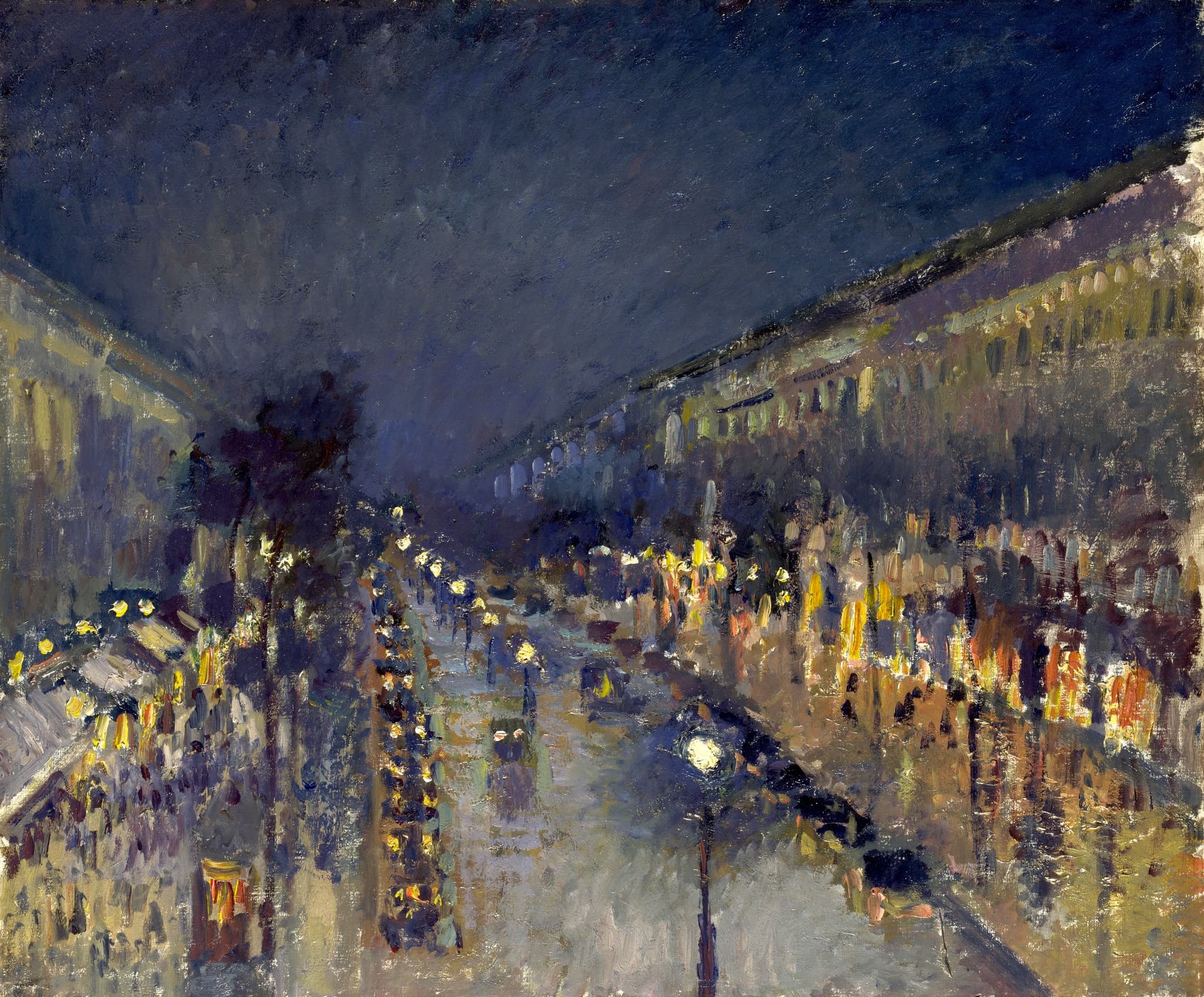
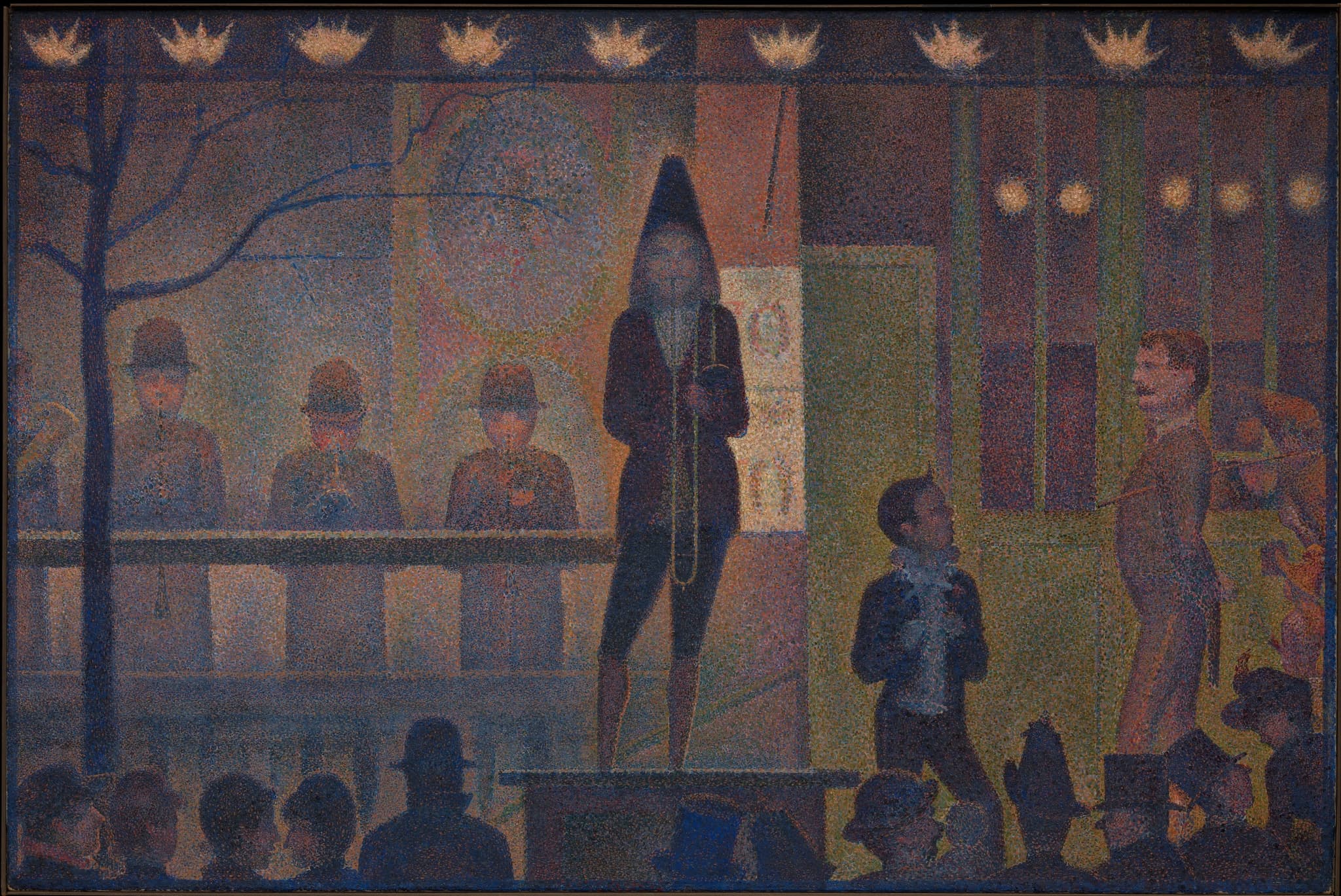
Both painters turn modern perception into a subject in its own right. Pissarro’s 1897 boulevard campaign, made from a hotel window, tests how different technologies of light—electric arc lamps strung down the center, warm shopfront gaslight, cab headlamps—reconfigure the city at various hours and weathers. Seurat, in works from Bathers at Asnières to Circus Sideshow (Parade de cirque), builds images whose organization and atmosphere are literally conditioned by illumination and calibrated color contrasts. Each makes the ordinary consequential: a weekday crowd on the Boulevard Montmartre; workers at leisure on a suburban bank; a fairground teaser under gas jets. Scale, planning, and a cool refusal of anecdote elevate these scenes from passing views to modern monuments.
Methods align even as moods differ. Pissarro’s serial, fixed-vantage projects are rigorous viewing machines: one motif multiplied across times and seasons so the eye experiences change as structure. Seurat’s practice is comparably engineered—intensive drawings and oil sketches test geometry, intervals between figures, and night effects before large canvases. Both treat optics as craft. Pissarro keeps Neo‑Impressionist lessons about optical mixture even after he lets go of a strict pointillist grid; Seurat systematizes color contrast so mood and order are governed by hue. In short, both artists design how we look at modern life—Pissarro by staging a continuum of sensation, Seurat by constructing a measured tableau—while using light and color as the operative tools.
Decisive Difference
The decisive split is what painting is for. For Pissarro, it is an empirical register of flux. From his high Paris window, the city reads as a circulating field where individuals, vehicles, facades, and weather share one currency of touch. In Boulevard Montmartre at Night, a cool bead-chain of electric lamps counters the buttery pools of gaslit vitrines; rain-slick stone doubles both into reflections so movement and atmosphere are inseparable. Brushwork stays supple, letting edges fray like night itself; identity yields to tempo. Even when he learned from Divisionism, Pissarro ultimately loosened the grid so that perception could remain time-based and democratic—aggregation over enforcement, flow over pose.
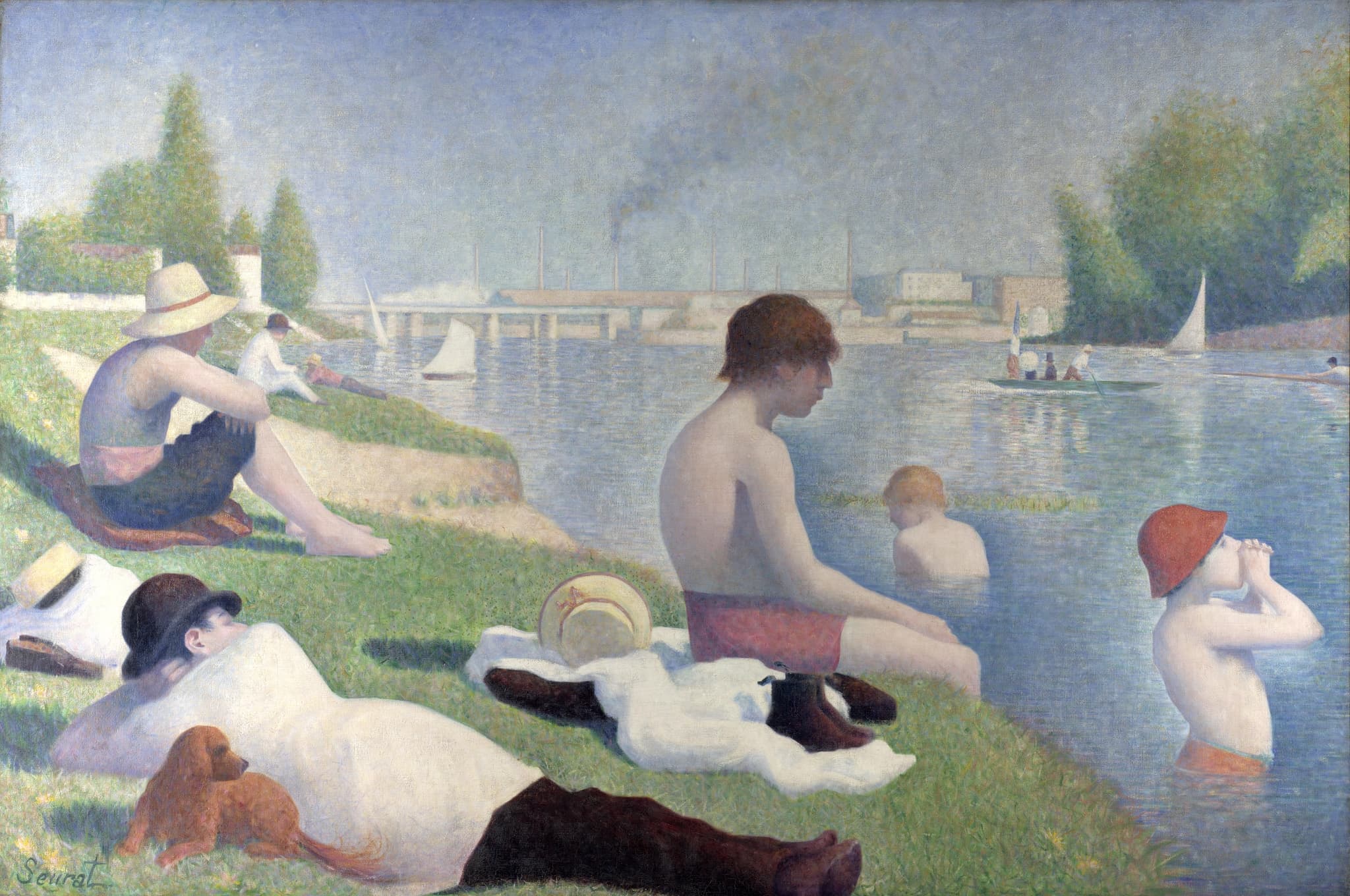
For Seurat, painting is a constructed instrument. Composition, pose, and divided color make contingent scenes legible as designed harmonies. Bathers at Asnières freezes working-class leisure into a classicizing frieze: profiles, measured spacing, and a unified haze give ordinary bodies monumental stillness against bridges and chimneys. Circus Sideshow turns publicity into a rite: a row of nine gas jets crowns the platform; band, barker, and railings lock viewers at a threshold; optical mixture hums without releasing into bustle. The eye is asked to synthesize a planned order—figures as intervals, color as a rule-set, access as choreography. Where Pissarro’s hotel window absorbs you into a stream, Seurat’s proscenium regulates your approach. The difference is fundamental: perception as flow versus perception as construction.
Paired Works
Night: flow vs threshold
Focus question: How does artificial light remake public space and spectatorship at night?
Boulevard Montmartre at Night vs Circus Sideshow (Parade de cirque)
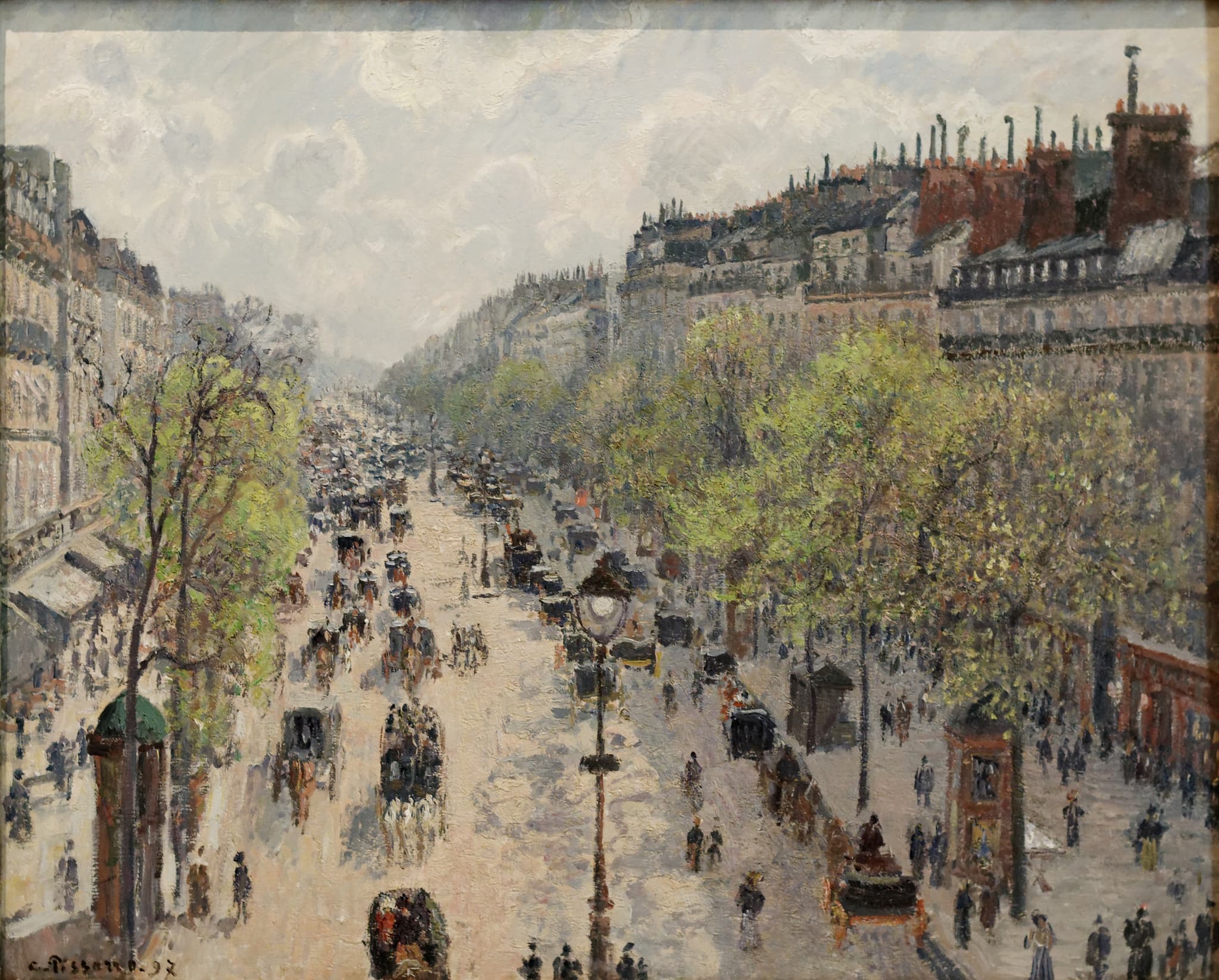
Leisure engineered
Focus question: How do they stage modern leisure within designed settings?
The Boulevard Montmartre on a Spring Morning vs Bathers at Asnières
Ordinary life, two ethics
Focus question: What kind of dignity do they give to the everyday and the working classes?
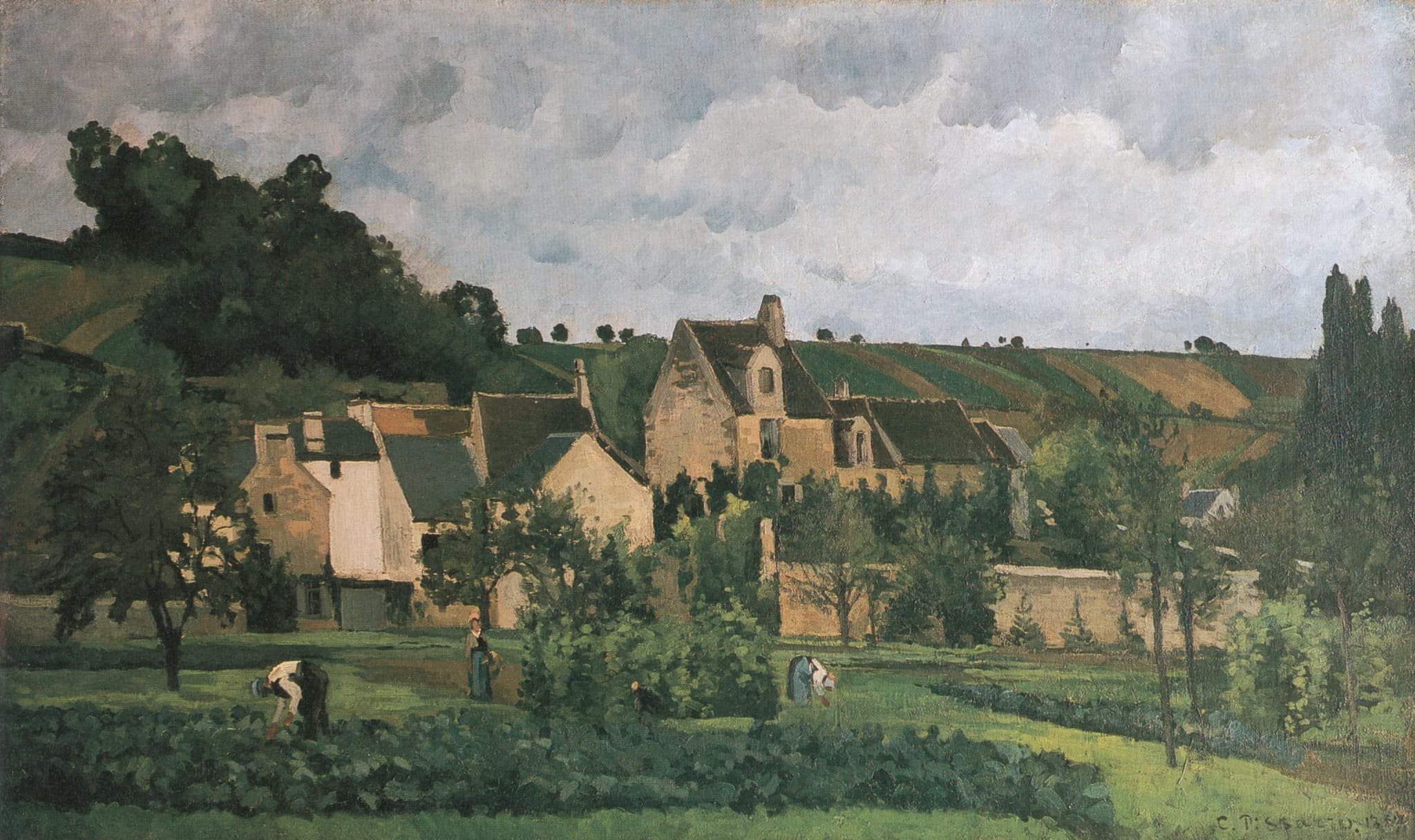
The Hermitage at Pontoise vs Bathers at Asnières
Why This Comparison Matters
These two models of modern vision still shape how images govern our attention. Pissarro proposes a way to see complex systems—streets, weather, crowds—as shared experience in time; the eye gathers fragments into a felt whole. Seurat proposes a counter-model: experience made legible by design, where spacing, symmetry, and calibrated color choreograph how we look. Recognizing the difference clarifies why a boulevard can feel like a river, or why a sideshow can read like a rite. It also explains later art: serial city views, data-like mappings of light, and, conversely, image-worlds that regulate spectatorship by grids and thresholds. In both cases, everyday life is sufficient material for grand art; the choice is whether to honor its motion or to build its order.
Related Links
Sources
- National Gallery, London – Camille Pissarro, The Boulevard Montmartre at Night
- National Gallery, London – Georges Seurat, Bathers at Asnières
- The Metropolitan Museum of Art – Circus Sideshow (Parade de cirque)
- The Met – Seurat’s Circus Sideshow (2017) publication
- National Gallery Technical Bulletin – Seurat: Theory, Development and Technology
- Britannica – The eight Impressionist exhibitions
- Art Institute of Chicago – Pissarro: Paintings and Works on Paper (Digital Scholarly Catalogue)
- Smarthistory – Neo‑Impressionist color theory
- Ashmolean Museum – Pissarro exhibition press release (practice after Divisionism)