Presence or attention?
Both painters make vision the subject. Van Eyck treats description as a public act that certifies presence; Vermeer uses it to stage concentrated, time‑bound looking. The result is two convincing contracts with the eye that still shape how we trust images.
Comparison frame: How do Van Eyck and Vermeer turn seeing into proof—one through witnessed presence, the other through disciplined attention?
Quick Comparison
| Topic | Jan van Eyck | Johannes Vermeer |
|---|---|---|
| What description certifies | Witnessed presence: a moment guaranteed by inscription and mirror | Disciplined attention: meaning formed by selective, time‑bound seeing |
| Focus strategy | Panoptic clarity—hair to brass equally resolved | Selective focus—cone of clarity with softened periphery |
| Viewer’s role | Witness invited inside the scene (convex mirror; “fuit hic”) | Beholder guided by light and simplification |
| Authorship signal | Performs presence: wall‑signature; motto “Als Ich Can” | Effaces self: painter turned away in The Art of Painting |
| Treatment of props | Enumerated textures as truth‑tokens; symbolic additions intensify presence | Edited stage; elements painted out to purify attention |
| Light’s job | Certifies matter and sanctifies space via luminous oil glazes | Architects attention; measures time and calm |
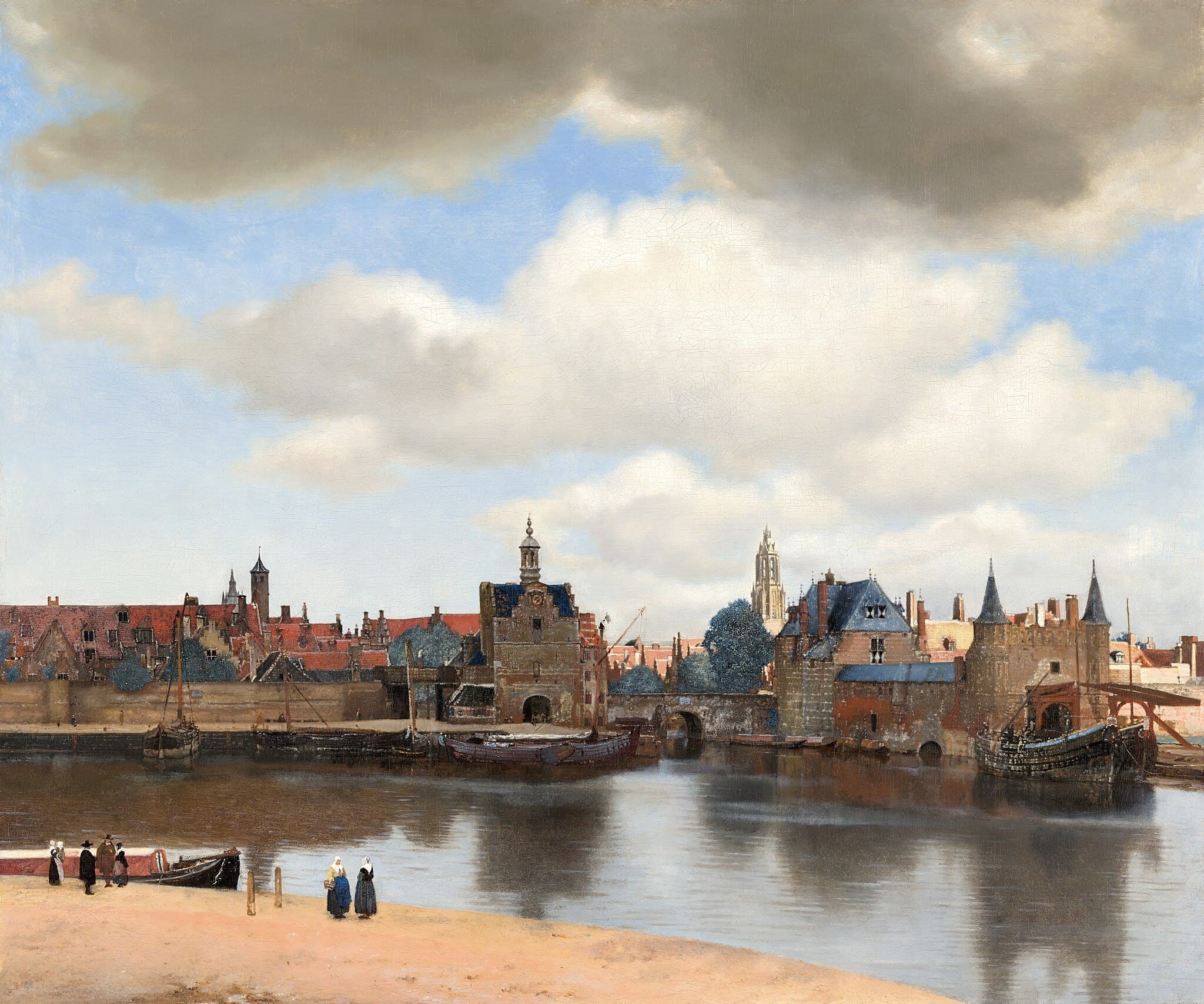
| City as idea | Sacred–civic continuum under ideal light (Rolin) | Civic poise and resilience in measured daylight (View of Delft) |
| Attitude to time | Enduring, notarized moment | Lived instant sharpened by looking |
Shared Ground
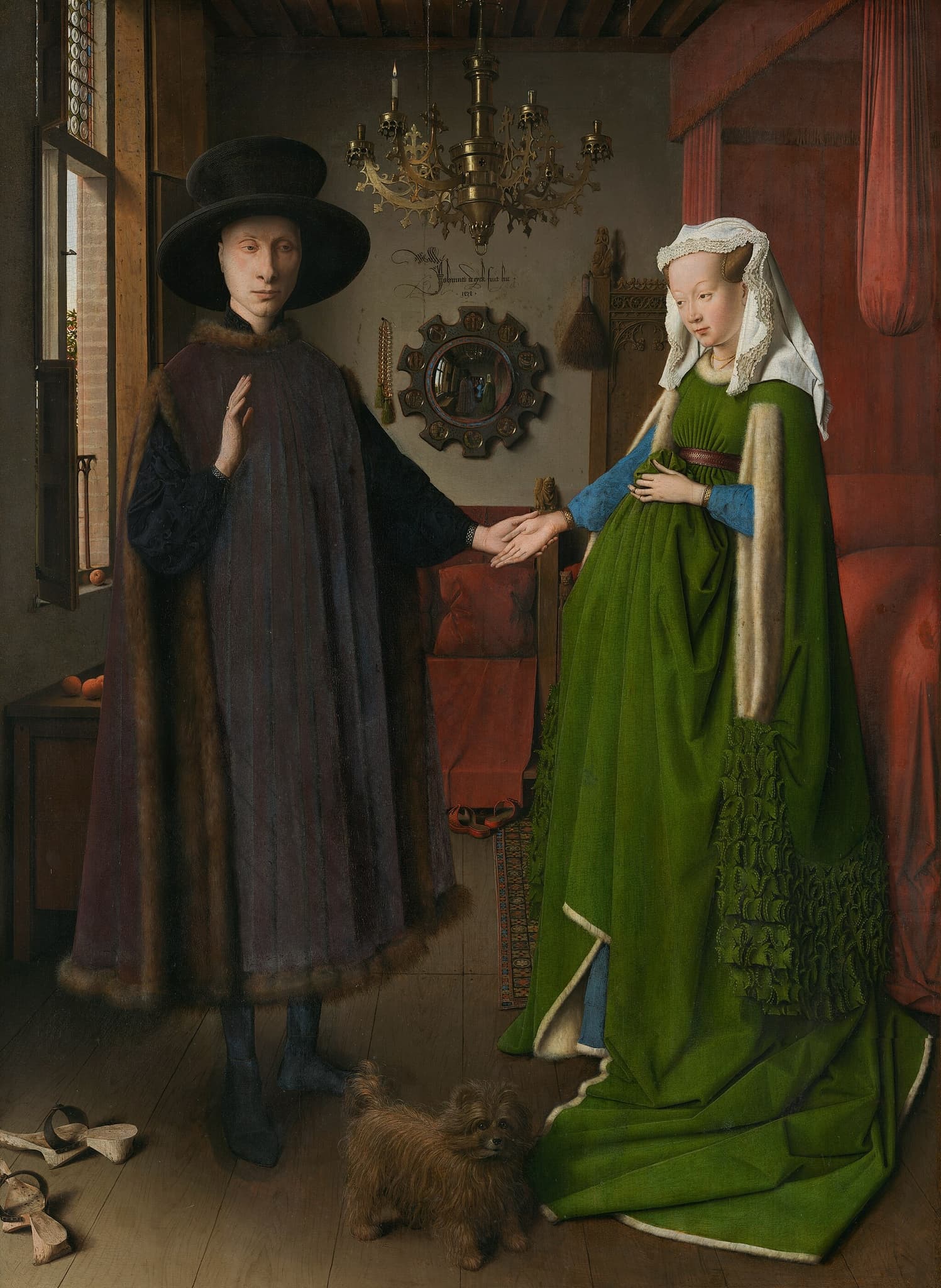
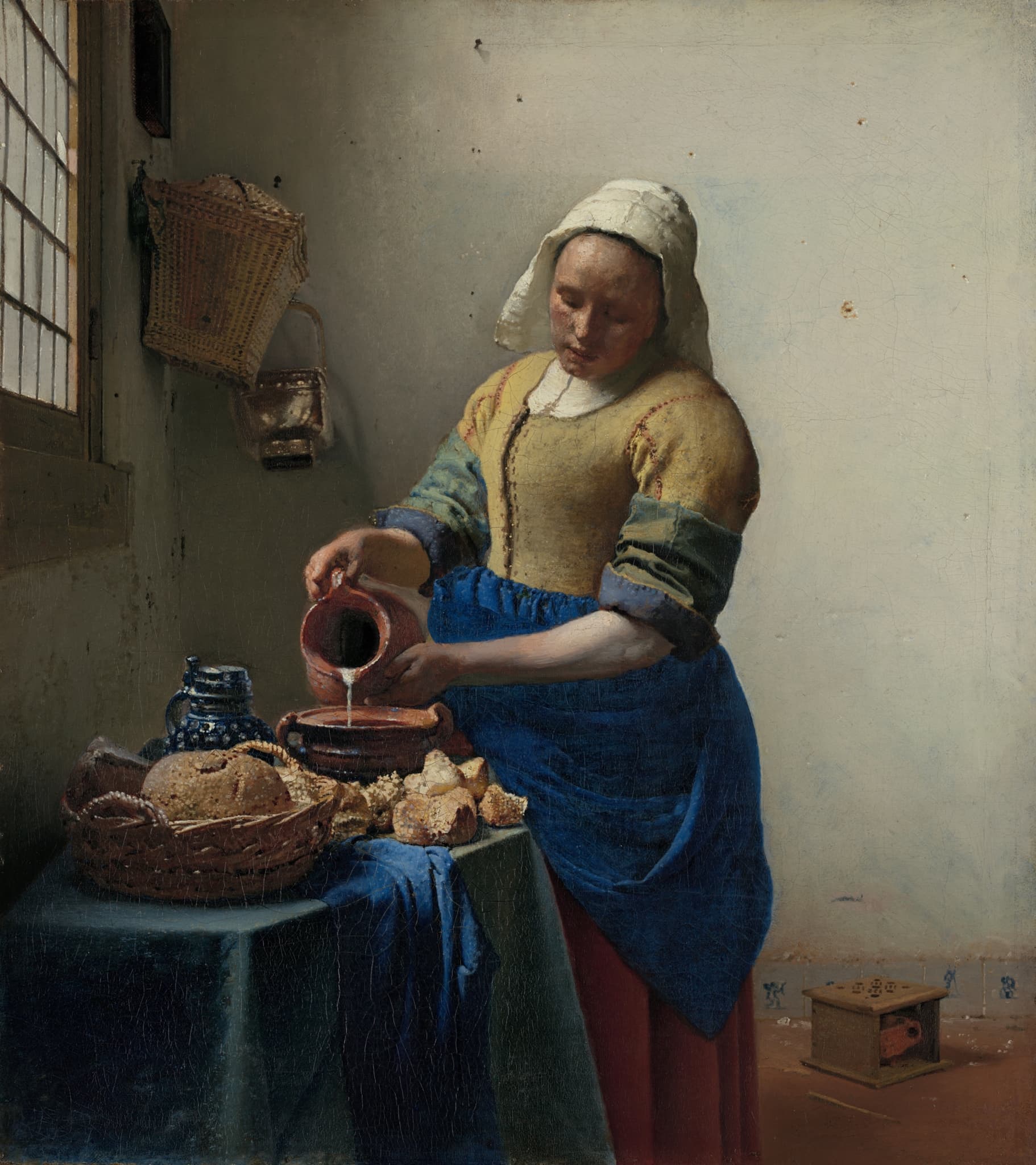
Jan van Eyck and Johannes Vermeer share a central problem: how can paint make looking feel like truth? Both turn vision itself into subject matter. Van Eyck orchestrates rooms where every surface—glass, fur, brass, rosary beads—reads crisply and carries moral weight. In The Arnolfini Portrait, a convex mirror centers the act of beholding, while the wall inscription, “Johannes de eyck fuit hic 1434,” stages the painter’s presence inside the scene. Vermeer builds interiors that discipline attention with calibrated geometry, left‑hand light, and pared‑down props. In The Milkmaid, a narrow stage, the measured thread of pouring milk, and the small foot warmer and Cupid tile focus the room’s meaning without grand allegory.
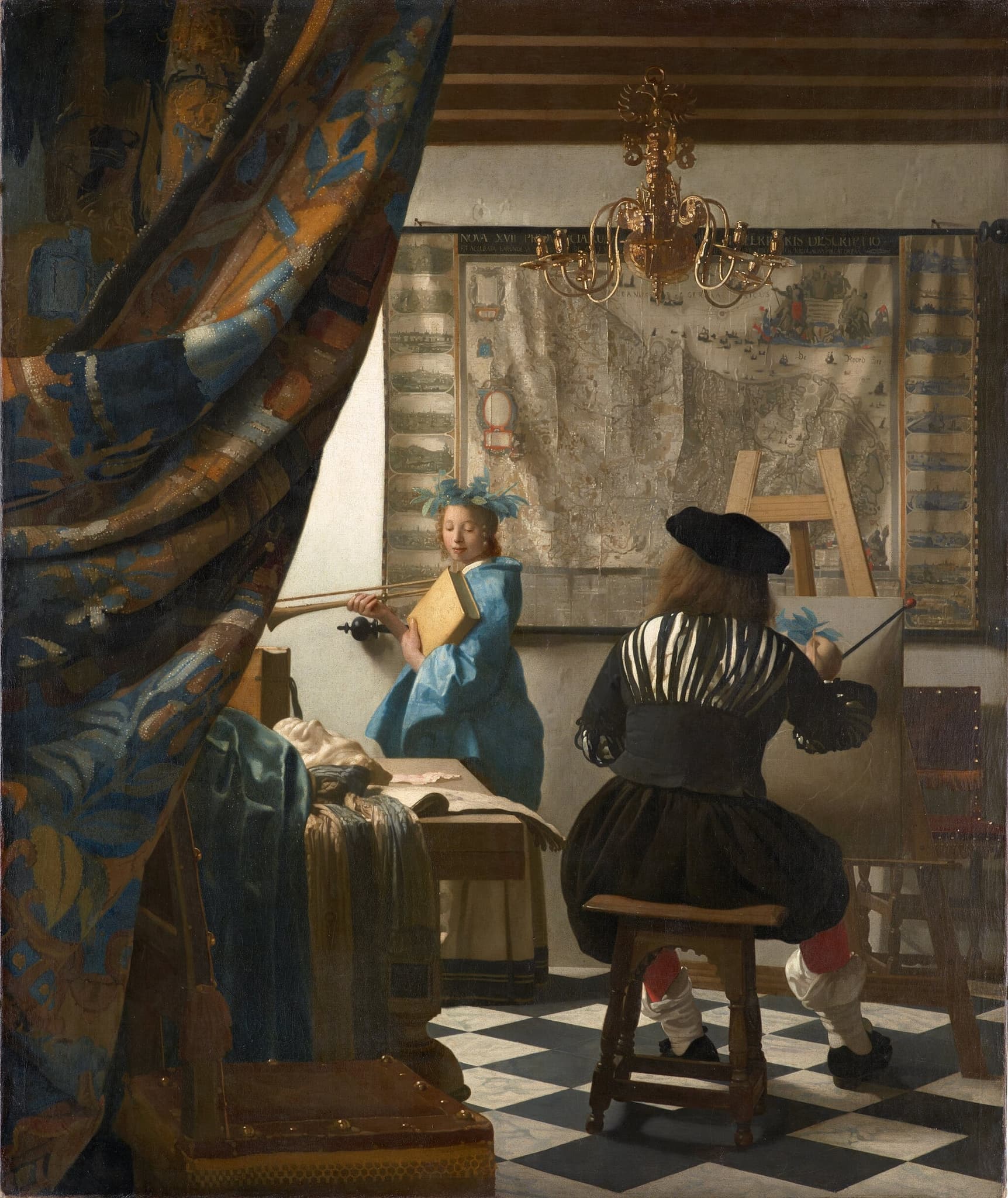
Both artists fold factual things into systems of sense. Van Eyck can insert salvation history directly into a bourgeois chamber—tiny Passion roundels encircle Arnolfini’s mirror—so domestic order sits under sacred time. Vermeer raises everyday order to ethical clarity: bread crusts, a Delft jug, or point‑highlights on tiles become proofs of work and care. Each is also reflexive about painting’s status. Van Eyck writes himself “into” the room and positions the viewer where a witness would stand. Vermeer’s The Art of Painting lifts a curtain like a proscenium and sets Clio and a national map in the studio, claiming for painting the work of memory and history. In both hands, optics and staging are not tricks; they are arguments about how images make meaning.
Decisive Difference
Their decisive split lies in what description is asked to guarantee. For van Eyck, description certifies presence—near‑legal, devotional, and public. Panoptic focus tallies surfaces as if each were a token of truth. The convex mirror folds viewers inside the event; the audacious “was here” signature asserts the artist’s physical presence. Even when technical imaging shows late additions in Arnolfini, the changes intensify the fiction of witnessed reality. Vision, in this model, guarantees truth by showing everything and by anchoring that seeing to an author who stands as witness.
For Vermeer, description certifies attention—private, time‑bound, and constructed. He privileges a cone of clarity over equal focus and lets edges soften. Imaging of The Milkmaid confirms that he removed wall clutter and a larger basket to purify the act of looking; light and reduction teach us what to notice. In The Art of Painting, the painter’s face is withheld even as he claims painting’s reach into history. The beholder is asked to share a disciplined gaze rather than to ratify a public act. Where van Eyck says, in effect, “I was here,” Vermeer says, “look here.” The difference is not technical but philosophical: presence versus attention, certification versus discovery, a witnessed contract versus a cultivated habit of seeing.
Paired Works
Two rooms, two proofs of seeing
Focus question: In a domestic interior, does sight certify an event or train attention?
The Arnolfini Portrait vs The Milkmaid
Horizon of order: sacred loggia vs civic quay
Focus question: How does a city view organize moral order?
Madonna of Chancellor Rolin vs View of Delft
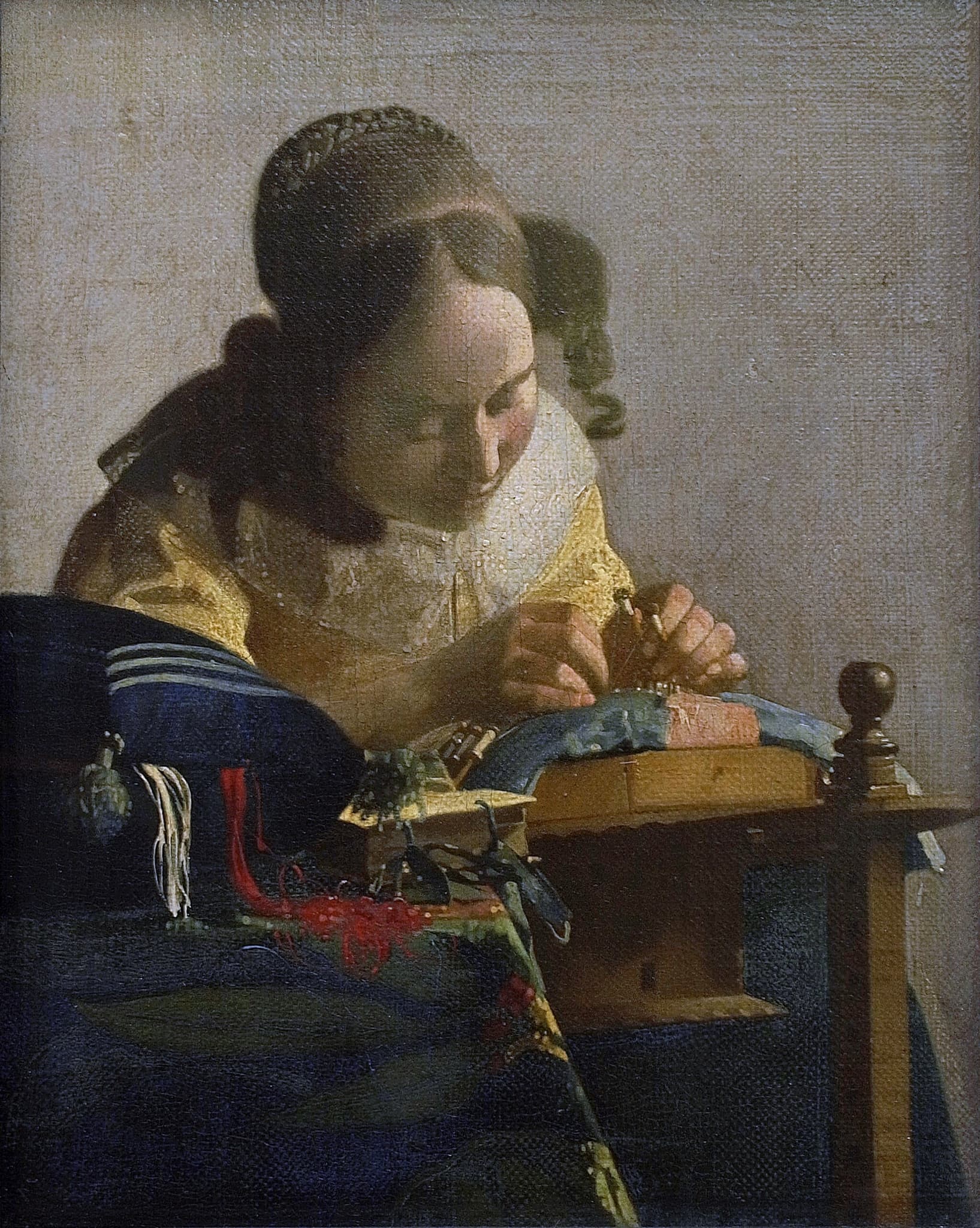
Miniature persuasion
Focus question: At small scale, what kind of clarity persuades?
Portrait of a Man (Self Portrait?) vs The Embroiderer
How painting asserts itself
Focus question: Does painting notarize presence or claim history?
The Arnolfini Portrait vs The Art of Painting
Why This Comparison Matters
These painters model two durable ways pictures earn trust. Van Eyck’s contract is public and declarative: show everything, fix the witness inside the image, and let material truth—fur, brass, glass—stand as a guarantee. Vermeer’s contract is interior and disciplined: reduce, light, and focus until the world’s sense emerges without noise. The first reassures by certification; the second convinces by training perception.
That difference still maps how images persuade us, from documentary photographs to carefully edited feeds. Presence promises “it happened, and I was there.” Attention says “look here; this is what matters.” Seeing how Van Eyck and Vermeer build those claims—mirror and signature versus cone of clarity and edited stages—gives a practical grammar for judging pictures today: what is being guaranteed, and by what means?
Related Links
Sources
- National Gallery, London: The Arnolfini Portrait
- National Gallery Technical Bulletin: IRR on Arnolfini
- The Met: Johannes Vermeer (1632–1675) overview
- Rijksmuseum: Imaging discoveries on The Milkmaid
- Kunsthistorisches Museum: Vermeer, The Art of Painting
- Mauritshuis: Vermeer, View of Delft
- Louvre Collections: Vermeer, The Lacemaker
- National Gallery: Van Eyck, Portrait of a Man (Self Portrait?)
- Closer to Van Eyck (technical project)