Seeing as remembrance vs seeing as a test
Both artists keep the world legible and then insert one precise break that changes how we look. For Chagall, that break folds memory, ritual, and place into a single living scene. For Magritte, it blocks or contradicts what seems obvious to expose the gap between what we see and what we know. The result is painting as communion (Chagall) versus painting as proposition (Magritte).
Comparison frame: How does Chagall turn seeing into remembrance and Magritte turn seeing into a problem?
Quick Comparison
| Topic | Marc Chagall | Rene Magritte |
|---|---|---|
| Primary aim | Bind a dispersed life‑world into one present tense of memory | Expose the split between seeing and knowing; test representation |
| Typical device | Scale and gravity bent by recollection; time layered in one field | Occlusion, substitution, and word–image mismatch |
| Figure logic | Lovers, violinists, villagers and animals share one breathing space | Bowler‑hatted everyman and veiled faces enforce anonymity |
| Color/finish | Lyrical, saturated greens/violets; faceted planes with crisp contours | Polished, commercial clarity; cool lighting and neutral grounds |
| Space and gravity | Floating couples, giant guardians, rotational cycles of village life | Shallow stages with a wall and horizon; stillness as a lab bench |
| Motif system | Motifs carry communal memory (fiddler, goat, rooftops, domes) | Motifs act as probes (apple, veil, pipe, window-within-window) |
| What the viewer must do | Enter a pact of recognition; feel how fragments cohere | Interrogate the image; accept limits and play the riddle out |
| Role of titles | Lyrical and connective (place, feeling, person) | Deflective and propositional; tilt toward paradox |
Shared Ground
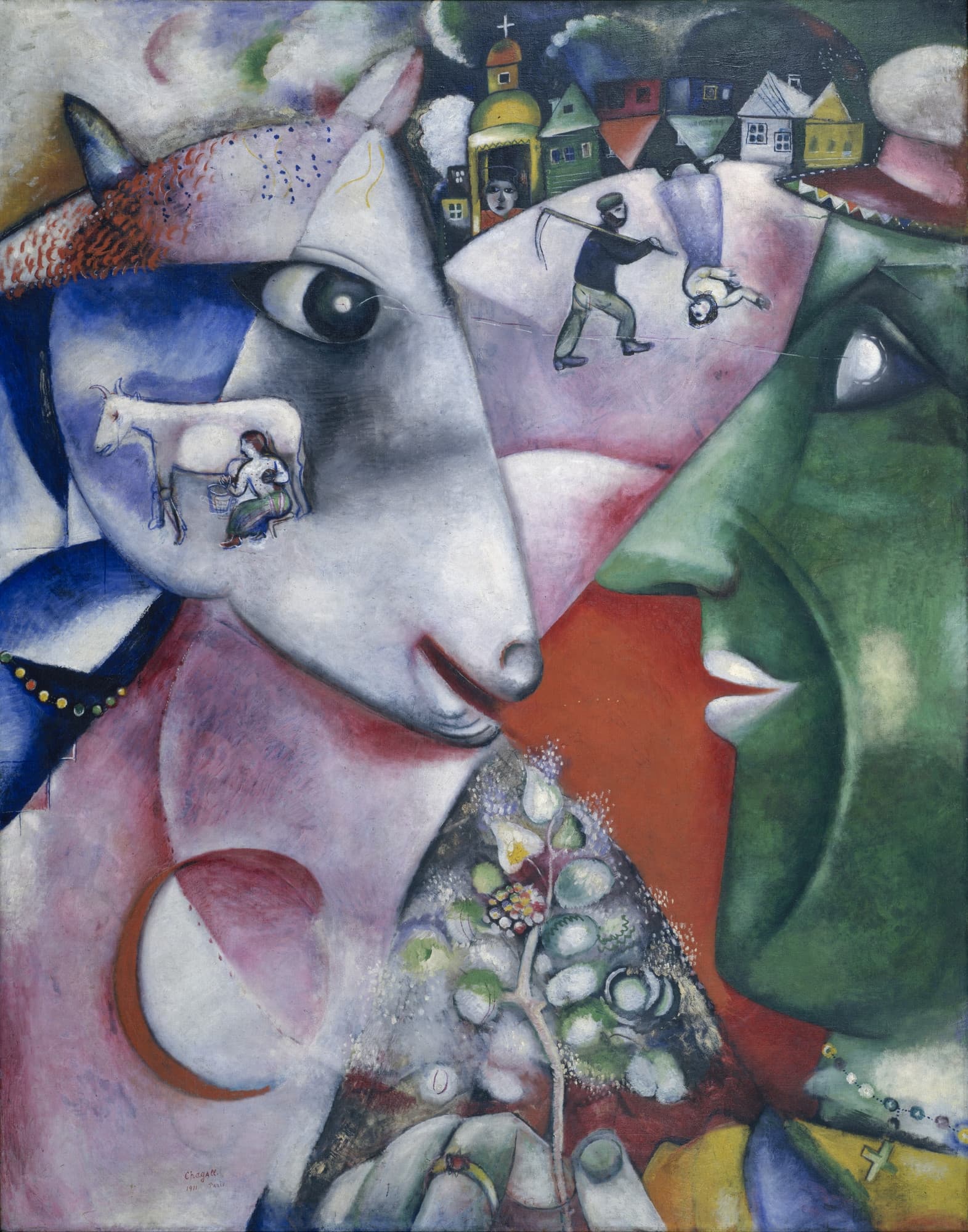
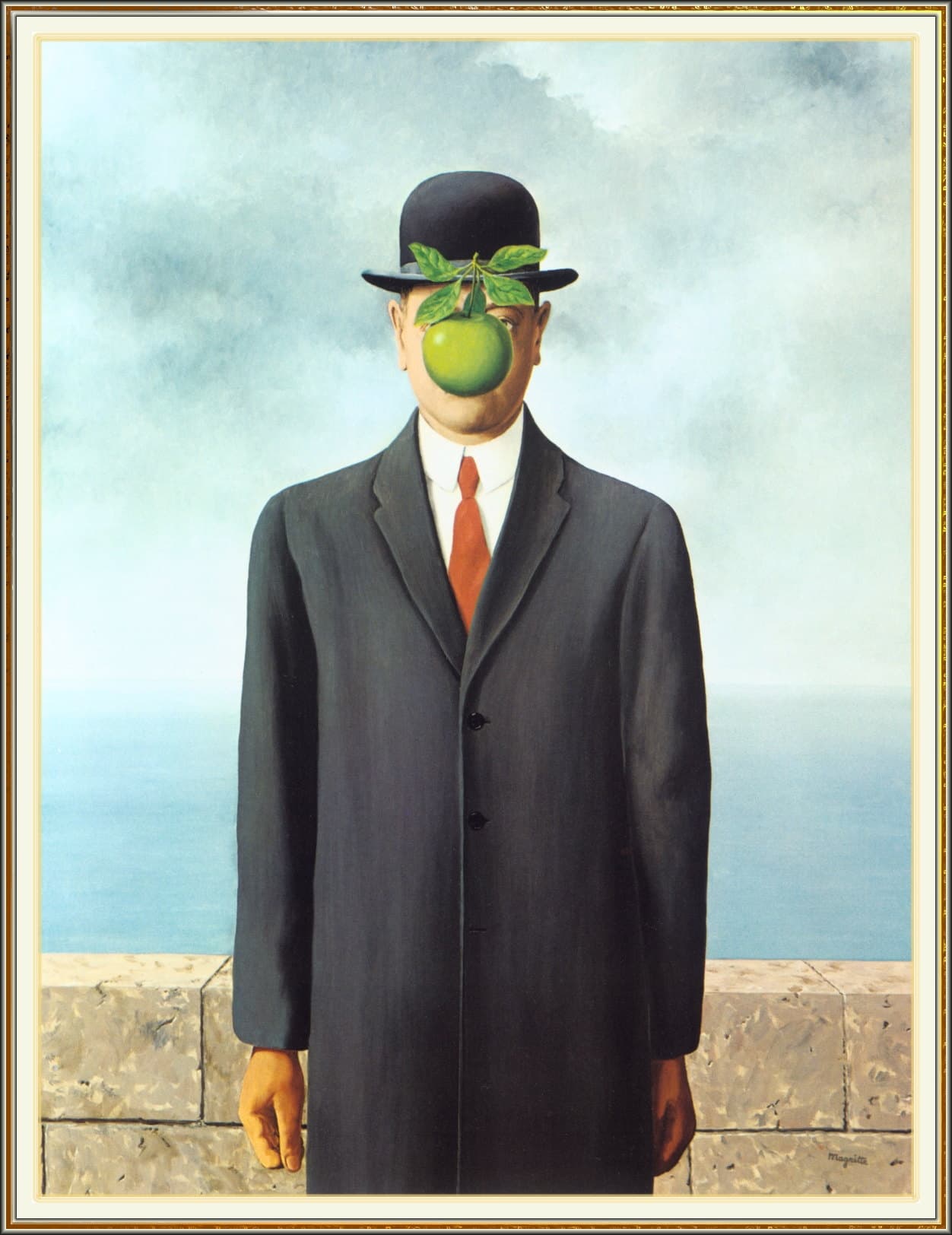
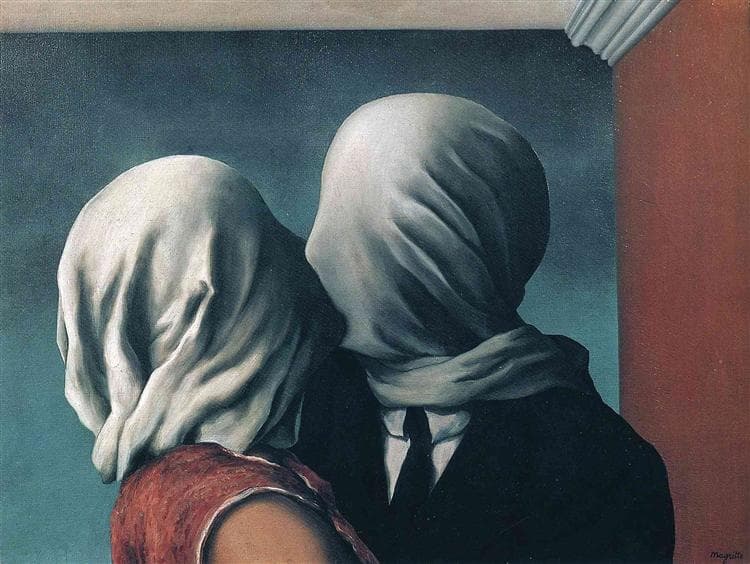
Chagall and Magritte are exacting realists of the impossible. Each keeps forms clean and ordinary, then installs a single, controlled violation that turns looking into thinking. In Chagall’s I and the Village, a villager and a pale animal meet eye to eye as rooftops tilt and time nests inside a muzzle; gravity and scale yield to recollection, yet the scene remains lucid. In Magritte’s The Son of Man, the green apple that blocks a face, like the white cloth in The Lovers or the sentence in This is Not a Pipe, is equally precise: one obstruction that reroutes the whole picture. The strangeness lands because the world around it is so steady.
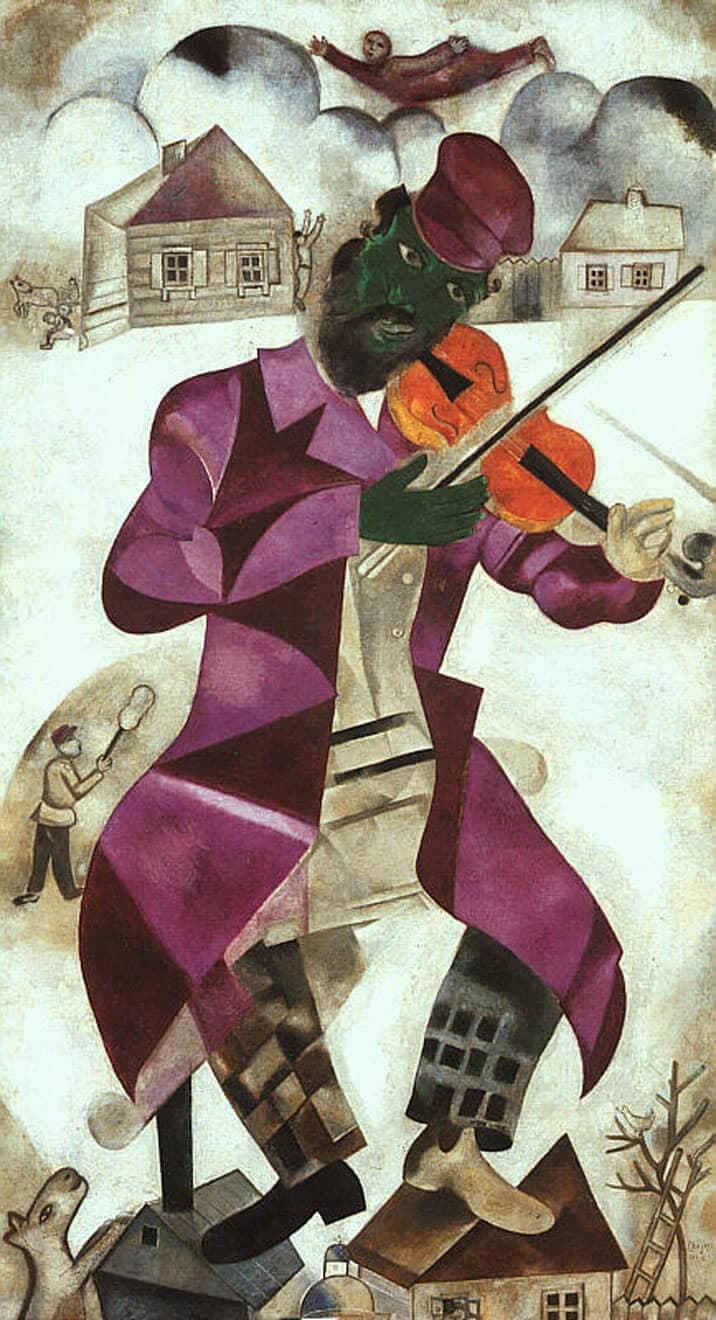
Both artists treat painting as a device for inquiry rather than a mere view. Chagall layers folklore, ritual signs, and Parisian structure to test how images can hold a dispersed community together across time. Magritte runs serial experiments on the relations among words, images, and things, often on an uncluttered stage of wall and horizon. Motifs function as laboratories: Chagall’s violinist—shaped by his Moscow theater work and monumentalized in The Green Violinist—returns as a cultural agent; Magritte’s bowler‑hatted everyman recurs for decades to measure how a small change (an apple, a bird, a window) reorganizes meaning. Crucially, both rely on clarity to deliver strangeness: Chagall’s bright, faceted color keeps dream‑logic readable; Magritte’s advertisement‑like polish makes each paradox undeniable.
Decisive Difference
Chagall treats painting as a world‑maker for memory and spiritual continuity. His break with naturalism—giant figures bridging rooftops, couples floating above Vitebsk, animals and people sharing one spatial breath—reads as the inner logic of remembrance rather than a puzzle to solve. In I and the Village, the eye‑to‑eye pact fuses work, faith, and place; in Over the Town, love’s levitation becomes a map of belonging; in The Green Violinist, a colossal musician strides the roofs as a guardian presence. Chagall bends Cubist/Orphist devices toward lyric montage so that seasons, rituals, and private recollection can coexist in a single field. His pictures propose that images carry lived bonds forward.
Magritte, by contrast, makes painting a proposition that undoes naive seeing. He builds near‑photographic clarity only to restrict access: the apple that withholds a face in The Son of Man, the cloths that deny a kiss in The Lovers, the caption that contradicts a pipe in The Treachery of Images, the canvas that swaps places with a view in The Human Condition. These devices expose the gap between appearance and knowledge. Identity becomes a type (the bowler‑hatted man), intimacy becomes opacity (the veiled kiss), and language becomes a trap (the denied pipe). Where Chagall expands seeing into remembrance, Magritte cross‑examines seeing, insisting that the image—and the word—are not the thing. The decisive difference is ethical and epistemic: communion versus constraint.
Paired Works
Face offered vs face withheld
Focus question: What changes when a picture asks for recognition versus when it blocks it?
I and the Village vs The Son of Man
World‑ordering presence vs rule of concealment
Focus question: How do scale and obstruction transform cultural meaning and intimacy?
The Green Violinist vs The Lovers
Painting thinking about painting
Focus question: When pictures reflect on their own making, what do they decide matters: identity or knowledge?
Self-Portrait with Seven Fingers vs The Human Condition
Flight as lyric memory vs flight as concept
Focus question: What does levitation mean in a remembered world versus in a system of types?
Why This Comparison Matters
These artists clarify two durable ways pictures work on us. Chagall shows how images can gather a scattered life—places left, rituals remembered, loves sustained—into a single present tense. His clarity is hospitable: strangeness opens a path back to recognition. Magritte shows how images, even when perfectly clear, can mislead or withhold. His clarity is investigative: it trains the eye to separate a thing from its picture, a face from its mask, a word from what it names.
That split remains urgent in the age of polished screens and quick takes. We need pictures that help us keep continuity with what matters, and we need pictures that slow us down when we are too ready to believe what we see. Chagall and Magritte offer both capacities without noise: one models how to remember, the other how to doubt. Learning to feel their difference equips viewers to navigate images today with steadier sense—of belonging and of skepticism.
Related Links
Sources
- MoMA collection: Marc Chagall, I and the Village (1911)
- LACMA collection: René Magritte, The Treachery of Images (This Is Not a Pipe) (1929)
- MoMA: Magritte—The Mystery of the Ordinary (interactive/overview)
- MoMA collection: René Magritte, The Lovers (1928)
- The Menil Collection: René Magritte, Golconda (1953)
- Guggenheim (store/collection materials): Marc Chagall, The Green Violinist (1923–24)
- Marc Chagall Official Site: Self-Portrait with Seven Fingers (1912–13)
- SFMOMA press release: Magritte’s bowler‑hat figure and serial types
- MoMA Magazine: “Everything we see hides another thing…” on visible/hidden
- National Gallery of Art: René Magritte, The Human Condition (1933)