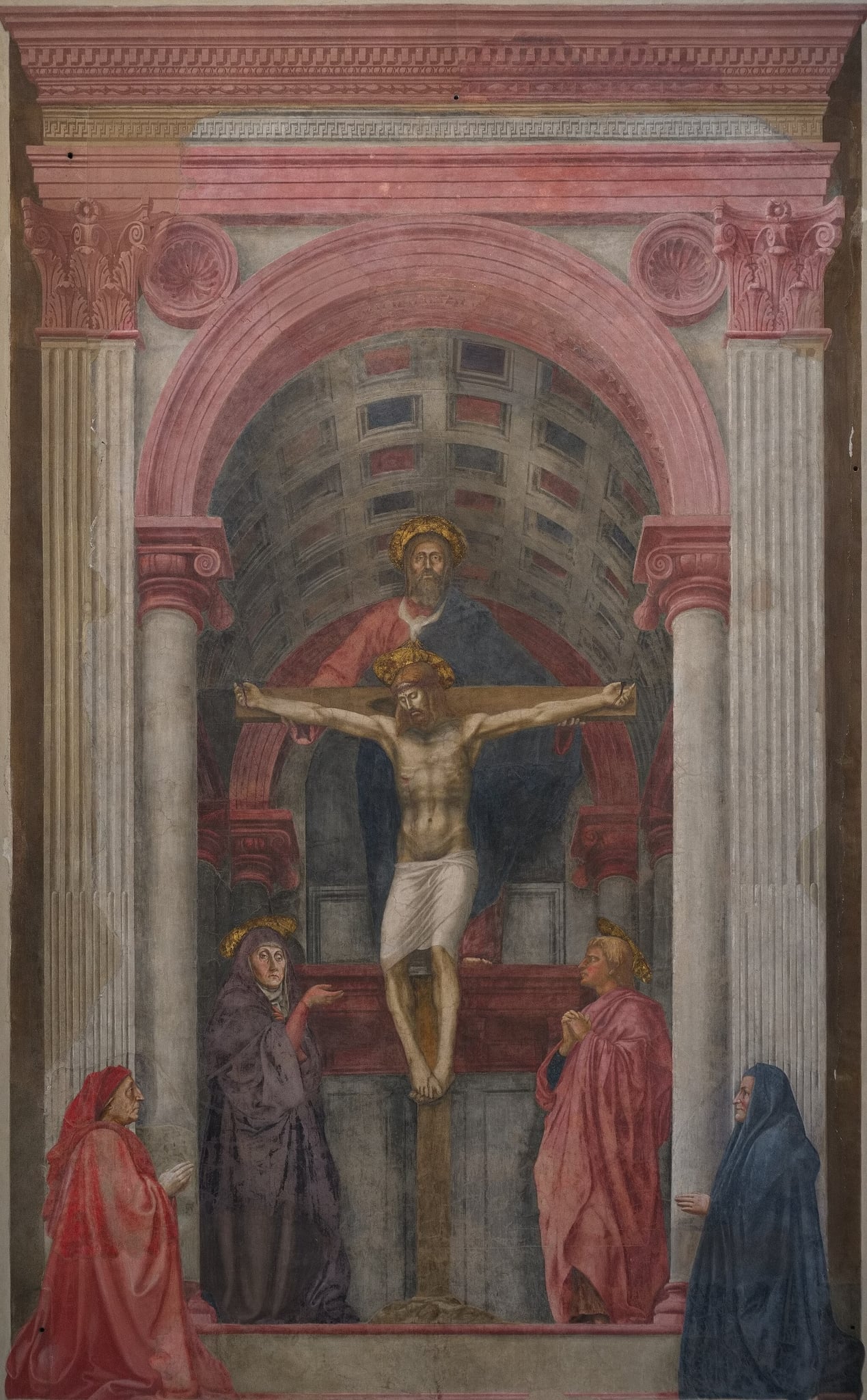
God the Father supporting the cross (Throne of Mercy) Symbolism
God the Father supporting the cross, often called the Throne of Mercy, shows the Father presenting and upholding the crucified Son as a single image of sacrifice and compassion. In Western Christian art this motif affirms the unity of the Trinity in the work of salvation, making divine mercy visible to worshippers. Artists use the arrangement to join doctrine with focused devotion.
God the Father supporting the cross (Throne of Mercy) in The Holy Trinity
In our collection, Masaccio’s The Holy Trinity (c. 1425–1427) provides a canonical example of the Throne of Mercy: the Father presents and upholds the Son’s sacrifice within a mathematically precise, coffered barrel vault constructed in one‑point perspective. The fictive chapel opens to the nave, placing kneeling donors at our eye level while Mary presents Christ and John prays in grief, translating the theology of mercy into a clear, staged encounter for viewers.
Masaccio’s rigorously ordered space turns the symbol into architectural reality, aligning the unity of divine will with strict visual order. The Father’s act of support anchors the composition and concentrates devotion on the Son’s offering within an exacting, perspectival setting.