Nu couché (sur le côté gauche)

by Amedeo Modigliani

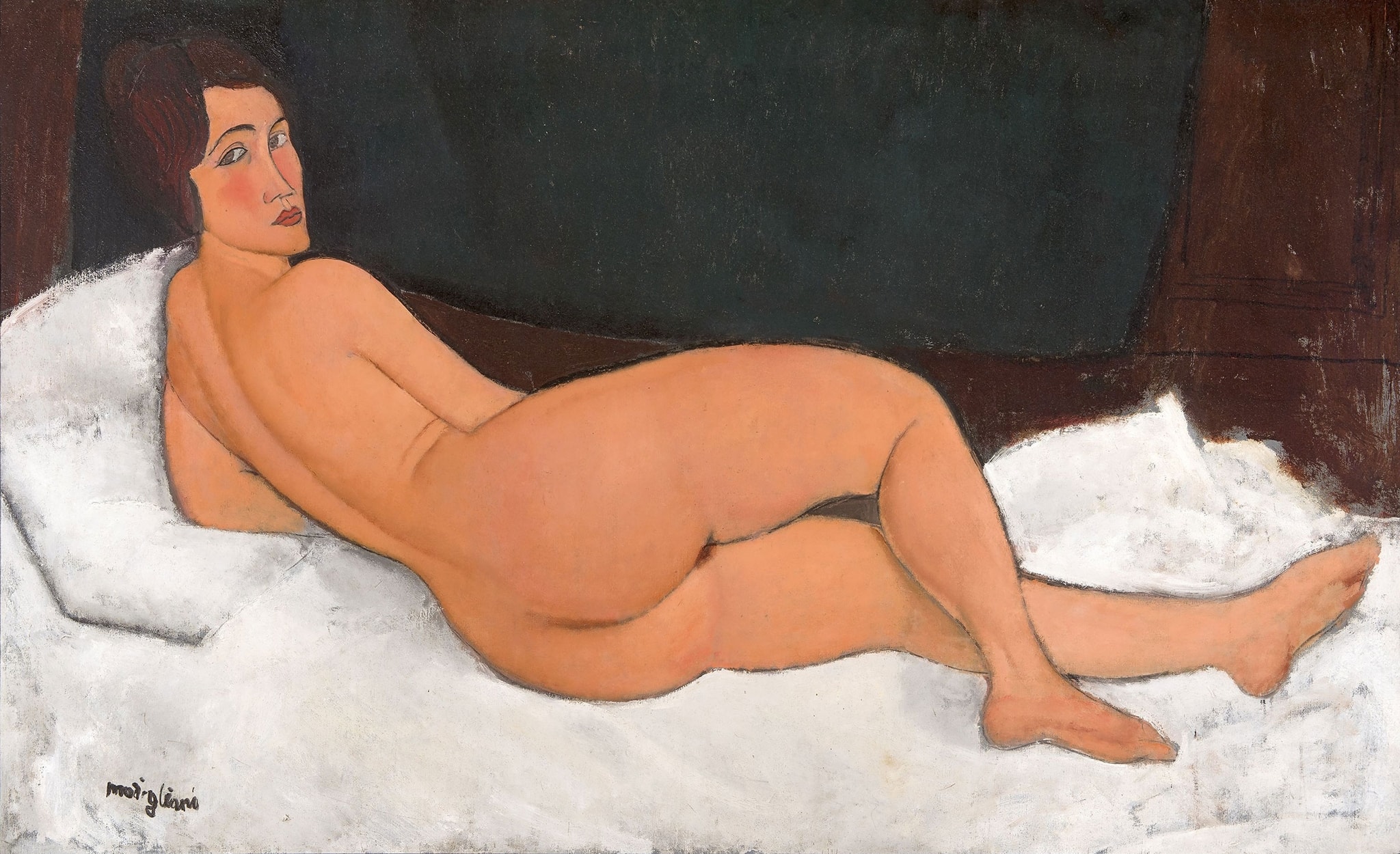
Nu couché (sur le côté gauche) is a 1917 oil painting in which Amedeo Modigliani monumentalizes a reclining nude through a continuous, sculptural contour and a flattened, nearly void backdrop. The figure’s warm terracotta body, set against crisp white sheets and a dark field, fuses modern candor with classical poise [1][2]. The direct, appraising gaze and masklike face assert a new, autonomous modern nude.

Study Print Studio

Create a personal study print

Build a companion study sheet around the part of this painting that speaks to you most. Choose a detail, shape an interpretation, and walk away with something personal and display-worthy.

Fast Facts

Year
1917
Medium
Oil on canvas
Dimensions
89.5 x 146.7 cm
Location
Private collection
Nu couché (sur le côté gauche) by Amedeo Modigliani (1917) featuring Dark calligraphic contour, Masklike visage with almond eyes, S-curve reclining body, White sheet as secular stage

Click on any numbered symbol to learn more about its meaning

Meaning & Symbolism

Modigliani organizes the body as a continuous, sinuous S-curve that runs from the left shoulder to the extended heels, a rhythmic arabesque enclosed by a taut, unbroken contour. That outline—dark, calligraphic, and decisive—turns flesh into sculptural volume while refusing academic description. The figure’s terracotta tonality is broadly modeled, then abruptly staged on a chalky white sheet; the bed’s edges and the voided dark background cancel deep space, flattening the room so the nude dominates the field 12. Her almond eyes and small, compressed mouth form a masklike visage that nods to archaic and African statuary while maintaining a cool, appraising look back at us 124. This balance—frank sensuality checked by composure—redefines the genre: not a coy odalisque encircled by props, but a woman whose scale, directness, and gaze claim autonomy. The lack of jewelry, drapery, or mythic attributes is a deliberate desymbolization; the bed and sheet become the only setting, a secular stage on which the body is both subject and idea 12. Formally, the painting fuses classicism and modernism. The elongated limbs and elegant torsion recall Mannerist precedents, yet the planar simplification, cropping, and high vantage are decisively modern 24. By reducing the background to a near-monochrome slab and tightening the composition edge-to-edge, Modigliani converts the reclining nude into an icon of immediacy—a presence encountered rather than a story told. The white sheet’s broken impasto and the thinly scumbled dark wall intensify the figure’s solidity; warm flesh reads as a carved form laid upon light, sharpening the eros/purity polarity that structures the image 12. Historical context clinches its significance: produced under Léopold Zborowski’s stipend during the 1916–1919 nude campaign, the series culminated in the artist’s 1917 Berthe Weill exhibition, briefly shuttered by police for indecency—a signal of how its unprotected frankness broke with decorum and allegory 13. That rupture is still legible here in the unflinching pubic visibility and the subject’s steady gaze. Critical reception remains polarized—celebrated for line and construction, dismissed by some as mannered—but its market and museum histories confirm its emblematic status within twentieth-century figurative modernism, underscored by the record 2018 sale 56. In short, Nu couché (sur le côté gauche) codifies a modern ideal: elegant, autonomous, serenely unembarrassed—a classical type recast through simplified planes, sculptural contour, and a returned gaze that insists on the present tense of the body 124.

Explore Deeper with AI

Ask questions about Nu couché (sur le côté gauche)

Popular questions:

Powered by AI • Get instant insights about this artwork

💬 Ask questions about this artwork!

Interpretations

Historical Context

Painted amid Modigliani’s 1916–1919 nude campaign, this canvas crystallizes a moment when the modern nude collided with civic morality. Dealer Léopold Zborowski’s stipend supplied models, materials, and space, enabling an unprecedented focus on large-scale nudes that culminated in the 1917 Galerie Berthe Weill show—swiftly shuttered by police for “indecency” owing to visible pubic hair. That episode is not mere anecdote: it marks the work’s refusal of allegorical alibis and the state’s attempt to regulate a new, secular erotics. Exhibition histories trace its subsequent normalization across Europe and, a century later, its restoration as a keystone of figurative modernism, including Tate’s 2017–18 retrospective that reframed the nudes through archival and VR reconstructions of the studio economy that produced them 134.

Source: Sotheby’s; Musée de l’Orangerie; Tate Modern press office

Formal/Material Analysis

Beyond its famous contour, the painting’s construction depends on a high vantage, tight lateral cropping, and the friction between scumbled darks and broken white impasto. The sheet’s chalky passages act like a plaster plinth for the warm body, while the background’s near-monochrome slab cancels depth, thrusting the figure forward. These decisions echo Modigliani’s sculptural thinking after his carving years: flesh is modeled as an object in space, yet the flattened field arrests recession, creating a charged frontality. The Met notes that his 1917 nudes often stretch to the canvas edges, monumentalizing the form; line, not chiaroscuro, becomes the primary organizer, so that “volume” is achieved by contour plus planar simplification rather than academic modeling 12.

Source: The Metropolitan Museum of Art; Sotheby’s

Postcolonial/Primitivism Critique

The “masklike” visage and almond eyes participate in early-20th-century primitivism—modernists mining African sculpture and archaic statuary for alternatives to academic portraiture. While this produces a distilled, iconic physiognomy, it also reveals asymmetries of cultural power: African forms are aestheticized as formal resources, detached from their original meanings. Scholarship stresses how Modigliani synthesized such sources within a Renaissance lineage, but a postcolonial lens interrogates how this borrowing shaped a European ideal of the nude while sidelining the cultural specificity of its referents. The result is a compelling hybridity that is also historically fraught, situating the painting within modernism’s entanglement with empire and the ethics of looking across cultures 28.

Source: The Metropolitan Museum of Art; Smithsonian Magazine

Gender Politics and the Returned Gaze

Unlike odalisques staged by props and attendants, Modigliani strips the set to bed and sheet, then meets us with a level stare. Sotheby’s frames this as a modern autonomy—neither mythic Venus nor commodity spectacle—but a body that claims the field through scale, directness, and lack of alibi. Compared to Ingres or Manet, the gaze here is less confrontationally social and more self-possessed, a cool appraisal that tempers exposure with agency. The effect is to recalibrate the erotic as mutual encounter rather than voyeuristic peep: the nude is not merely seen; she also sees, making spectatorship reflexive and unstable, a key innovation in the modern nude’s politics of looking 12.

Source: Sotheby’s; The Metropolitan Museum of Art

Reception, Criticism, and the Market

The painting’s reception charts modernism’s oscillation between formal veneration and skepticism. Critics like Matthew Collings praise its shape-making and constructive line over salacious appeal, while Jonathan Jones derides it as a “trite pastiche,” signaling persistent doubts about Modigliani’s stylization. The market, however, has canonized it: the 2018 Sotheby’s sale at $157.2M set a house record, transforming an image once policed for indecency into a blue-chip standard. This divergence—critical ambivalence versus market consecration—underscores how value accrues through exhibition circuits, provenance, and auction theater as much as through theory, making the canvas a case study in the cultural economics of twentieth-century figurative art 567.

Source: Bloomberg; The Guardian; Evening Standard

Related Themes

About Amedeo Modigliani

Amedeo Modigliani (1884–1920) worked in Paris from 1906, developing a signature idiom of elongated forms, mask‑like faces, and sculptural contour after a formative sculpture phase. Between 1916 and 1919, under dealer Léopold Zborowski’s support, he painted the celebrated series of reclining nudes that redefined modern erotic imagery. He died in 1920, with rapid posthumous recognition consolidating his legacy.
View all works by Amedeo Modigliani

More by Amedeo Modigliani