Tête

by Amedeo Modigliani

Tête distills a human face into an icon: an ovoid head, blade-like nose, tight bow of lips, and slitted, pupil-less eyes emerging from a dark, smoky field. Drawing on his sculptural idiom, Amedeo Modigliani fuses elegance and estrangement so the sitter becomes a universal sign rather than a likeness [1][2].

Study Print Studio

Create a personal study print

Build a companion study sheet around the part of this painting that speaks to you most. Choose a detail, shape an interpretation, and walk away with something personal and display-worthy.

Fast Facts

Year
1915
Medium
Oil on cardboard
Dimensions
54 × 42.5 cm
Location
Musée national d’Art moderne, Centre Pompidou, Paris
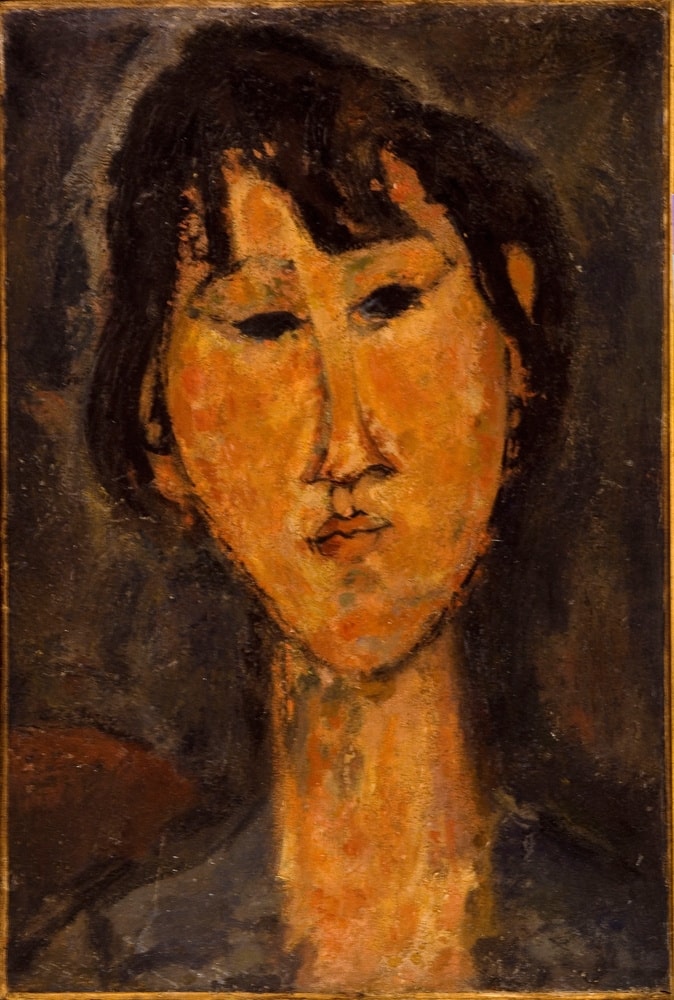
Tête by Amedeo Modigliani (1915) featuring Blade-like triangular nose, Ovoid head, Compressed bow of lips, Almond, pupil-less eyes

Click on any numbered symbol to learn more about its meaning

Meaning & Symbolism

Tête asserts that the human face can be both sign and substance. The smooth oval head, the triangular ridge of the nose, and the compressed mouth reduce features to a deliberate, geometric grammar—moves indebted to Modigliani’s close study of African masks (Fang, Guro) and archaic statuary (Egyptian, Cycladic, Khmer) 12. In the image, the almond eyes are scarcely open, rendered as dark, masklike slits; their refusal to meet our gaze breaks the portrait contract and reorients attention from social identity to interiority. The elongated neck—almost columnar—carries the head like a reliquary, amplifying the work’s hieratic stillness. Around it, a hushed field of smoky blues and browns suspends the figure, as if the head were an apparition pushed forward by chromatic heat in the skin—ochres, siennas, and bruised reds that flicker across cheeks and throat 1. The result is a declarative archetype: a head that is less someone than a sign for everyone. This iconicity is not cold abstraction. Modigliani’s medium—thick, scumbled oil on a humble cardboard support—keeps the image anchored in matter. Strokes accumulate like shallow carvings translated into paint; edges taper and swell with a chisel’s logic, a direct carryover from his years of stone carving (and his 1912 Salon d’Automne display of seven heads) 3. That sculptural memory gives Tête its paradoxical charge: stone-like stillness animated by a breathing surface. The painting stages an encounter between two realities—an ideal, universal type and the mortal, tactile flesh of pigment. In curatorial terms, the Pompidou reads this head as an apparition that “projects out of darkness,” an icon rather than a person; the Jewish Museum frames the occluded, pupil-less eyes as a metaphor for the inner/outer gaze—a way to picture consciousness while resisting easy readability 12. Both views clarify why Tête feels at once intimate and distant: the elegance of its proportions seduces, while the withheld gaze estranges. Why Tête is important becomes clear in this synthesis. In 1915, after abandoning sculpture due to health and hardship, Modigliani re-forged his sculptural “head” into a painted language that stood apart from Cubist fragmentation and mere Fauvist colorism 13. He proposed an alternative modernism—rooted in encounter with non-Western and ancient models yet insistently personal and ethical in its borrowing—seeking a universal human visage rather than an appropriated exoticism 2. In Tête, the face becomes a vessel for memory and absence, a timeless emblem staged with modern means. The painting’s authority flows from its clarity: a few exact decisions—frontality, elongation, masklike eyes, heated flesh against darkness—conjure a human condition that feels both specific and beyond name. That is the lasting stake of Tête: it demonstrates how modern art can pursue universality without abandoning the sensuous, mortal presence of paint 123.

Explore Deeper with AI

Ask questions about Tête

Popular questions:

Powered by AI • Get instant insights about this artwork

💬 Ask questions about this artwork!

Interpretations

Historical Context: An Alternative to Cubism and Fauvism

In 1915, Modigliani reactivated the sculptural "head" he had pursued between 1909 and 1914, now forging it in paint as a counter‑proposal to Cubist fragmentation and mere Fauvist chroma. The 1912 Salon d’Automne display of seven carved heads had already established a frontal, hieratic type; returning to painting under straitened means, he kept that type but exchanged stone’s permanence for the tactile contingency of oil on cardboard. The Centre Pompidou reads the head’s projection from darkness and its saturated field as an apparition, while the Kimbell’s account of the sculpted ensemble clarifies the lineage of the elongated neck and columnar poise. Tête thus marks a pivotal synthesis: a modern portrait idiom that refuses analytic dissection yet resists decorative surface, maintaining sculptural clarity within painterly breath. 13

Source: Centre Pompidou; Kimbell Art Museum

Iconology: From Portrait to Icon

Read through iconological method, Tête exchanges the social contract of the portrait for the protocols of an icon. The rigid frontality, withheld pupils, and hovering head pull the image from time into ritual space, akin to a panel that is venerated rather than conversed with. The Pompidou’s “apparition” framing captures this sacral register; Kimbell’s citation of the 1912 heads as a “temple of beauty” (columns aligned like a frieze) implies an architectural-liturgical ambition later translated to canvas. The neck functioning “like a reliquary” heightens this reading: it elevates, isolates, and protects the visage as if it were a sacred fragment. The result is a devotional mode for modernity—secular materials staging a hieratic presence that asks for contemplation, not biography. 13

Source: Centre Pompidou; Kimbell Art Museum

Postcolonial Lens: Borrowing, Translation, and Ethics

The head’s morphology—almond eyes, triangular nose, compressed lips—signals studied engagement with Fang/Guro masks and Egyptian–Khmer–Cycladic statuary. Curators at the Jewish Museum argue Modigliani sought a hieratic, universal type rather than ethnographic quotation, a stance more interpretive than extractive within a Paris shaped by colonial display. Even so, the work participates in the era’s “primitivism,” where asymmetries of access and power framed who could borrow and be seen as modern. Tête can thus be read as a case of ethical translation under unequal conditions: its de-personalized, timeless head aims at shared human form while acknowledging, in its hybrid grammar, the non-Western sources that catalyzed it. That doubleness—modernist innovation entangled with empire—remains central to its critical afterlife. 12

Source: The Jewish Museum

Medium/Process: Carving with Paint

Modigliani’s facture makes paint behave like stone. On a humble cardboard support, strokes accrue as shallow reliefs; contours taper and swell with a carver’s pressure, echoing the chiselled edges of his limestone heads. This is not mere stylistic echo but a technical translation: volume is built by planar cuts, then warmed by chroma so the head seems to push out of darkness. The Pompidou ties this emergence to Cézannian construction and to a saturated, incandescent palette that animates the surface without dissolving form. In effect, Tête stages a dialogue between media—stone’s iconic stillness retained, oil’s breathing surface achieved—so that material process itself becomes meaning: a universal head made mortal through the drag and scumble of pigment. 13

Source: Centre Pompidou

Gaze and Interiority: The Unreadable Subject

The half-sealed, pupil‑less eyes short‑circuit the viewer’s search for psychological legibility. The Jewish Museum names this Modigliani’s “inner/outer eye”: a pictorial metaphor whereby looking is withdrawn inward, converting portraiture’s exchange into a one‑way contemplative circuit. The refusal to meet our gaze dislodges identity from physiognomic detail and relocates it in interiority, figured as silence and opacity. This is not blankness but an ethics of distance: by limiting access to the sitter’s individuality, Tête resists the era’s appetite for typologizing faces and instead posits personhood as fundamentally unknowable. The result is a paradox—at once intimate (close, frontal, warm in color) and estranging (masklike, averted), a modern psychology crafted through reduction rather than expressionism. 21

Source: The Jewish Museum

Material/Social Economy: Modesty as Aesthetic Choice

The use of oil on cardboard is practical and polemical. In wartime Paris and under financial constraint, Modigliani turns a modest support into a virtue, letting absorbency and tooth register scumbled layers that evoke carved stone translated to paint. The Pompidou notes the work’s intense color and apparition‑like emergence; those effects are inseparable from the substrate, which muffles glare and deepens matte passages so the head’s relic‑like stillness can hold. In this reading, material economy is not deficit but method: a modern classicism built from accessible means, aligning an ethic of restraint with an ideal of timeless form. The support thus participates in meaning, anchoring the universal head in the ordinary world of things. 1

Source: Centre Pompidou

Related Themes

About Amedeo Modigliani

Amedeo Modigliani (1884–1920) worked in Paris from 1906, developing a signature idiom of elongated forms, mask‑like faces, and sculptural contour after a formative sculpture phase. Between 1916 and 1919, under dealer Léopold Zborowski’s support, he painted the celebrated series of reclining nudes that redefined modern erotic imagery. He died in 1920, with rapid posthumous recognition consolidating his legacy.
View all works by Amedeo Modigliani

More by Amedeo Modigliani
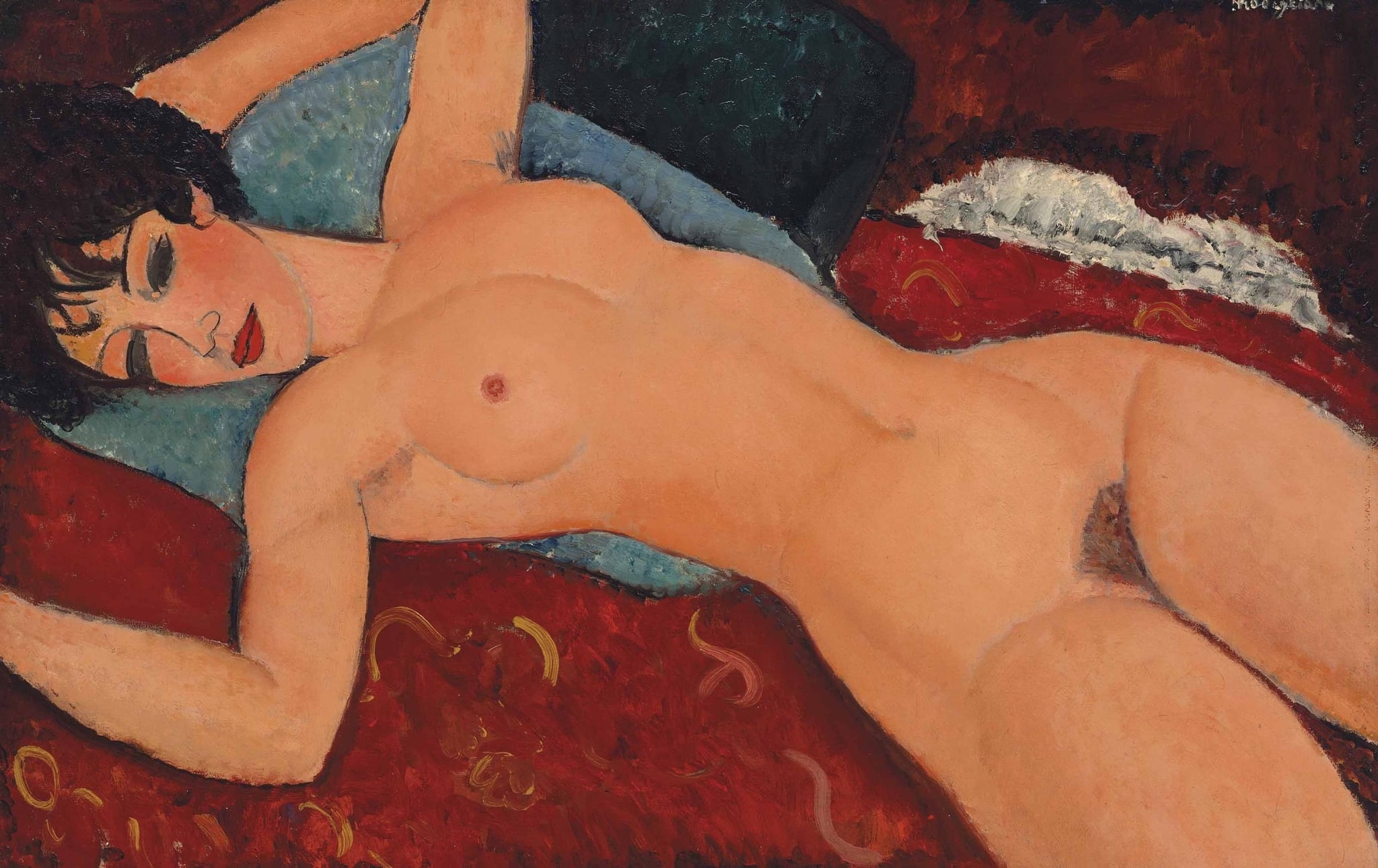
Nu couché by Amedeo Modigliani

Nu couché

Amedeo Modigliani (1917)

Amedeo Modigliani’s Nu couché (1917) recasts the reclining nude as a <strong>modern icon of desire</strong>—a body reduced to <strong>lyric contour</strong> and glowing planes that stretch diagonally across a crimson bed. Warm, peach-toned flesh is keyed against <strong>saturated reds</strong> and <strong>cool blue pillows</strong>, fusing intimacy with monumentality while stripping away myth to confront eroticism directly <sup>[2]</sup><sup>[3]</sup>. Painted amid wartime Paris, it helped ignite the 1917 censorship scandal and later became a market landmark, underscoring its status as a defining image of <strong>modernism’s nude</strong> <sup>[4]</sup><sup>[5]</sup>.
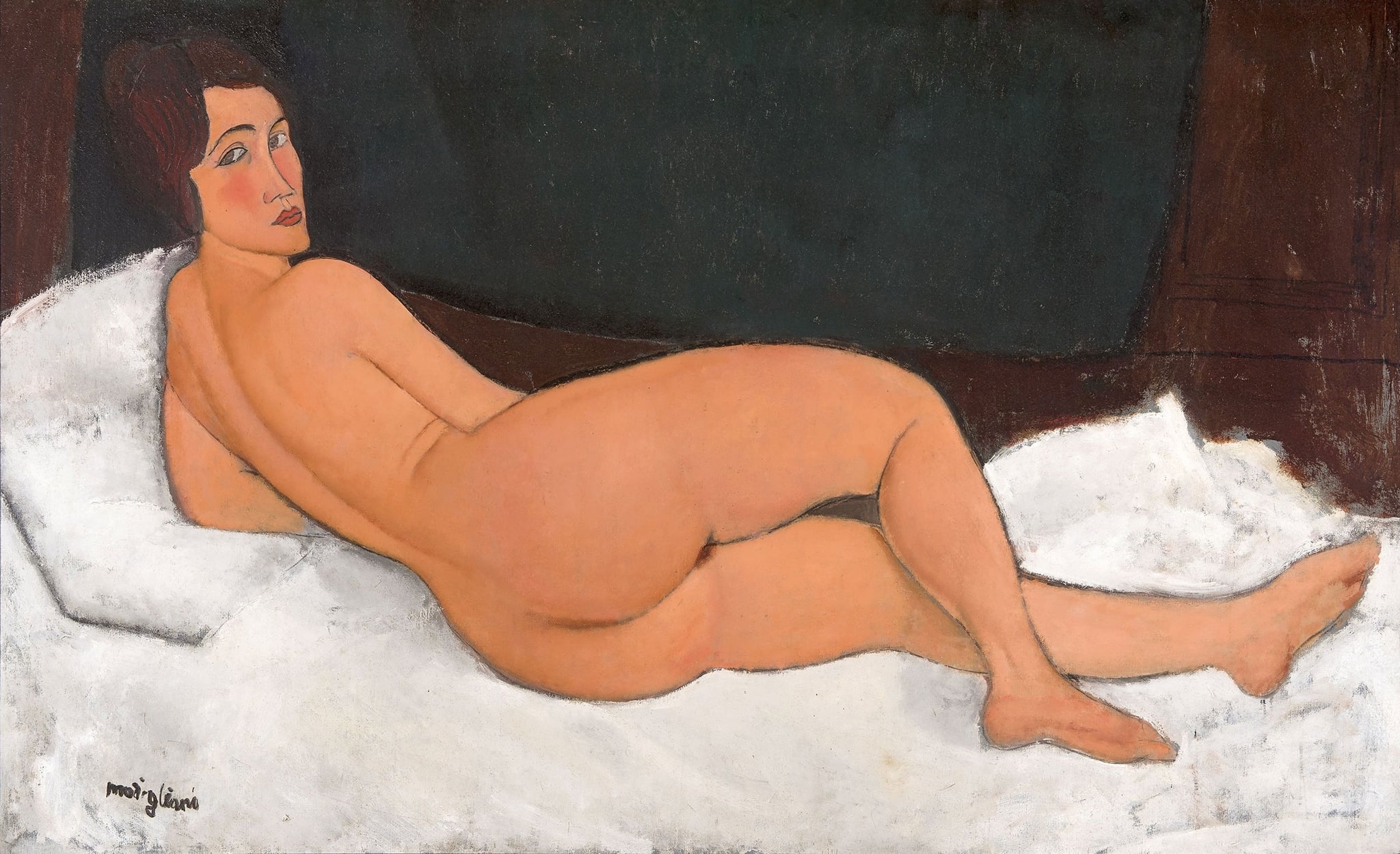
Nu couché (sur le côté gauche) by Amedeo Modigliani

Nu couché (sur le côté gauche)

Amedeo Modigliani (1917)

Nu couché (sur le côté gauche) is a 1917 oil painting in which Amedeo Modigliani monumentalizes a reclining nude through a continuous, sculptural contour and a flattened, nearly void backdrop. The figure’s warm terracotta body, set against crisp white sheets and a dark field, fuses <strong>modern candor</strong> with <strong>classical poise</strong> <sup>[1]</sup><sup>[2]</sup>. The direct, appraising gaze and masklike face assert a new, <strong>autonomous modern nude</strong>.
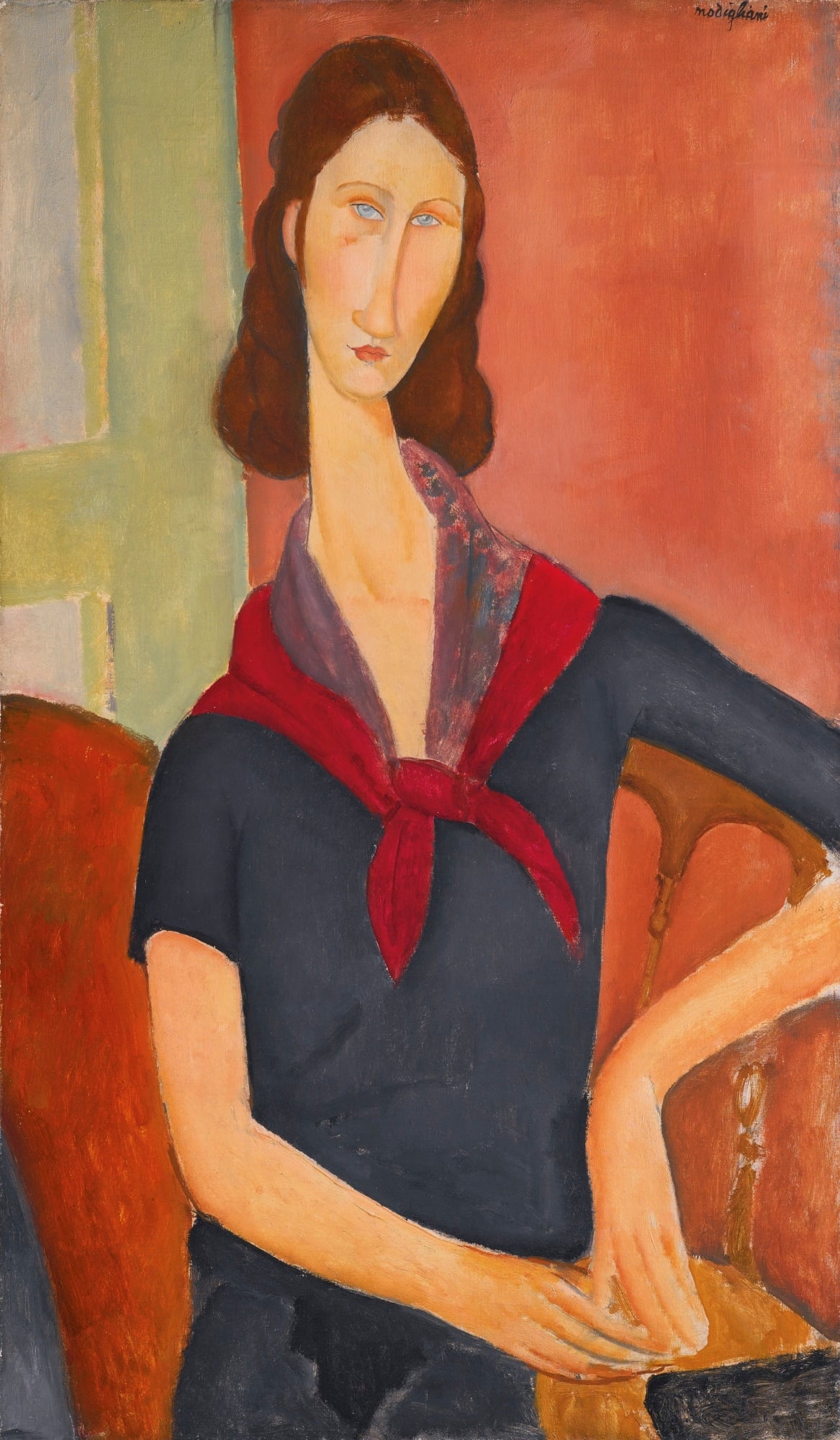
Jeanne Hébuterne (au foulard) by Amedeo Modigliani

Jeanne Hébuterne (au foulard)

Amedeo Modigliani (1919)

Jeanne Hébuterne (au foulard) crystallizes Modigliani’s late style into a poised emblem of <strong>tenderness held in restraint</strong>. The elongated neck, <strong>masklike visage</strong>, and cool navy dress are pierced by the <strong>red scarf</strong> at the throat, a chromatic node that concentrates feeling and presence <sup>[1]</sup><sup>[2]</sup>. The subtly indicated pupils—rare in many Modigliani portraits—sharpen her psychological immediacy amid the flattened, terracotta field <sup>[1]</sup>.
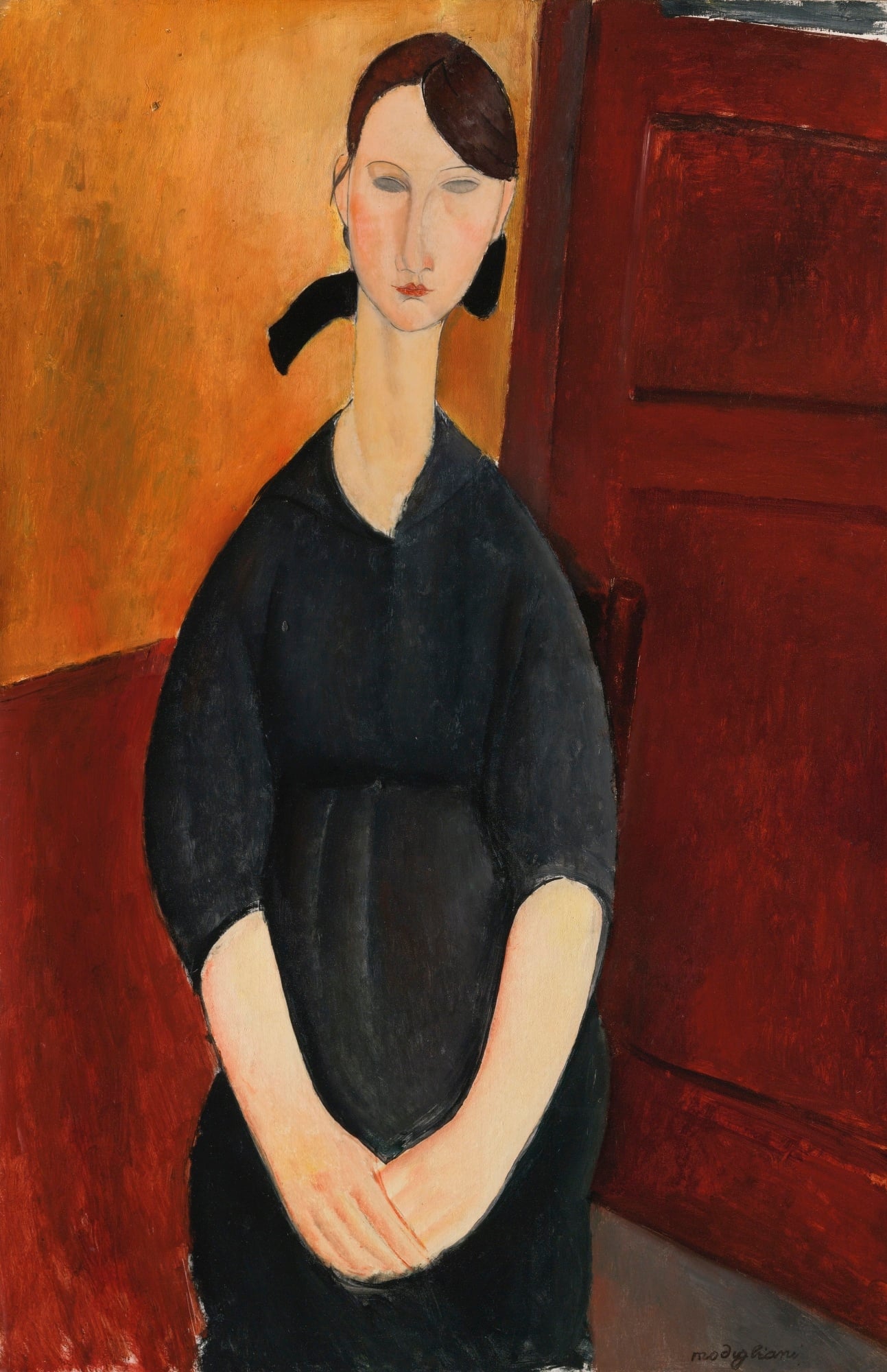
Portrait of Paulette Jourdain by Amedeo Modigliani

Portrait of Paulette Jourdain

Amedeo Modigliani (1919)

Portrait of Paulette Jourdain crystallizes a young sitter into a <strong>poised, timeless icon</strong>: an attenuated neck, mask-like almond eyes, and gently folded hands set before ochre walls and a <strong>slightly ajar red door</strong>. Modigliani’s sculptural contour and restrained palette turn likeness into an <strong>archetype of grace and inwardness</strong> <sup>[1]</sup><sup>[2]</sup><sup>[3]</sup>.