Devolved Parliament

by Banksy

Devolved Parliament is Banksy’s monumental oil painting that replaces Members of Parliament with chimpanzees on the green benches of the House of Commons. Using theatrical light that pools around the dispatch boxes and the Speaker’s Chair, it stages British democracy as a spectacle where ceremony collides with animalistic pandemonium [1][3].

Study Print Studio

Create a personal study print

Build a companion study sheet around the part of this painting that speaks to you most. Choose a detail, shape an interpretation, and walk away with something personal and display-worthy.

Fast Facts

Year
2009 (reworked and retitled by 2019)
Medium
Oil on canvas
Dimensions
250 × 420 cm (unframed)
Location
Private collection (sold at Sotheby’s London, 3 Oct 2019)
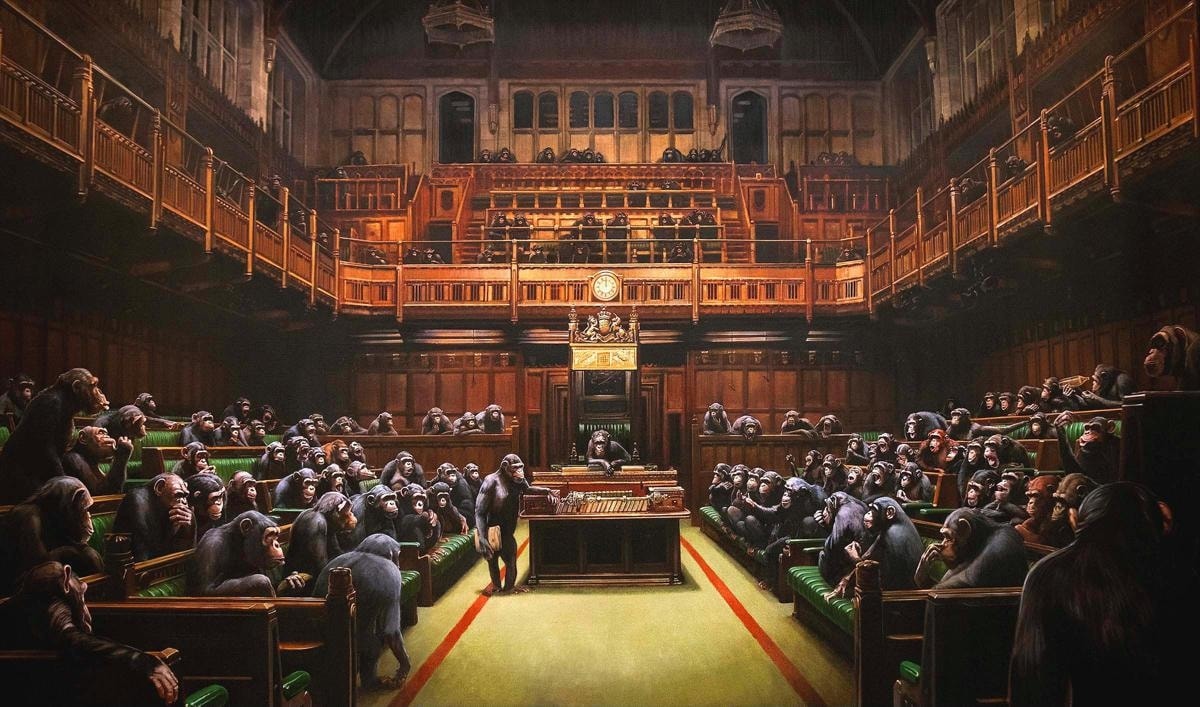
Devolved Parliament by Banksy (2009 (reworked and retitled by 2019)) featuring Chimpanzees (as MPs), Green benches of the House of Commons, Dispatch boxes, The Mace

Click on any numbered symbol to learn more about its meaning

Meaning & Symbolism

Banksy weaponizes the Commons’ own iconography against it. The green benches face off across the aisle, bracketed by the chamber’s paired red lines, while the dispatch boxes and Mace sit under the clock and Royal Arms atop the Speaker’s Chair—symbols that ordinarily materialize constitutional authority and procedural restraint 34. Here those emblems preside over a troop of chimpanzees: some gesticulate mid‑harangue, others slump or stare blankly, and one leans proprietorially across the table, as if authority were a matter of stance rather than argument. The lighting—cinematic and centralized—turns the room into a stage, intensifying the gap between venerable setting and unruly cast. By populating this meticulously rendered chamber with our evolutionary cousins, Banksy literalizes a popular insult and transforms it into structural critique: when politics becomes theater, procedure risks becoming ritual without reason 13. Scale is part of the polemic. At 250 × 420 cm, Banksy adopts the dimensions and gravitas of history painting to elevate a sight gag into a state portrait of dysfunction 12. That choice positions him within the British tradition of visual satire—Hogarth’s moral theater and Gillray’s caricatures—while also echoing Orwell’s animal allegory, where beasts expose human power’s hypocrisies 16. The simian motif is a through‑line in Banksy’s practice (cf. Laugh Now); here it serves a double pun: devolution as the devolution of power from responsible governance, and as evolution run in reverse. The later reworking deepens this tone: Sotheby’s notes the “snuffed‑out” lamps and a banana turned downward, inverting the cheeky prop into a sign of exhaustion or decay 1. Even the frequently cited, possibly apocryphal rationale for the red lines—“two swords’ length apart”—feels on‑point: adversarial choreography hardened into lore, a boundary that marks civility while advertising perpetual combat 4. In Banksy’s telling, such decorum frames, rather than cures, the chamber’s performative antagonism. Context sharpened the image’s bite. First shown in Bristol in 2009 as Question Time, the work returned to the museum in 2019 as Devolved Parliament to coincide with the planned “Brexit Day,” which Banksy himself flagged—an artist’s note that stitched the painting to a moment when parliamentary process seemed both over‑visible and under‑effective 28. Days of televised shouting and arcane procedural maneuvers made the Commons feel precisely like the picture: a grand room where noise smothers sense. Its record‑setting auction shortly thereafter did not merely reward notoriety; it testified to the image’s resonance as a global meme of democratic malaise, legible across borders even as it is rooted in very British furniture and ceremony 5. The painting’s power lies in that friction: the Mace, the Royal Arms, the green benches, and the clock promise stability, yet the chamber swarms with instincts—status display, mimicry, pack dynamics—that undercut deliberation. Devolved Parliament endures not because it calls politicians apes, but because it shows a system built to tame human passions becoming yet another arena for them. In doing so, it reframes satire as public service: a mirror held up to the House that asks whether its rituals still serve its reason for being 136.

Explore Deeper with AI

Ask questions about Devolved Parliament

Popular questions:

Powered by AI • Get instant insights about this artwork

💬 Ask questions about this artwork!

Interpretations

Institutional Semiotics: Emblems That Govern

Read the painting as a study in constitutional semiotics. The meticulously rendered Mace, Royal Arms, portcullis, and Speaker’s ensemble are not mere props; they are juridical signs that ordinarily materialize Crown-in-Parliament authority. Banksy keeps these markers intact while swapping out the human subjects, showing how symbols can outlast—and obscure—the quality of deliberation beneath them. The result is a paradox of legitimacy: ritual objects still guarantee the House “sits,” yet their aura now frames a theatre of animality. Banksy’s fidelity to furnishings (green benches, clock, dispatch boxes) grounds the satire in verifiable iconography, letting institutional detail carry the sting of the critique: authority is produced and perceived through repeated signs, even when reason is not 137.

Source: UK Parliament Heritage Collections; UK Parliament Glossary; Sotheby’s catalogue note

History Painting as Tactical Frame

At 250 × 420 cm, Banksy commandeers the apparatus of history painting—monumental scale, axial composition, and centralized, cinematic lighting—to elevate a vernacular insult into a state allegory. The Commons is staged like a proscenium, with benches raking toward a vanishing point that centers power’s throne. This formalism cites the gravitas of canonical tableaux while importing the bite of Hogarthian and Gillray-esque satire: a hybrid of the academy’s rhetoric and the street’s derision. The work’s “largest known canvas” status is not just bravura; it asks whether scale and lighting can still confer authority when the actors are apes—and whether that tension clarifies how spectacle mediates modern governance 126.

Source: Sotheby’s catalogue; Bristol Museum & Art Gallery; Aesthetic Investigations (on Banksy, Hogarth, democracy)

Animal Allegory and Political Ethology

Beyond a species swap, the picture deploys animal allegory to probe political ethology: gesticulation as dominance, blank stares as withdrawal, clustering as factionalism. The simian motif—familiar from Banksy’s practice—meets an Orwellian register, where beasts expose the hypocrisies of human power. By 2019, the artist’s reworking (snuffed lamps, a down‑turned banana) drains the original gag of its levity, edging from farce toward entropy. The allegory thus shifts from mockery to diagnosis: a chamber ruled by primate signals rather than logos. Crucially, the satire targets structures and scripts, not species; the apes are conduits for seeing parliamentary habit as instinct in ceremonial dress 16.

Source: Sotheby’s catalogue note; Aesthetic Investigations

Invented Tradition and the Red Lines

The paired red lines down the aisle—popularly glossed as “two swords’ length apart”—are a perfect case of invented tradition. Official factsheets enshrine the lines’ prohibitions, but parliamentary handbooks flag the swords origin as apocryphal. Banksy leverages that ambiguity: whether myth or rule, the lines choreograph adversarial comportment. In the painting, they read as a proscenium mark for ritual without reason, a reminder that decorum can stabilize conflict as performance. The insight is anthropological as much as political: boundaries sacralize behaviour even when outcomes falter, turning debate into a rehearsed antagonism whose choreography survives proof of its efficacy 4101.

Source: UK Parliament Factsheet G07; How Parliament Works (9th ed., preview); Sotheby’s catalogue note

Reception Study: Market, Meme, and Meaning Drift

Devolved Parliament’s life-cycle—museum debut, Instagram caption tying it to “Brexit Day,” and a record Frieze Week auction—demonstrates how circulation re-writes meaning. Social distribution gave the image meme-legibility as a shorthand for democratic malaise; the auction spectacularized that legibility as value. Skeptics called the piece a market-friendly “one-note joke,” yet the sale’s global attention confirmed its translatability across political contexts. Banksy’s own post sutured authorial intent to a specific crisis, but the market reframed it as a portable icon of governance fatigue. The work thus functions as art and as media object, its critique intensified—and risked—by the same spectacle it condemns 589.

Source: Bloomberg; Banksy Instagram (via InsideHook); Axios

Related Themes

About Banksy

Banksy is an English street artist associated with the Bristol scene, known for politically edged stencils and interventions that test the boundaries between public space, activism, and the art market. His practice spans walls, editions, film, and orchestrated critiques like the 2018 shredding, situating him within contemporary and post-graffiti art discourse [5][3].
View all works by Banksy

More by Banksy