Love is in the Bin

by Banksy

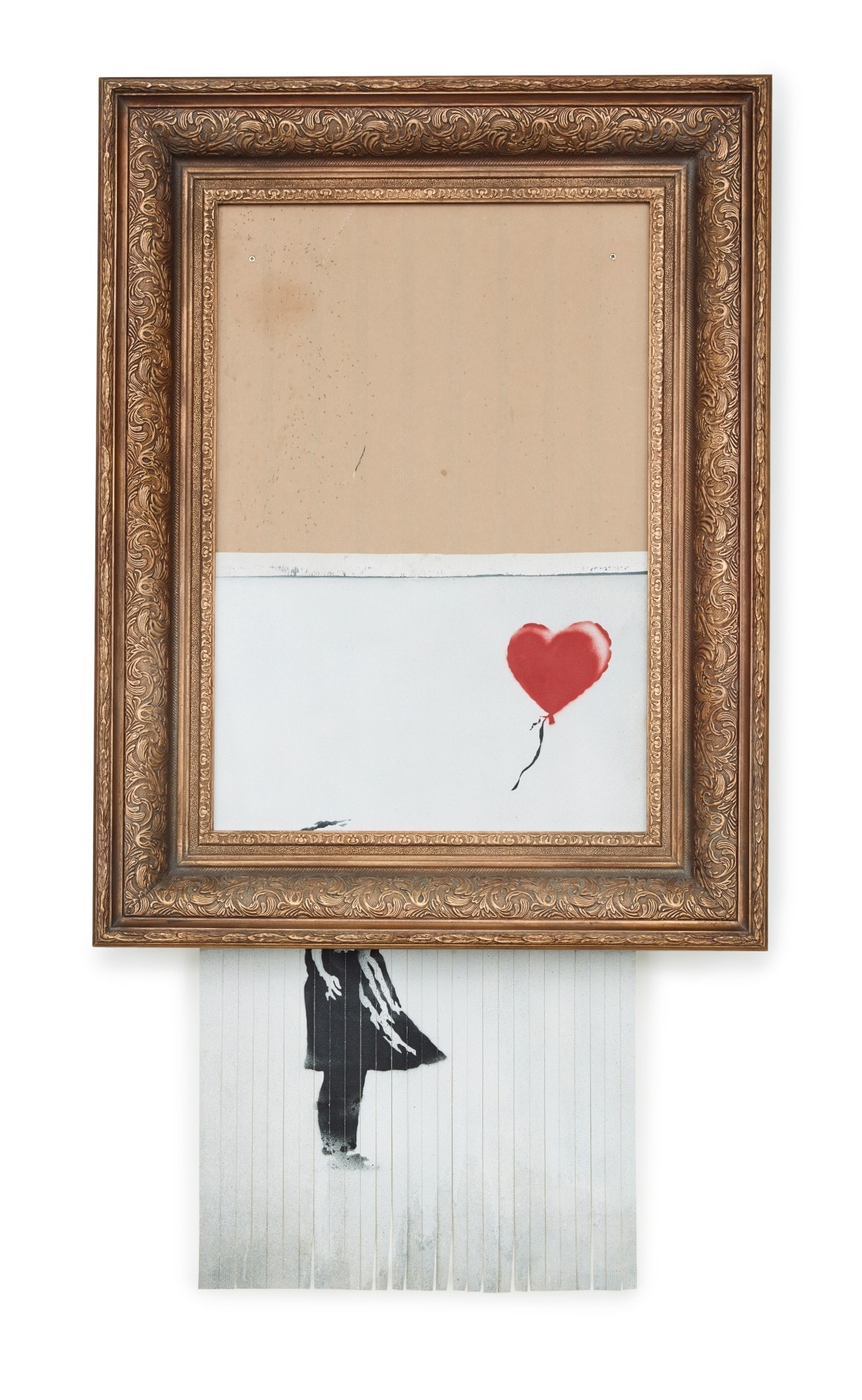
Banksy’s Love is in the Bin turns a familiar image into a live act of institutional critique: the ornate frame that normally guarantees value becomes a machine of auto‑destruction. The red, heart‑shaped balloon floats intact in a pale field while the lower half—showing the girl—hangs in vertical shreds, freezing the second when symbol survives but subject is sacrificed [1][3]. The work asserts that in contemporary art, spectacle and framing can fabricate value as surely as craftsmanship.

Study Print Studio

Create a personal study print

Build a companion study sheet around the part of this painting that speaks to you most. Choose a detail, shape an interpretation, and walk away with something personal and display-worthy.

Fast Facts

Year
2018
Medium
Spray paint and acrylic on canvas, mounted on board; artist’s frame with integrated (now decommissioned) shredder
Dimensions
142 × 78 × 18 cm (56 × 30⅞ × 7 in.)
Location
Private collection
Love is in the Bin by Banksy (2018) featuring Red heart-shaped balloon, Severed balloon string, Partially shredded girl, Vertical paper strips

Click on any numbered symbol to learn more about its meaning

Meaning & Symbolism

Love is in the Bin fuses image, object, and event into a single argument about value. The gilded, old‑master‑style frame houses the now‑decommissioned shredder—a device built into the very apparatus that typically sanctifies and protects art in elite settings 12. By triggering the blades the instant the hammer fell, the work redirects attention from the represented scene to the power of framing itself. The visual logic is ruthlessly clear in the object’s current state: the bright red, heart‑shaped balloon levitates unscathed against a pale ground, while the black‑stenciled lower figure has been converted into trembling paper strips that spill out beneath the frame. The balloon’s thin string snaps at the threshold where canvas becomes fringe; hope remains, the human bearer is literally processed. This split formalizes a central claim of Banksy’s practice: the idea (balloon/ideal) can survive the destruction of its object (commodity/canvas). By leaving the symbol intact and sacrificing the depiction of the subject, the piece stages a hierarchy of endurance—concept over matter, sign over body 45. The work’s performative birth inside the auction saleroom intensifies its critique. Because the partial shredding happened live, the market’s theater became the medium; bidders, specialists, and cameras became unwitting collaborators, and the viral circulation of the moment became part of the artwork’s substance 5. Banksy later suggested the device was intended to shred the whole canvas, but it jammed, freezing the action at a halfway point that visually and conceptually outperforms total annihilation: the lower half testifies to the act, the upper half preserves the icon, and the seam reads as a scar across which value, authorship, and authenticity are contested 3. In this sense, the frame is not a neutral border but an active agent that both enforces and perforates the boundary between protected art and expendable material—an object‑lesson in institutional critique rendered as hardware 15. The paradox, of course, is that the market that was lampooned promptly absorbed and amplified the gesture; the retitled work, newly certified by Pest Control, became even more valuable on resale, proof that ruin can be a generator of price when staged as spectacle 289. Critical responses map the stakes. Admirers argue that the piece revives avant‑garde strategies by demonstrating that meaning can be produced through rule‑breaking and risk, aligning Banksy with histories of auto‑destructive art and readymade sabotage 6. Skeptics counter that the drama is an empty flourish—an advertisement for itself—exposing not the market’s hypocrisy but its omnivorous appetite for narrative 7. Both readings, however, concede the same structural point: context manufactures significance. In the object before us, that manufacturing is made visible in the sheared edges, the dangling strips, the pristine red ellipse of the balloon, and the baroque frame turned inside‑out as a machine. Love is in the Bin thus operates as a compact treatise on how artworks become meaningful and expensive: by orchestrating collisions between image and event, symbol and system, hope and its shredding 145.

Explore Deeper with AI

Ask questions about Love is in the Bin

Popular questions:

Powered by AI • Get instant insights about this artwork

💬 Ask questions about this artwork!

Interpretations

Value-Form and Spectacle Economics

Read through value theory, the piece lays bare how price coalesces around narrative and mediation rather than intrinsic qualities. The auction room, cameras, and social media formed a distributed apparatus that converted an act of damage into a premium on authenticity and risk. As market-studies scholars note, the saleroom is a stage where meaning and value are co-produced by ritual, expertise, and publicity; Banksy weaponizes that stage so the “value-form” becomes visible in the object’s scar—the seam of shredding 2. In Isabelle Graw’s terms, the work dramatizes how art’s value clings to signs of labor/intention and to its discursive surround; here, intention is spectacularized as sabotage, and discourse explodes virally, pushing the price higher 35.

Source: Texte zur Kunst (Isabelle Graw); Journal for Art Market Studies

Ontology and the Law: Event vs. Object

What, legally and conceptually, is the “work”—the residual canvas or the performed event? Legal scholarship on conceptual art suggests that when the action is constitutive, the sale implicates authorship, consent, and potential liability in novel ways 7. Banksy’s post-hoc retitling and Pest Control’s certification codify the transformation of a lot into a new artwork, stressing that authorship can reframe damage as creation 1. The case spotlights tensions between property law (buyer’s expectation of condition), contract terms at auction, and moral rights in performative alteration. Conceptually, it aligns with precedents where the protocol or act outranks the residue; here, the jammed mechanism—documented by contemporaneous reporting—also becomes part of the ontology: a constitutive “failure” that fixes the image mid-metabolism 4.

Source: SSRN Legal Note on Conceptual Art; Sotheby’s; The Art Newspaper

Auto-Destruction: From Metzger to Market Integration

Situated in the lineage of auto-destructive art, Banksy updates Gustav Metzger’s destructive strategies by grafting them onto the 21st‑century art market’s media complex. Rather than a total erasure, the partial shred operates as an index—a living proof of action—preserving the icon while injuring the ground. Critics like Jonathan Jones see this as a contemporary revival of avant‑garde negation that redefines art by breaking its frame 6. Yet market-studies analysis shows the twist: destruction no longer exits the market but becomes content for it, with performativity and circulation directly capitalized 2. The work thus both inhabits and criticizes its genealogy: it practices auto-destruction but demonstrates how, under spectacle conditions, destruction can be an engine of value production.

Source: The Guardian (Jonathan Jones); Journal for Art Market Studies

Hardware as Institutional Critique

The frame—normally a passive border—mutates into infrastructure, turning institutional critique into literal hardware. The ornate, old‑master syntax houses a shredder that both enforces and perforates the line between protected art and disposable matter. This object-level inversion echoes Banksy’s earlier museum interventions, where smuggled works exploited display codes to question authority and canon 19. In the saleroom, that inversion scales up: the auction’s choreography (estimates, hammer, gavel) becomes the switching mechanism for meaning itself, shifting attention from pictorial content to the conditions of presentation. The result is medium-reflexive sculpture masquerading as a picture—an “image-object-event” whose power lies in how it reprograms the devices that normally stabilize value and taste 2.

Source: Sotheby’s; ArtsJournal (museum interventions); Journal for Art Market Studies

Semiotics of Survival: Sign vs. Subject

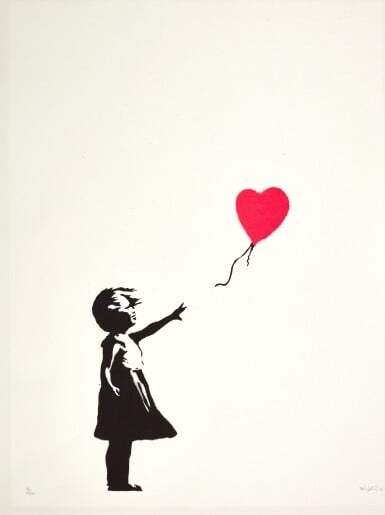
Semiotically, the intact heart-shaped balloon persists as a floating signifier of hope while the referent—the girl—dissolves into strips. Read against prior iterations paired with “There Is Always Hope,” the composition literalizes a hierarchy: the symbol endures, the subject is sacrificed 58. This split visualizes what theorists describe as the autonomy of the sign in late-capitalist image ecologies: icons circulate resiliently even as bodies and materials are expended. The severed string marks the indexical seam where event touches image, a scar that both records action and recodes meaning. By staging this semiotic survival in a high-visibility auction, Banksy shows how icons accrue aura through risk and narrative, not solely through craft or medium 25.

Source: Artsy (iconography of Girl with Balloon); Semiotic study (Privietlab); Journal for Art Market Studies

Related Themes

About Banksy

Banksy is an English street artist associated with the Bristol scene, known for politically edged stencils and interventions that test the boundaries between public space, activism, and the art market. His practice spans walls, editions, film, and orchestrated critiques like the 2018 shredding, situating him within contemporary and post-graffiti art discourse [5][3].
View all works by Banksy

More by Banksy