Girl with Balloon
by Banksy
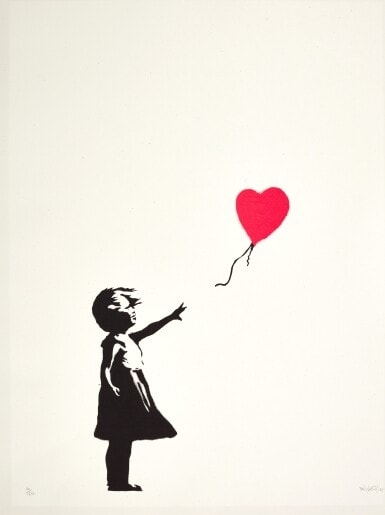
A lone, stenciled child reaches toward a bright red, heart-shaped balloon drifting into the blank field—an image that compresses hope, loss, and resilience into a single gesture. The monochrome figure and the one note of red make Girl with Balloon a portable emblem that moves easily from the street to prints and global campaigns [1][2].
Study Print Studio
Create a personal study print
Build a companion study sheet around the part of this painting that speaks to you most. Choose a detail, shape an interpretation, and walk away with something personal and display-worthy.
Fast Facts
- Year
- 2002 (street motif); 2004–2005 (screenprint editions)
- Medium
- Stencil and aerosol paint on wall; screenprint on wove paper (editions)
- Dimensions
- c. 70 × 50 cm (sheet, print editions); variable (street)
- Location
- Various; original London stencils altered/removed; prints largely in private collections
Click on any numbered symbol to learn more about its meaning
Meaning & Symbolism
Banksy builds the work’s meaning through ruthless economy. The child is rendered in flat black, all edges and silhouette; the balloon is the only saturated color, a bright red heart pulled by a thin, slackened string. That single accent performs the labor of pathos. Because red isolates itself against the otherwise neutral field, it reads as an intensified value—love, promise, a future—while its upward drift confirms that such values are momentary and easily lost. The key is the hand: the fingers are not clenched, not fully open, but frozen at the instant of almost-contact. Banksy scripts a narrative hinge in that gap—either the child has just let go, or they are a breath late in reaching. By refusing to resolve the gesture, he forces viewers to complete the story in their own terms, producing identification (we have all been just-too-late) and agency (we might still reach). Semiotic accounts note how this minimal contrast—monochrome body versus red sign—assigns the balloon the status of an abstract ideal while preserving emotional immediacy through a child-proxy 6.
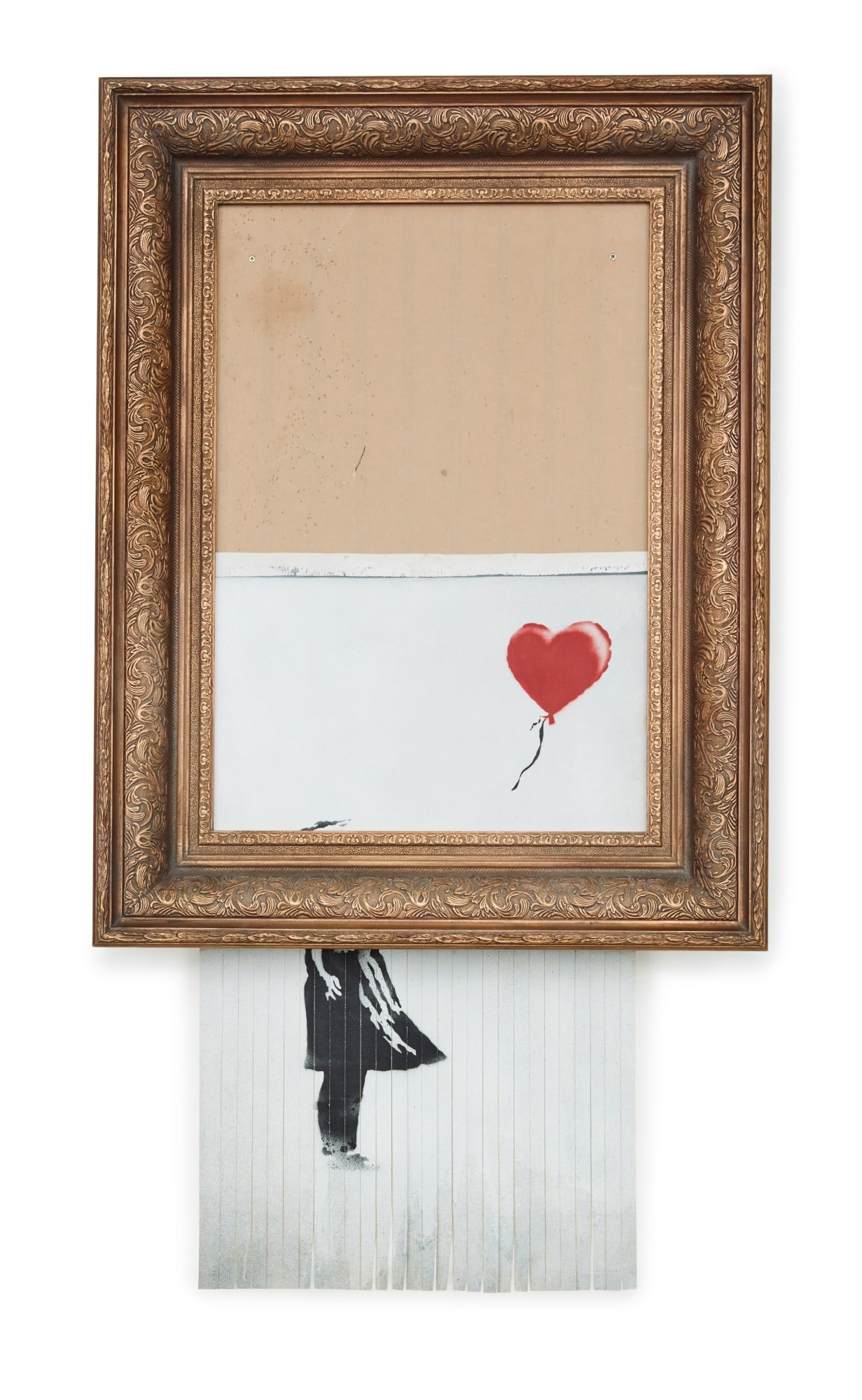
That open structure explains the image’s adaptability. When the stencil appeared on London walls in the early 2000s, sometimes paired with the line “There is always hope,” its optimism was always tempered by the wind tugging the string away 1. In print editions, the crisp screenprint edges and generous negative space intensify the emblem-like clarity, enabling circulation far beyond the street without diluting the motif’s readability 2. Banksy later re-sited the symbol within a concrete emergency by recasting the figure as a Syrian child for the #WithSyria campaign, which shifted the work from generalized longing to a targeted humanitarian appeal; the balloon’s drift there reads as a life interrupted by war, converting private poignancy into public urgency 4. The same mutability powered one of the most consequential moments in recent art history: at Sotheby’s in 2018, a canvas version self-shredded at the fall of the hammer and was authenticated as a new work, Love is in the Bin. The act reframed the familiar image as a performance of value’s instability—desire elevated and destroyed in the same breath—aligning the piece with traditions of auto-destructive art and institutional critique 3.
Why Girl with Balloon is important is thus twofold. First, as street art, it demonstrates how a few highly legible signs can engage a broad, non-specialist public without sacrificing complexity; it is pedagogy by image, not didactic text. Second, as contemporary art, it shows how symbols travel: a child’s reaching hand can speak to private grief, collective trauma, and market spectacle by slight contextual turns, while keeping its core promise of hope under pressure intact 53. The visual details make that durability possible—the directional pull of the balloon, the unresolved hand, the empty field that invites projection. In this way, the work becomes not a fixed story but a reusable tool for feeling, capable of staging resilience even as it concedes loss. The balloon keeps rising; whether we grasp it is the ethical question the picture leaves in our hands.
Explore Deeper with AI
Ask questions about Girl with Balloon
Popular questions:
Powered by AI • Get instant insights about this artwork
💬 Ask questions about this artwork!
Interpretations
Semiotic Reading
Read through semiotics, the image hinges on a tight code: a monochrome silhouette functions as an index of the everyday, while the saturated red heart operates as a floating symbol of ideality whose motion vectors meaning. The tug of the string and the frozen hand create an indeterminate narrative resolved by the viewer—a classic instance of Barthesian “anchorage” when paired with the optional text, which orients without fixing meaning. In Peircean terms, the balloon’s redness is both a qualitative icon (affective intensity) and a symbol (conventional sign for love/hope), while its upward drift signals transience. This compact sign-system explains the motif’s portability across walls, prints, and campaigns without semantic dilution, maintaining immediacy even as contexts shift 8.
Source: Privietlab peer‑reviewed semiotics article
Humanitarian Politics
Banksy’s #WithSyria reworking exemplifies how an adaptable emblem can be re-sutured to a concrete emergency: the child becomes a Syrian girl, the heart’s ascent becomes a figure for lives interrupted by war, and projection onto national monuments translates street activism into state-facing address. The shift is not merely illustrative; it rearticulates agency, inviting spectators to convert pathos into action (donation, advocacy). Importantly, the campaign demonstrates an ethic of appropriation in service of publics—circulating a familiar sign to reframe a news cycle saturated with abstraction. The balloon’s drift thus mediates between individual empathy and geopolitical scale, turning a “private” longing into public urgency 4.
Source: Sky News reporting on #WithSyria projection
Institutional Critique and Auto-Destruction
The 2018 auction intervention, authenticated as Love is in the Bin, relocates meaning from image to event. By embedding a shredder in the frame, Banksy converts a collectible canvas into an auto-destructive performance that materializes value’s instability at the point of market consecration. The half-shredded remnant—neither intact painting nor pure documentation—belongs to a lineage from Gustav Metzger to Tinguely, yet operates with twenty-first-century media savvy: virality as co-author. Institutional critique here is twofold: it exposes the auction as ritual theater and demonstrates how institutions retroactively stabilize rupture by certifying it as a “new work.” Desire and destruction arrive in the same breath, a dialectic the market then re-prices 123.
Source: Sotheby’s lot entry; The Art Newspaper
Circulation and Public Pedagogy
Girl with Balloon is engineered for mass legibility—stencil repeatability, poster-like clarity, and generous negative space—allowing it to migrate from wall to print to screen without losing read. This portability isn’t dilution but pedagogy: a visual lesson in how minimal form can carry complex ethical content to non-specialist publics. The 2004–05 screenprints (signed and unsigned editions) institutionalize circulation while preserving the emblem’s didactic punch, echoing modern poster traditions. As street practice, the work exploits speed (stencil efficiency) and site (urban visibility); as contemporary art, it tests how symbols accrue authority through reproducibility and context-switching—without surrendering their affective core 167.
Source: Smarthistory (artist context) and Sotheby’s print cataloguing
Market Spectacle and Vanitas
Banksy turns auction ritual into a vanitas allegory: what the market crowns, the artist un-makes—transforming triumph into memento. The shredding’s timing (the hammer’s fall) allegorizes price as a fragile veneer; the remnant’s subsequent value spike doubles the critique, revealing spectacle as the market’s metabolic fuel. This is not merely prankism; it is a structural reading of how contemporary art circulates as asset, performance, and media event. The work thereby collapses categories—object, action, documentation—while casting collectors, house, and audience as actors in a choreography of worldly vanity, reprised when the altered piece resold at a dramatically higher price 123.
Source: The Guardian (auction coverage) and Sotheby’s
Related Themes
About Banksy
Banksy is an English street artist associated with the Bristol scene, known for politically edged stencils and interventions that test the boundaries between public space, activism, and the art market. His practice spans walls, editions, film, and orchestrated critiques like the 2018 shredding, situating him within contemporary and post-graffiti art discourse [5][3].
View all works by Banksy →