The Storm

by Giorgione

Giorgione’s The Storm stages human life on the brink of change, fusing pastoral calm with sudden rupture. A watchful youth and a nursing mother face each other across a stream as lightning splits the blue‑green sky, while ruins and a narrow bridge signal fragile passage. The landscape itself becomes the protagonist, turning everyday figures into a poetic allegory of vulnerability and fate [1][2].

Study Print Studio

Create a personal study print

Build a companion study sheet around the part of this painting that speaks to you most. Choose a detail, shape an interpretation, and walk away with something personal and display-worthy.

Fast Facts

Year
c. 1505–1508
Medium
Oil (with traces of tempera) on canvas
Dimensions
82 × 73 cm
Location
Gallerie dell’Accademia, Venice
The Storm by Giorgione (c. 1505–1508) featuring Nursing mother and infant, Youth with staff, Broken column/ruins, Bridge over canal/stream

Click on any numbered symbol to learn more about its meaning

Meaning & Symbolism

Giorgione binds opposed forces into a single, legible drama. On the left, the youth—part courtier‑soldier, part shepherd—plants his staff beside a broken column, the stump of man‑made order. On the right, the nude woman nurses, wrapped in a white cloth that gleams against the greenery, a sign of fertility and charity but also exposure. Between them runs the canal and bridge, compressing the scene into a clear threshold: neither figure crosses, yet sightlines meet over the dark water. In the middle distance, a walled town promises security; above, a jagged lightning bolt tears the heavy sky. These elements operate as a sentence: life begins (infant), culture decays (ruin), passage beckons (bridge), protection is provisional (walls), and fate interrupts (lightning). The landscape is not backdrop but actor; Giorgione turns weather and masonry into syntax, making the storm the work’s verb and the figures its nouns 12. This structure sustains several learned readings without collapsing into one. Read biblically, the pair can stand for Adam and Eve after the Fall—exiled from a garden now transposed into Venetian wetlands, their separation across water and their proximity to ruins underscoring loss and labor; the bolt reads as divine judgment cutting across human refuges 4. Read allegorically, the nursing woman resembles Caritas, the active love that feeds, set against a youthful soldier/fortitude whose purpose is uncertain; their standoff across the stream pictures the unresolved contract between war and charity in civic life 2. Read historically, the walled town and fractured masonry echo Venetian anxieties around the War of the League of Cambrai (1508–1516), when fortifications and bridges were urgent but tenuous; the sudden flash becomes a sign of political contingency flickering over patrician security 3. Crucially, x‑radiography shows Giorgione first placed a second nude where the youth now stands, then revised the painting—evidence that he pivoted from a closed myth to an open poetic calculus of contrasts (nude/armed, nature/culture, shelter/storm), crafting ambiguity as a virtue rather than a gap 26. Giorgione’s color and weather deliver the argument as feeling. Cool blue‑greens pool in the canal and sky; foliage leans subtly toward the coming squall; silvery light threads through the bridge and distant walls. The figures hold still, but the world moves: cloud‑edges shear, the bolt advances, and the city recedes. That atmospheric mobility is Giorgione’s invention—meaning carried by tone and air more than by emblem. The viewer is asked not to decode a single story but to inhabit a condition: before the storm, amid ruins, with love in one’s arms and a staff in one’s hand. In that sense, the painting’s subject is simply time—biological, civic, and meteorological—condensed into a moment that feels both ordinary and fated. The Storm endures because it makes ambiguity ethically and sensually precise: it tells us exactly what it feels like to live on the threshold, and it does so by turning landscape into language 125.

Explore Deeper with AI

Ask questions about The Storm

Popular questions:

Powered by AI • Get instant insights about this artwork

💬 Ask questions about this artwork!

Interpretations

Political-Historical Lens (Cambrai Wars)

Read against 1508–1509, the bridge, walls, and shattered stone behave like crisis-architecture: channels of passage under threat, masonry that cannot guarantee safety. Deborah Howard argues that Venetian pictures of these years register patrician anxiety—fortifications proliferate, yet a flash from above can nullify them in an instant. The poised youth across from the nursing woman suggests a civic dyad—defense and care—suspended as policy and weather shift. In this climate, the landscape’s storm is not décor but a political mood: an icon of contingency that flickers over private life and public order alike 31.

Source: Deborah Howard, Art History (1985); Gallerie dell’Accademia

Process and Poesia: The X-ray as Interpretation

Radiography reveals that Giorgione first placed a second nude where the youth now stands, then repented, installing a clothed male with staff. This pentimento is not a mere correction; it is a conceptual pivot from closed myth to open poesia, exchanging a sealed erotic pairing for a charged contrast (armed/cultured vs. maternal/natural). The revision clarifies the method: meaning emerges through calibration of differences, not through a fixed story. The painter composes a thinking machine—figures as nouns, weather as verb—whose final state deliberately preserves ambiguity as a positive, learned value 26.

Source: Smarthistory; Monika Schmitter, Studies in Iconography

Colorito and Atmospheric Causality

Venetian colorito makes argument out of tone: cool greens and silvers circulate like weather systems, advancing the storm as a causal force that binds space, figures, and time. Instead of emblematic clarity, Giorgione opts for tonal transitions—wet roads, moving clouds, leaf-dark against sky—that carry the work’s ethical voltage. Landscape is actor, not stage: a sensuous grammar where civic masonry pales into distance as pressure builds aloft. This is the Venetian invention admired by later writers—meaning delivered through air and light, proving that atmosphere can structure narrative as surely as contour can 51.

Source: Encyclopaedia Britannica; Gallerie dell’Accademia

Humanist Studiolo Reading

Made for a private, learned setting, the picture reads like a compacted exercise in Venetian poesia, suited to a studiolo where weather and ruins invite philosophical rumination. A Lucretian lens—common in Renaissance humanist circles—clarifies how clouds, light, and sudden storm become meditations on nature’s constitutive motion rather than mere backdrop. In this view the painting teaches by mood: a world of atoms and swerves where security is provisional and perception is training in prudence. The cultivated collector (Vendramin) would have recognized the image as a prompt for colloquy, not a single myth—an atmospheric thesis about contingency and sensation, delivered through color and air rather than inscription 715.

Source: Renaissance Quarterly (studiolo and Lucretius); Gallerie dell’Accademia; Encyclopaedia Britannica

Allegory and Early Modern Charity

The nursing figure aligns with pre-Ripa conventions of Caritas: a mother feeding a child as emblem of sacrificial love. While Cesare Ripa later codifies this, earlier imagery already tied maternal lactation to charity’s civic and theological meanings. Tiny avian motifs on rooftops have been read (cautiously) as storks—birds emblematic of filial piety in humanist emblem culture—reinforcing a network of parental virtues. Yet Michiel’s 1530 note (“gypsy woman and a soldier”) complicates a tidy allegory, mixing social type with virtue sign. The result is a hybrid: lived marginality and ideal caritas interwoven within a storm-prone polis 896.

Source: British Art Studies (Charity iconography); Horapollo, Hieroglyphica; Monika Schmitter, Studies in Iconography

Related Themes

About Giorgione

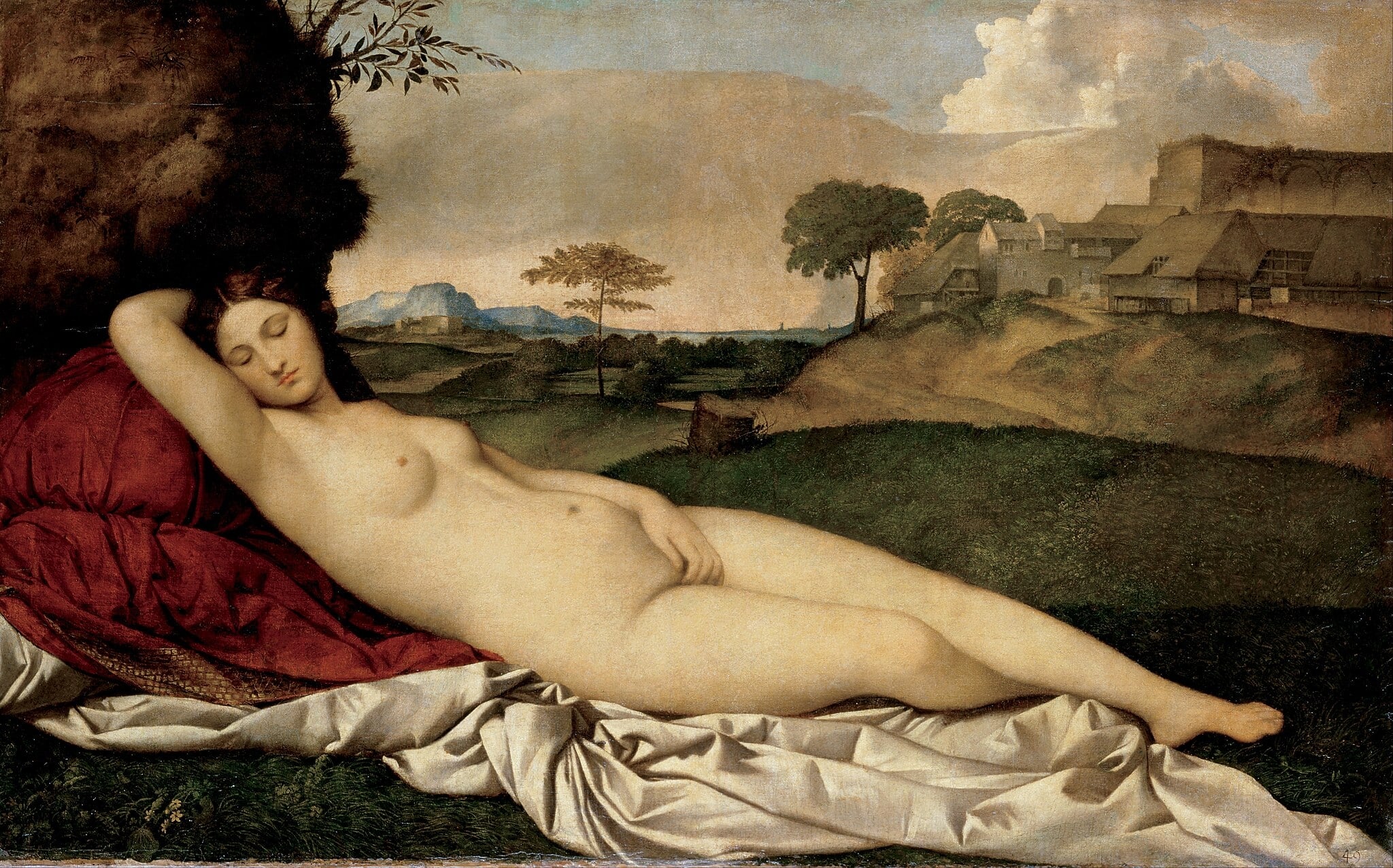
Giorgione (c. 1477/78–1510) was a seminal Venetian painter whose small oeuvre profoundly shaped the city’s poetic, color-driven mode. Renowned for atmospheric ‘poesia’ and idealized forms, he influenced Titian directly; The Sleeping Venus is often treated as a keystone of this legacy [2][5].
View all works by Giorgione

More by Giorgione