Noon

by Joan Mitchell

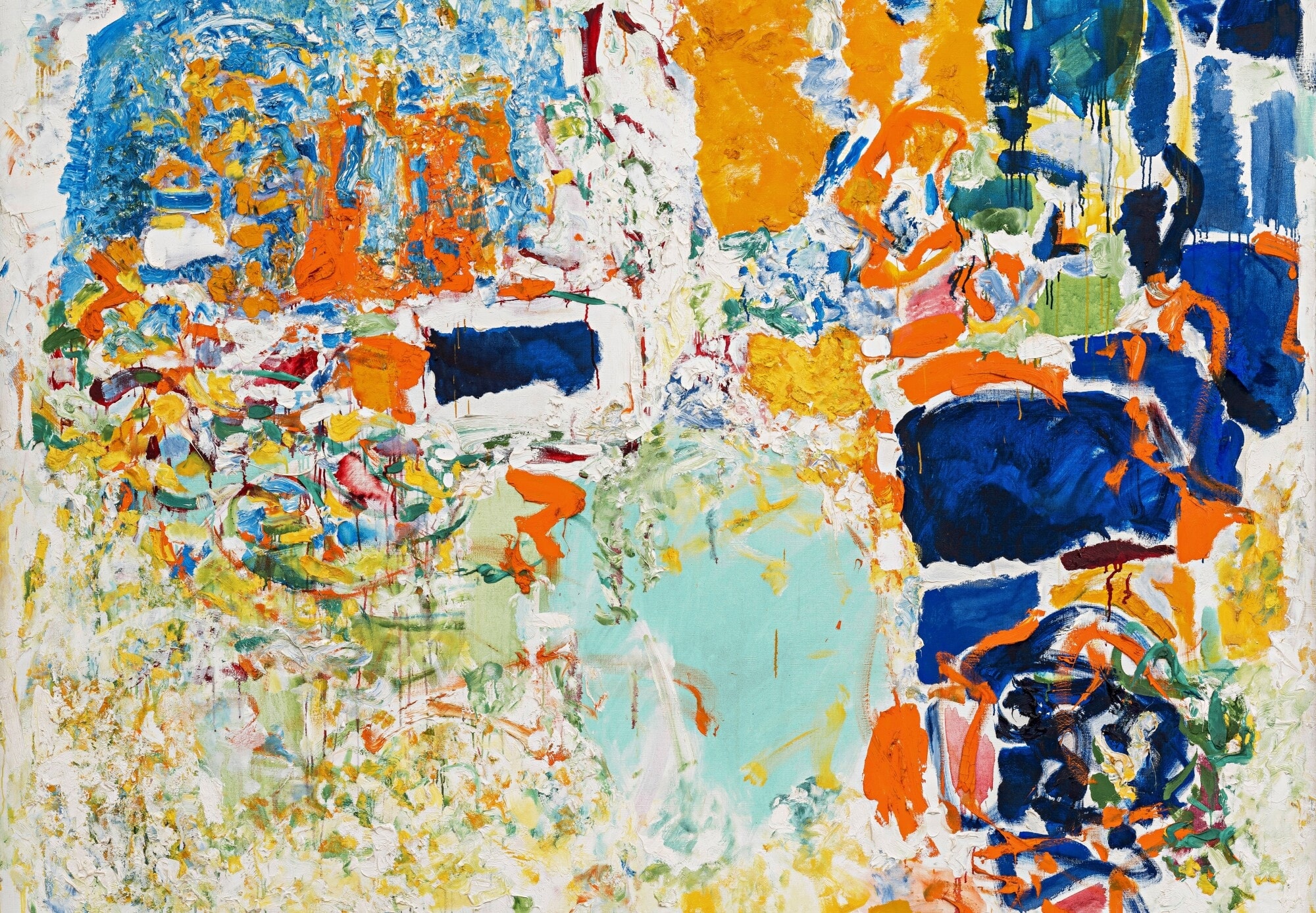
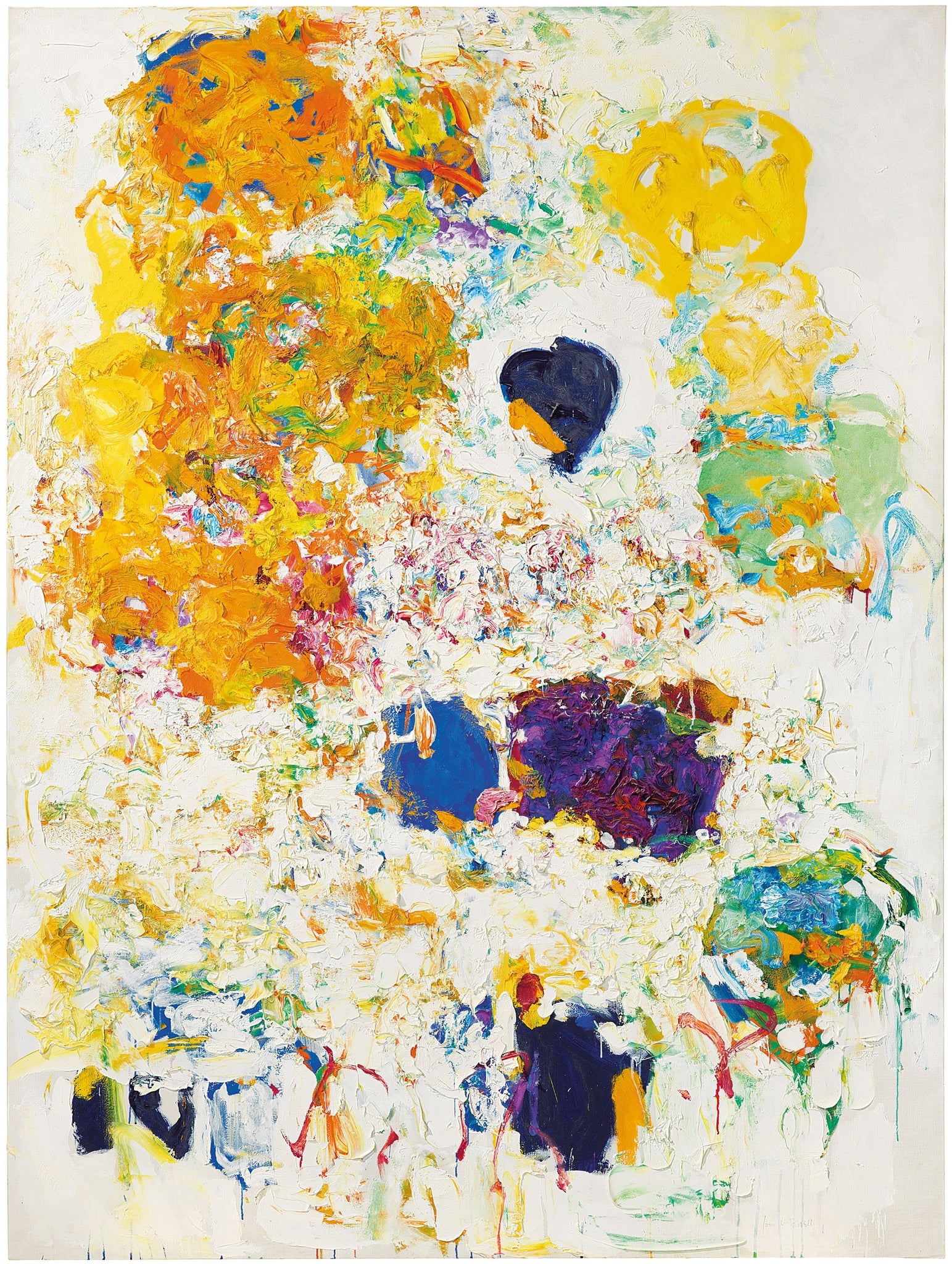
Painted in 1969, Joan Mitchell’s Noon is a monumental oil whose blazing oranges, ultramarines, and ragged whites condense the glare and density of midday into gesture. A central mint-turquoise clearing is ringed by stacked blocks of orange and navy, while drips and dragged impasto stage a volatile equilibrium between dazzle and depth [1][2].

Study Print Studio

Create a personal study print

Build a companion study sheet around the part of this painting that speaks to you most. Choose a detail, shape an interpretation, and walk away with something personal and display-worthy.

Fast Facts

Year
1969
Medium
Oil on canvas
Dimensions
261.6 x 200.6 cm
Location
Private collection
Noon by Joan Mitchell (1969) featuring Mint‑turquoise clearing, Interlocking navy rectangles with orange bands, Ragged white shears, Falling drips

Click on any numbered symbol to learn more about its meaning

Meaning & Symbolism

Noon asserts that sensation can be built, not merely described. The painting’s architecture pivots on a pale, mint-turquoise field near center, a chromatic breathing space against which Mitchell braces compacted passages of cadmium orange and dense ultramarine. At the upper right and lower right, navy-blue rectangles interlock with orange bands; at left, a churn of cobalt and orange rises into a thickened, stippled dome. These masses are not ornamental; they are structural counterweights that stage noon’s simultaneity—the world fully exposed, yet spatially flattened by glare. Ragged whites shear across the surface like sun-flare, dissolving edges and forcing the eye to squint, while drips that tumble from the blues and oranges register heat as time: paint liquefies, descends, and then collides with stacked, blocky strokes that arrest the flow 12. The push-pull between falling drips and arrested slabs produces a felt pressure, the stillness of midday vibrating with optical noise. Mitchell’s method clarifies the work’s stakes. She insisted she painted from remembered landscapes and the feelings they summoned; titles came afterward, keyed to what the painting had become 4. Noon, then, names a condition the painting constructs. The saturated oranges read as sun-struck foliage or walls, but not as symbols; their meaning is abstract and structural—heat as chroma, glare as broken white, shelter as navy weight. The central mint expanse functions like an ocular respite, a retina-cooling pool that keeps the composition from total saturation. Around it, she layers heterogeneous touches—impastoed slabs, scumbled veils, pattering stipples—so the surface oscillates between opacity and translucency, much as light at noon both blinds and reveals 12. This oppositional matrix, frequently noted in Mitchell scholarship, is not mannerism but content: the work communicates equilibrium under duress, a balance struck at the peak of day 3. Context sharpens the reading. Executed soon after Mitchell’s move to Vétheuil—the Seine valley terrain of Monet—Noon participates in a dialogue about how painting can register light without depiction. Like Monet’s serial noon effects, Mitchell pursues duration and temperature, but by abstract means: intervals of bare or lightly stained canvas admit air; thick, scraped, and reworked passages accumulate time. Auction and foundation texts stress the late-1960s turn to large scale and a radiant palette; here, breadth enables her to stage multiple optical climates at once: the right-hand navy/orange bulwarks feel shaded and cool, even as the left surges with ochre and cobalt glare 23. That simultaneity is why Noon is important within her oeuvre: it demonstrates her capacity to compress landscape memory into formal tension, to make painting itself carry the load of weather, heat, and brightness. The work’s authority lies in its decisive structure—zones that lock like chords—and in its refusal of illustration. Noon does not picture the sun; it generates a noon—an achieved state where vision teeters between overwhelm and clarity, and where Mitchell’s remembered country becomes an instrument tuned to intensity 1234.

Explore Deeper with AI

Ask questions about Noon

Popular questions:

Powered by AI • Get instant insights about this artwork

💬 Ask questions about this artwork!

Interpretations

Formal Analysis

Noon orchestrates a tense field of oppositions that produce spatial and optical ambiguity. The central mint-turquoise breathing space acts as negative pressure, a calibrated recess that interrupts saturation and clarifies adjacent chroma. Around it, Mitchell counterposes impastoed rectangles with scumbled veils and pattering touches, so planes alternately assert and dematerialize. This dialectic—weight vs. transparency, block vs. drip—leverages figure/ground instability to mimic the squinting condition of midday glare. Crucially, the right-hand navy/orange “bulwarks” behave like visual buttresses, pinning the composition while the left-hand churn surges upward, a vectorial tilt that keeps the eye in motion. The result is not decorative variety but a structural grammar: discrete “chords” of color that lock, pause, and release across the span, rendering equilibrium as something achieved, not given 12.

Source: Christie’s; Sotheby’s

Historical Context

Painted soon after Mitchell settled in Vétheuil, Noon belongs to the moment when expanded studio space enabled her late‑1960s leap in scale and radiance. That relocation also positioned her in direct conversation with Monet’s terrain and his investigations of temporal light. Where Monet parsed noon via serial motifs, Mitchell internalizes duration into procedural layers: intervals of bare or lightly stained canvas admit air, while thick, reworked passages bank time as accretion. The painting’s breadth allows concurrent optical climates—cool, shaded right vs. blazing, cobalt‑ochre left—so the canvas stages simultaneity rather than sequence. In early exhibitions (Fournier, 1969; Everson/Martha Jackson, 1972), Noon helped define her “country” period as one where landscape memory became a structural engine, not a subject to depict—crucial for her consolidation as a leading post‑war abstractionist in France and the U.S. 123.

Source: Christie’s; Sotheby’s; Joan Mitchell Foundation

Psychological Interpretation

Mitchell’s stated method—painting from remembered landscapes and the feelings they summon—suggests Noon operates as a mnemonic device tuned to affect. The painting’s glare‑whitened shears and heat‑dense oranges function like somatic triggers, recalling how memory stores place as sensation rather than image. Drips that tumble and then arrest against stacked strokes read as micro‑narratives of attention: a mind wandering (liquefying, descending) and re‑focusing (colliding, bracing). The title, assigned after completion, crystallizes what the painting had become—an atmosphere or “state”—rather than naming a scene. In this sense, Noon’s equilibrium under duress models psychological self‑regulation: a felt balance achieved amid overstimulation, as the retina seeks respite in the mint field while peripheral zones insist on intensity. The work’s authority lies in this conversion of memory to structure, affect to architecture 14.

Source: Smithsonian Magazine; Christie’s

Medium Reflexivity

Noon turns oil paint into an instrument for measuring time and temperature. Liquefied blues and oranges that drip register gravity and duration; scraped, blocky slabs counter‑inscribe stoppage and resistance. These are not merely stylistic signs but indexical traces—evidence of forces acting on matter—so that the work “models” noon through the behavior of the medium itself. Dry, stippled passages scatter light differently from glossy impasti, creating local micro‑climates across the surface. Such heterogeneity makes the viewer’s looking durational, sequencing touch, sheen, and density the way one acclimates to glare outdoors. In this reflexive framework, painting both depicts and enacts: it is at once the site where sensation is constructed and the procedure that proves sensation’s construction, making medium and meaning coextensive 23.

Source: Sotheby’s; Joan Mitchell Foundation

Comparative/Oeuvre Position

Situated near Mitchell’s late‑1960s Sunflower canvases, Noon exemplifies her pivot from clustered bouquet forms to more architectonic zoning. Auction and foundation texts note the era’s radiant palette and increasing scale; here, amplitude allows polyrhythmic “chords” to sound at once, rather than in series. Compared with earlier, denser New York works, Noon’s central mint interval creates a modernist pause that recalls high‑key Post‑Impressionist light while asserting second‑generation AbEx structure. Its dialogue with Monet is not derivative: Monet’s serial noon accumulates temporality across canvases, whereas Mitchell compacts time within a single surface via heterogeneous touch and withheld ground. This compression—landscape memory into formal tension—marks Noon as a keystone in her mature language, balancing lyricism with decisive, load‑bearing design 123.

Source: Christie’s; Sotheby’s; Joan Mitchell Foundation

Related Themes

About Joan Mitchell

Joan Mitchell (1925–1992) emerged among the second generation of Abstract Expressionists in 1950s New York and developed a lifelong practice between the U.S. and France. Drawing on memory, landscape, poetry, and music, she forged a distinctive language of dense chromatic centers and breathing peripheries; by the late 1960s she was based in Vétheuil, working at ambitious scales and in lyrical series [3][4].
View all works by Joan Mitchell

More by Joan Mitchell