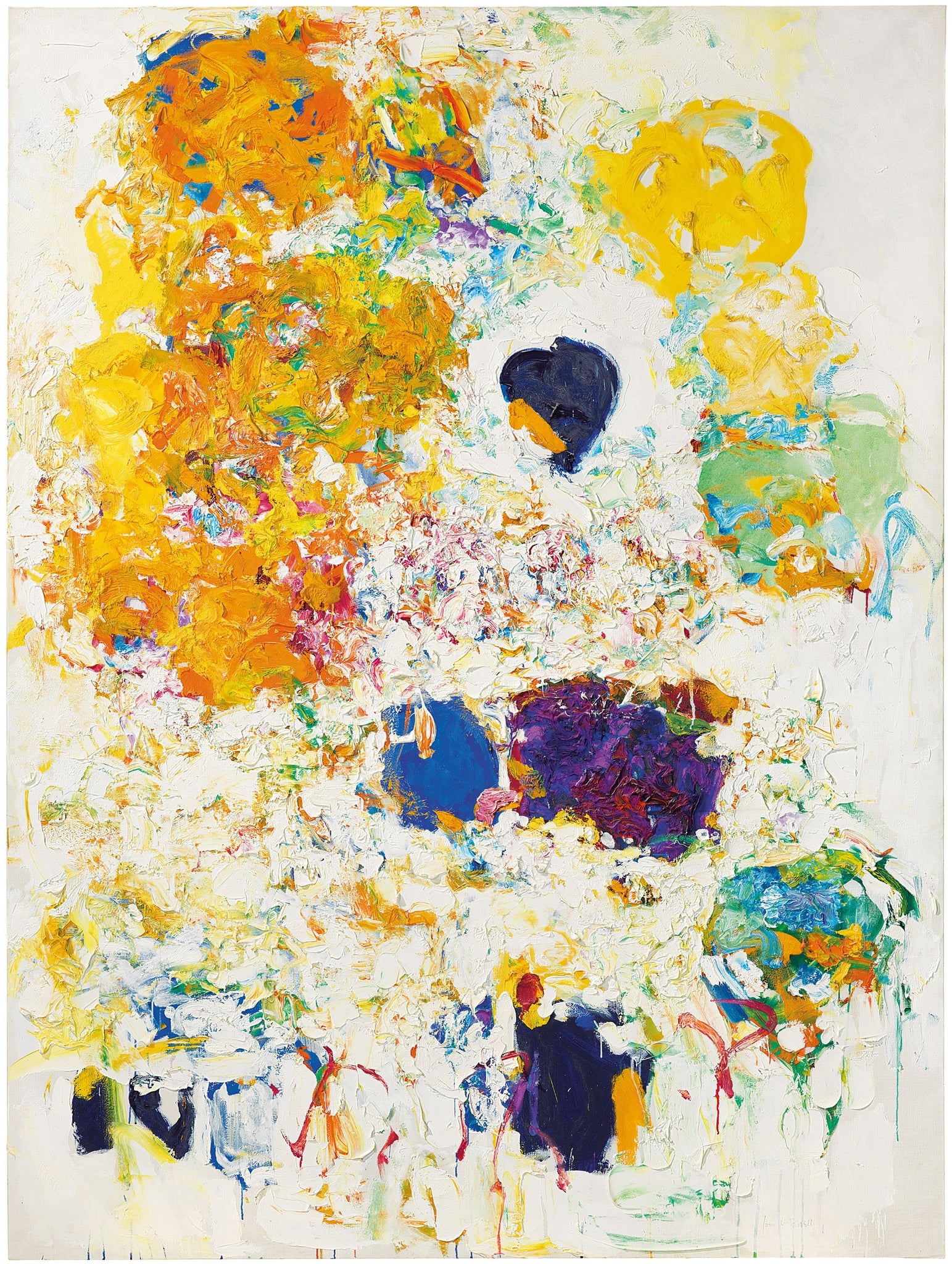
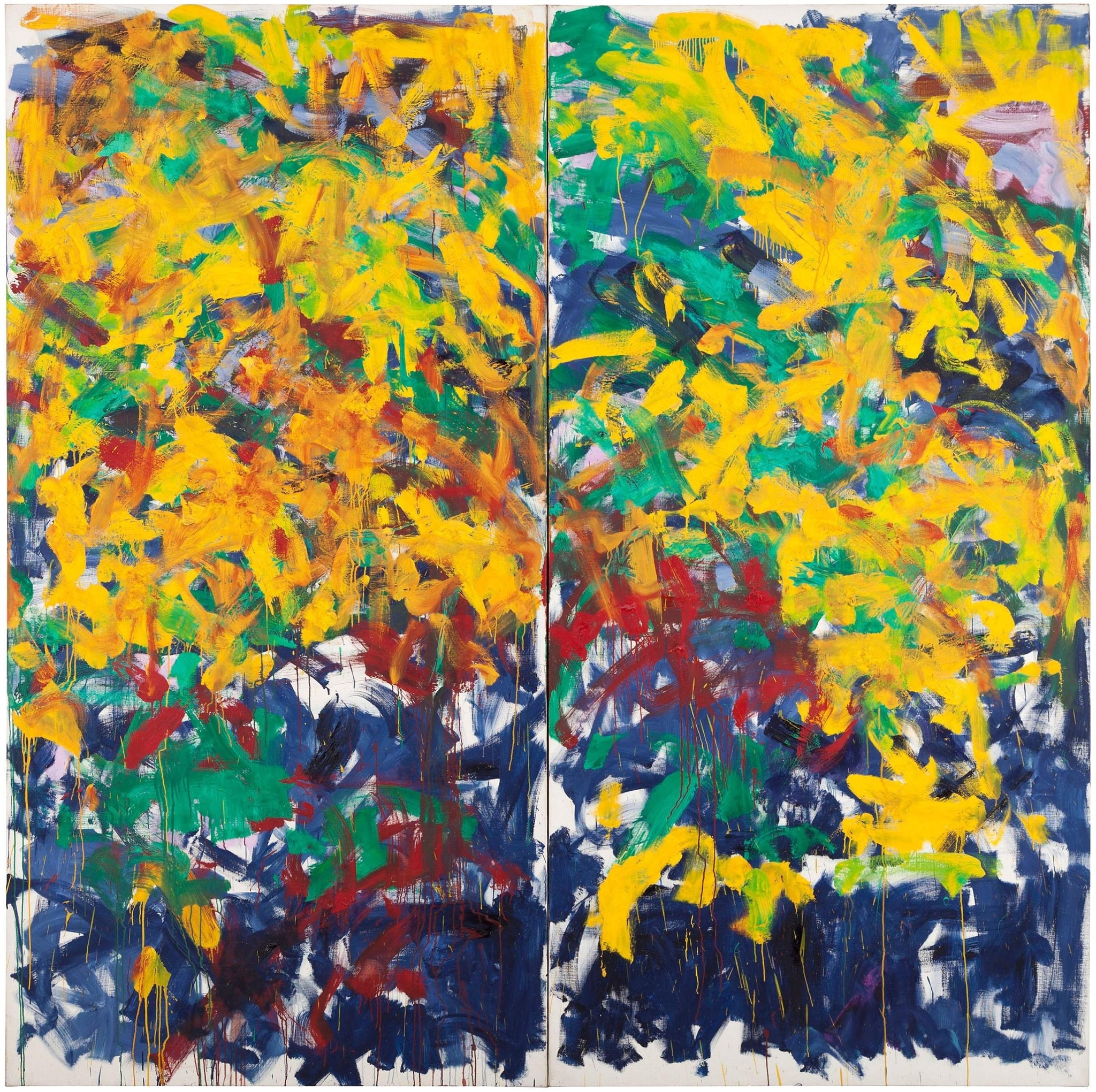
La Grande Vallée VII
La Grande Vallée VII is a monumental diptych in which Joan Mitchell converts a remembered landscape into a charged field of color and motion. Cascades of blazing yellow, leafy green, and inky blue collide across the seam, where drips and slashing strokes keep the surface alive—an arena where exuberance and elegy co-exist [1][2].
Study Print Studio
Create a personal study print
Build a companion study sheet around the part of this painting that speaks to you most. Choose a detail, shape an interpretation, and walk away with something personal and display-worthy.
Fast Facts
- Year
- 1983
- Medium
- Oil on canvas (diptych)
- Dimensions
- approx. 260 x 261 cm overall (see sources for minor measurement variance)
- Location
- Private collection
Click on any numbered symbol to learn more about its meaning
Meaning & Symbolism
Across two towering panels, Mitchell organizes feeling as weather. The left and right canvases are sutured by a narrow vertical interval that behaves like a hinge in memory: it opens a passage while reminding us that experience is split and rejoined. Above mid-height, thick skeins of sun-charged yellow sweep laterally and then arc downward; beneath, dense blue pools accumulate, their edges feathered by streaks and drips that pull gravity into the picture. Between them, greens surge in irregular swathes, while threads of red and maroon knot and release the eye, like veins or vines that keep the circulation of looking—and feeling—uninterrupted. Mitchell’s facture is decisive: loaded, slashing strokes; scumbles that rasp across earlier layers; and rivulets that refuse closure. These moves do not describe flowers, sky, or water; they propose their energies. As Mitchell often insisted, she painted from remembered landscapes and what they “leave” in her—here, yellow can be sun or flowers, blue water or sky, but always affect first, referent second 2. The result is not a view but a field in which intensity itself is the subject 12.
Biographically, the series rises from a braid of stories and losses: the composer Gisèle Barreau’s tale of a secret childhood valley and the death of her cousin, alongside the death of Mitchell’s own sister in the same week. La Grande Vallée VII converts that adversity into amplitude—what philosopher Véronique Fóti terms a trans‑substantiation of adversity—by expanding sorrow into rhythm, color, and breath 234. You can feel this in the painting’s temporal signatures: staccato yellow marks that syncopate against legato blue pools; vertical drips that register duration; and sudden clearings of raw canvas that flash like inhalations. Such orchestration reflects Mitchell’s deep rapport with music and poetry, long noted by curators of her late work: composition as phrasing, repetition as refrain, contrast as counterpoint 5. The painting’s seam further intensifies this musicality—two staves that read continuously yet admit a bar line in the middle, a structural beat that both divides and unifies. In this way, La Grande Vallée VII asserts nature not as subject matter but as arena for emotion, where color becomes language and gesture becomes memory’s musculature 245.
That ambition situates the work at the apex of Mitchell’s late career. Painted in Vétheuil in 1983, within a 21‑painting cycle of single canvases, diptychs, and one triptych, VII assumes a scale traditionally reserved for history painting but dedicates it to interior weather—an ethics of looking equal to life’s radiance and weight 125. Its continued prominence in exhibitions and its landmark market history underline how fully it embodies Mitchell’s expansion of Abstract Expressionism into a transatlantic, late‑20th‑century idiom that binds place, memory, and feeling without depiction 56.
Explore Deeper with AI
Ask questions about La Grande Vallée VII
Popular questions:
Powered by AI • Get instant insights about this artwork
💬 Ask questions about this artwork!
Interpretations
Phenomenology of Grief
Philosopher Véronique M. Fóti reads the Grande Vallée canvases as instantiations of a lived, temporal field where adversity is not represented but trans‑substantiated—changed in substance—through luminous gesture and horizon effects. In VII, the pooling blues register duration, the sheeting yellows flare like brief intensities of presence, and the vertical drips index time’s descent. This is grief organized as exposure rather than image: a phenomenological surface where sorrow and vitality co‑inhabit, sustained by the painting’s scale and syncopated facture. The result is an affective topology—less a scene than a state—where bereavement (Mitchell’s sister; Barreau’s cousin) is metabolized into rhythm and breath, refusing closure while enlarging capacity for feeling 32.
Source: Véronique M. Fóti, Philosophy Today
Rhythmic Composition and Musical Counterpoint
Mitchell’s rapport with music offers a structural key: the diptych reads like adjacent staves, the seam a bar-line that coordinates phrases across panels. Staccato yellow attacks ride over legato blue sustains, while green passages provide middle-register continuity; red and maroon act as syncopated accents that prevent harmonic stasis. This orchestration clarifies why the work feels composed rather than improvised: repetition functions as refrain, contrast as counterpoint, and clearing as rest. Such musical logics convert landscape memory into time-based form, aligning with the artist’s avowed ties to poetry and the composer Gisèle Barreau’s influence within this cycle. In VII, looking becomes listening: a score for grief transposed into color and cadence 42.
Source: SFMOMA (retrospective catalogue)
The Diptych as Hinge and Passage
VII’s identity as a diptych is not incidental; it is the work’s central engine of spacing and recall. The narrow vertical interval both sutures and divides, producing a reversible hinge that lets vision cross while reminding it of the split—an architecture of passage that echoes other Grande Vallée titles. This constructed cleft intensifies the painting’s internal weather: yellows loft across the join before cascading, while blues pool differently on each side, introducing non-synchronous time. The seam converts a continuous field into a doubled memory, staging difference without rupture. In this sense, format becomes content: a structural beat that turns painting into a choreography of approach, crossing, and return 21.
Source: Christie’s lot essay; Joan Mitchell Foundation
Late Monet Dialogues and Immersion
Placed in dialogue with Monet’s late cycles, VII participates in a transgenerational project: dissolving motif into immersive atmospheres while retaining the charge of place. Where Monet’s lilies dilate into vaporous light, Mitchell’s remembered valley condenses into chromatic vectors—yellow weather, blue reservoirs, green surge—without giving up scale-induced bodily address. The Fondation Louis Vuitton’s pairing underscored this shared wager: landscape as a site where sensation, duration, and memory cohere, not as view but as milieu. Mitchell radicalizes the premise by emptying out referents altogether, asking color to carry feeling first and association second, and transforming the water-garden’s lyricism into an athletic, resistant surface that keeps looking alive 54.
Source: Fondation Louis Vuitton (Monet–Mitchell: Dialogue and Retrospective)
Reception, Scale, and Canon Formation
By assuming history-painting scale for interior weather, VII helped reframe late Abstract Expressionism as a capacious, transatlantic idiom. Retrospectives have positioned the Grande Vallée cycle as a late-career apex, clarifying how Mitchell extended gestural abstraction beyond midcentury heroics toward memory, music, and grief. The work’s market arc—culminating in a new auction record for Mitchell in Asia—tracks institutional embrace, but more importantly, it signals a consensus about the painting’s achievement: to make intensity itself the subject, and to anchor that ambition in disciplined structure rather than spectacle. Canon formation here turns on rigor and resonance: a diptych that sustains both breadth and beat, radiance and weight 46.
Source: SFMOMA; Sotheby’s
Related Themes
About Joan Mitchell
Joan Mitchell (1925–1992) emerged among the second generation of Abstract Expressionists in 1950s New York and developed a lifelong practice between the U.S. and France. Drawing on memory, landscape, poetry, and music, she forged a distinctive language of dense chromatic centers and breathing peripheries; by the late 1960s she was based in Vétheuil, working at ambitious scales and in lyrical series [3][4].
View all works by Joan Mitchell →