How Much Is Belshazzar's Feast Worth?
Last updated: March 13, 2026
Quick Facts
- Methodology
- comparable analysis
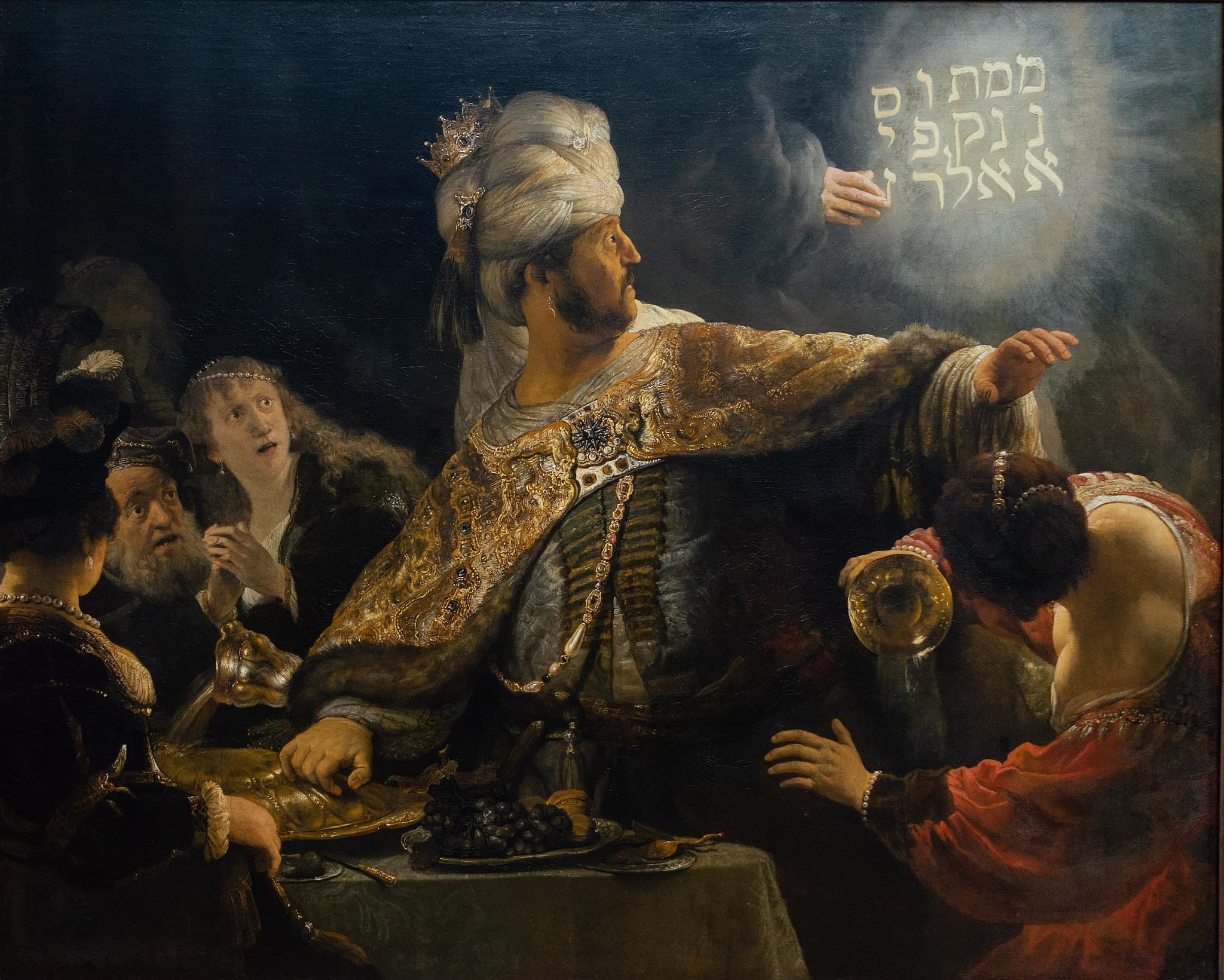
If this is the canonical, autograph Belshazzar’s Feast (National Gallery, NG6350) the work is effectively off‑market and a market‑equivalent/insurance valuation is approximately $100–$150 million. This band assumes a secure autograph attribution, museum‑quality condition and established provenance; a downgrade to studio/follower would reduce value to the low millions.
Valuation Analysis
Valuation conclusion: The canonical Belshazzar’s Feast by Rembrandt (National Gallery, inv. NG6350) is a major, museum‑quality history painting and, because comparable autograph Rembrandts rarely enter open market, its practical market‑equivalent (insurance/replacement) value sits in the $100–$150 million band. The National Gallery picture is a principal reference for the composition and is effectively off‑market, which constrains direct price discovery but supports a high replacement valuation [1].
Methodology: This estimate is driven by comparable analysis of the very limited universe of top‑tier Rembrandt transactions and museum purchases rather than a single recent auction lot. The 2016 joint acquisition by the Rijksmuseum and the Louvre of the two full‑length portraits (Maerten Soolmans and Oopjen Coppit) establishes a contemporary museum‑level ceiling for Rembrandt masterpieces (reported at €160M for the pair) and demonstrates institutional willingness to pay at the uppermost tier [2]. Public auction benchmarks (secured autograph Rembrandts sold in the tens of millions) and headline reattributions also anchor the lower end of the band; when combined with qualitative adjustments for scale, subject and provenance, the $100–$150M band is a conservative, defensible market equivalent for an autograph Belshazzar.
Key assumptions and sensitivity: The estimate assumes (A) robust, expert consensus that the work is fully autograph; (B) no catastrophic condition issues and a documented, museum‑grade conservation history; and (C) unencumbered title/export status. If any of these assumptions fail—particularly attribution—the value profile changes dramatically: a securely attributed studio or follower work would more typically be valued in the low millions or less, while a heavily restored or questionably provenanced picture would trade at a material discount.
Market context and comparables: Recent market activity underlines selective but strong demand for securely attributed Rembrandt works and for rare, well‑provenanced sheets and paintings that survive scholarly scrutiny. Rediscoveries and reattributions have produced notable auction results (and the market has shown strong appetite for top‑quality drawings and prints), which supports the notion that museum‑quality Rembrandts retain very high replacement values even when they do not appear at auction [3][4][5].
Practical next steps: For any formal commercial or insurance valuation you should secure high‑resolution recto/verso photography, an up‑to‑date condition report, full provenance documentation, and technical analysis (infrared, x‑ray, pigment/dendrochronology as applicable). A final market valuation should be provided by an Old Master specialist appraiser in coordination with conservators and, if relevant, the Rembrandt scholar community. Given those caveats, $100–$150 million is the reasoned market‑equivalent estimate for an autograph, museum‑quality Belshazzar’s Feast.
Key Valuation Factors
Art Historical Significance
High ImpactBelshazzar’s Feast (the canonical composition) is a major Rembrandt history painting: large scale, complex biblical subject matter and important in scholarship and exhibition history. History paintings by Rembrandt are scarce relative to portraits and studies, and they carry outsized institutional and scholarly value. This rarity elevates both cultural and market standing and supports a high replacement/insurance valuation because museums place premium importance on acquiring or retaining such signature narrative works. The painting’s significance also intensifies buyer competition in any hypothetical top‑tier private or institutional sale.
Attribution (autograph vs. studio)
High ImpactAttribution is the single most decisive value driver. A firm autograph Rembrandt attribution sustains the present high estimate band; conversely, a reclassification to studio, follower, or heavily assisted execution typically reduces market value precipitously (often to the low millions or less). Attribution requires connoisseurship, catalogue‑raisonné inclusion and technical verification; new technical studies or consensus shifts therefore have material price impact. Market liquidity and buyer pool are far greater for works with unanimous scholarly support.
Provenance & Ownership
High ImpactClean, long provenance in notable collections—such as the documented Knowsley / Earl of Derby history and the National Gallery acquisition history—significantly bolsters buyer confidence and market value. Well‑documented provenance reduces restitution/export risk and enhances institutional interest in insurance/replacement valuations. Gaps in provenance, contested ownership, or unresolved restitution claims materially depress marketability and can render the work unsellable to major institutions.
Condition & Conservation
High ImpactStructural condition, the extent of original paint, and the degree and visibility of past restorations exert direct influence on price. A picture in stable, well‑conserved condition with minimal invasive restorations commands near‑full market value; conversely, heavy overpainting or structural compromise can reduce appeal to museums and private collectors and therefore lower the achievable price by tens of percent. A formal conservation report and documentation of past interventions are essential to substantiate the estimate.
Market Scarcity & Demand
High ImpactTop‑tier Rembrandts are extremely scarce in the open market; most important examples are held by national museums. Scarcity and institutional demand push replacement/insurance valuations upward, while auction liquidity remains limited. Periodic reattributions and rediscoveries spike demand and create isolated price records, but the market is selective: trophies with impeccable scholarship and provenance attract intense competition, whereas attribution‑uncertain works do not.
Sale History
Belshazzar's Feast has never been sold at public auction.
Rembrandt van Rijn's Market
Rembrandt van Rijn is a preeminent, A‑list Old Master whose securely attributed paintings, drawings and prints command significant museum and private demand. Major Rembrandt paintings are scarce at auction, leading to infrequent but high‑value outcomes; the public‑auction benchmarks for paintings sit in the multi‑millions to tens of millions, while museum purchases and negotiated deals for top masterpieces demonstrate a substantially higher ceiling. Collectors and institutions prize autograph works with strong provenance and technical validation, and recent high‑profile reattributions and record results for drawings have reinforced Rembrandt’s market strength.
Comparable Sales
Portraits of Maerten Soolmans and Oopjen Coppit
Rembrandt van Rijn
Top-tier museum purchase for two autograph Rembrandt full-length portraits; provides the contemporary market ceiling for museum-quality Rembrandt masterpieces and is the best available market analogue for the top end of a major Rembrandt painting's value.
$174.0M
2016, Joint acquisition by the Rijksmuseum and the Louvre (private sale; deal announced)
~$235.0M adjusted
Portrait of a Man with Arms Akimbo
Rembrandt van Rijn
Public-auction benchmark for a Rembrandt painting (secure autograph portrait); useful as an auction-based ceiling/benchmark prior to major private museum purchases — though smaller in scale and different subject than Belshazzar's Feast.
$33.3M
2009, Christie's London (Old Masters evening sale)
~$50.3M adjusted
The Adoration of the Kings
Rembrandt van Rijn
A reattributed/rediscovered Rembrandt history painting sold at auction; shows the premium that secure reattributions/rediscoveries can fetch for narrative/biblical subjects, but it is materially smaller/less prominent than Belshazzar's Feast.
$13.8M
2023, Sotheby's London (Old Masters sale)
~$14.6M adjusted
Pair of small Rembrandt portraits (signed and dated 1635)
Rembrandt van Rijn
Recent auction result for securely attributed small Rembrandt portraits demonstrating strong demand/pricing for high‑quality, well‑provenanced portrait works; informative on buyer appetite but different in scale/subject from a large history painting.
$14.3M
2023, Christie's London (Old Masters sale)
~$15.2M adjusted
Current Market Trends
The Old Masters market in 2024–2026 has been selective but supportive for museum‑quality Rembrandts: strong results for rare drawings and reattributed paintings, institutional acquisitions and headline rediscoveries have reinforced demand. The segment is ‘spiky’—few lots move the market, but when an authenticated masterpiece appears it can achieve outsized prices driven by scarcity and institutional competition.
Sources
- National Gallery, London — Rembrandt, Belshazzar’s Feast (NG6350)
- Louvre / Rijksmuseum press release — Joint acquisition of Maerten Soolmans & Oopjen Coppit (Rembrandt), 2016
- Artnet coverage — Reattributed Rembrandt examples and market commentary (Sotheby's, 2023)
- The Leiden Collection / Sotheby's — Young Lion Resting (Rembrandt drawing) post‑sale release, Feb 2026
- Artnet Intelligence — Mid‑Year 2025 Old Masters market report