How Much Is The Jewish Bride Worth?
Last updated: February 22, 2026
Quick Facts
- Methodology
- comparable analysis
Our synthesized estimate for Rembrandt’s The Jewish Bride is $180–230 million in an unconstrained, global open‑market sale. In a realistic institutional negotiation (the only plausible pathway given public ownership and export controls), pricing would likely cluster toward the lower half of that band.
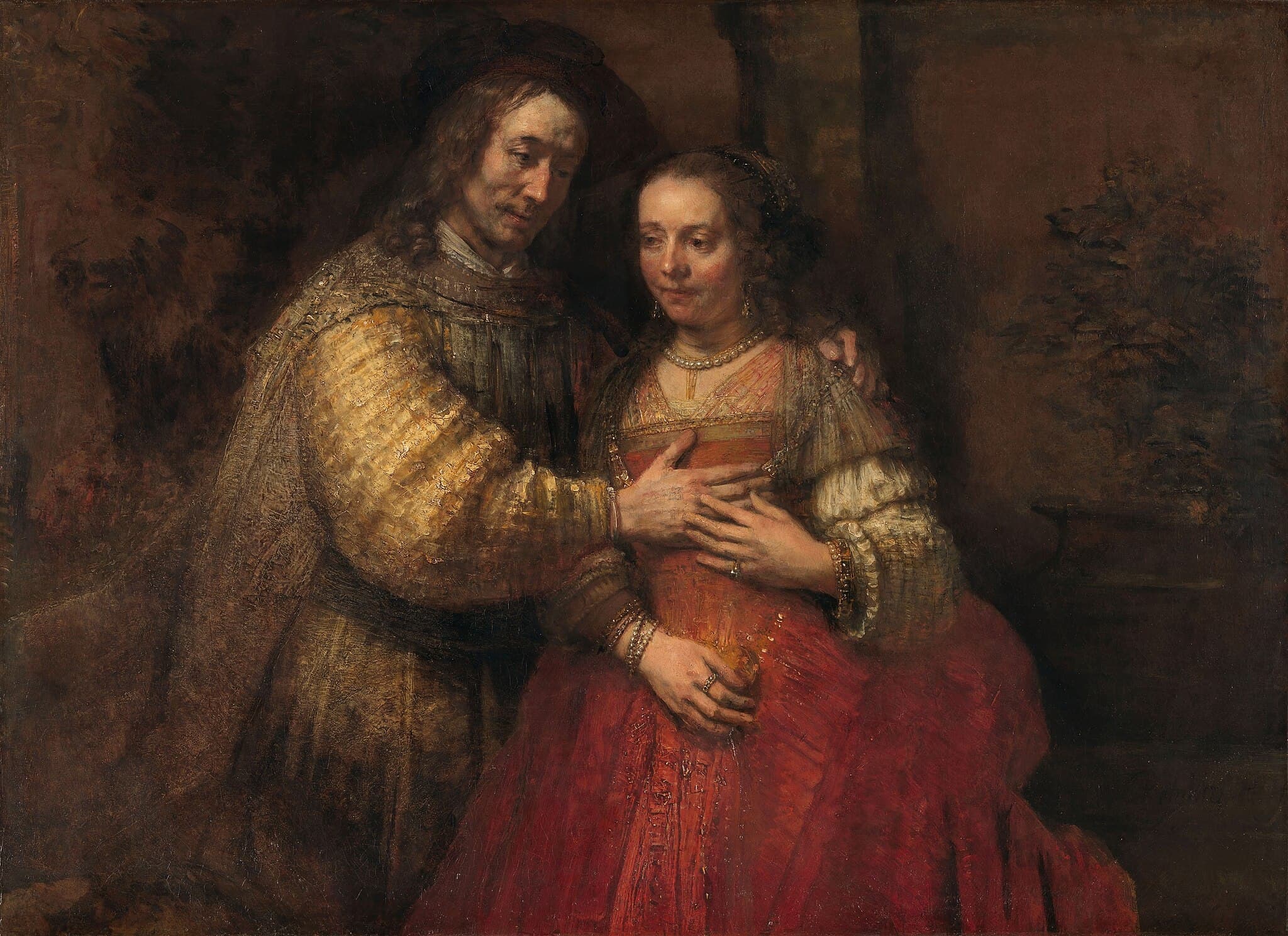
The Jewish Bride
Rembrandt van Rijn, c. 1665–1669 • Oil on canvas
Read full analysis of The Jewish Bride →Valuation Analysis
Overview and ownership. Rembrandt’s Isaac and Rebecca, known as The Jewish Bride, is a late‑period masterwork in the City of Amsterdam’s A. van der Hoop Bequest, on long‑term loan to the Rijksmuseum. Its canonical status within Rembrandt’s oeuvre—and within Dutch Golden Age painting more broadly—is uncontested; it is frequently cited alongside The Night Watch as a pinnacle of the artist’s achievement and a signature highlight of the Rijksmuseum’s collection [1].
Method and anchors. Because The Jewish Bride has no modern public sale, we anchor value to closely relevant Rembrandt benchmarks and the demonstrated ceiling for museum‑caliber Old Masters. The clearest modern price point for a top Rembrandt painting is the joint museum acquisition of the pendant full‑length portraits of Maerten Soolmans and Oopjen Coppit via Christie’s Private Sales at approximately €160 million for the pair (c. €80m each) in 2016 [2]. Public‑auction evidence for autograph Rembrandt paintings is far lower due to the rarity and typical scale of works that reach the rostrum: the standing auction record for a painting is the 2009 Portrait of a Man, Half‑length… at £20.2m with fees (≈$33.2m at the time) [3], while an important early panel, The Adoration of the Kings, brought £10.9m (≈$13.8m) in 2023 [4]. These auction results calibrate the public‑sale tier but understate the pricing of true museum trophies, which transact privately or by state/institutional purchase.
Resulting estimate. The Jewish Bride’s art‑historical standing, critical renown, and painterly bravura place it above the Soolmans/Oopjen portraits in cultural resonance. On that basis, and allowing for market growth at the top end of Old Masters since 2016, we synthesize an unconstrained open‑market estimate of $180–230 million. This range reflects its singular stature within Rembrandt’s late period, the near‑total museum sequestration of close peers, and the premium global collectors attach to universally recognized masterpieces.
Real‑world pathway and legal context. In practice, any transaction would almost certainly be a negotiated institutional/state acquisition. The work is publicly owned; Dutch and EU export regimes require licensing and strongly restrict disposal or export of protected cultural goods [5]. Such constraints typically narrow the buyer universe and temper pricing dynamics relative to a free‑for‑all private auction. Accordingly, a realistic institutional outcome would likely cluster toward the lower half of our range, even as the painting’s intrinsic market power comfortably supports the nine‑figure valuation.
Key sensitivities. The estimate assumes: stable condition consistent with a major museum holding; no attribution risk; and a sale structure that allows competition among top museums and select private buyers. Upside catalysts include a rare opportunity for international institutions to compete; downside would stem from tighter legal constraints, limited competition, or undisclosed condition complexities.
Key Valuation Factors
Art Historical Significance
High ImpactThe Jewish Bride is a late Rembrandt masterpiece, celebrated for its profound emotional tenor, radical painterly handling, and central role in shaping modern responses to the artist’s late style. It is a core highlight of the Rijksmuseum’s Rembrandt holdings and a frequent touchstone in scholarship and exhibition narratives. Works of this cultural weight command scarcity premiums that transcend ordinary subject or scale effects, drawing cross‑category interest from institutions and private collectors alike. Among Rembrandt’s paintings not effectively unavailable (e.g., Night Watch), The Jewish Bride sits at the apex of recognition and influence. That centrality, coupled with the painting’s late date, distinctive technique, and textbook status, justifies a valuation above more conventional portraits and religious scenes that sometimes surface at auction [1].
Comparable Benchmarks
High ImpactThe strongest modern reference for museum‑level Rembrandt pricing is the 2016 joint Rijksmuseum/Louvre private acquisition of Maerten Soolmans and Oopjen Coppit at approximately €160 million for the pair (c. €80m each) [2]. Public‑auction records for autograph paintings—including the 2009 London record at £20.2m with premium [3] and the 2023 Adoration of the Kings at £10.9m [4]—demonstrate solid but supply‑limited ceilings for works that reach the rostrum. The Jewish Bride is more culturally resonant than the majority of auctioned examples and commands a status premium over the Soolmans/Oopjen individual pendants. Triangulating these benchmarks, and adjusting for top‑end Old Master market depth since 2016, supports a consolidated open‑market estimate in the high‑nine‑figure range.
Rarity and Supply Constraints
High ImpactAutograph Rembrandt paintings of undisputed masterpiece caliber are essentially sequestered in museums. The small number of legitimate, autograph works that emerge tend to be modest in scale, early in date, or otherwise less canonical. This structural scarcity magnifies the value of a universally recognized late work such as The Jewish Bride. Moreover, cross‑category collectors have become increasingly engaged with singular Old Master ‘trophies,’ adding incremental demand at the very top end. In this context, even marginal increases in high‑net‑worth demand can have outsized price effects given the near‑zero supply of comparable opportunities, which reinforces the plausibility of a nine‑figure valuation absent legal or transactional constraints.
Legal/Heritage Constraints and Transaction Structure
Medium ImpactThe painting is publicly owned (City of Amsterdam, A. van der Hoop Bequest) and on long‑term loan to the Rijksmuseum. Dutch and EU heritage regimes require export licensing and impose strict controls on protected cultural goods, effectively steering any disposition toward institutional or state outcomes rather than a free‑market auction [1][5]. Such constraints narrow the buyer pool and can suppress price momentum that a global bidding war might otherwise generate. While the intrinsic market value supports an open‑market range of $180–230 million, a real‑world, negotiated acquisition by a museum or state actor would likely settle toward the lower half of the range given policy considerations, public funding optics, and limited competitive dynamics.
Sale History
The Jewish Bride has never been sold at public auction.
Rembrandt van Rijn's Market
Rembrandt occupies the absolute top tier of Old Masters, with near‑total institutional sequestration of major paintings and a deep, global collector base for drawings and prints. Public‑auction pricing for autograph paintings is limited by scarcity; the standing auction record for a painting is £20.2 million with fees (2009) [3]. The most informative modern benchmark for museum‑caliber paintings is private treaty: the Rijksmuseum and Louvre’s joint purchase of the Maerten Soolmans and Oopjen Coppit pendants at about €160 million for the pair in 2016 [2]. Recent auction results for smaller or earlier works, including The Adoration of the Kings at £10.9 million in 2023, confirm strong demand when quality and freshness align [4]. Together, these data points support nine‑figure expectations for a canonical, late Rembrandt masterpiece.
Comparable Sales
The Standard Bearer (De Vaandeldrager)
Rembrandt van Rijn
Same artist; indisputable trophy painting acquired by a national institution; strong modern benchmark for a museum‑caliber Rembrandt painting even if earlier (1636) and a single figure rather than a double portrait.
$198.0M
2022, Private treaty (Dutch State acquisition for the Rijksmuseum)
~$217.8M adjusted
Portrait of Maerten Soolmans (pendant to Oopjen Coppit)
Rembrandt van Rijn
Same artist; museum‑to‑museum private treaty; rare full‑length portrait at the highest level, providing a clear modern price anchor for top Rembrandt paintings despite being earlier (1634) and a single‑figure format.
$88.0M
2016, Christie’s Private Sales (joint acquisition by Rijksmuseum and Louvre)
~$118.8M adjusted
Portrait of a Man, Half-length, with his Arms Akimbo (1658)
Rembrandt van Rijn
Same artist; late period (1658) close to The Jewish Bride’s date; long‑standing auction record for a Rembrandt painting; demonstrates auction ceiling for single‑figure late Rembrandts in a public sale context.
$33.2M
2009, Christie’s London
~$50.1M adjusted
The Adoration of the Kings (c. 1628)
Rembrandt van Rijn
Same artist; important early panel painting with fresh scholarship; shows current auction demand and pricing for authenticated Rembrandt paintings, though smaller, earlier, and far less iconic than The Jewish Bride.
$13.8M
2023, Sotheby’s London
~$14.6M adjusted
Portraits of Jan Willemsz. van der Pluym and Jaapgen Carels (1635) — pair
Rembrandt van Rijn
Same artist; pendants of a married couple create a relevant portrait-pair reference point (though much smaller and earlier); illustrates contemporary auction pricing for rediscovered Rembrandt portraits.
$14.3M
2023, Christie’s London
~$15.1M adjusted
Saint John on Patmos (c. 1660)
Rembrandt van Rijn
Same artist; late period religious subject close in date to The Jewish Bride; underscores the auction market’s price level for smaller late Rembrandts versus museum‑level masterpieces.
$8.9M
2025, Sotheby’s London
Current Market Trends
The Old Masters market remains selective but healthy, with 2023–2026 activity underscoring renewed depth for high‑quality, fresh‑to‑market works. While auction ceilings for Rembrandt paintings are constrained by supply, private‑treaty and institutional transactions establish a much higher price context for true museum trophies. Cross‑category collectors continue to target singular, art‑historically important works, and recent headline results in Old Masters drawings and prints signal broader confidence in top‑tier pre‑Modern material. In this environment, a universally recognized late Rembrandt with unimpeachable provenance and institutional standing can credibly achieve a high nine‑figure valuation, with actual outcomes shaped by legal constraints and whether competitive tension can be engineered in the sale process.
Study print
Study this painting as a print
Pair the full artwork with a museum-style study sheet focused on one meaningful detail.
Sources
- Rijksmuseum object page: Isaac and Rebecca, Known as ‘The Jewish Bride’ (SK-C-216)
- Christie’s: My highlight of 2016 — Two Rembrandt masterpieces
- Christie’s London (reported): Rembrandt, Portrait of a Man, Half-length... (2009) — £20.2m with fees
- Sotheby’s London Dec 6, 2023 results (report): Rembrandt, The Adoration of the Kings — £10.9m
- Government of the Netherlands: Export licences for cultural goods