How Much Is The Return of the Prodigal Son Worth?
Last updated: February 21, 2026
Quick Facts
- Methodology
- extrapolation
Fair-market/insurance-type valuation for Rembrandt’s The Return of the Prodigal Son: $250–400 million. This range extrapolates above the €175m Standard-Bearer benchmark given the painting’s canonical late status, monumental scale, and singular fame. While inalienable in the Hermitage, the figure reflects what leading museums or sovereign buyers would plausibly pay today.
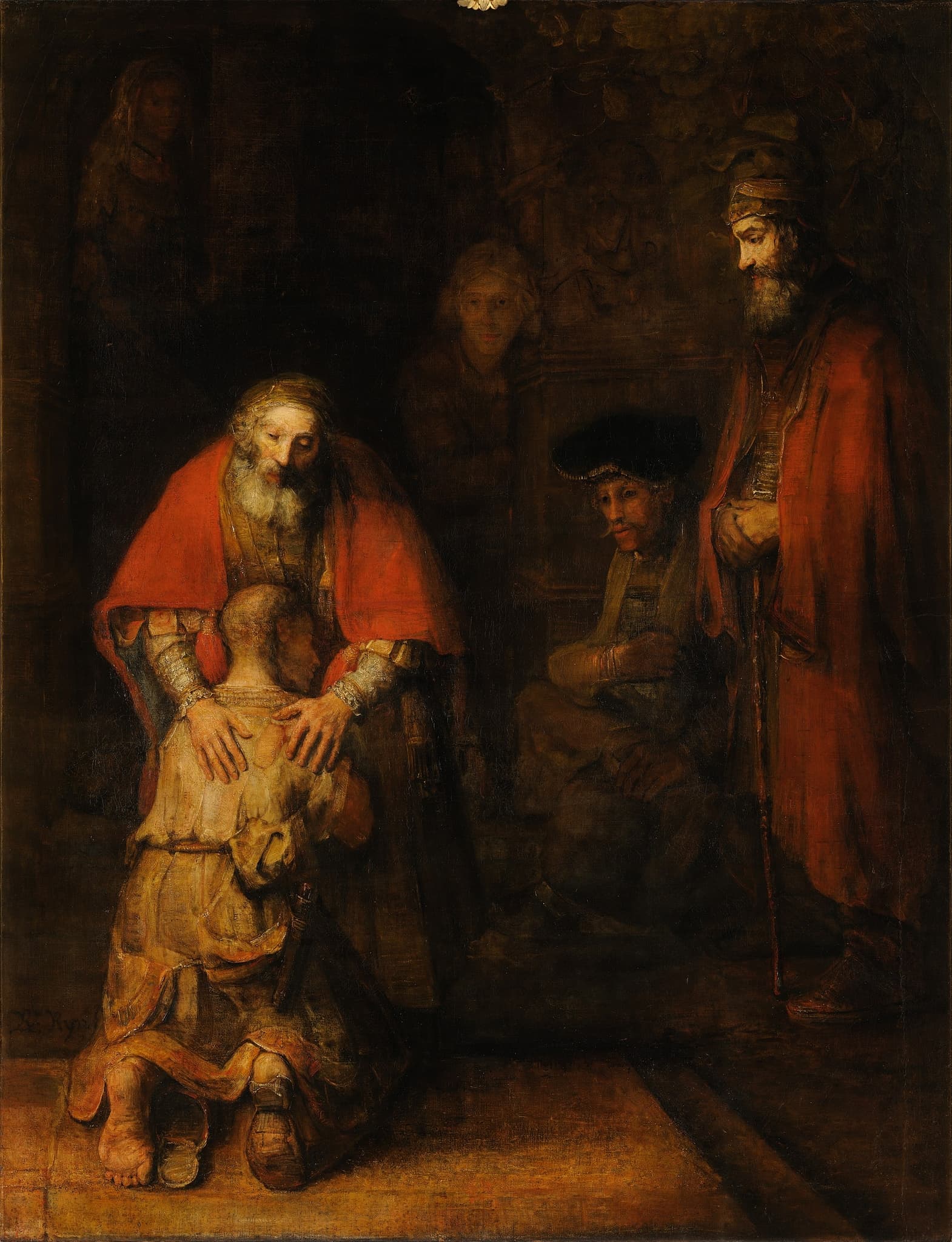
The Return of the Prodigal Son
Rembrandt van Rijn, c. 1661–1669 (probably completed by 1669) • Oil on canvas
Read full analysis of The Return of the Prodigal Son →Valuation Analysis
Opinion of value: $250–400 million. This valuation for Rembrandt’s The Return of the Prodigal Son is derived by extrapolating from the most recent top-tier Rembrandt transactions and the demonstrated ceiling for pre‑1800 masterpieces. The Dutch State’s 2022 acquisition of The Standard‑Bearer for €175 million (≈$199m at the time) establishes a modern anchor for autograph, museum-grade Rembrandts [1]. The 2016 joint purchase of the full‑length portraits of Maerten Soolmans and Oopjen Coppit for €160 million provides a second benchmark at a closely comparable level of museum urgency and state involvement [2]. Against these, the Hermitage’s Prodigal Son is widely regarded as a culminating late masterpiece of greater art‑historical stature and monumentality, warranting a premium over both prior Rembrandt transactions.
Scarcity and demand: Fully accepted, major Rembrandt paintings of this scale and significance are effectively unobtainable; when apex works do move, they do so via private treaty and often to states or leading museums. Public‑auction benchmarks for Rembrandt paintings sit far below this tier because the very best examples virtually never reach the rostrum. The broader Old Master market’s capacity at the pinnacle is evidenced by Leonardo da Vinci’s Salvator Mundi at $450.3 million, establishing a proven upper bound for pre‑1800 pictures [3]. Within that framework, a price materially above the €175m Standard‑Bearer level is well supported for an icon of this magnitude.
Ownership and legal context: The painting has been in the State Hermitage Museum since 1766, with no modern market appearance [4]. Russian federal protections for state museum collections and cultural property make permanent deaccession and export effectively impossible; accordingly, this figure represents a fair‑market/insurance‑type estimate rather than a realizable auction price [5]. The Hermitage’s authorship and status confer maximal institutional validation.
Valuation drivers and positioning: Prodigal Son combines exceptional art‑historical importance, celebrity, monumental scale (approx. 262 × 205 cm), and the psychological chiaroscuro of Rembrandt’s late style—attributes that command a significant premium over portrait benchmarks. Assuming stable museum condition and secure attribution (as universally accepted), we place fair value at $250–400 million, with central tendency in the low‑to‑mid $300 millions. This band reflects a measured uplift over €175m for qualitative superiority and cultural resonance, balanced by the reality that Rembrandt’s market, while blue‑chip, is unlikely to challenge the absolute Leonardo ceiling in the near term. If hypothetically offered with clear title and export permissions, competition from sovereigns and leading museums would be expected, reinforcing this range [1][2][3].
Key Valuation Factors
Art Historical Significance
High ImpactThe Return of the Prodigal Son is broadly regarded as a culminating masterpiece of Rembrandt’s late period—arguably the most profound statement of forgiveness and human compassion in Baroque painting. Its monumental scale (about 262 × 205 cm), masterful orchestration of light and shadow, and psychological depth place it alongside The Night Watch as the artist’s most iconic works. Canonical standing drives exceptional willingness to pay among museums and sovereign buyers because such pictures define collections and national narratives. This level of cultural centrality typically commands a substantial premium over even very fine portrait or narrative works by the same artist, justifying a value above recent Rembrandt benchmarks.
Extreme Scarcity and Global Demand
High ImpactFully accepted, large‑scale Rembrandt masterpieces almost never appear in the marketplace; when top examples have moved in recent decades, it has been via private treaty to leading institutions or governments. This supply drought amplifies competition when a trophy‑caliber opportunity arises, leading to outlier prices. The artist’s cross‑cultural appeal and curricular ubiquity ensure a deep pool of institutional stakeholders and potential state actors. In this context, a canonical late religious scene of this renown would trigger museum‑level urgency and sovereign funds’ interest, supporting a range well above public‑auction painting records and above prior private‑treaty levels for portraits.
Market Benchmarks and Extrapolation
High ImpactThe 2022 Dutch State purchase of The Standard‑Bearer at €175m and the 2016 Maerten & Oopjen pair at €160m provide robust anchors for apex Rembrandt pricing. Extrapolating from these, The Return of the Prodigal Son warrants a premium due to superior cultural weight, subject, scale, and late style. The broader Old Master ceiling—Leonardo’s Salvator Mundi at $450.3m—demonstrates the market’s capacity for once‑in‑a‑generation pictures. Positioning Prodigal Son at $250–400m balances its preeminence over recent Rembrandt comparables with a conservative stance relative to Leonardo’s unique brand power, yielding a defensible and internally coherent range.
Legal/Marketability Constraints (Hermitage/Russia)
Medium ImpactThe painting resides in the State Hermitage Museum and is protected by Russian cultural‑heritage and museum laws that effectively preclude deaccession and permanent export. Practically, this means the work is non‑marketable; any figure must be framed as a fair‑market/insurance equivalent rather than a realizable auction price. While this constraint limits immediate transactional potential, it does not diminish intrinsic value; if hypothetically offered with clear title and export permissions, the buyer universe would include sovereign and institutional actors capable of paying at the $250–400m level. Insurance and indemnity frameworks would likely be calibrated to this band.
Sale History
The Return of the Prodigal Son has never been sold at public auction.
Rembrandt van Rijn's Market
Rembrandt sits at the pinnacle of the Old Master market. Autograph paintings are exceptionally scarce in commerce; the most important examples tend to trade privately to museums or states. The modern apex for a Rembrandt is The Standard‑Bearer, acquired by the Dutch State in 2022 for €175 million, while the paired full‑length portraits of Maerten Soolmans and Oopjen Coppit sold in 2016 for €160 million. Public‑auction records for Rembrandt oils remain far lower, reflecting the absence of true trophy material at auction and not demand weakness. Meanwhile, strong results for works on paper and prints underscore deep, cross‑category appetite for the artist’s work across the collector and institutional base.
Comparable Sales
The Standard-Bearer
Rembrandt van Rijn
Same artist; museum‑level, trophy work acquired by a nation; best modern benchmark for top-tier Rembrandt pricing though earlier period and smaller than Prodigal Son.
$198.9M
2022, Private sale (Dutch State/Rijksmuseum)
~$222.8M adjusted
Portraits of Maerten Soolmans and Oopjen Coppit (pair)
Rembrandt van Rijn
Same artist; landmark private-treaty acquisition of two fully autograph, major portraits—an apex Rembrandt market data point for museum-caliber works.
$180.0M
2016, Christie's Private Sales (joint acquisition by the Louvre and Rijksmuseum)
~$230.4M adjusted
Portrait of a Man, Half-length, with His Arms Akimbo
Rembrandt van Rijn
Same artist; public-auction record for a Rembrandt oil painting; anchors the gap between auctionable material and museum-grade trophies.
$33.2M
2009, Christie's London
~$47.5M adjusted
The Adoration of the Kings
Rembrandt van Rijn
Same artist; biblical subject; small early panel recently (re)attributed—illustrates pricing for religious imagery by Rembrandt when not at the canonical masterpiece level.
$13.8M
2023, Sotheby's London
~$14.6M adjusted
Portraits of Jan Willemsz. van der Pluym and Jaapgen Carels (pair)
Rembrandt van Rijn
Same artist; pair of small early portraits with strong provenance; confirms recent public-auction appetite and pricing for intimate, autograph oils.
$14.3M
2023, Christie's London
~$15.1M adjusted
Saint John on Patmos
Rembrandt van Rijn
Same artist; late biblical subject, reattributed after technical study; useful for subject-matter proximity to a late religious masterwork, albeit on a far smaller scale.
$8.9M
2025, Sotheby's London
Current Market Trends
The Old Masters category has strengthened on the back of high‑profile consignments and renewed cross‑category participation from modern and contemporary buyers. When true masterpieces surface—especially with impeccable attribution and provenance—competition is intense and prices can materially exceed historical norms. Sovereign and museum buyers remain crucial at the top end, where private‑treaty transactions predominate. Supply remains the key constraint; thus, pricing for canonical works is set by rare, reference transactions rather than steady auction comparables. In this environment, a universally celebrated, large‑scale Rembrandt of the late period would command a substantial premium over recent benchmarks.
Study print
Study this painting as a print
Pair the full artwork with a museum-style study sheet focused on one meaningful detail.

Sources
- Guinness World Records – Most expensive painting by Rembrandt in private sale (The Standard-Bearer)
- Christie’s – My highlight of 2016: Two Rembrandt masterpieces (Maerten Soolmans and Oopjen Coppit)
- Christie’s – Press release: Leonardo da Vinci’s Salvator Mundi sold for $450,312,500
- State Hermitage Museum – Digital Collection entry: The Return of the Prodigal Son
- Center for Art Law – Russia expands on import and export of art objects
- The Guardian – Rembrandt auction record (2009)