How Much Is Isaac and Rebecca, Known as ‘The Jewish Bride’ Worth?
Last updated: July 8, 2026
Quick Facts
- Methodology
- comparable analysis
Under unconstrained, private‑treaty conditions, Rembrandt’s Isaac and Rebecca, Known as ‘The Jewish Bride’ would command roughly $240–320 million. This range is anchored to recent nine‑figure state/museum purchases of top Rembrandts and adjusted upward for the painting’s canonical late status and near‑unmatched art‑historical importance.
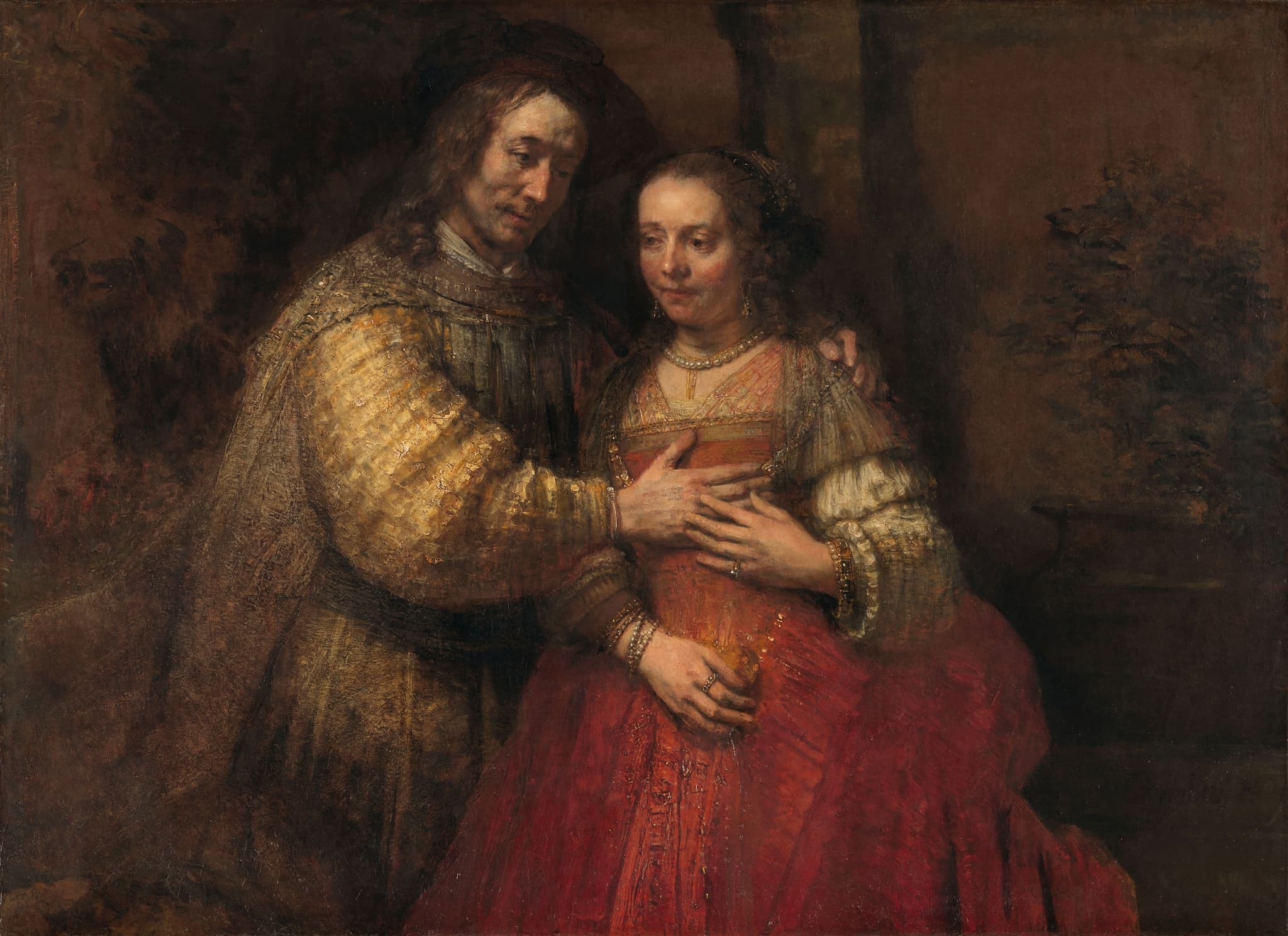
Isaac and Rebecca, Known as ‘The Jewish Bride’
Rembrandt van Rijn, c. 1665–1669 • Oil on canvas
Read full analysis of Isaac and Rebecca, Known as ‘The Jewish Bride’ →Valuation Analysis
Final estimate: $240–320 million (hypothetical fair‑market value under unrestricted conditions). This synthesis triangulates two modern, best‑in‑class price signals for Rembrandt—The Standard Bearer acquired by the Dutch State for the Rijksmuseum at €175m in 2022 and the Rijksmuseum/Louvre’s joint purchase of the Maerten Soolmans and Oopjen Coppit pendants at €160m in 2015—then adjusts for inflation and for the singular canonical status of The Jewish Bride within the artist’s late oeuvre [2][3].
Why this level: The Jewish Bride is universally regarded as a late Rembrandt masterpiece—iconic for its glowing impasto, psychological depth, and intimate portrayal—ranked in the Rijksmuseum’s Gallery of Honour and cited alongside The Night Watch among the artist’s defining works [1]. Museum‑caliber Rembrandts at this tier have recently transacted privately in the high eight to low nine figures. The Standard Bearer’s ~€175m price in 2022 (~$199m then; ≈$215m in current dollars) and the €160m pendants (~$179m then; ≈$238m in today’s terms) establish a robust floor for a museum‑defining Rembrandt. Given The Jewish Bride’s equal or greater critical esteem and late‑style importance, a carefully brokered competition among top institutions, sovereign collectors, and ultra‑high‑net‑worth patrons would likely clear $240m and could reach or exceed $300m [2][3].
Auction benchmarks vs. private reality: Public‑auction records for Rembrandt oils are far lower because the very best paintings almost never appear at auction. The standing auction mark for a Rembrandt oil (Christie’s London, 2009) is ~£20.2m with premium (≈$33m reported at the time), and a rediscovered small early panel, The Adoration of the Kings, made £10.9m ($13.7m) in 2023—useful datapoints for liquidity but not for masterpieces of this stature [4][5]. In contrast, state/museum private‑treaty acquisitions are the relevant comparables for The Jewish Bride.
Supply, scholarship, and demand: Late, autograph Rembrandt masterpieces in private hands are vanishingly scarce. The Jewish Bride’s unimpeachable standing in the literature, near‑continuous exhibition in Amsterdam, and centrality to late Rembrandt connoisseurship concentrate demand at the very top of the market. Recent records in Rembrandt drawings and prints further signal deepening, cross‑segment demand for best‑in‑class works by the artist, reinforcing nine‑figure pricing resilience for paintings of the highest caliber [7].
Constraints and scope: The work is public property (City of Amsterdam) on long‑term loan to the Rijksmuseum. Any real transaction would be shaped by Dutch/EU cultural‑property laws and export licensing, potentially invoking state matching/priority and limiting the buyer pool [6]. The range above therefore represents an unconstrained fair‑market estimate; institutional insurance/replacement values could be higher.
Key Valuation Factors
Art Historical Significance
High ImpactThe Jewish Bride is a touchstone of Rembrandt’s late style, famed for its tactile impasto, warmth of palette, and profound psychological insight. It is one of the Rijksmuseum’s crown jewels, installed in the Gallery of Honour and habitually cited with The Night Watch as a definitive Rembrandt. Its interpretive richness (commonly read as Isaac and Rebecca) and its role in shaping scholarly and public understanding of Rembrandt’s late manner elevate it beyond a typical narrative or portrait. This level of canonical status commands a scarcity and prestige premium, concentrating global institutional and sovereign demand and justifying pricing that meets or exceeds the best modern precedents for the artist.
Rarity and Supply
High ImpactAutograph Rembrandt paintings of top-tier quality are extraordinarily scarce, and late masterpieces of this caliber are effectively non-replaceable. Most comparable works reside in museums and are not commercially available. When a work of near-comparable quality has approached the market in recent years, it has done so via state/museum private-treaty acquisitions at nine-figure levels, underscoring the steep supply/demand imbalance. This structural scarcity is a primary driver of value, creating the conditions for competitive, institution-level bidding and partnership acquisitions that can propel the price well beyond traditional Old Master auction ceilings.
Market Benchmarks
High ImpactTwo modern anchors define the pricing corridor for a museum-defining Rembrandt oil: the Dutch State’s €175m acquisition of The Standard Bearer (2022) and the €160m joint purchase of the Maerten Soolmans and Oopjen Coppit pendants (2015). Adjusted to current dollars, these sit around the low- to mid-$200m range, providing a credible floor for a masterpiece of similar or greater standing. Meanwhile, public-auction records for Rembrandt oils (topping out near $30–35m) reflect the absence of masterpieces at auction rather than true market capacity. Together, these benchmarks justify a $240–320m range for The Jewish Bride in an unconstrained, carefully managed sale.
Condition, Scale, and Medium
Medium ImpactOil on canvas at substantial scale, The Jewish Bride presents with the rich surface and glazing effects characteristic of Rembrandt’s late period. While major museums seldom publish granular insured values or detailed condition reports for single masterpieces, the painting’s continuous exhibition history at the Rijksmuseum and its central display suggest a stable condition profile managed under top conservation standards. A current technical dossier (imaging, structural assessment) would refine pricing precision, but the work’s material and visual impact—integral to late Rembrandt’s market appeal—supports its top-tier valuation within the proposed range.
Legal/Heritage Status and Transaction Complexity
Medium ImpactThe painting is public property (City of Amsterdam) on long-term loan to the Rijksmuseum, and the Netherlands/EU maintain protective export frameworks. In any real scenario, these constraints could narrow the buyer pool, trigger state matching or priority rights, and elongate transaction timelines. Our estimate assumes an unconstrained fair-market context to isolate pure economic value; in practice, policy frameworks can dampen competitive dynamics or re-route sales into state-funded solutions. Notably, recent nine-figure Rembrandt acquisitions have occurred precisely through such state/museum channels, which remain capable of meeting trophy-level pricing.
Sale History
Stanley's, London
Offered as 'Jephthah and his Daughter', lot 68; bought in at £420. Original-currency figure only; no reliable USD conversion.
Private sale (John Smith via A. Brondgeest to Adriaan van der Hoop, Amsterdam)
Private transaction recorded at fl. 5,000 (Dutch guilders). Original-currency figure only; no reliable USD conversion.
Rembrandt van Rijn's Market
Rembrandt van Rijn occupies the apex of the Old Masters market. Supply of autograph paintings in private hands is extremely limited, and true masterpieces typically reside in museums or transact privately. The most relevant modern price anchors are institutional acquisitions: The Standard Bearer at €175m (Dutch State for the Rijksmuseum, 2022) and the Rijksmuseum/Louvre’s joint purchase of the Maerten Soolmans and Oopjen Coppit pendants at €160m (2015). By contrast, auction records for Rembrandt oils sit far lower—about £20.2m with premium in 2009—reflecting that masterpieces rarely go to auction. Recent records for works on paper and prints (2025–2026) further attest to robust demand for top-tier Rembrandt material across categories, reinforcing nine-figure pricing for blue-chip paintings.
Comparable Sales
The Standard Bearer
Rembrandt van Rijn
Same artist; universally acknowledged masterpiece acquired by a national institution; high market benchmark for top-tier Rembrandt oils, demonstrating nine-figure institutional demand.
$199.0M
2022, Private treaty (Dutch State for the Rijksmuseum)
~$215.0M adjusted
Pendant portraits of Maerten Soolmans and Oopjen Coppit (pair)
Rembrandt van Rijn
Same artist; full-length life-size portraits acquired jointly by two top museums; closest modern precedent for nine-figure valuation of prime Rembrandt paintings.
$179.0M
2015, Private sale (Rothschild family to Rijksmuseum and Louvre)
~$238.0M adjusted
Portrait of a Man, Half-length, With His Arms Akimbo
Rembrandt van Rijn
Same artist; auction record for a Rembrandt oil painting; establishes public-auction ceiling for high-quality but less iconic Rembrandt oils.
$33.2M
2009, Christie's London
~$49.1M adjusted
Saint James the Greater
Rembrandt van Rijn
Same artist; late-period oil (1661) close in date to The Jewish Bride; strong auction benchmark for late Rembrandt portraits of apostles/saints.
$25.8M
2007, Sotheby's New York
~$39.5M adjusted
The Adoration of the Kings (c. 1628)
Rembrandt van Rijn
Same artist; recent, widely reported auction of an autograph painting; shows current demand/price level for smaller early-panel narratives (a conservative lower bound for major oils).
$13.8M
2023, Sotheby's London
~$14.2M adjusted
Current Market Trends
Old Masters rebounded strongly in 2025, with high sell-through and renewed depth at the top end, while supply of best-in-class Dutch Golden Age paintings remains structurally tight. Institutions and sovereign/ultra-high-net-worth buyers continue to prioritize historically validated names, and private-treaty structures dominate at the pinnacle. Recent Rembrandt results—from a rediscovered early panel at $13.7m to a drawing record in 2026—signal healthy cross-segment demand. In this context, canonical, museum-grade Rembrandt paintings command sustained nine-figure interest, with state-backed acquisitions providing the clearest price discovery and establishing firm benchmarks for valuation.
Study print
Study this painting as a print
Pair the full artwork with a museum-style study sheet focused on one meaningful detail.
Sources
- Rijksmuseum Collection – The Jewish Bride (SK-C-216)
- Rijksmuseum – Rembrandt’s The Standard Bearer enters the collection (state acquisition, €175m)
- Musée du Louvre – Acquisition of Rembrandt’s portraits of Maerten Soolmans and Oopjen Coppit (€160m, joint with Rijksmuseum)
- Christie’s 2009 Old Masters results recap (Rembrandt oil at £20.2m with premium)
- Artnet News – Rediscovered Rembrandt ‘Adoration of the Kings’ sells for almost $14m (Dec 6, 2023)
- Netherlands Inspectorate – EU Regulation 116/2009 on cultural goods (export licensing)
- The Leiden Collection – Post-sale release: Rembrandt drawing ‘Young Lion Resting’ sets auction record (Feb 4, 2026)