How Much Is Self-Portrait with Two Circles Worth?
Last updated: March 13, 2026
Quick Facts
- Methodology
- comparable analysis
Estimated market value: $100–150 million. This comparable analysis balances the institutional ceiling demonstrated by the 2016 Rijksmuseum/Louvre purchase with typical public‑auction realizations and is conditional on secure attribution, good or restorable condition, and an executable transfer route out of Kenwood/Iveagh custody.
Valuation Analysis
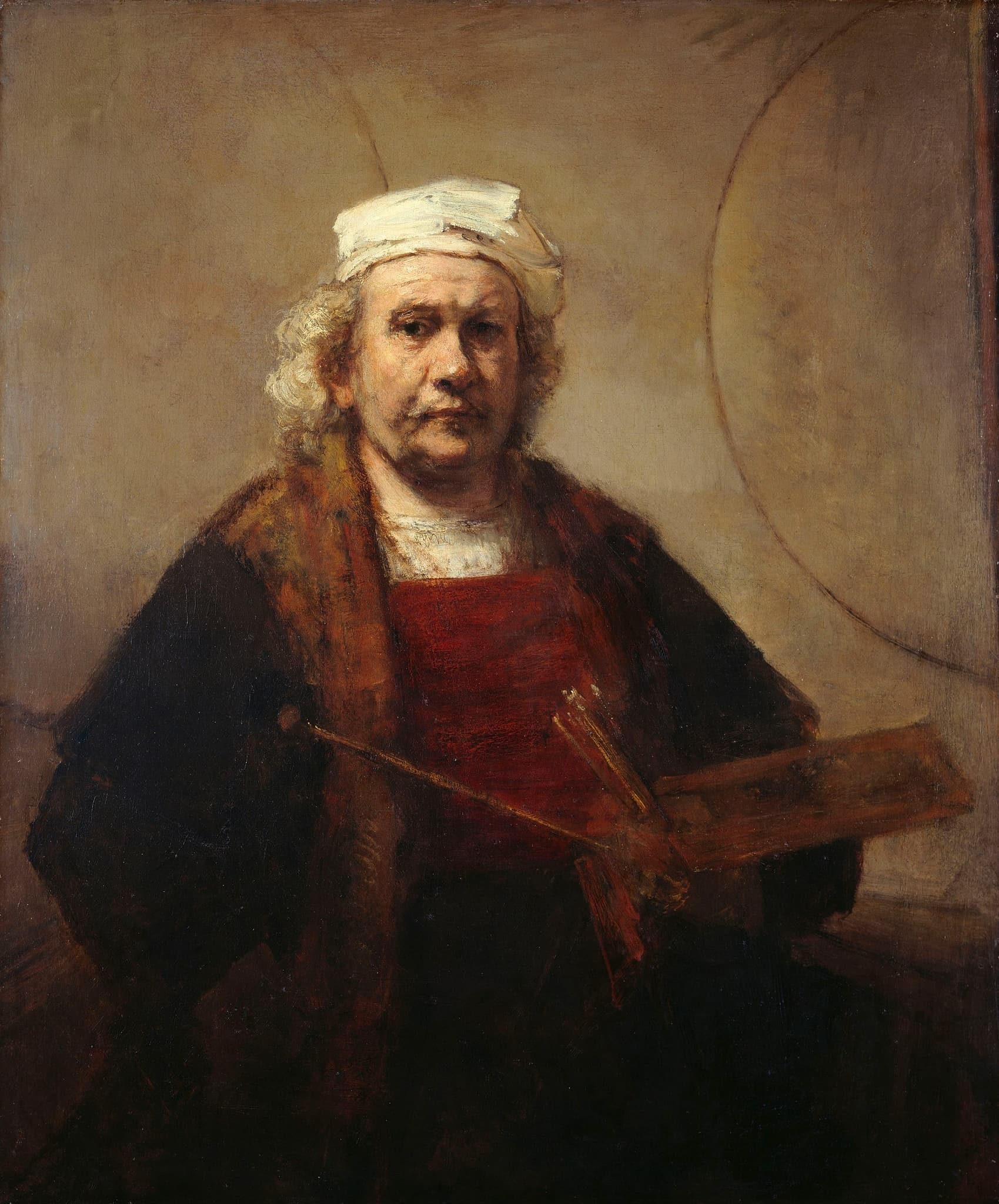
Estimated market value range: $100–150 million (USD). Self‑Portrait with Two Circles is one of Rembrandt's canonical late self‑portraits and is held in the Iveagh Bequest at Kenwood House, a public collection that has kept the picture off the modern market for more than a century [1]. Because it is museum‑held, a transactional route to market would most likely be a negotiated institutional or state purchase rather than a competitive auction, and the painting's public status creates additional legal and political friction around deaccessioning.
The valuation uses a comparable analysis that anchors with two market tiers. On the one hand, exceptional institutional acquisitions define the ceiling for museum‑quality Rembrandts (for example, the joint Rijksmuseum/Louvre acquisition of the Maerten Soolmans and Oopjen Coppit pendants for a reported €160 million in 2016) [2]. On the other hand, historical public auction realizations for single Rembrandt oils have typically settled in the low tens of millions. I weighted the institutional ceiling heavily while tempering for single‑picture dynamics and market liquidity to arrive at the $100–150M range.
Specific value drivers supporting the upper half of this range include the painting's late‑career, autobiographical importance, high display value for museum narratives, and the acute scarcity of autograph Rembrandt oils capable of filling top‑tier collection gaps. Offsetting restraints are the painting's entrenched public ownership, potential export and deaccession hurdles, and the lack of a modern, competitive sale to establish a fresh market price. If the picture could be transferred internationally without restriction and were presented in pristine, conservationally secure condition, institutional bidders could reasonably push toward the higher end of the range.
Downside scenarios will compress value rapidly: a significant conservation history or evidence of over‑restoration, contested attribution, or legal encumbrances would move this work into the established auction band for single Rembrandt paintings (tens of millions USD), not the institutional ceiling. All figures presented assume secure attribution, good or restorable condition, clear title, and a sale route permitting institutional acquisition or export. The estimate does not assume a contested re‑attribution or a forced, rapid sale.
Conclusion: $100–150 million represents a marketable institutional valuation conditional on the assumptions above. To refine this estimate into a firm asking price, obtain the Kenwood provenance file and deed terms, commission full technical and conservation reports, and engage in confidential market soundings with likely institutional buyers and national authorities about export/deaccession feasibility.[1][2]
Key Valuation Factors
Art Historical Significance
High ImpactSelf‑Portrait with Two Circles is categorically one of Rembrandt's late, introspective self‑portraits and occupies a central place in the artist's critical canon. Late self‑portraits are essential to understanding Rembrandt's mature handling of paint, light, and psychological presence; this picture features in monographs and exhibition narratives and therefore carries a premium for display and scholarship. Museums prize such works for their pedagogical and visitor value, and that institutional appetite translates directly into monetary uplift. In practice, art‑historical significance expands the pool of qualified buyers (national museums and major private collectors) and supports applying an institutional premium above typical auction baselines.
Rarity & Supply
High ImpactAuthentic late autograph Rembrandt oils are exceptionally scarce in the open market. Most canonical late paintings are already in national or major museum collections and new supply appears rarely. This structural scarcity materially raises the value of any genuinely autograph late Rembrandt that becomes available, because competition is concentrated among a small number of institutions and collectors able to finance top‑tier purchases. Scarcity therefore justifies a meaningful premium relative to ordinary Old Master portraits and is a principal reason this work aligns with institutional valuation ceilings rather than median auction results.
Provenance & Legal Status
High ImpactThe painting's published provenance demonstrates a long Guinness/Iveagh ownership chain before the Iveagh Bequest placed it in public stewardship; that provenance supports attribution and market confidence. However, the bequest and the painting's UK location introduce potential legal and political barriers: UK export licensing regimes, temporary export bars, and the terms of the Iveagh Bequest can complicate or prevent deaccessioning and international transfer. Legal encumbrances materially affect marketability and timing; even where market demand is high, protracted export or deaccession negotiations can depress realized prices or prevent a sale altogether.
Condition & Conservation
Medium ImpactCondition is a decisive value determinant and is currently unknown to this appraisal. Technical condition issues — including paint layer integrity, evidence of significant overpainting, and structural problems with support — can materially reduce value. Conversely, careful conservation and modern technical imaging that clarify autograph paint and original surfaces can enhance market confidence and support premium pricing. Before any firm asking price is set, comprehensive technical examination (infrared, X‑ray, pigment analysis) and a conservation report are essential to confirm the valuation assumptions underlying the $100–150M range.
Market Demand & Comparables
High ImpactDemand for top‑tier Rembrandts is concentrated among national museums, major encyclopedic institutions, and a small pool of ultra‑high‑net‑worth private buyers. Comparable evidence is bifurcated: exceptional institutional purchases set a high ceiling (e.g., the 2016 Soolmans/Oopjen acquisition), while public auction realizations for single Rembrandt oils have historically settled in the low tens of millions. Given that split, a museum‑held, canonical self‑portrait like the Kenwood example would likely be bid for chiefly by institutions, placing it nearer the institutional tier provided legal transfer is feasible and condition/attribution are secure.
Sale History
Self-Portrait with Two Circles has never been sold at public auction.
Rembrandt van Rijn's Market
Rembrandt van Rijn remains one of the most collectible and academically prized Old Masters. Genuine, high‑quality autograph paintings by Rembrandt are rare and attract disproportionate institutional attention. Public auction records for single Rembrandt oils have historically been in the low tens of millions, whereas exceptional private or state purchases have demonstrated a willingness to pay into the high tens or low hundreds of millions for museum‑quality works. Recent market activity has shown renewed strength at the top end — especially for rare works on paper and rediscoveries — which underscores a segmented market in which attribution certainty and institutional interest are the primary price multipliers.
Comparable Sales
Portraits of Maerten Soolmans & Oopjen Coppit (pendants)
Rembrandt van Rijn
Highest-profile modern institutional purchase of Rembrandt paintings; shows the institutional/top-market ceiling for museum-quality Rembrandts.
$174.0M
2016, Joint institutional acquisition (Rijksmuseum + Musée du Louvre) — reported Feb 2016
~$208.8M adjusted
Portrait of a Man (often cited as 'Portrait of a Man with Arms Akimbo')
Rembrandt van Rijn
One of the highest public-auction results for a Rembrandt painting; useful as an auction-market ceiling for major Rembrandt oils.
$33.2M
2009, Christie's, London (Dec 2009)
~$45.2M adjusted
Self-Portrait (half-length, 1632)
Rembrandt van Rijn
Direct subject match (self-portrait) by the same artist sold at public auction recently — good comparator for collector/institutional interest in autograph Rembrandt self-portraits.
$18.8M
2020, Sotheby's, London ('Rembrandt to Richter' sale, July 2020)
~$21.6M adjusted
The Adoration of the Kings (attributed/rediscovered Rembrandt)
Rembrandt van Rijn
Recent rediscovered-attribution sale showing mid/high‑tier market demand for important Rembrandt works at auction in the 2020s.
$13.8M
2023, Sotheby's, London (Old Master & 19th-Century Evening Sale, Dec 2023)
~$14.6M adjusted
Current Market Trends
Top‑tier Old Masters and canonical Rembrandt works have seen a selective resurgence: high‑quality, well‑provenanced pieces and rare works on paper have achieved record or near‑record prices recently. Liquidity remains concentrated at the very top; mid‑market volume is constrained. Institutional budgets, export controls, and scholarly reattributions are immediate drivers, while macroeconomic uncertainty can quickly narrow bidder depth. For a museum‑held Rembrandt self‑portrait, these conditions mean public availability is unlikely but competition among national museums and major private collectors could push realized prices into the institutional tier if a sale is permitted.
Sources
- English Heritage — Kenwood: Rembrandt self‑portrait (Iveagh Bequest)
- Press release — Musée du Louvre & Rijksmuseum joint acquisition of Maerten Soolmans & Oopjen Coppit (2016)
- National Gallery — Rembrandt supplement (provenance and catalogue notes)
- Coverage of high public‑auction Rembrandt realizations (example: 2009 Christie’s result reporting)
- Sotheby’s sale page — Rembrandt self‑portrait (comparative auction example, 2020)