How Much Is The Blinding of Samson Worth?
Last updated: April 28, 2026
Quick Facts
- Methodology
- comparable analysis
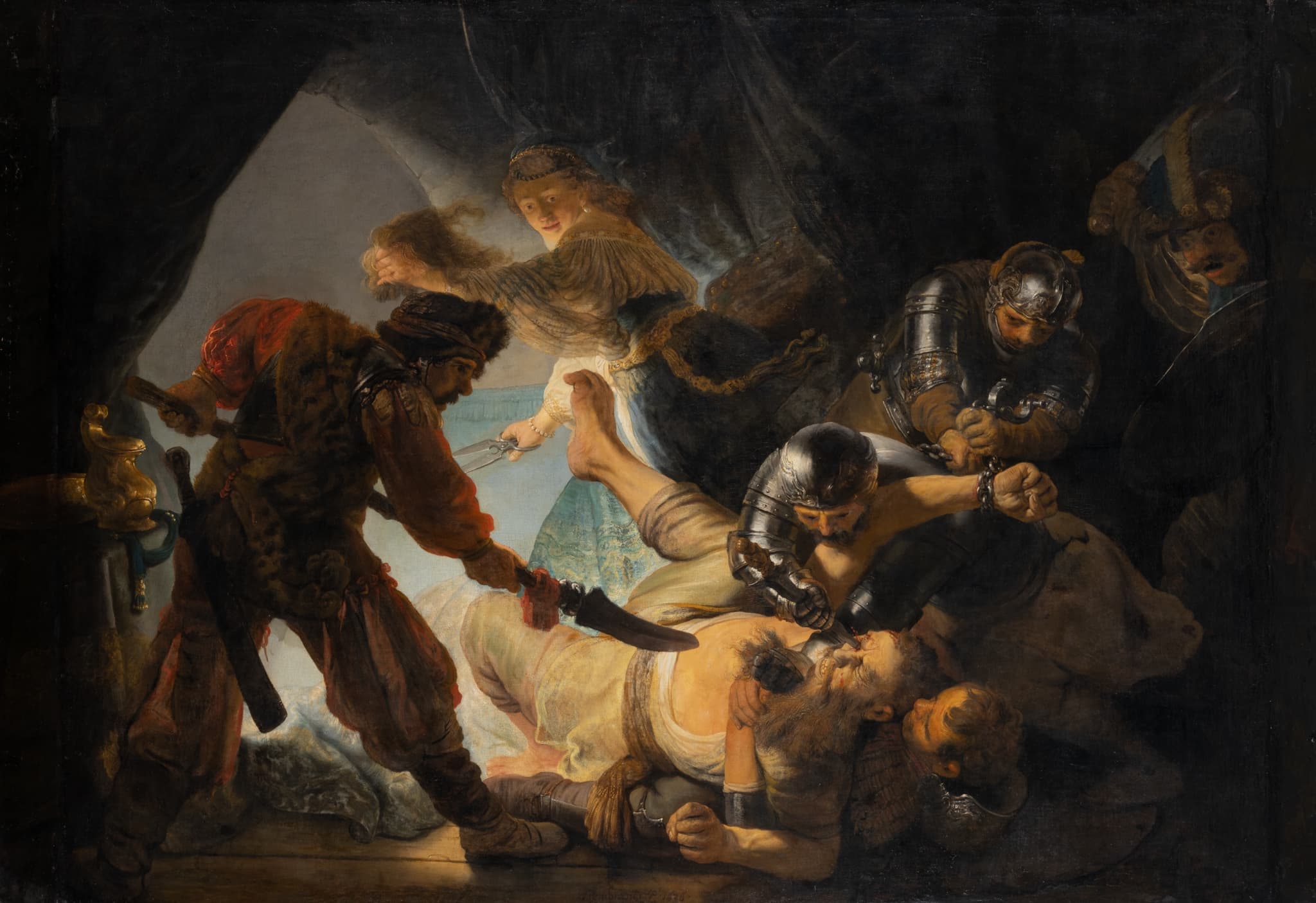
On a fully hypothetical, exportable basis, Rembrandt’s The Blinding of Samson (1636, Städel Museum) would likely command about $120–200 million today. This range triangulates against recent nine‑figure private/state acquisitions of top‑tier Rembrandts and the painting’s exceptional scale, subject, and art‑historical stature.
Valuation Analysis
Estimated value (hypothetical, private‑treaty basis): $120–200 million. Rembrandt’s The Blinding of Samson (1636) is a monumental, signed and dated history painting in the Städel Museum, Frankfurt—a canonical early masterpiece celebrated for its violent dramaturgy, complex multi‑figure composition, and bravura chiaroscuro [1]. Because it is museum‑held and subject to strict German cultural‑property controls, any sale is highly improbable; the indication here reflects an insurance‑style or private‑treaty benchmark assuming clear title, export permission, and excellent condition.
Comparable analysis. Two recent transactions anchor the nine‑figure tier for uniquely important Rembrandts. In 2022 the Dutch State acquired Rembrandt’s The Standard Bearer for €175 million (≈$199m), underscoring current institutional willingness to pay for singular, nationally significant works from the 1630s [2]. In 2016 the Rijksmuseum and the Louvre jointly acquired the full‑length pendant portraits of Maerten Soolmans and Oopjen Coppit for €160 million (~$180m for the pair), another clear nine‑figure benchmark for museum‑grade Rembrandts with impeccable provenance and scholarship [3]. Given Samson’s prime 1636 date, theatrical biblical subject, and exceptional scale, it reasonably sits in this same trophy stratum.
Public‑auction context. Rembrandt’s public auction record for a painting—$33.2m in 2009—derives from a smaller portrait and thus understates private‑treaty pricing for masterpieces of museum caliber [5]. Recent auction evidence reinforces the bifurcation: a reattributed, small biblical panel, The Adoration of the Kings, brought roughly $13.8m in 2023, reflecting demand for high‑quality works while also highlighting the distance between smaller panels at auction and the nine‑figure prices achieved privately for apex works [4]. In short, top Rembrandts transact in state/museum deals at levels far above public‑auction portrait benchmarks.
Adjustments and assumptions. The Städel announced a multi‑year conservation and research campaign on The Blinding of Samson in 2025, reflecting the painting’s priority status; final treatment outcomes (surface coherence, color balance, structural stability) would materially influence the achieved price and could move the work toward the upper half of this range if the paint surface proves particularly sound [7]. Legal and logistical factors also matter: under Germany’s Cultural Property Protection Act, export licensing can be restrictive, typically funneling any conceivable transaction into a state‑mediated framework that may limit competitive tension [6]. This valuation therefore presumes a best‑case, export‑permitted, private‑treaty setting with deep global demand.
Bottom line. Balancing the painting’s canonical status, monumental scale, prime 1630s date, and market scarcity against realistic constraints, a hypothetical value of approximately $120–200 million is well supported by recent nine‑figure Rembrandt acquisitions and broader Old Master trophy pricing [2][3][4][5].
Key Valuation Factors
Art Historical Significance
High ImpactThe Blinding of Samson is widely regarded as one of Rembrandt’s great early masterpieces: a signed and dated work from 1636 at monumental scale, synthesizing his Amsterdam-period virtuosity in lighting, gesture, and narrative. The violent biblical subject and complex multi-figure composition make it a touchstone in Baroque history painting and in Rembrandt’s development from Leiden precision to mature theatricality. Its frequent reproduction in scholarship and exhibitions, together with its place in the literature, positions it among the most desirable Rembrandts conceptually available. This significance adds a substantial scarcity and status premium relative to portraiture or smaller narrative panels.
Rarity and Scale
High ImpactAutograph, large-scale, multi-figure Rembrandt history paintings are exceedingly rare in private hands; most are long in public collections. At roughly 219 × 305 cm, Samson’s monumental format materially elevates trophy appeal, display impact, and thus value. Large Baroque narratives by peer masters (e.g., Rubens) have historically commanded some of the category’s top prices, and within Rembrandt’s oeuvre, comparable ‘museum-grade’ canvases essentially transact only via private/state arrangements. This rarity at the very top end compresses supply and supports a nine-figure valuation when legal and logistical barriers are neutralized.
Attribution and Scholarship
High ImpactThe work is signed and dated 1636 and is firmly accepted in the literature as an autograph Rembrandt—a critical determinant of value in a field where authorship scrutiny is rigorous. Secure provenance (centuries-long noble ownership before acquisition by the Städel in 1905) and extensive scholarly coverage strengthen market confidence. In recent years, consensus-backed Rembrandt works—especially with strong technical dossiers—have drawn intense demand and premium pricing, as seen in state/museum acquisitions and high-profile private-treaty deals.
Condition and Conservation
Medium ImpactCondition is a pivotal swing factor for 17th-century canvases. The Städel’s 2025 announcement of a comprehensive conservation and research program underscores the painting’s importance and the museum’s commitment to optimizing its presentation. The final state of the paint surface, the degree of any historic abrasion or overpaint, and the stability of the support would all calibrate the achievable price—potentially lifting the picture toward the top of the range if the treatment confirms strong surface preservation and visual unity.
Ownership and Exportability
Medium ImpactThe painting is held by the Städel Museum, a leading public institution in Germany. In practice, deaccession and export would be extraordinarily constrained by policy and by Germany’s Cultural Property Protection Act, typically pushing any hypothetical transfer into state- or museum-mediated channels. Such frameworks can limit buyer competition and price discovery. This valuation assumes a fully exportable scenario with clear title; in a real-world, license-restricted context, realized pricing could be shaped more by negotiated public funding than by open-market bidding.
Sale History
Private purchase via Dominik Artaria (Vienna)
Acquired by the Städel Museum from the Schönborn family; negotiated price 336,000 marks (≈$80,000 at 1905 exchange).
Rembrandt van Rijn's Market
Rembrandt’s market is uniquely bifurcated. Public-auction prices for paintings peak in the mid–eight figures (record ~$33.2m in 2009 for a smaller portrait), reflecting limited supply of major works and the tendency for masterpieces to trade privately or via state/museum acquisitions. Recent headline benchmarks include the Rijksmuseum/Louvre’s €160m purchase of the Maerten Soolmans/Oopjen Coppit pendants (2016) and the Dutch State’s €175m acquisition of The Standard Bearer (2022). Meanwhile, demand has broadened across media: a Rembrandt drawing achieved $17.86m in 2026 and a print record was set in 2025. The buyer pool is deep but highly selective, paying premiums for unimpeachable quality, condition, and scholarship.
Comparable Sales
The Standard Bearer
Rembrandt van Rijn
Same artist and exact year (1636) as The Blinding of Samson; a nationally significant, fully accepted masterpiece showing current nine‑figure pricing for top‑tier Rembrandts acquired by a state/museum.
$198.9M
2022, Private sale (Dutch State/Rijksmuseum)
~$220.8M adjusted
Pendant portraits of Maerten Soolmans and Oopjen Coppit (pair)
Rembrandt van Rijn
Same artist, early‑1630s maturity, museum‑level private acquisition; establishes nine‑figure benchmarks for uniquely important, uncontested Rembrandt masterpieces. Price is for the pair; directional but highly relevant.
$180.0M
2016, Private sale (Rijksmuseum & Louvre joint acquisition)
~$243.0M adjusted
The Massacre of the Innocents
Peter Paul Rubens
Baroque Old Master, monumental multi‑figure biblical violence—subject/scale akin to Samson’s blinding drama. A long‑standing trophy benchmark for narrative Baroque canvases.
$77.0M
2002, Sotheby's London
~$139.0M adjusted
Portrait of a Young Man Holding a Roundel
Sandro Botticelli
Top Old Master market benchmark in recent years; while a portrait (not a history scene), it evidences current nine‑figure appetite for canonical pre‑1800 masterpieces with pristine scholarship and provenance.
$92.2M
2021, Sotheby's New York
~$110.6M adjusted
Portrait of a Man, Half-Length, with His Arms Akimbo
Rembrandt van Rijn
Artist’s auction record for a painting; illustrates the public‑auction ceiling for smaller portraiture versus the much higher private/state prices for museum‑caliber Rembrandts.
$33.2M
2009, Christie's London
~$50.5M adjusted
The Adoration of the Kings
Rembrandt van Rijn
Autograph Rembrandt biblical history panel (reattributed), confirming robust demand for early Rembrandt narratives even at small scale; useful as a lower‑bound, small‑format benchmark.
$13.7M
2023, Sotheby's London
~$14.6M adjusted
Current Market Trends
Old Masters rebounded in 2025 after a softer 2024, with results concentrated at the very top. Supply remains thin, but masterpieces with fresh scholarship and institutional-quality provenance achieve strong sell-through and, at times, record prices. State and museum acquisitions continue to shape the pricing of canonical works by Rembrandt and peers, often above public-auction levels. Collectors are highly quality-sensitive: rediscoveries and reattributions can ignite competition, while middling material requires disciplined estimates. In this environment, a monumental, prime-period Rembrandt history painting—if hypothetically marketable and exportable—would attract intense private-treaty interest at nine-figure levels.
Sources
- Städel Museum collection record: Rembrandt, The Blinding of Samson
- Rijksmuseum press: Rembrandt’s The Standard Bearer to enter the Rijksmuseum collection
- Musée du Louvre press: The portraits of Maerten Soolmans and Oopjen Coppit by Rembrandt
- Artnet News: Old Masters London Week—Reattributed Rembrandt sells for ~$14m
- The Guardian: Rembrandt auction record (2009)
- German Cultural Property Protection Act – Export Regulations
- Städel Museum press: Rembrandt’s The Blinding of Samson will be restored (2025)