How Much Is The Denial of St Peter Worth?
Last updated: April 28, 2026
Quick Facts
- Methodology
- comparable analysis
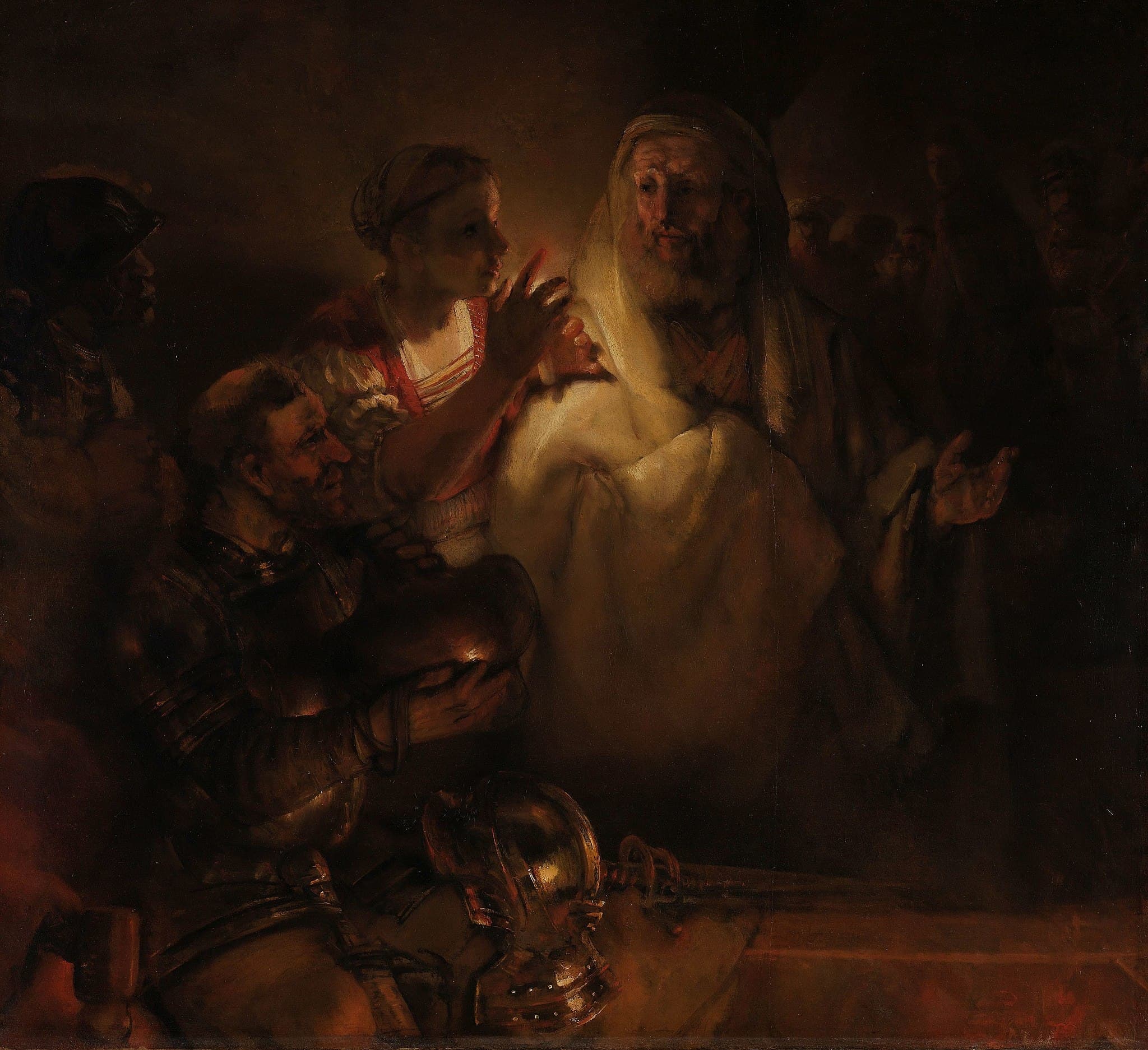
Hypothetical private-sale valuation for Rembrandt’s The Denial of St Peter (1660, Rijksmuseum) is $140–190 million. The estimate is anchored to state-backed purchases of top-tier Rembrandts—The Standard Bearer at €175 million and the Maerten & Oopjen pendants at €160 million—adjusted for this work’s late date, scale, and importance.
Valuation Analysis
Conclusion: On a hypothetical, lawful private-sale basis, Rembrandt’s The Denial of St Peter (1660; oil on canvas, 154.5 × 169.5 cm; Rijksmuseum, Amsterdam) would reasonably command $140–190 million. The painting is a signed, late biblical narrative widely recognized in Rembrandt’s mature oeuvre and firmly within the canon of museum-caliber works [1].
Comparable anchors: The upper pricing context for A+ Rembrandt paintings has been established through state- and institution-backed private negotiations rather than auctions. The Dutch State’s 2022 acquisition of The Standard Bearer for €175 million demonstrates the contemporary ceiling for a singular, trophy-grade Rembrandt in a negotiated sale [2]. The joint purchase by the Rijksmuseum and the Louvre of the full-length pendant portraits of Maerten Soolmans and Oopjen Coppit for €160 million in 2016 further confirms mid–nine-figure pricing for masterpieces with prime provenance and scholarship [3]. By contrast, public auctions underrepresent the top tier because supply is thin; the long-standing auction record is $33.2 million (Portrait of a Man, 1658) from 2009 [5], and the best recent painting at auction, The Adoration of the Kings (c.1628), realized about $13.8 million in 2023 after reattribution [4].
Positioning of The Denial of St Peter: This work’s late date (1660), substantial scale, dramatic chiaroscuro, and psychological depth align it with Rembrandt’s mature biblical narratives most coveted by institutions and leading collectors [1]. While not as universally iconic as The Night Watch, it is a frequently published masterwork and a cornerstone of the Rijksmuseum’s Rembrandt holdings. On quality and importance, it sits far closer to the private-sale comparables than to small-format auction lots.
Range rationale: The $140–190 million range is calibrated below the €175 million paid for The Standard Bearer, reflecting relative subject fame and market narrative, yet above any auction benchmark due to this painting’s scale, period, and autograph status. The low end contemplates conservatively framed transaction dynamics; the high end reflects strong institutional competition and pristine technical condition. Assuming sound structural condition, stable paint layers, and unambiguous attribution, pricing would concentrate toward the upper half of the range.
Transactability: In practice, this painting is not for sale and is subject to stringent cultural-heritage protections. Any theoretical sale would likely occur via state-preempted or institutionally negotiated channels, with price discovery set privately rather than by open auction—precisely the context in which recent Rembrandt masterpieces have achieved nine-figure results [2][3].
Key Valuation Factors
Art Historical Significance
High ImpactThe Denial of St Peter is a major late work by Rembrandt, signed and dated 1660, and long recognized within the core canon of his mature biblical narratives. Its psychological nuance, mastery of chiaroscuro, and complex multi-figure composition exemplify the late Rembrandt style that is prized by institutions and advanced collectors. The work is widely published and central to the Rijksmuseum’s narrative of Rembrandt’s development, giving it enduring scholarly weight. Within Rembrandt’s oeuvre, such large-scale, emotionally charged religious scenes from the late period are notably scarce outside museums, placing this painting in a rarefied tier that commands significant valuation premiums over portraits or small, early panels.
Quality, Scale, and Condition
High ImpactLarge, late Rembrandt canvases with autograph execution are exceptionally rare in the market. At 154.5 × 169.5 cm, this painting delivers a museum-scale presence that supports nine-figure pricing when coupled with strong condition. At this altitude, condition is one of the most price-sensitive variables: paint-layer integrity, surface coherence, degree of historic abrasion or overpaint, and conservation history can shift value by tens of millions. Assuming stable structure and paint, legible original surface, and minimal disruptive restoration, this factor supports placement toward the upper half of the $140–190 million range; conversely, material condition issues would pull the value toward the lower bound.
Market Scarcity and Comparables
High ImpactAutograph Rembrandt paintings of this significance essentially trade only through private, state-backed or institutional purchases. Recent benchmarks include The Standard Bearer at €175 million and the Maerten & Oopjen pendants at €160 million—both negotiated sales reflecting intense institutional demand. Public auction anchors are much lower because the best works almost never reach the block; the 2009 auction record stands at $33.2 million, and even a strong 2023 rediscovery achieved ~$13.8 million. Given subject, date, and caliber, The Denial of St Peter aligns with the private-sale benchmarks rather than auction outliers, justifying a mid–nine-figure valuation band adjusted modestly below Standard Bearer for relative iconography.
Provenance and Institutional Status
Medium ImpactThe painting’s elite provenance—from an 18th‑century Paris sale to Catherine the Great’s Hermitage, and since 1933 in the Rijksmuseum—confers exceptional credibility and reduces attribution or title risk. This deep, blue-chip chain of ownership enhances value and buyer confidence. At the same time, the work’s current status as a core holding of the Dutch national collection means it is not practically for sale. Any hypothetical transfer would almost certainly trigger cultural‑heritage protections and potential state pre‑emption, meaning price discovery would be set in a negotiated framework rather than through open bidding—consistent with how the highest Rembrandt prices have been established.
Sale History
Colnaghi, London (private purchase for the Rijksmuseum via Vereniging Rembrandt)
Acquired from the Soviet Union together with Rembrandt's Titus in monk’s habit for fl. 800,000 total (combined price for two works; USD shown is an approximate 1933 conversion).
Paris (P. Remy), Comte de Vence sale
Listed as Rembrandt’s Denial of St Peter, lot 49; recorded at frs. 500 (18th‑century French currency; no reliable modern USD conversion provided).
Private transaction via Melchior Grimm to Empress Catherine II (Hermitage)
Sold en bloc with a group of paintings; no price cited in the Rijksmuseum record. Date approximate within the year.
Rembrandt van Rijn's Market
Rembrandt van Rijn occupies the absolute top tier of the Old Masters market. His most important paintings are effectively non-fungible cultural assets, with peak prices discovered in private, state-backed negotiations rather than at auction. The contemporary ceiling was set by The Standard Bearer at €175 million (2022), while the 2016 joint purchase of the Maerten Soolmans and Oopjen Coppit full-lengths at €160 million affirmed deep institutional demand. Auction prices for autograph paintings are lower due to limited supply of major works; the auction record remains $33.2 million (2009), and a notable 2023 rediscovery achieved ~$13.8 million. The market for top-quality Rembrandt remains exceptionally strong, albeit thin, with intense competition for singular works.
Comparable Sales
The Adoration of the Kings
Rembrandt van Rijn
Same artist; biblical narrative subject; strong scholarly backing and recent auction benchmark, though much earlier (c.1628) and materially smaller than The Denial of St Peter.
$13.8M
2023, Sotheby's London
~$14.6M adjusted
Portraits of Jan Willemsz. van der Pluym and Jaapgen Carels
Rembrandt van Rijn
Same artist; rare intact pair of 1635 portraits with fresh market appearance—useful for current liquidity/price depth even if smaller and non‑narrative compared to the late, large Denial.
$14.3M
2023, Christie's London
~$15.1M adjusted
Portrait of a Man, Half‑Length, With His Arms Akimbo
Rembrandt van Rijn
Same artist; late period (1658) close in date to 1660 Denial; long‑standing auction record for a Rembrandt painting, though portrait format and smaller scale than Denial.
$33.2M
2009, Christie's London
~$49.2M adjusted
The Standard Bearer
Rembrandt van Rijn
Same artist; trophy‑level, state‑backed acquisition establishing the contemporary ceiling for masterworks by Rembrandt; though earlier (1636) and single‑figure, it is the closest proxy for what an institutionally coveted, museum‑caliber Rembrandt can command privately.
$198.9M
2022, Private sale to the Dutch State (for the Rijksmuseum)
~$216.8M adjusted
Current Market Trends
In the Old Masters category, true masterpieces increasingly transact privately or via state/institutional acquisition, while public auction results skew toward smaller or earlier works. Supply—especially fresh, scholarship-backed paintings—remains the key driver of price. When A+ material appears, demand is global and cross-category, and prices can reach nine figures. Prints and drawings show healthy depth, but paintings by Rembrandt at this level are exceptionally scarce, which supports resilient valuations even amid broader market cycles. Overall, the segment is stable-to-firm at the top, with negotiated deals setting the most meaningful price signals for culturally significant works.
Sources
- Rijksmuseum collection: The Denial of St Peter
- Guinness World Records: Most expensive Rembrandt painting (private sale)
- Christie’s: My highlight of 2016 — Two Rembrandt masterpieces
- The Art Newspaper: Rembrandt’s Adoration of the Kings sells for £10.9m
- Christie’s Press Release (Dec 2009): Old Masters & 19th Century Art