How Much Is The Sampling Officials (The Syndics) Worth?
Last updated: March 13, 2026
Quick Facts
- Methodology
- comparable analysis
The Sampling Officials (De Staalmeesters, 1662) is a canonical, museum‑held Rembrandt and is functionally off‑market. For a hypothetical, well‑advertised sale to an institutional/sovereign buyer, a defensible open‑market estimate is $150–300 million; in practice the work is effectively inestimable and would likely be treated as priceless by the Rijksmuseum.
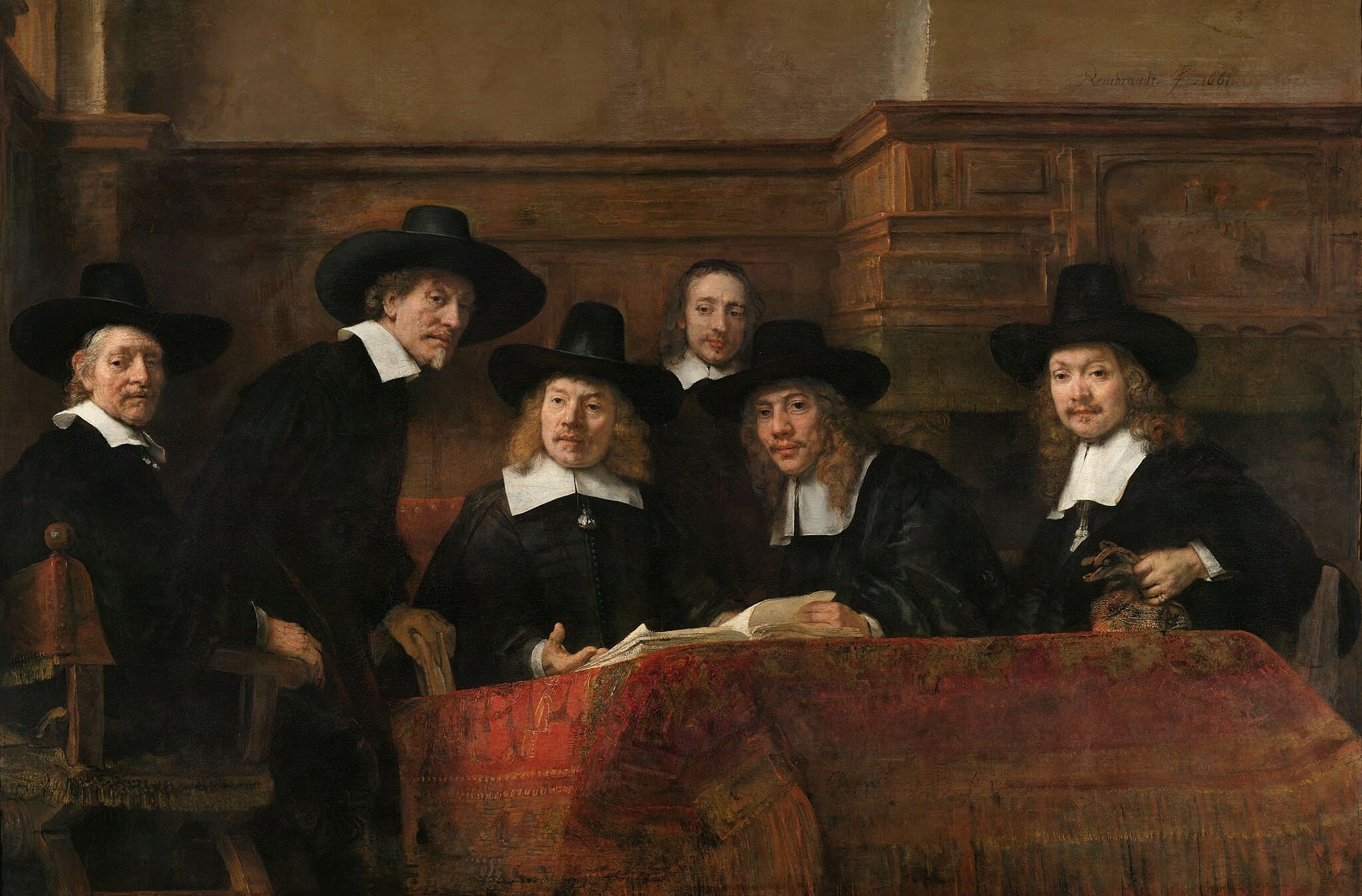
The Sampling Officials (The Syndics)
Rembrandt van Rijn, 1662 • Oil on canvas
View more by Rembrandt van Rijn →Valuation Analysis
Valuation summary: The Sampling Officials (De Staalmeesters, 1662) is a canonical Rembrandt group portrait in the Rijksmuseum and has not appeared as a modern commercial lot; it is therefore functionally off‑market and protected in the Dutch national collection [1]. For hypothetical valuation purposes—assuming a willing seller, adequate marketing time and a competitive field of institutional or sovereign buyers—a defensible open‑market range is approximately $150–300 million, reflecting modern trophy‑level private‑treaty anchors and scarcity of comparable Rembrandt canvases.
Methodology and anchors: This estimate uses comparable analysis balanced against known private‑treaty transactions and the limited high‑end auction record. The joint Louvre–Rijksmuseum purchase of Maerten Soolmans and Oopjen Coppit (reported at €160m for the pair) and press‑reported sovereign purchases such as The Standard‑Bearer establish practical ceilings for museum‑quality Rembrandts and demonstrate that national institutions will transact in the low‑to‑mid hundreds of millions [2][3]. By contrast, the modern auction high for a painted Rembrandt remains much lower (the 2009 Christie’s portrait remains the open‑market auction benchmark), which explains the wide gulf between auction ceilings and private‑treaty institutional pricing [4].
Key value drivers and constraints: The principal positive drivers are the painting’s art‑historical significance, secure attribution, exemplary provenance and continuous public display; these characteristics concentrate institutional demand and support a trophy premium. Critical constraining factors are the museum ownership, deaccession rules, export and national‑heritage protections that make a bona fide sale unlikely and limit the buyer pool to states, national museums or exceptional private consortia. Condition and conservation history, exhibition record and scholarly attention also materially affect perceived marketability.
Scenarios and practical guidance: In a well‑timed, fully marketed sale with time to assemble institutional funding, price could reasonably fall in the $150–300 million band; a determined consortium or sovereign purchaser could pay toward the upper end. In a constrained or forced sale the market would be much weaker—typical distressed or legally encumbered scenarios would likely produce results in the $50–150 million range owing to fewer qualified buyers and higher transfer risk. For insurance and institutional planning the work would ordinarily be treated as effectively “priceless” with a confidential replacement figure held by the museum/insurer.
Refinement steps: To narrow this theoretical range, obtain any confidential Rijksmuseum insurance/replacement valuation, commission a formal written appraisal from an Old‑Master desk or independent Rembrandt specialist, assemble condition and conservation dossiers, and confirm applicable Dutch export/deaccession law. Those actions will convert a theoretical trophy range into an actionable figure for underwriting or contingency planning.
Key Valuation Factors
Art Historical Significance
High ImpactDe Staalmeesters is one of Rembrandt’s foremost civic/group portraits and occupies a canonical position in 17th‑century Dutch painting. Commissioned by the Amsterdam cloth‑sampling officials (1662), the canvas showcases Rembrandt’s late‑career mastery of composition, light and psychological portrayal. Its continuous public prominence, frequent citation in scholarship and centrality to Rijksmuseum displays confer exceptional cultural value that directly elevates theoretical market value: buyers (especially institutions) pay a premium for singular works that are benchmarks in an artist’s oeuvre. This rarity of position — not just quality of execution — is the critical reason a museum‑quality Rembrandt commands trophy‑level pricing in hypothetical market scenarios.
Market Scarcity and Comparability
High ImpactTop‑tier Rembrandt paintings in private hands are extremely rare; most canonical canvases are in national or major museum collections and rarely, if ever, reach public sale. As a result, comparable transactions are dominated by private‑treaty institutional purchases (e.g., Soolmans/Oopjen pair; The Standard‑Bearer) rather than open auctions. That scarcity creates a two‑tier market: modest auction benchmarks on one side and sporadic, very large institutional treaty prices on the other. The paucity of true comparables widens valuation ranges but also supports a very high theoretical ceiling when an eligible institutional buyer is involved.
Ownership / Legal & Institutional Constraints
High ImpactThe work’s custodial status in the Rijksmuseum subjects it to museum deaccession policies, national patrimony considerations and export controls that effectively remove it from ordinary market circulation. Those legal and institutional constraints materially reduce the set of legitimate buyers to other sovereigns, national museums or rare consortia, increasing transaction complexity and reducing fungibility. From a valuation perspective this dual effect raises replacement/insurance thinking (supporting very high notional values) while making any real‑world sale improbable and legally fraught.
Condition, Conservation & Exhibition History
Medium ImpactCondition and documented conservation history are critical modifiers of secondary‑market value. Works maintained in major museums are typically in stable conservation states, which is positive for marketability and value. Conversely, contentious restorations or unresolved condition issues can depress buyer confidence and price. Exhibition history and scholarly engagement increase visibility and institutional desirability; technical studies that corroborate attribution and state of preservation also reduce transactional risk and can uplift hypothetical valuations.
Sale History
The Sampling Officials (The Syndics) has never been sold at public auction.
Rembrandt van Rijn's Market
Rembrandt van Rijn is among the most important and highest‑valued Old Master artists; his works command intense institutional and private collector interest. The market is bifurcated: while open‑market auction highs for paintings remain well below trophy private purchases, exceptional works (when they become available) attract sovereign and museum buyers prepared to pay in the mid‑to‑high hundreds of millions in private transactions. Recent years show strong demand for rare Rembrandt drawings and prints as well, and technical reappraisals or rediscoveries continue to produce steep uplifts in value.
Comparable Sales
Portraits of Maerten Soolmans and Oopjen Coppit (pair)
Rembrandt van Rijn
Top-tier Rembrandt portraits sold privately to national institutions — demonstrates institutional/trophy ceiling for museum‑quality Rembrandts.
$174.4M
2016, Private treaty (joint purchase by the Louvre & Rijksmuseum)
~$233.7M adjusted
The Standard‑Bearer
Rembrandt van Rijn
Large state/institutional purchase of a single‑figure Rembrandt — a direct modern price anchor for national‑level masterpieces.
$198.0M
2022, Acquisition by the Dutch State / Rijksmuseum (reported price)
~$217.8M adjusted
Portrait of a Man (arms akimbo)
Rembrandt van Rijn
Highest reported auction result for a Rembrandt painting (modern auction benchmark) — shows open‑market painting ceiling is far below institutional treaty prices.
$33.2M
2009, Christie's, London
~$49.8M adjusted
The Adoration of the Kings (Adoration of the Magi)
Rembrandt van Rijn
Rediscovered / re‑attributed Rembrandt sold at auction — illustrates the value uplift from secure attribution but remains well below trophy private purchases.
$13.8M
2023, Sotheby's, London
~$14.7M adjusted
Arnout Tholinx, Inspector (etching)
Rembrandt van Rijn
Record result for an Old‑Master/Rembrandt print at auction — shows very strong demand for works on paper but at a much lower price scale than paintings.
$4.1M
2025, Christie's, London
Current Market Trends
The top end of the Old Masters market is supply‑constrained and trophy‑driven: institutional acquisitions and private treaties set ceilings while auction results vary. Recent years have seen renewed appetite for museum‑quality material and record prices for works on paper, but volatility remains. Attribution, technical validation and public‑institution interest increasingly determine whether a lot enters the high‑value tier.
Sources
- Rijksmuseum — The Sampling Officials (De Staalmeesters) collection entry
- Louvre press release — Maerten Soolmans and Oopjen Coppit acquisition
- The Art Newspaper — Dutch government / Rijksmuseum purchase reporting (The Standard‑Bearer)
- Christie’s press release — 2009 Rembrandt auction benchmark (Portrait of a Man)
- Sotheby’s / press coverage — Young Lion Resting (Rembrandt drawing) auction record (Feb 2026)