How Much Is Evening (after Millet) Worth?
Last updated: June 2, 2026
Quick Facts
- Insurance Value
- $80.0M (Assistant estimate: prudent replacement value for outbound museum loan based on market comparables)
- Methodology
- comparable analysis
Hypothetical fair-market value for Vincent van Gogh’s Evening (after Millet) (1889) is $45–70 million. The estimate reflects its Saint-Rémy date, scale, museum-grade provenance, and importance within Van Gogh’s Millet ‘translations,’ balanced against the commercial discount typically applied to “after” works.
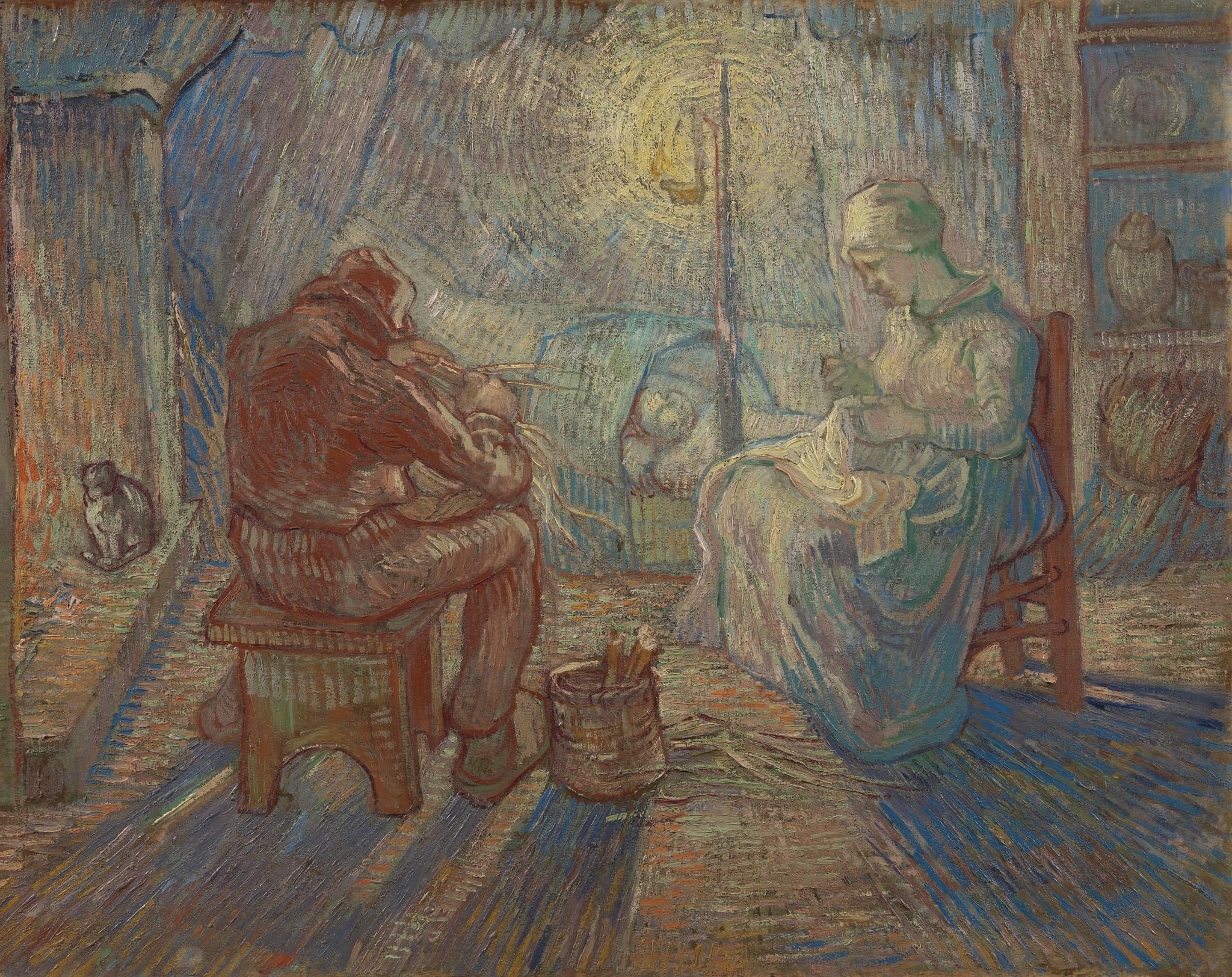
Evening (after Millet)
Vincent van Gogh, 1889 • Oil on canvas
Read full analysis of Evening (after Millet) →Valuation Analysis
Conclusion: If legally and openly offered at a top evening sale, Vincent van Gogh’s Evening (after Millet) (1889; 74.2 × 93 cm; Van Gogh Museum, Amsterdam) would likely achieve $45–70 million. The work is securely held by the Vincent van Gogh Foundation/Van Gogh Museum and has no public sale history; this valuation is therefore hypothetical and based on recent market evidence and the work’s art-historical profile [1].
How the estimate was derived. We anchor the lower bound to the primary series-specific comparable: Van Gogh’s Le moissonneur (d’après Millet), from the same 1889 Saint-Rémy copying campaign, sold for approximately $30.86 million at Christie’s London in 2017 [3]. Adjusted for the stronger Van Gogh market post-2021 and for the subject’s scale and finish here, a premium over that benchmark is warranted. We set the upper bound by reference to prime Saint-Rémy originals that are not universally iconic but remain blue chip, notably Cabanes de bois parmi les oliviers et cyprès at $71.35 million (Christie’s New York, 2021) [5]. The absolute ceiling for the artist—Orchard with Cypresses at $117.18 million (Christie’s New York, 2022)—illustrates the premium reserved for fully original, top-tier masterpieces [2]. A 2024 Paris-period garden canvas achieved $33.19 million, underscoring current liquidity for non-iconic Van Gogh oils and supporting our lower band [4].
Positioning and key factors. This canvas sits within Van Gogh’s celebrated Saint-Rémy period and is a fully worked, museum-scale oil. Its “after Millet” status is central: art-historically, the Millet translations are crucial to his program of reimagining peasant life and spiritual themes; commercially, the market applies a clear (but not prohibitive) discount relative to the artist’s most coveted original compositions. Provenance is unimpeachable—artist to Theo to Jo van Gogh-Bonger to Vincent Willem van Gogh to the Foundation—and the exhibition record is extensive, enhancing confidence and perceived quality [1].
Market climate and execution risk. Demand for late-19th-century blue-chip masters remains deep, with headline Van Gogh results in 2021–2024 reaffirming a strong bid for prime-period works [2][4][5]. With optimal global marketing, third-party support/guarantees, and a tight condition report, competitive bidding could place the work toward the midpoint or upper quartile of this range. Conversely, any condition reservations or conservative sale orchestration would skew outcomes toward the lower band. Given museum ownership, any actual sale is unlikely; for loan insurance, replacement values are often set at or above fair-market estimates.
Key Valuation Factors
Art Historical Significance
High ImpactEvening (after Millet) belongs to Van Gogh’s pivotal Saint-Rémy campaign of ‘translations’ after Jean-François Millet. Far from mere copies, these works were vehicles for Van Gogh’s spiritual and formal explorations—reframing Millet’s peasant subjects with intensely modern color and brushwork. This series sits at the core of his late practice and is deeply discussed in scholarship and exhibitions, enhancing its art-historical weight. While the market differentiates between original motifs and ‘after’ works, the Millet group is the most esteemed among derivative subjects in his oeuvre, giving the painting significant cultural capital even if it does not carry the same commercial cachet as Sunflowers, Irises, or the major Arles/Saint-Rémy originals.
Period, Scale, and Execution
High ImpactPainted in 1889 at Saint-Rémy, the work is squarely within one of the most coveted periods of Van Gogh’s career. Its substantial dimensions (74.2 × 93 cm) and fully worked surface place it among the more desirable market formats, which typically command strong premiums over smaller oils or works on paper. The 1889 palette and brushwork—hallmarks of Van Gogh’s mature style—are clearly present in this Millet reinterpretation. Together, prime period and compelling execution support robust demand, positioning the work well above Paris-period mid-tier results and just below the strongest 1889 originals in price potential, assuming a clean, current condition report and first-rate sale presentation.
Subject/Series Market Positioning (After Millet)
Medium ImpactCommercially, the market applies a consistent discount to ‘after’ works relative to Van Gogh’s fully original and iconic motifs. The best guide is the 2017 Christie’s London sale of Le moissonneur (d’après Millet), which realized about $30.86 million [3]. Evening (after Millet) is larger and comparably finished, and the Van Gogh market has strengthened since 2017, warranting a higher valuation. Nonetheless, collectors who chase headline prices typically prioritize original compositions. This creates a performance ceiling below top Saint-Rémy originals (e.g., the $71.35 million 2021 result) while keeping the picture squarely in the high-value tier when measured against recent non-iconic Van Gogh oils, which have transacted in the $30–35 million range in 2024 [4][5].
Provenance and Exhibition History
High ImpactThe uninterrupted chain from the artist to Theo van Gogh, to Jo van Gogh-Bonger, to their son Vincent Willem, and then to the Vincent van Gogh Foundation—combined with long-term Van Gogh Museum stewardship—provides exemplary title clarity and scholarly pedigree [1]. Such provenance minimizes transactional risk and adds a museum-grade imprimatur that the market reliably rewards. The painting’s extensive exhibition record further elevates its standing, ensuring broad recognition among curators, scholars, and collectors. In a market that increasingly prizes clean, documented histories, this work’s provenance and institutional validation act as meaningful value accelerators, supporting a result in the mid to upper part of the estimated range under optimal sale conditions.
Sale History
Evening (after Millet) has never been sold at public auction.
Vincent van Gogh's Market
Vincent van Gogh is an apex, trophy-market artist with extremely limited supply and global, cross-category demand. The artist’s auction record stands at $117.18 million for Orchard with Cypresses (Christie’s New York, 2022), underscoring the premium for prime Arles/Saint-Rémy masterpieces [2]. Other major results include $81.31 million for Laboureur dans un champ (2017) and $61.8 million for Still Life: Vase with Daisies and Poppies (2014), with strong 2024 sales around $33 million for high-quality Paris-period works [4][5]. Fresh-to-market, well-documented oils from 1888–90 remain the most hotly contested. Guarantees and global marketing continue to drive outcomes, and the best examples typically command tens of millions, with select masterpieces surpassing $100 million.
Comparable Sales
Le moissonneur (d’après Millet)
Vincent van Gogh
Direct 'after Millet' oil from the same 1889 Saint-Rémy copying campaign; closest subject-type and period benchmark for pricing a Millet translation.
$30.9M
2017, Christie's London
~$41.1M adjusted
Laboureur dans un champ (Ploughman in the Field)
Vincent van Gogh
Original Saint‑Rémy (1889) composition with a working figure in a field—same year, comparable palette/brushwork and asylum-period context; anchors upper-tier pricing for prime 1889 oils.
$81.3M
2017, Christie's New York
~$108.2M adjusted
Cabanes de bois parmi les oliviers et cyprès
Vincent van Gogh
Saint‑Rémy (1889) landscape from the same coveted period; demonstrates recent pricing for high-quality, non-iconic 1889 oils with blue-chip provenance.
$71.3M
2021, Christie's New York
~$85.9M adjusted
Nature morte: Vase aux marguerites et coquelicots (Still Life: Vase with Daisies and Poppies)
Vincent van Gogh
Late 1890 Auvers oil; different subject but top-tier late work with strong exhibition/provenance; establishes pricing for high-quality Van Gogh oils outside the Millet-copy series.
$61.8M
2014, Sotheby's New York
~$85.1M adjusted
Coin de jardin avec papillons (Corner of a Garden with Butterflies)
Vincent van Gogh
Paris-period (1887) oil; smaller and earlier but a fresh, decorative canvas with a 2024 price that indicates current liquidity/floor for non-iconic Van Gogh oils.
$33.2M
2024, Christie's New York
~$34.0M adjusted
Orchard with Cypresses
Vincent van Gogh
Prime 1888 Arles masterpiece; not a Millet copy but immediate adjacent period. Serves as the artist’s auction ceiling and calibrates the discount that markets apply to 'after Millet' works.
$117.2M
2022, Christie's New York
~$130.5M adjusted
Current Market Trends
The upper tier of the Impressionist/Post‑Impressionist market remained resilient through 2022–2024, with Van Gogh among the most reliable bellwethers. The 2022 artist record reaffirmed collector appetite for prime-period, museum-grade works, while 2024 results in the low‑$30 million range showed consistent liquidity for non‑iconic but high-quality oils [2][4]. Trophy buyers remain highly selective, favoring top period, scale, and provenance, and houses routinely deploy third‑party guarantees to secure and de‑risk headline consignments. In this context, a Saint‑Rémy oil with unimpeachable provenance should clear strongly, though ‘after’ status imposes a known discount relative to fully original compositions, naturally bracketing the estimate below the artist’s top-tier masterpieces.
Study print
Study this painting as a print
Pair the full artwork with a museum-style study sheet focused on one meaningful detail.
Sources
- Van Gogh Museum: Evening (after Millet) object record
- The Art Newspaper: Van Gogh record—Orchard with Cypresses soars to $117m (Nov 2022)
- Christie’s London: Impressionist & Modern Art Evening Sale results (includes Le moissonneur d’après Millet, £24.245m, Jun 2017)
- Christie’s: 20th Century Evening Sale totals (includes Corner of a Garden with Butterflies, $33.185m, May 2024)
- The Art Newspaper: Four Van Goghs go for $161m at the New York auctions (Nov 2021)