Evening (after Millet)

by Vincent van Gogh

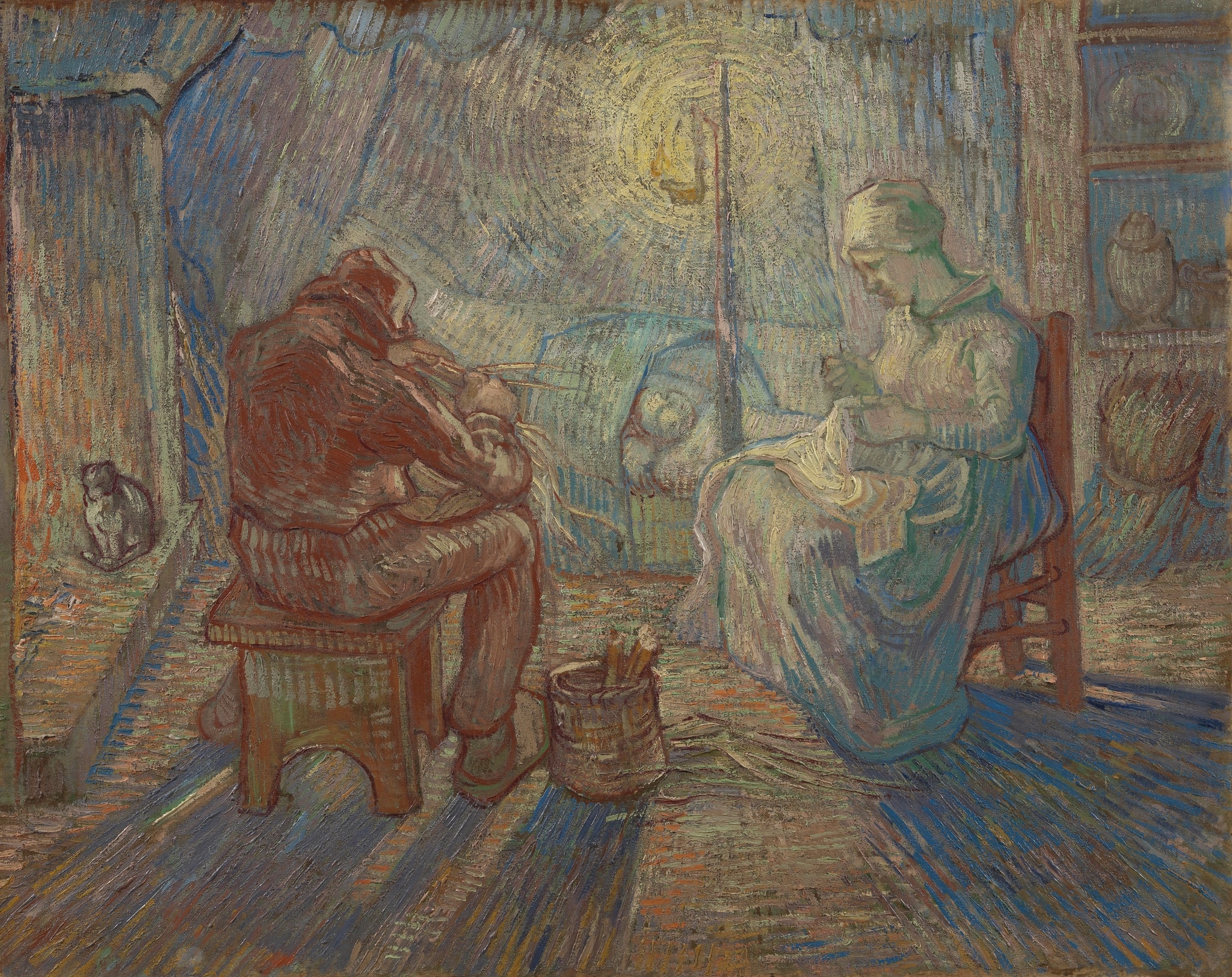
A peasant couple bends to evening tasks under a glowing lamp, its halo pulsing through the room while cool violets and blues pool across the floor. Van Gogh "translates" Millet’s print into a larger, color‑charged meditation on care, labor, and light at day’s end [1][2].
💰

Market Value

$45-70 million

How much is Evening (after Millet) worth?

Study Print Studio

Create a personal study print

Build a companion study sheet around the part of this painting that speaks to you most. Choose a detail, shape an interpretation, and walk away with something personal and display-worthy.

Fast Facts

Year
1889
Medium
Oil on canvas
Dimensions
74.2 × 93 cm
Location
Van Gogh Museum, Amsterdam
See all Vincent van Gogh paintings in Amsterdam
Evening (after Millet) by Vincent van Gogh (1889) featuring Sewing work (needle and cloth), Hanging lamp and halo, Cradle with rocking pole and cord, Basketry tools and willow rods

Click on any numbered symbol to learn more about its meaning

Meaning & Symbolism

Van Gogh builds the image around the suspended lamp, a bright kernel whose radiating strokes form concentric tremors across wall, cradle, and figures. This is not natural daylight; it is chosen light, engineered indoors, which lets him stage a deliberate clash of complements—sulfurous yellows for the flame and aureole; blue‑violets on the plank floor and rear wall; russet‑orange drawing the man’s jacket, the woman’s chair, and the shelf uprights. The result is a chromatic current that runs from center outward, so that everything in the room—basket, cat, tools, the rocking pole—seems to vibrate in sympathy with the lamp. By preserving Millet’s iconography (seated man weaving, woman sewing, cradle steadied by a pole, hearth with a cat) yet enlarging the scale and saturating the color, Van Gogh enacts the program he described from Saint‑Rémy: to translate Millet “into another language rather than to copy him” 2. In this language, color is meaning. The warm lamp bleeds into the woman’s dress as lemon and pale green, tenderly binding her to the child in the cradle; the man, cast in earth reds, absorbs heavier shadows, registering the weight of work even in rest. The bucket of willow rods at his feet and the stitched seams in her lap become visual rhymes, joined by the insistent parallel hatches that seam the whole interior together. These strokes do not merely model forms; they choreograph an evening tempo—the slow, repetitive motions of mending, weaving, and rocking made visible as pulses of paint. That tempo is ethical as much as optical. Van Gogh revered Millet as a painter of the dignity of labor, and here he makes that dignity legible through the lamp’s logic: light confers worth on what it touches 13. The cradle and its taut cord to the pole compose a practical machine of care, spanning the room like a plumb line; its alignment with the lamp implies that caregiving, too, is a central fire. The small cat by the hearth functions as a counter‑note—an emblem of settled heat that anchors the left edge, balancing the woman’s calm on the right. Meanwhile the shelves packed with vessels and the textured, tread‑like floorboards translate domestic accumulation into a field of memory, each object holding a trace of use. This is why Evening (after Millet) is important: it demonstrates how artificial light—from lamp or candle—became a laboratory for Van Gogh’s late color, enabling him to fuse observation with symbolic resonance and to re‑enter ambitious figure painting during recovery at Saint‑Rémy 14. By staging modern peasant life as a nocturne whose center is a man‑made sun, he argues that meaning is made in the ordinary and that painting, like evening work, is a craft of steady, saving attention. The image is thus less a copy of Millet than a profession of artistic faith: that translation, undertaken with devotion, can renew both subject and self 234.

Explore Deeper with AI

Ask questions about Evening (after Millet)

Popular questions:

Powered by AI • Get instant insights about this artwork

💬 Ask questions about this artwork!

Interpretations

Formal Analysis: From Engraving Matrix to Chromatic Architecture

Working from a black‑and‑white Lavieille engraving after Millet, Van Gogh executes a deliberate act of chromatic construction: complementary yellow–violet fields, longitudinal hatching that binds surfaces, and a centripetal glow that organizes space. The translation from a small print to a broad canvas is not just enlargement; it is a re‑specification of value into hue, replacing print chiaroscuro with coloristic modeling. The lamp becomes an optical engine that stabilizes the composition like a keystone, while parallel strokes across floor, furniture, and clothing create a unified facture—a visible tempo suturing figures to interior. Such repainting demonstrates how scale, color, and brushwork can re-author the iconography of the source, turning Millet’s quiet vigil into a modern nocturne of vibrating surfaces 534.

Source: Saint Louis Art Museum

Medium Reflexivity: Translation as Authorship

Van Gogh’s oft‑quoted aim was to “translate” rather than copy Millet; the work stages this claim at the level of medium. A monochrome engraving’s syntax—line, hatch, reserve—is recast as painterly registers of saturation, temperature, and impasto. This is not imitation but intermedial authorship, where meaning migrates with transformation. The painting thematizes its own procedure: the lamp, a man‑made source, allegorizes how art manufactures light—and thus significance—inside a closed room. By choosing a canonical print and re‑inscribing it in color and scale, Van Gogh participates in nineteenth‑century debates on originality and appropriation, demonstrating that fidelity can be interpretive, not mechanical 23.

Source: Van Gogh Letters (Letter 816); Saint Louis Art Museum

Nocturne Studies: Artificial Light as Modern Motif

Evening (after Millet) belongs to Van Gogh’s broader pursuit of “representing night by light,” a program spanning interiors and skies where lamps, candles, and stars are operational motifs. Here, the oil lamp’s aureole lets him stage high‑key yellows against blue‑violets, compressing value contrasts into color complements to model darkness without black. MoMA’s Colors of the Night situates this tactic alongside works like The Night Café and Starry Night, where localized sources act as both literal illumination and metaphors of inner intensity. In this interior, the lamp’s sun‑like role modernizes the peasant veillée, recoding it as a laboratory for late color: controlled, symbolic, and psychologically charged 41.

Source: MoMA, Van Gogh and the Colors of the Night; Van Gogh Museum

Social History: Gendered Labor and the Peasant Veillée

Millet’s Four Times of the Day codified the peasant evening as a veillée—domestic work continuing after field labor. Van Gogh retains this social script: basket‑making and sewing as gendered tasks, the cradle‑pole mechanism enabling childcare to synchronize with production. Far from quaintness, the scene models how labor is distributed and extended by technology (lamp, pole) within a modest interior economy. The cat, hearth, and utensils are not décor but indices of use—material signs of classed life where accumulation equates to function. By saturating the scene in expressive color, Van Gogh reframes Millet’s moral economy for a modern audience, dignifying ordinary reproductive labor as central to community survival 531.

Source: Art Institute of Chicago (Millet’s print context); Saint Louis Art Museum; Van Gogh Museum

Psychological Interpretation: Convalescent Practice and Order

At Saint‑Rémy, Van Gogh adopted a disciplined program of painting after Millet as a way to re‑enter ambitious figure work during recovery. The method offered stabilizing constraints—fixed iconography, available prints, and a clear task—while leaving room for expressive reinvention through color. In Evening, the lamp’s centripetal order and the room’s parallel hatching read as structures of control over a volatile sensorium: rhythm regularizes sensation, and warm light confers value on humble continuities. This aligns with his letters framing translation as a pathway back to large compositions, fusing therapeutic routine with artistic ambition. The result is a quietly assertive proof that craft and constraint can restore agency in the wake of crisis 21.

Source: Van Gogh Letters (Letter 816); Van Gogh Museum (biographical context)

Spiritual-Poetic Reading: Domestic Sanctum and the Cult of Millet

Van Gogh revered “Father Millet” as a moral exemplar whose peasants carried a latent spiritual gravity. In Evening, the lamp operates like a domestic altar light: a man‑made nimbus that sanctifies caregiving and labor. The alignment of lamp, cradle, and rocking pole reads as a modest axis mundi binding generations, while the calm cat and stocked shelves function as tokens of settled hearth‑life. Rather than didactic symbolism, the effect is poetic immanence—grace encountered in routines. By translating Millet’s veillée into a saturated, tender nocturne, Van Gogh articulates a lay devotion where attention itself is a form of prayer rendered in color 314.

Source: Saint Louis Art Museum; Van Gogh Museum; MoMA, Colors of the Night

Related Themes

About Vincent van Gogh

Vincent van Gogh (1853–1890) developed a radical, emotion‑driven use of color after moving from Paris to Arles in 1888, seeking southern light and an artists’ community. In Arles he created the Sunflowers series to decorate the Yellow House ahead of Gauguin’s visit. His late work fused impasto, high chroma, and symbolic motifs that shaped modern painting [2][5].
View all works by Vincent van Gogh

More by Vincent van Gogh
Café Terrace at Night by Vincent van Gogh

Café Terrace at Night

Vincent van Gogh (1888)

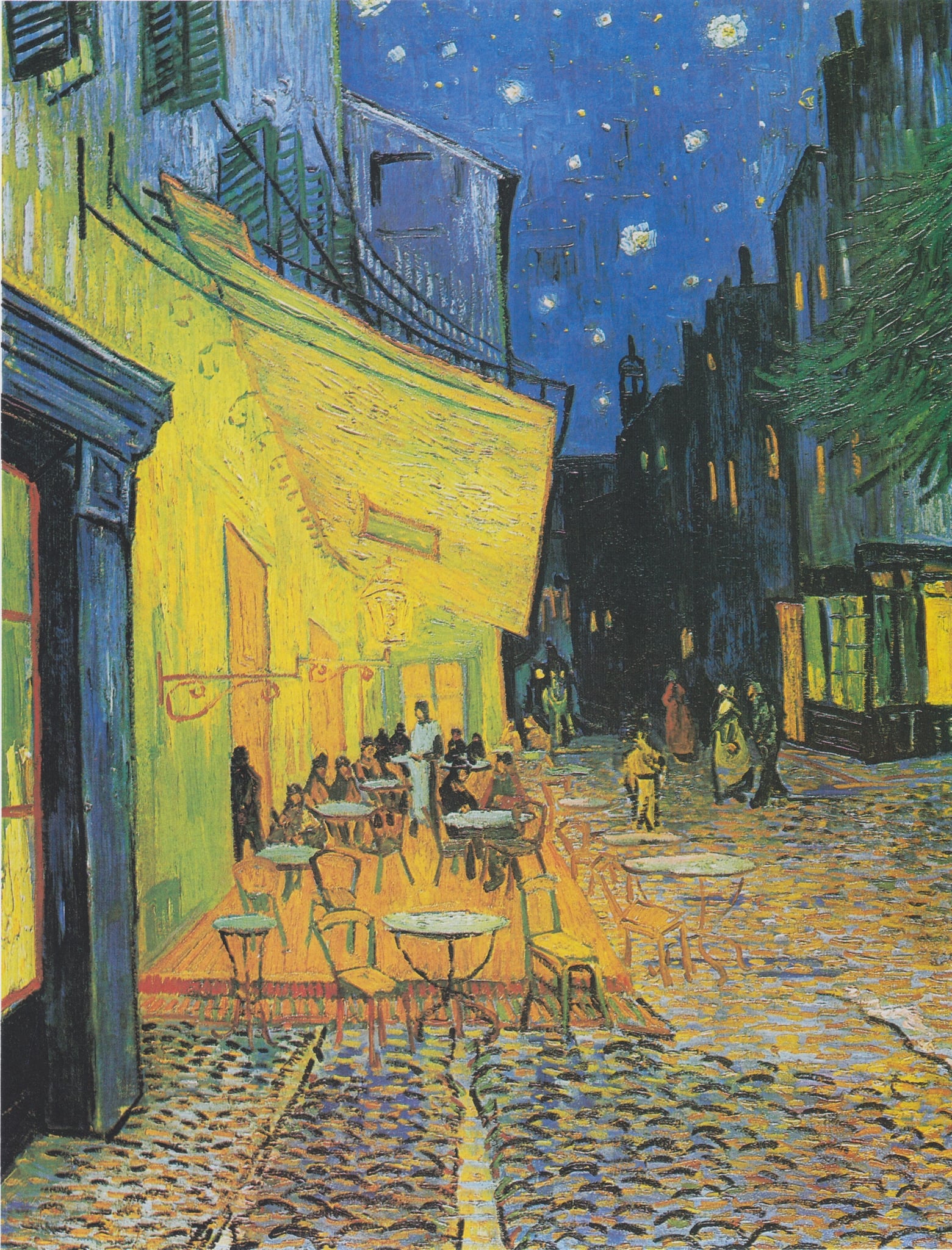
In Café Terrace at Night, Vincent van Gogh turns nocturne into <strong>luminous color</strong>: a gas‑lit terrace glows in yellows and oranges against a deep <strong>ultramarine sky</strong> pricked with stars. By building night “<strong>without black</strong>,” he stages a vivid encounter between human sociability and the vastness overhead <sup>[1]</sup><sup>[2]</sup>.
Red Cabbages and Onions by Vincent van Gogh

Red Cabbages and Onions

Vincent van Gogh (1887)

In Red Cabbages and Onions, Vincent van Gogh turns everyday produce into a drama of <strong>complementary color</strong> and <strong>restless brushwork</strong>. Hot red contours cinch violet cabbages and pale yellow bulbs against a cool, striated blue table, while a mustard‑yellow patch in the upper right tilts the space and sharpens the chromatic clash. The result asserts ordinary food as a locus of <strong>resilience</strong> and <strong>experimentation</strong> <sup>[1]</sup><sup>[2]</sup>.

Irises by Vincent van Gogh

Irises

Vincent van Gogh (1889)

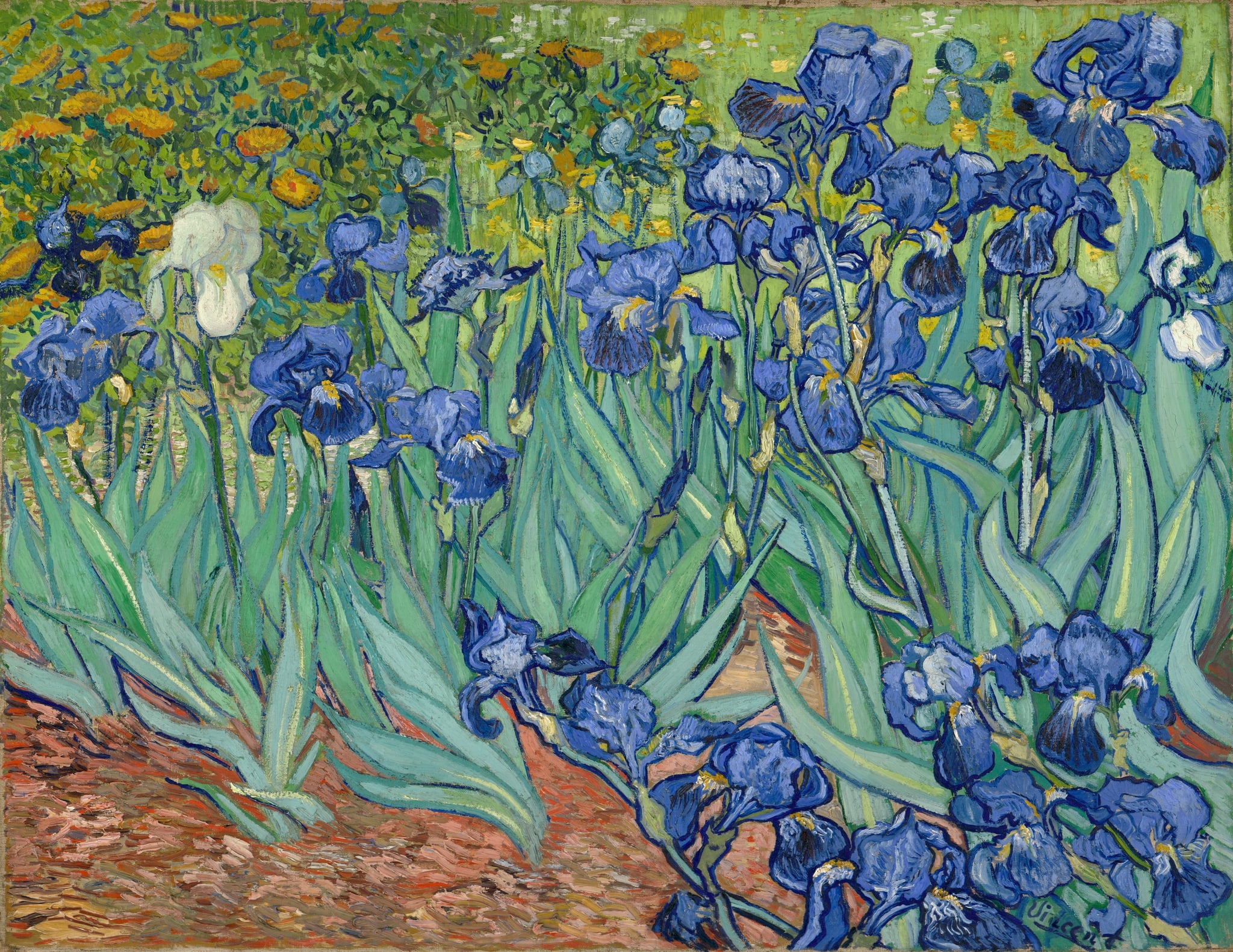
Painted in May 1889 at the Saint-Rémy asylum garden, Vincent van Gogh’s <strong>Irises</strong> turns close observation into an act of repair. Dark contours, a cropped, print-like vantage, and vibrating complements—violet/blue blossoms against <strong>yellow-green</strong> ground—stage a living frieze whose lone <strong>white iris</strong> punctuates the field with arresting clarity <sup>[1]</sup><sup>[2]</sup>.
Sunflowers by Vincent van Gogh

Sunflowers

Vincent van Gogh (1888)

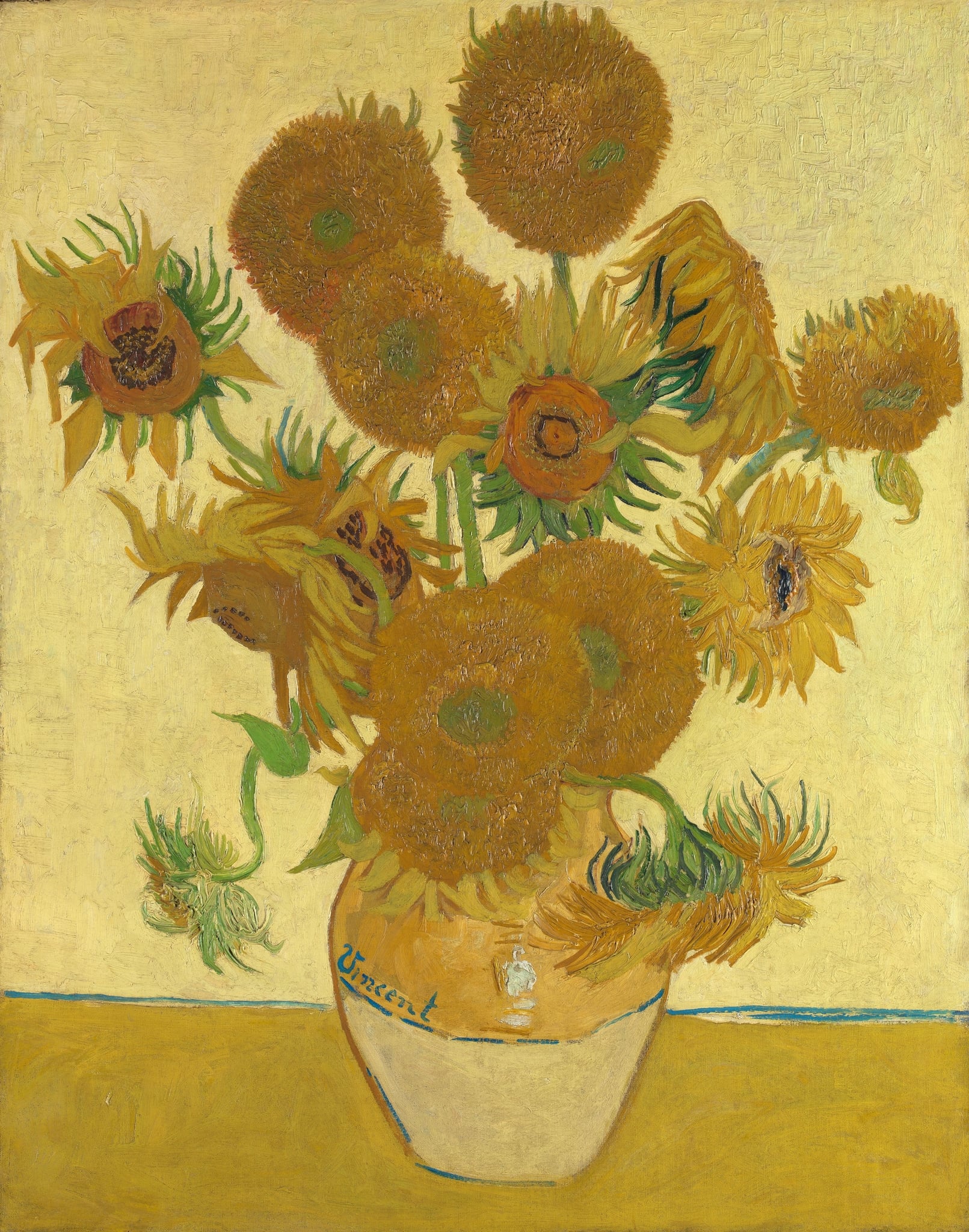
Vincent van Gogh’s Sunflowers (1888) is a <strong>yellow-on-yellow</strong> still life that stages a full <strong>cycle of life</strong> in fifteen blooms, from fresh buds to brittle seed heads. The thick impasto, green shocks of stem and bract, and the vase signed <strong>“Vincent”</strong> turn a humble bouquet into an emblem of endurance and fellowship <sup>[1]</sup><sup>[2]</sup>.

Garden with Courting Couples: Square Saint-Pierre by Vincent van Gogh

Garden with Courting Couples: Square Saint-Pierre

Vincent van Gogh (1887)

In Garden with Courting Couples: Square Saint-Pierre, Vincent van Gogh turns a small Montmartre park into a stage where <strong>spring</strong>, <strong>intimacy</strong>, and <strong>urban leisure</strong> converge. Short, shimmering strokes fuse pink chestnut blossoms, curving paths, and paired figures into one pulse of <strong>renewal</strong> and <strong>togetherness</strong> <sup>[1]</sup><sup>[2]</sup>.

In the Café: Agostina Segatori in Le Tambourin by Vincent van Gogh

In the Café: Agostina Segatori in Le Tambourin

Vincent van Gogh (1887 (Jan–Mar))

Van Gogh casts Agostina Segatori at a tiny, tambourine‑like café table, turning Le Tambourin into a <strong>stage of modern life</strong>. Cool greens and greys make the red <strong>flame‑plume hat</strong> and the foaming <strong>beer</strong> flare, while folded arms and a set‑aside <strong>parasol</strong> register private fatigue amid public display <sup>[1]</sup><sup>[2]</sup><sup>[3]</sup>.