How Much Is The Olive Trees Worth?
Last updated: June 26, 2026
Quick Facts
- Methodology
- comparable analysis
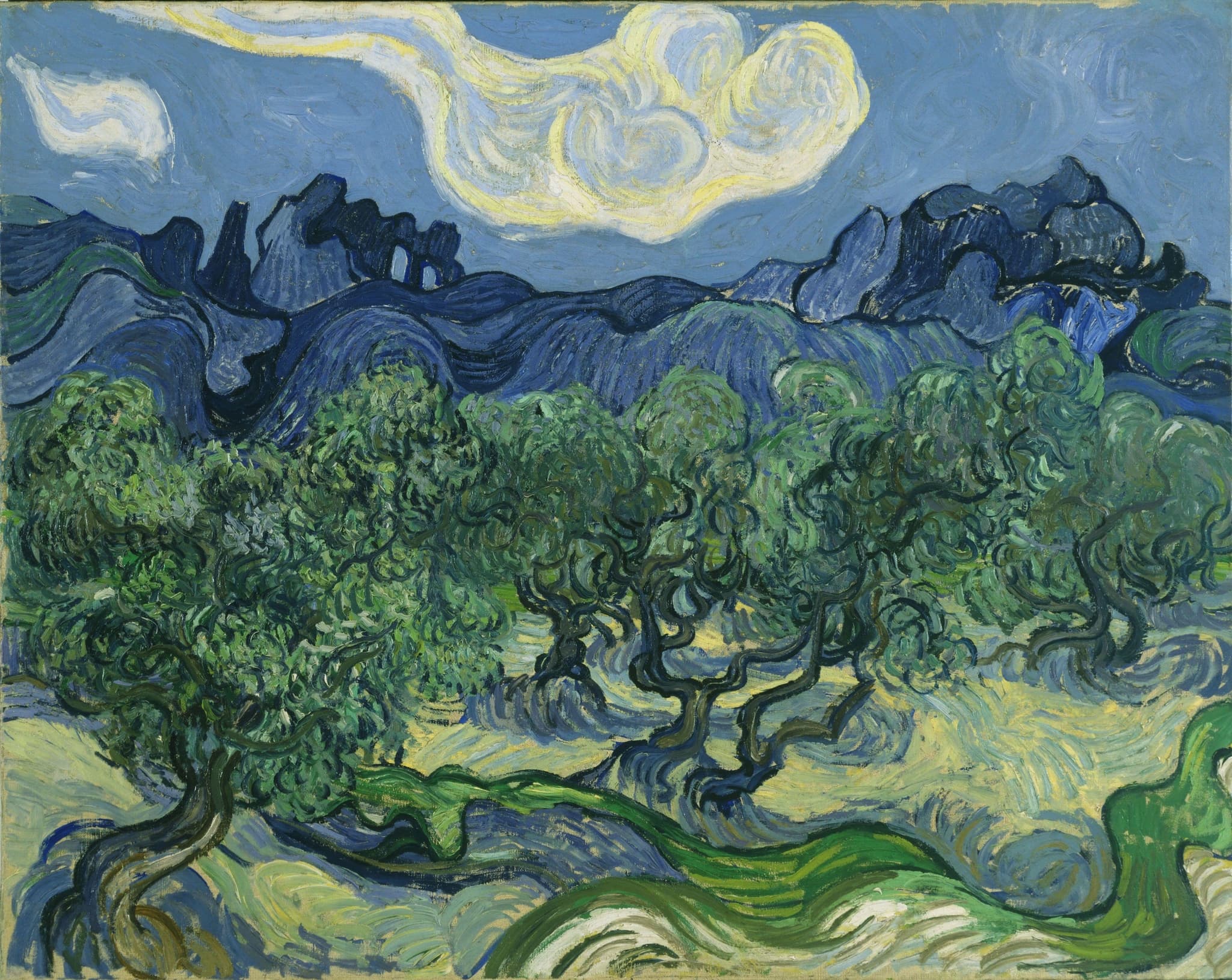
We estimate Vincent van Gogh’s The Olive Trees (1889, MoMA) at $180–300 million in a hypothetical sale. This reflects its prime Saint‑Rémy date, central place in the Olive Trees series, and explicit pairing with The Starry Night, warranting a premium above the artist’s $117.2m auction record.
Valuation Analysis
Conclusion: In a hypothetical sale, Vincent van Gogh’s The Olive Trees (1889, oil on canvas, 72.6 × 91.4 cm; MoMA) would command $180–300 million. The work is a full‑scale, museum‑quality canvas from the artist’s coveted Saint‑Rémy period and a cornerstone of the Olive Trees series. MoMA identifies it as a deliberate daylight counterpart to The Starry Night, underscoring its art‑historical centrality and singular appeal to top collectors and institutions [1].
Comparable evidence and premiums: The current auction record for Van Gogh, Orchard with Cypresses (1888), achieved $117.18 million in 2022, confirming nine‑figure demand for luminous, top‑period Provence landscapes [2]. Closely related subject matter from Saint‑Rémy has also performed strongly: Cabanes de bois parmi les oliviers et cyprès realized $71.35 million in 2021, affirming market depth for olive/cypress motifs [3], while Champs près des Alpilles made $51.915 million in 2022 [4]. Relative to these benchmarks, MoMA’s Olive Trees stands at a higher tier of significance: it is a large, resolved composition from 1889, integral to a signature series conceived alongside The Starry Night, with unmatched museum status and exhibition history. Adjusting from the $117.2m record for quality, subject, and rarity, a 1.5–2.5× premium supports the $180–300m range, with a central tendency around $225–250m in optimal marquee conditions.
Market positioning and demand drivers: Van Gogh is a blue‑chip outlier with extreme supply scarcity; the best Saint‑Rémy landscapes reside in museums and rarely, if ever, come to market. Trophy‑level liquidity remains concentrated at the high end of the Modern/Post‑Impressionist category. Recent major exhibitions—culminating in record‑breaking attendance for the National Gallery’s “Van Gogh: Poets and Lovers” in 2024–25—have further amplified visibility and scholarly focus, supporting sustained global demand among institutions and UHNW collectors [5]. In a well‑timed sale with a robust guarantee and international outreach, competition would likely clear the artist’s standing auction record materially.
Work‑specific strengths: Beyond its prime date and subject, the painting’s scale (72.6 × 91.4 cm), vivid palette, intense impasto, and dynamic brushwork exemplify the Saint‑Rémy language at full power. MoMA’s longstanding stewardship, the Whitney bequest provenance, and extensive publication and exhibition history elevate its desirability and reduce transaction risk [1]. While MoMA is exceptionally unlikely to deaccession, any insurance or private‑treaty context would need to reflect scarcity and trophy premiums evident in the comparables. On balance, these factors justify a confident $180–300 million valuation, with upside contingent on perfect sale choreography.
Key Valuation Factors
Art Historical Significance
High ImpactThe Olive Trees sits at the heart of Van Gogh’s Saint‑Rémy project, conceived in parallel with The Starry Night and developed as an explicit daylight complement. The Olive Trees series is central to scholarship on his late style, where he distills landscape into rhythmic, near‑abstract arabesques that anticipate expressive modernism. MoMA’s canvas is a full, resolved statement in this language, widely published and frequently exhibited, which places it among the artist’s most important landscapes. Works with this level of canonical significance anchor major museum narratives and are exceptionally scarce in private hands. That art‑historical weight translates into tangible market power, supporting valuations well above even strong late‑1880s comparables.
Period and Subject Quality
High ImpactDated 1889, the painting belongs to Van Gogh’s most coveted period. Collectors prize Saint‑Rémy canvases for their saturated color, sculptural impasto, and charged line, and the olive/cypress motifs are particularly resonant. The subject is unmistakably iconic within his oeuvre, with compositions that read powerfully across a room and reproduce indelibly in catalogues and media. Market evidence shows consistent premiums for Provence landscapes—especially those with cypresses, orchards, or olive groves—over other periods. The crisp composition, luminous palette, and scale of MoMA’s work elevate it above the already strong cohort of late‑1880s landscapes, justifying a substantial uplift to the artist’s $117.2m auction benchmark.
Scarcity and Trophy Competition
High ImpactTrue museum‑grade Van Gogh canvases almost never surface; most prime examples are locked in institutional collections. When a top‑tier painting appears, it catalyzes broad competition among a global set of sophisticated buyers—often with irrevocable bids or guarantees in place—which can propel results beyond historical records. The Olive Trees, as a cornerstone Saint‑Rémy landscape intimately linked to The Starry Night, would represent a once‑in‑a‑generation buying opportunity. In today’s trophy‑driven market, scarcity premiums are decisive: they compress due diligence, expand bidder geography, and reward best‑in‑class quality with step‑function pricing. This dynamic underpins our 1.5–2.5× multiple of the 2022 record and the $180–300 million range.
Provenance and Institutional Status
Medium ImpactThe painting’s distinguished chain—from Theo and Jo van Gogh to early European collectors, to John Hay Whitney, and ultimately by bequest to MoMA—confers exceptional credibility and visibility. Decades of museum stewardship and frequent exhibition reduce condition uncertainty and reinforce scholarly consensus, both of which are prized by risk‑averse buyers at the nine‑figure level. While MoMA’s ownership also makes the work effectively off‑market, any hypothetical pricing (insurance or private‑treaty) must recognize that deaccession‑caliber Van Goghs carry premiums beyond recent auction comps. The institutional imprimatur does not just reassure; it elevates the painting’s cultural standing, helping to justify a valuation substantially above the artist’s existing public auction record.
Sale History
The Olive Trees has never been sold at public auction.
Vincent van Gogh's Market
Vincent van Gogh is a top‑tier blue‑chip artist with sustained global demand and acute supply scarcity. His auction record—$117.18m for Orchard with Cypresses (Christie’s, Nov 2022)—confirms deep, nine‑figure bidding for prime Provence works. Strong recent results across periods (notably 1888–89) demonstrate a resilient collector base in the US, Europe, and Asia, with museums and private foundations further constraining supply. Fresh, masterpiece‑level oils are extremely rare; when they appear, they reset benchmarks. High‑quality but mid‑tier works transact reliably in the $20–60m range, while top canvases with iconic subjects and peak dates can command multiples of the record in a once‑in‑a‑generation sale. Overall, Van Gogh’s market remains one of the most liquid and resilient in Modern art.
Comparable Sales
Orchard with Cypresses (Verger avec cyprès)
Vincent van Gogh
Same artist; Arles 1888 landscape with orchard/cypress motif; similar scale and ‘trophy’ quality; current Van Gogh auction record.
$117.2M
2022, Christie's New York
~$128.9M adjusted
Cabanes de bois parmi les oliviers et cyprès
Vincent van Gogh
Direct subject analogue (olive and cypress), Saint‑Rémy 1889; close in date/scale; major result from the Cox Collection.
$71.3M
2021, Christie's New York
~$84.9M adjusted
Champs près des Alpilles
Vincent van Gogh
Saint‑Rémy 1889 landscape (same year as The Olive Trees); evidences depth for A‑tier Provence landscapes.
$51.9M
2022, Christie's New York
~$57.1M adjusted
Laboureur dans un champ
Vincent van Gogh
Major 1889 Saint‑Rémy canvas; similar format and intensity; widely exhibited; strong benchmark even though subject includes figure.
$81.3M
2017, Christie's New York
~$106.5M adjusted
Coin de jardin avec papillons
Vincent van Gogh
High‑quality 1887 garden scene; useful as a lower‑bound check for desirable oils outside the 1888–89 Provence peak.
$33.2M
2024, Christie's New York
~$34.2M adjusted
Current Market Trends
The current market for Impressionist and Post‑Impressionist masterpieces is characterized by selective strength at the top end: trophy‑level works with pristine provenance, strong scholarship, and iconic subjects attract intense global competition, often supported by guarantees. While mid‑market consignments face more scrutiny, best‑in‑class pieces continue to outperform estimates, reflecting a flight to quality. Institutional programming and high‑visibility exhibitions have reinforced demand for canonical names, and a growing Asian buyer base has broadened the bidding pool for Western masters. Against this backdrop, prime Van Gogh paintings—especially Saint‑Rémy landscapes—are positioned to achieve record‑challenging prices when they surface, with scarcity and brand recognition driving substantial premiums.
Study print
Study this painting as a print
Pair the full artwork with a museum-style study sheet focused on one meaningful detail.
Sources
- MoMA Collection: Vincent van Gogh, The Olive Trees (1889)
- The Art Newspaper: Van Gogh record—Orchard with Cypresses soars to $117m (Nov 2022)
- Christie’s Press Release: The Cox Collection and 20th Century Evening Sales achieve $751.9m (Nov 2021)
- Christie’s: May 2022 Marquee Week sale results (20th Century Evening)
- National Gallery, London: Poets and Lovers becomes most‑visited ticketed exhibition in NG history (Jan 2025)