The Olive Trees

by Vincent van Gogh

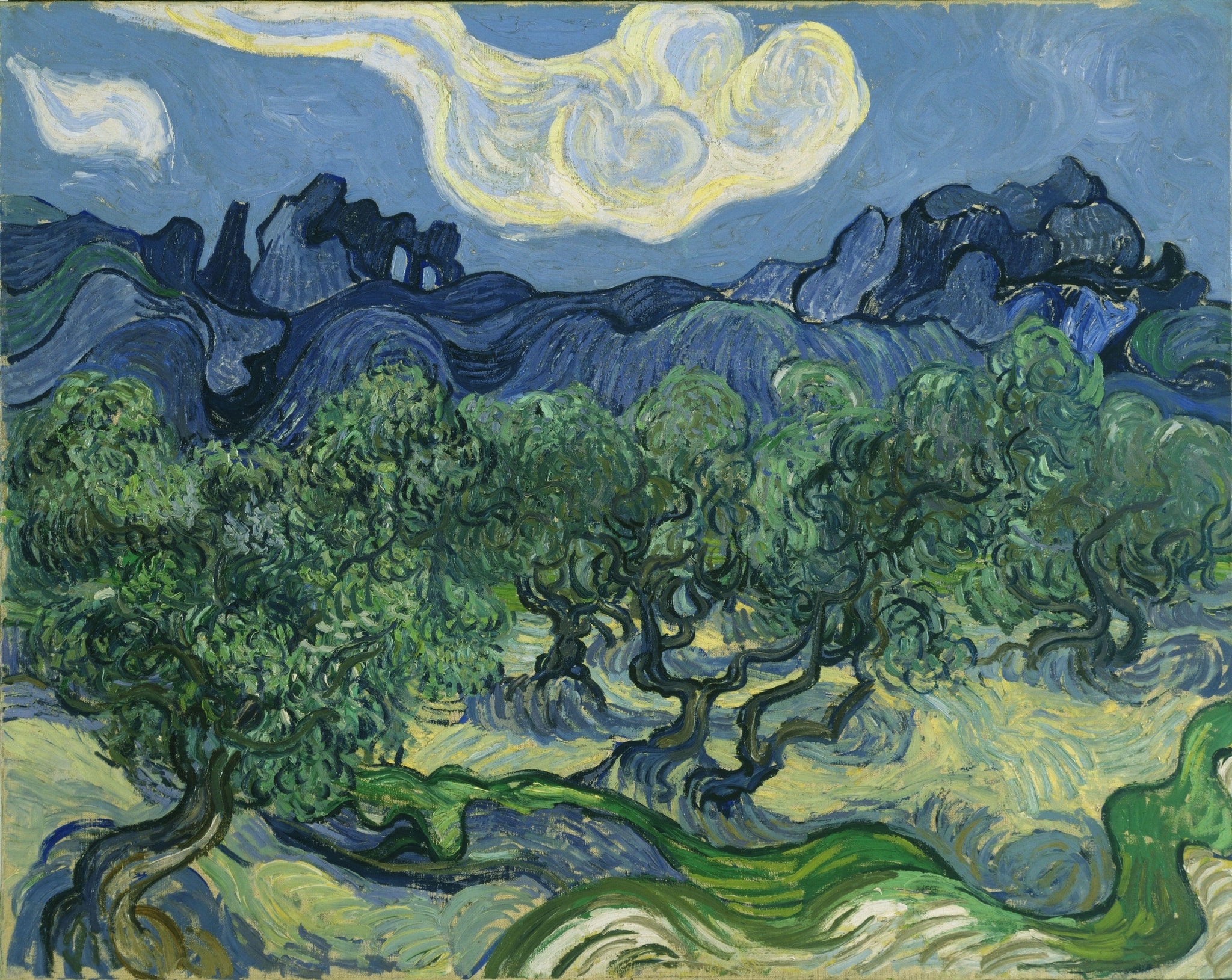
The Olive Trees courses with rhythmic, coiling strokes that bind earth and sky into a single pulse: twisted trunks, whorled foliage, and a pale, bundled cloud echo one another across the canvas. Van Gogh turns Provence’s grove before the Alpilles into a spiritual landscape where endurance and consolation feel visible in color and line [1].

Study Print Studio

Create a personal study print

Build a companion study sheet around the part of this painting that speaks to you most. Choose a detail, shape an interpretation, and walk away with something personal and display-worthy.

Fast Facts

Year
1889
Medium
Oil on canvas
Dimensions
72.6 × 91.4 cm
Location
The Museum of Modern Art, New York
See all Vincent van Gogh paintings in New York
The Olive Trees by Vincent van Gogh (1889) featuring Olive trees (twisted trunks and whorled crowns), Bundled white-yellow cloud, Alpilles mountains, Undulating yellow–blue ground

Click on any numbered symbol to learn more about its meaning

Meaning & Symbolism

Seen close, the canvas is built from muscular, directional strokes that knot the trunks and braid the foliage into restless, calligraphic masses; seen whole, those same strokes sweep the yellowed ground and ripple up the blue‑violet Alpilles, before looping into the sky’s pale, ectoplasmic cloud. The image compresses the grove’s parts into one cadence: the trees lean as if in a steady mistral, their limbs gesturing in counterpoint; the ground undulates in lemon and blue‑green eddies; the mountains crest and subside as if they were waves; and the cloud curls with the same torque as the branches below. This visual rhyme—form answering form across zones—states the work’s core idea: nature is a single living rhythm, not a set of separate things. Van Gogh paints that unity not by smoothing the world but by intensifying it, letting shadows flare as blues and violets and letting light pool in citrus strokes that read like moving water 1. Technical research shows his original chroma was likely even more vivid, so the orchestration of greens, blues, and yellows once struck the eye with still greater insistence—underscoring the painting’s thesis that color itself is a bearer of meaning 6. That meaning is explicitly spiritual yet stubbornly modern. Months after admitting himself to Saint‑Paul‑de‑Mausole, Van Gogh found in the olive grove a way to answer the sacred without painting saints. He had been uneasy with his friends’ overt Gethsemane narratives; here he relocates consolation and endurance to the trees themselves—the ancient Mediterranean emblem of peace rendered as gnarled survival, roots clenching the ocher soil, crowns chafing the wind 3. In a letter from mid‑June 1889 he reports, “At last I have a landscape with olive trees, and also a new study of a starry sky,” a pairing that clarifies intention: day and night as complementary states of belief, the grove a chorus of forms by day and the sky a cosmic choir by night 2. MoMA’s record preserves his later description of “the olive trees with the white cloud and the mountains behind,” emphasizing the heightened linearity that he likened to old woodcuts; the point isn’t transcription but transformation—turning observation into legible rhythm 15. The bundled cloud matters: it sutures heaven to earth, repeating the ground’s curves and thereby declaring that the consoling order we seek above is already pulsing through the grove below. Why The Olive Trees is important also has to do with place and modern identity. In Saint‑Rémy, Van Gogh set out to build a thematic image of Provence, and he chose olives and cypresses—regional constants undergoing modern agricultural change—as its emblems 4. The painting’s consistent midsize format, its serial exploration, and its insistence on working from nature despite illness all testify to a program: to prove that Provence could be both concrete and symbolic, a locale and a locus of meaning 14. The Olive Trees delivers that program with ethical stakes. By converting suffering—felt in the twisted wood and turbulent ground—into a coherent, breathing pattern, the work models how harmony can be forged through turbulence. In the anchoring line of the front trunk, the wavering shadows that never quite darken, and the cloud’s lemon edge lifting the sky, the canvas enacts an argument that hope is not a denial of struggle but its cadence. In sum, the painting makes nature’s pulse visible so that viewers might feel steadied by it, a modern Gethsemane achieved by observation, color, and line rather than by narrative display 35.

Explore Deeper with AI

Ask questions about The Olive Trees

Popular questions:

Powered by AI • Get instant insights about this artwork

💬 Ask questions about this artwork!

Interpretations

Material/Conservation Lens

Reconstruction of the series’ original palette shows how much of the painting’s argument once rode on coloristic intensity. Fugitives and darkening pigments have muted contrasts, but technical research indicates the greens, blues, and yellows were initially more saturated and precisely keyed, sharpening the counterpoint between foliage chroma and blue‑violet shadows 6. This matters interpretively: if color is a bearer of meaning, then the work’s consolatory charge was originally delivered with greater immediacy, tightening the visual “orchestration” that binds grove, ground, and Alpilles. The facture—impasto ridges catching light—also functioned as an optical amplifier, making hue shifts perceptible at viewing distance. Conservation thus reframes The Olive Trees as not only expressive but programmatically chromatic: a painting that staked spiritual import on the material behavior of paint itself 61.

Source: Van Gogh Museum/Dallas Museum of Art research project; MoMA

Comparative/Pendant Reading (Day–Night Pairing)

Van Gogh’s letter linking an “olive trees” canvas with a “new study of a starry sky” clarifies a conceptual diptych: day and night as complementary states of belief articulated through differing chroma and line 2. In daylight, olive trunks torque against the mistral; at night, celestial vortices articulate a cosmic order. Read together, they offer a modern, non‑narrative theology—creation affirmed through rhythmed marks rather than saints. MoMA notes he later described the grove’s heightened linearity “as in some old woodcuts,” a clue that both works pursue legibility through graphic emphasis rather than naturalistic recession 15. The pair invites viewers to test how the same hand translates terrestrial turbulence and astral rotation into a single syntax—an ethics of steadiness carried across diurnal extremes 125.

Source: MoMA; Van Gogh Letters (Letter 782); Richard Thomson

Regionalism, Agriculture, and Modern Identity

Scholars have shown Van Gogh deliberately built a thematic image of Provence through serial motifs—olives and cypresses foremost—chosen as “characteristic” emblems of the region 4. The olive tree was not a neutral symbol: it indexed agricultural labor, shifting markets, and a contemporary discourse about “classic” Provence even as the countryside modernized 4. By casting olives as protagonists, Van Gogh fuses emblem and economy: the grove reads as both working landscape and timeless sign. Joan Greer further argues that he invested this regional emblem with spiritual consolation, allowing local agriculture to carry metaphysical weight without recourse to narrative religion 3. The Olive Trees thus operates on two registers—regional identity and sacred import—modeling how modern art could make place do symbolic work while acknowledging lived, material labor 34.

Source: Vojtěch Jirat‑Wasiutyński; Joan E. Greer

Formal/Graphic Translation (Line as Meaning)

MoMA highlights the canvas’s “heightened linearity,” which Van Gogh likened to old woodcuts—a telling cue that line here is not merely descriptive but semantic 15. The “muscular, directional strokes” braid foliage into calligraphic masses, creating leitmotifs that repeat across ground, hills, and cloud. This is a strategy of graphic translation: compressing observed forms into a repeatable visual meter so that the eye reads rhythm as meaning. The result is a paradox of Post‑Impressionist mimesis: the scene is observed, yet its truth arrives through stylization—contour, hatching, and impasto functioning like carved marks that index pressure, speed, and direction. Such linear insistence makes the grove legible at scale, turning seeing into scanning, and scanning into the recognition of an underlying cadence 15.

Source: MoMA; Richard Thomson

Embodied Weather/Phenomenology

The trees lean “as if in a steady mistral,” and the brushwork does more than depict that wind—it enacts it 1. Short, bent, and recurving strokes register the painter’s hand as a seismograph of airflow, converting meteorology into motor pattern. This is a phenomenological landscape: the viewer intuits wind shear, glare, and heat through the kinesthetics of mark‑making. Institutional texts on related olive‑grove canvases affirm that Van Gogh sought to render the “passionate, supernatural and eternal” forces animating nature, not just its surfaces 7. In The Olive Trees the cloud’s looping contour mirrors the boughs’ torque, yoking sky and grove into one sensorial system. Weather becomes a medium of revelation: the felt body (artist, viewer) is the instrument that detects nature’s order-in-turbulence 17.

Source: MoMA; National Galleries of Scotland

Psychological/Ethical Architecture

Painted soon after self‑admittance to Saint‑Paul‑de‑Mausole, the grove’s twisted trunks and undulant ground articulate crisis resolved into pattern—a visual ethics of making harmony from turbulence 5. Van Gogh’s June letters tie expressive color and spontaneous drawing to the capacity to give “consolation,” recasting landscape as a site where psychological suffering can be shaped into rhythm 52. By refusing overt Passion narratives that troubled him, he builds a modern, observational piety—hope rendered as cadence, not doctrine 3. The painting thereby functions as a moral proposition: steadiness is not the erasure of struggle but its meter—the repeated stroke, the returning hue family, the echoing curve that keeps faith with the world despite its agitation 235.

Source: Richard Thomson; Van Gogh Letters; Joan E. Greer

Related Themes

About Vincent van Gogh

Vincent van Gogh (1853–1890) developed a radical, emotion‑driven use of color after moving from Paris to Arles in 1888, seeking southern light and an artists’ community. In Arles he created the Sunflowers series to decorate the Yellow House ahead of Gauguin’s visit. His late work fused impasto, high chroma, and symbolic motifs that shaped modern painting [2][5].
View all works by Vincent van Gogh

More by Vincent van Gogh
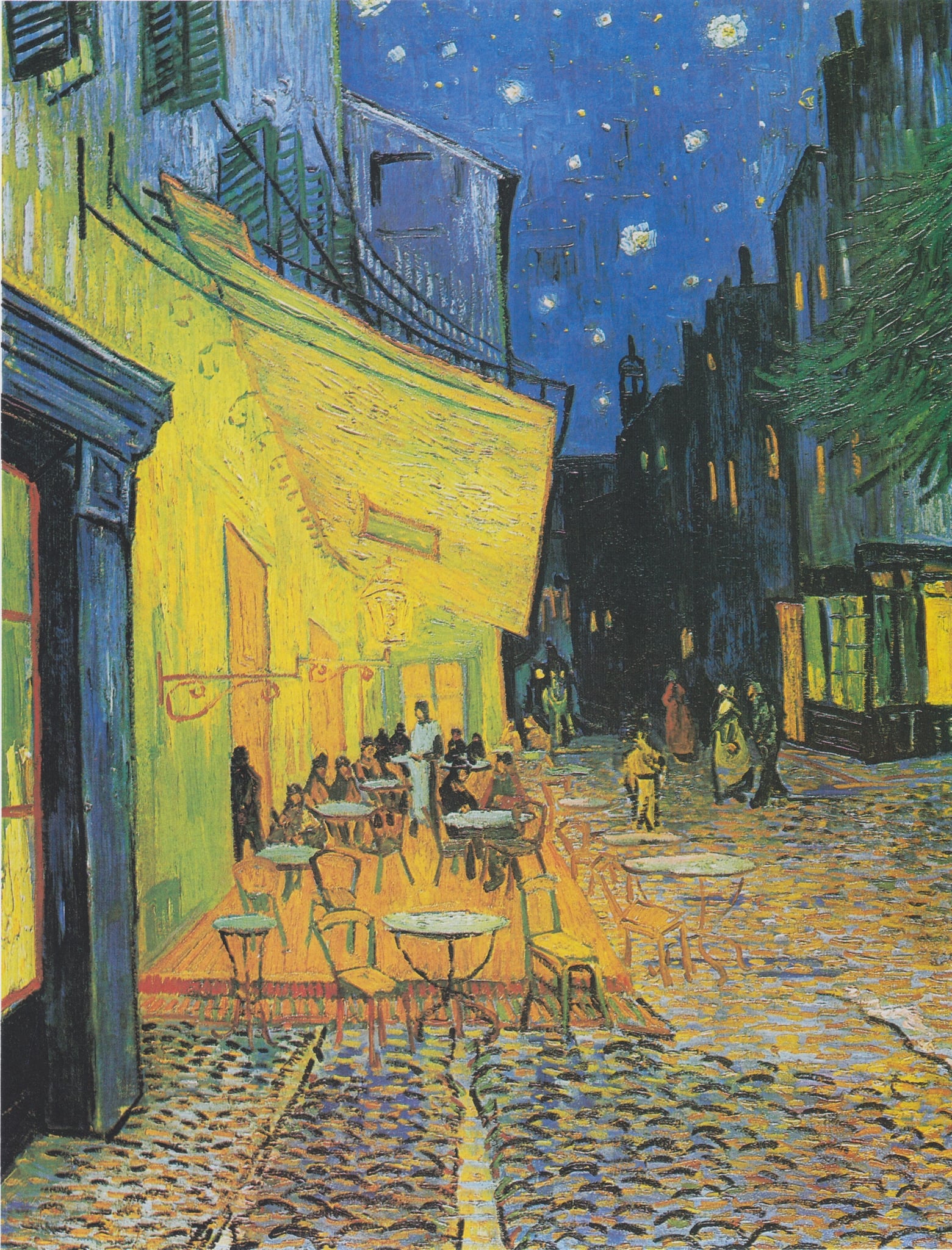
Café Terrace at Night by Vincent van Gogh

Café Terrace at Night

Vincent van Gogh (1888)

In Café Terrace at Night, Vincent van Gogh turns nocturne into <strong>luminous color</strong>: a gas‑lit terrace glows in yellows and oranges against a deep <strong>ultramarine sky</strong> pricked with stars. By building night “<strong>without black</strong>,” he stages a vivid encounter between human sociability and the vastness overhead <sup>[1]</sup><sup>[2]</sup>.
Red Cabbages and Onions by Vincent van Gogh

Red Cabbages and Onions

Vincent van Gogh (1887)

In Red Cabbages and Onions, Vincent van Gogh turns everyday produce into a drama of <strong>complementary color</strong> and <strong>restless brushwork</strong>. Hot red contours cinch violet cabbages and pale yellow bulbs against a cool, striated blue table, while a mustard‑yellow patch in the upper right tilts the space and sharpens the chromatic clash. The result asserts ordinary food as a locus of <strong>resilience</strong> and <strong>experimentation</strong> <sup>[1]</sup><sup>[2]</sup>.

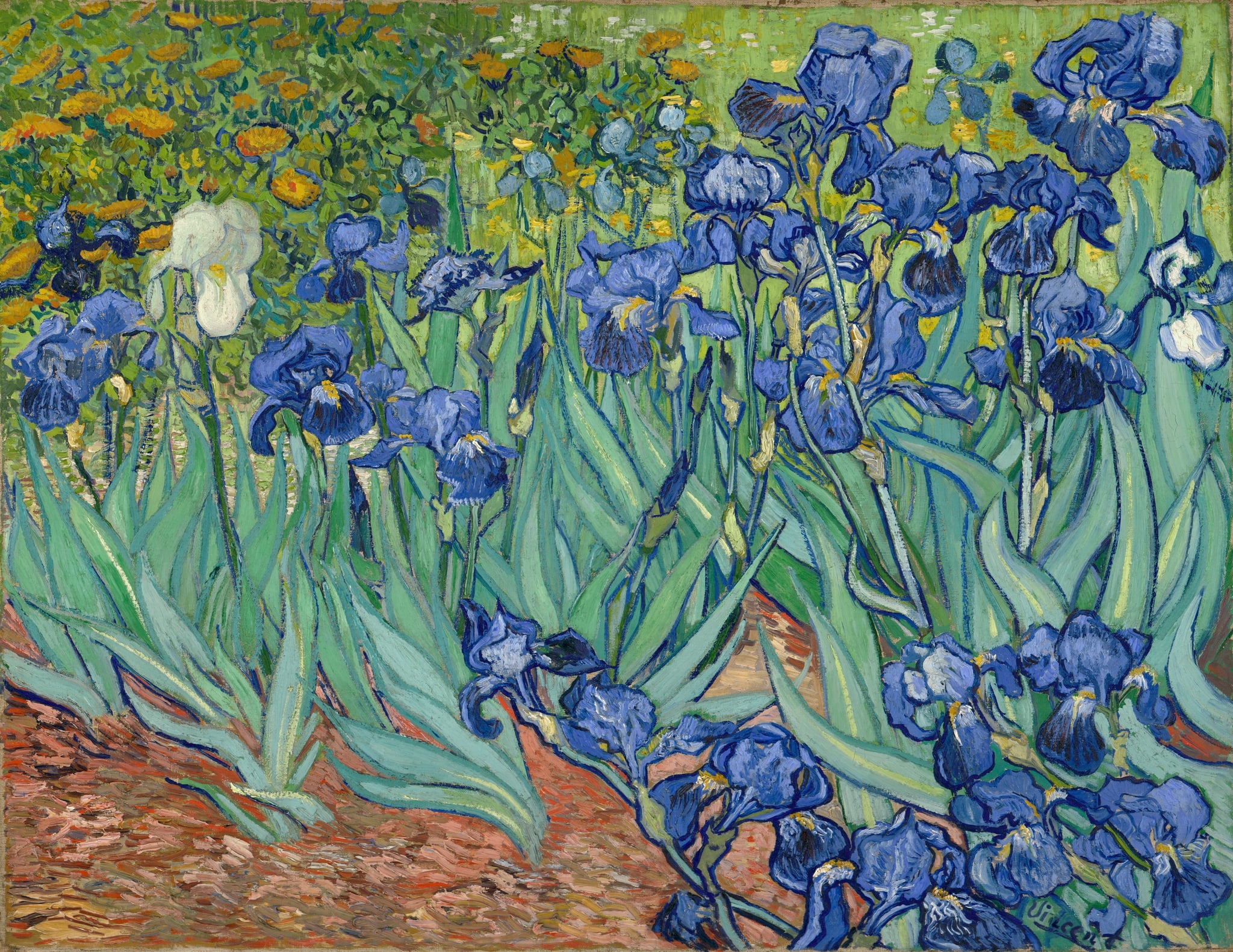
Irises by Vincent van Gogh

Irises

Vincent van Gogh (1889)

Painted in May 1889 at the Saint-Rémy asylum garden, Vincent van Gogh’s <strong>Irises</strong> turns close observation into an act of repair. Dark contours, a cropped, print-like vantage, and vibrating complements—violet/blue blossoms against <strong>yellow-green</strong> ground—stage a living frieze whose lone <strong>white iris</strong> punctuates the field with arresting clarity <sup>[1]</sup><sup>[2]</sup>.
Sunflowers by Vincent van Gogh

Sunflowers

Vincent van Gogh (1888)

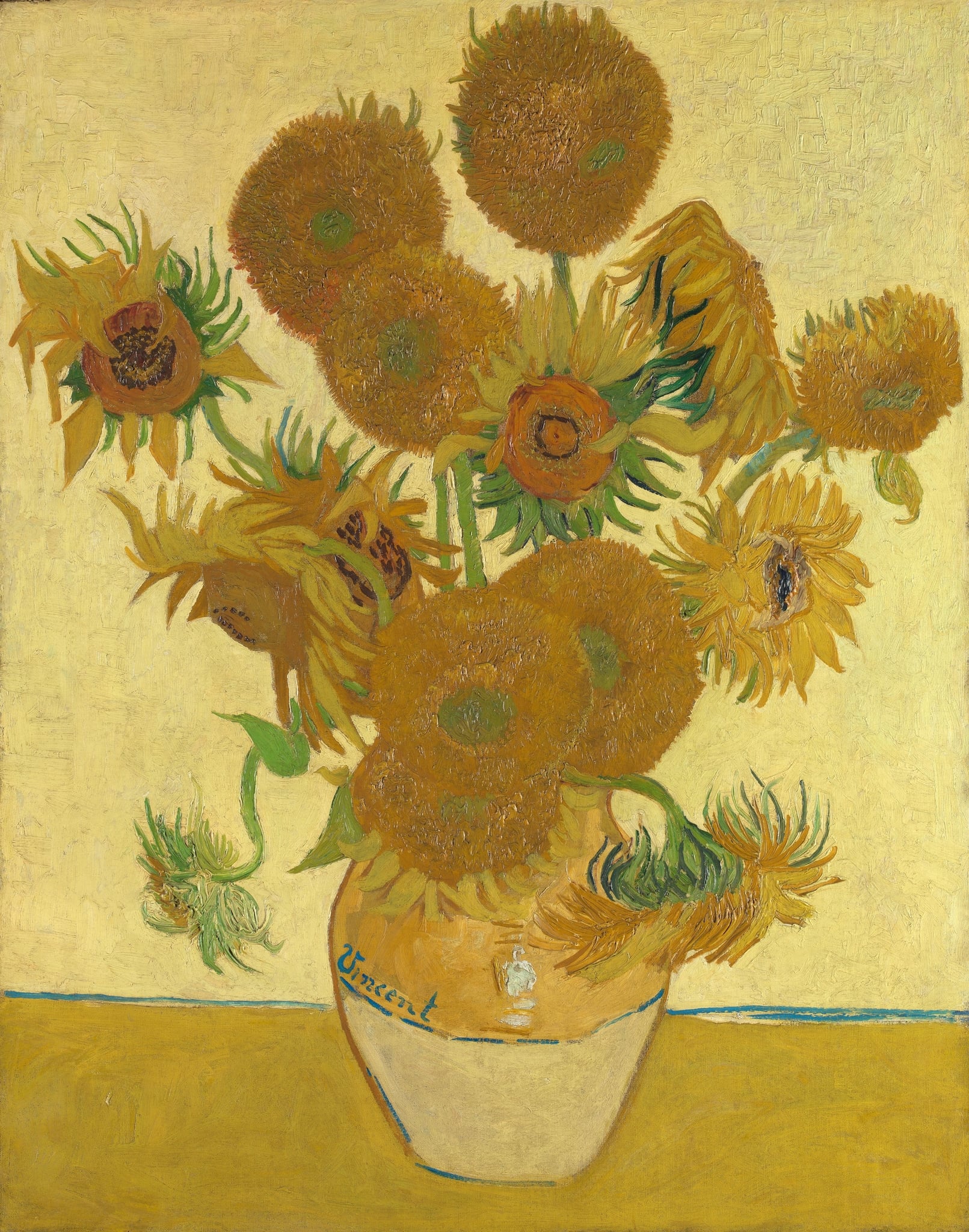
Vincent van Gogh’s Sunflowers (1888) is a <strong>yellow-on-yellow</strong> still life that stages a full <strong>cycle of life</strong> in fifteen blooms, from fresh buds to brittle seed heads. The thick impasto, green shocks of stem and bract, and the vase signed <strong>“Vincent”</strong> turn a humble bouquet into an emblem of endurance and fellowship <sup>[1]</sup><sup>[2]</sup>.

Garden with Courting Couples: Square Saint-Pierre by Vincent van Gogh

Garden with Courting Couples: Square Saint-Pierre

Vincent van Gogh (1887)

In Garden with Courting Couples: Square Saint-Pierre, Vincent van Gogh turns a small Montmartre park into a stage where <strong>spring</strong>, <strong>intimacy</strong>, and <strong>urban leisure</strong> converge. Short, shimmering strokes fuse pink chestnut blossoms, curving paths, and paired figures into one pulse of <strong>renewal</strong> and <strong>togetherness</strong> <sup>[1]</sup><sup>[2]</sup>.

In the Café: Agostina Segatori in Le Tambourin by Vincent van Gogh

In the Café: Agostina Segatori in Le Tambourin

Vincent van Gogh (1887 (Jan–Mar))

Van Gogh casts Agostina Segatori at a tiny, tambourine‑like café table, turning Le Tambourin into a <strong>stage of modern life</strong>. Cool greens and greys make the red <strong>flame‑plume hat</strong> and the foaming <strong>beer</strong> flare, while folded arms and a set‑aside <strong>parasol</strong> register private fatigue amid public display <sup>[1]</sup><sup>[2]</sup><sup>[3]</sup>.