How Much Is Undergrowth Worth?
Last updated: June 2, 2026
Quick Facts
- Methodology
- comparable analysis
Hypothetical open‑market value for Van Gogh’s Saint‑Rémy Undergrowth (1889) is estimated at $110–170 million. This positions the work near the top of the artist’s landscape market, anchored by the $117.2 million record for Orchard with Cypresses and robust late‑1880s Saint‑Rémy comparables. As the painting is held by the Van Gogh Museum, the figure reflects indicative market level rather than a sale intention.
Valuation Analysis
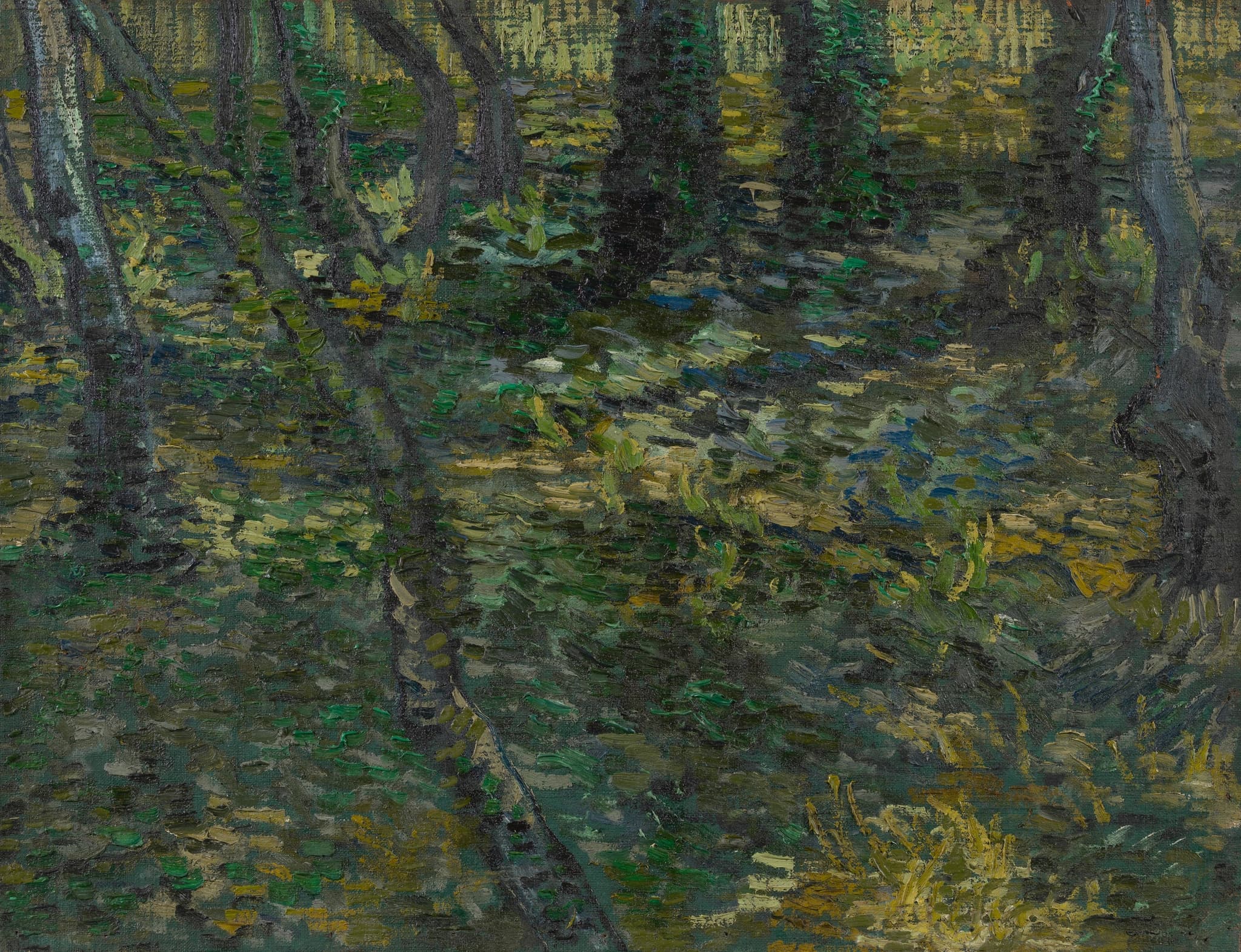
Conclusion: In a hypothetical, fully competitive sale, Vincent van Gogh’s Undergrowth (Saint‑Rémy, July 1889; F746/JH1762) would command approximately $110–170 million. This places the work squarely among the artist’s most coveted late‑1880s landscapes, reflecting its peak‑period date, sophisticated motif, and museum‑level stature. The painting is held by the Van Gogh Museum (Vincent van Gogh Foundation) and is not for sale; this is an open‑market indication for a directly comparable work of the same subject, date, quality, and scale. The museum’s object record confirms date, dimensions and family provenance, underscoring its canonical position within the oeuvre [1].
Market anchors and comparables: Van Gogh’s auction record stands at $117.18 million for Orchard with Cypresses (1888; Christie’s, 2022), establishing a recent ceiling for prime late‑1880s landscapes [2]. Closely related Saint‑Rémy oils have achieved $81.31 million (Laboureur dans un champ; Christie’s, 2017) and $71.35 million (Cabanes de bois parmi les oliviers et cyprès; Christie’s, 2021) [4][3]. While Undergrowth is not an “icon” on the order of Sunflowers or Irises, the ivy‑strewn forest‑floor theme from Saint‑Rémy is a connoisseur‑favored subject with strong exhibition and publication traction. By contrast, intimate Paris‑period garden subjects have recently realized around $33.19 million (Christie’s, 2024), illustrating the premium reserved for late Arles/Saint‑Rémy masterpieces [5].
Why this range: The $110–170 million band triangulates the artist’s 2022 record; the demonstrated $70–80+ million depth for major Saint‑Rémy oils; and the scarcity of top‑tier, museum‑quality late works in private hands. Within Van Gogh’s market, 1888–90 Provence canvases with vivid color, rhythmic structure, and celebrated literature/exhibition histories consistently attract global, trophy‑motivated bidding. An Undergrowth of this caliber, offered fresh with comparable scale and condition, would rationally clear prior Saint‑Rémy benchmarks and contest near the record zone, especially with modern auction dynamics (irrevocable bids/third‑party guarantees) concentrating demand on a scant supply of masterpieces.
Positioning vs. icons and risks: Although less instantly emblematic than Sunflowers or Starry Night, Undergrowth’s peak period, signature facture, and dense, decorative composition elevate it above mid‑tier subjects. Key sensitivities that could tighten or widen the band include condition and conservation history, completeness of provenance and literature, and macro liquidity at time of sale. The estimate assumes strong, typical museum‑grade condition and full scholarly acceptance consistent with the Van Gogh Museum’s documentation [1].
Bottom line: Given recent pricing for late‑1880s canvases, and the extreme scarcity of comparable Saint‑Rémy works outside institutions, a tightly contested sale of an Undergrowth of this quality would most plausibly land in the low‑to‑mid nine figures, with upside into record‑adjacent territory if competition is exceptional [2][3][4].
Key Valuation Factors
Art Historical Significance
High ImpactUndergrowth (1889) belongs to Van Gogh’s Saint‑Rémy period, among the most intensely studied and celebrated phases of his career. The work’s ivy‑strewn forest floor, punctuated by vertical trunks and a vibrating, tessellated surface, encapsulates the artist’s mature language—short, loaded strokes, high‑keyed palette, and a unifying decorative rhythm. This period has been the focus of major exhibitions and scholarship, reinforcing its canonical status in the oeuvre. The museum’s object record confirms the picture’s date, family provenance, and sustained publication, which are crucial markers of art‑historical weight. Works from 1888–90 are the nucleus of the Van Gogh market’s top tier, and this composition aligns closely with that peak in both style and ambition.
Period and Subject Appeal
High ImpactCollectors prize late Arles and Saint‑Rémy subjects for their vivid palette, expressive structure, and concentrated emotional intensity. The Undergrowth/Ivy motif is particularly appealing because it fuses abstraction and observation: a dense, carpet‑like field of foliage animated by directional brushwork and tree‑trunk scaffolding. This decorative complexity reads powerfully at scale and across a room, giving the work marquee presence comparable to other late landscapes. While not as universally iconic as Sunflowers or Irises, the motif is well‑recognized among scholars and seasoned buyers, appearing frequently in literature and on museum walls. That blend of peak‑period authorship and visually distinctive subject matter supports sustained nine‑figure interest in a competitive sale setting.
Rarity and Supply Dynamics
High ImpactPrime Van Gogh oils from 1888–90 are extremely scarce in private hands; most are concentrated in museums and foundations. This structural scarcity has a pronounced effect on pricing: when a best‑in‑class late work surfaces, bidding compresses years of unmet demand, especially among global collectors seeking canonical blue‑chip masterpieces. The probability that a directly comparable Saint‑Rémy Undergrowth of similar size and quality appears with freshness to market is low, which tends to push prices toward record territory when it does occur. Conversely, the absence of true substitutes limits price elasticity on the downside. This supply imbalance is a core driver behind the estimate’s elevation into the low‑to‑mid nine figures.
Market Evidence and Benchmarks
High ImpactRecent results provide a clear pricing scaffold. The 2022 record for Orchard with Cypresses at $117.18 million re‑rated the ceiling for late‑1880s Van Goghs. Major Saint‑Rémy oils achieved $81.31 million (2017) and $71.35 million (2021), confirming substantial depth below the record for high‑quality works of the same period. Meanwhile, earlier or more intimate botanical subjects (e.g., a 2024 Paris‑period garden work around $33.19 million) map the lower contour for less emblematic themes. Undergrowth’s date, motif, and ambition align it with the upper band of this spectrum, warranting a range that begins above prior Saint‑Rémy anchors and approaches the record zone under strong competitive conditions.
Sale History
Undergrowth has never been sold at public auction.
Vincent van Gogh's Market
Vincent van Gogh is a perennial, global blue‑chip artist whose late 1880s works regularly headline evening sales. The standing auction record is $117.18 million for Orchard with Cypresses (Christie’s, 2022), a prime Arles landscape that set a modern marker for the category. Strong recent prices for major Saint‑Rémy canvases ($71–81 million in 2021 and 2017) underscore deep demand for this peak period, while well‑chosen works from earlier phases can still achieve $30–60+ million depending on subject, scale, and freshness. Supply is inherently tight—most masterpieces reside in institutions—so when trophy‑level Van Goghs appear, intense competition and robust guarantee structures can propel results toward record‑adjacent territory.
Comparable Sales
Orchard with Cypresses (Verger avec cyprès)
Vincent van Gogh
Same artist; late-1880s Provençal landscape with cypresses; sets the current auction record for Van Gogh and provides the upper bound for top-tier landscapes near Undergrowth’s period.
$117.2M
2022, Christie's New York
~$126.6M adjusted
Laboureur dans un champ (Ploughman in the Field)
Vincent van Gogh
Same artist; Saint-Rémy, 1889—contemporary with Undergrowth; oil landscape of comparable ambition and facture from the same prized period; key private-market benchmark for Saint-Rémy oils.
$81.3M
2017, Christie's New York
~$105.7M adjusted
Cabanes de bois parmi les oliviers et cyprès
Vincent van Gogh
Same artist; Saint-Rémy, October 1889—very close in date, palette, and vegetative motifs to Undergrowth; strong, recent Saint-Rémy landscape comp.
$71.3M
2021, Christie's New York
~$83.5M adjusted
L'Allée des Alyscamps
Vincent van Gogh
Same artist; Arles, 1888—iconic tree-lined landscape from the immediately preceding year; useful for bracketing top-tier 1888–89 Van Gogh landscapes of similar general scale and ambition.
$66.3M
2015, Sotheby's New York
~$88.8M adjusted
Coin de jardin avec papillons
Vincent van Gogh
Same artist; garden-floor botanical motif closely akin to the 'undergrowth' theme (though Paris, 1887). Demonstrates market appetite for intimate nature subjects that are less iconic than the great Arles/Saint-Rémy vistas.
$33.2M
2024, Christie's New York
~$34.2M adjusted
Piles de romans parisiens et roses dans un verre (Romans parisiens)
Vincent van Gogh
Same artist; 1887 still life—less direct subject match, but a marquee-quality Van Gogh that shows the depth of nine-figure-adjacent demand for top works outside the most iconic Arles/Saint-Rémy landscapes.
$62.7M
2025, Sotheby's New York
Current Market Trends
The top of the late‑19th‑century market has been characterized by trophy concentration: museum‑quality works with strong provenance, literature, and exhibition histories draw global bidding, while lesser examples face greater selectivity. Following the 2022 Van Gogh record, the category continued to see disciplined but determined demand, with major results clustering around blue‑chip names and peak periods. Guarantees and third‑party backing remain common, helping anchor valuations and catalyze competition at the top end. In this context, a peak‑period Van Gogh landscape with marquee visual impact and scholarship is optimally positioned to command low‑to‑mid nine‑figure pricing, particularly if fresh to market and presented in a prime New York evening sale.
Study print
Study this painting as a print
Pair the full artwork with a museum-style study sheet focused on one meaningful detail.
Sources
- Van Gogh Museum – Undergrowth (F746/JH1762) object page
- The Art Newspaper – Van Gogh record: Orchard with Cypresses sells for $117m (Christie’s, 2022)
- The Value – Christie’s Cox Collection: Van Gogh Saint‑Rémy landscape sells for $71.35m (2021)
- Bloomberg – Van Gogh’s Saint‑Rémy view sells for $81.3m (Christie’s, 2017)
- The Art Newspaper – Christie’s 20th Century Evening: Van Gogh garden work makes $33.19m (2024)