Undergrowth

by Vincent van Gogh

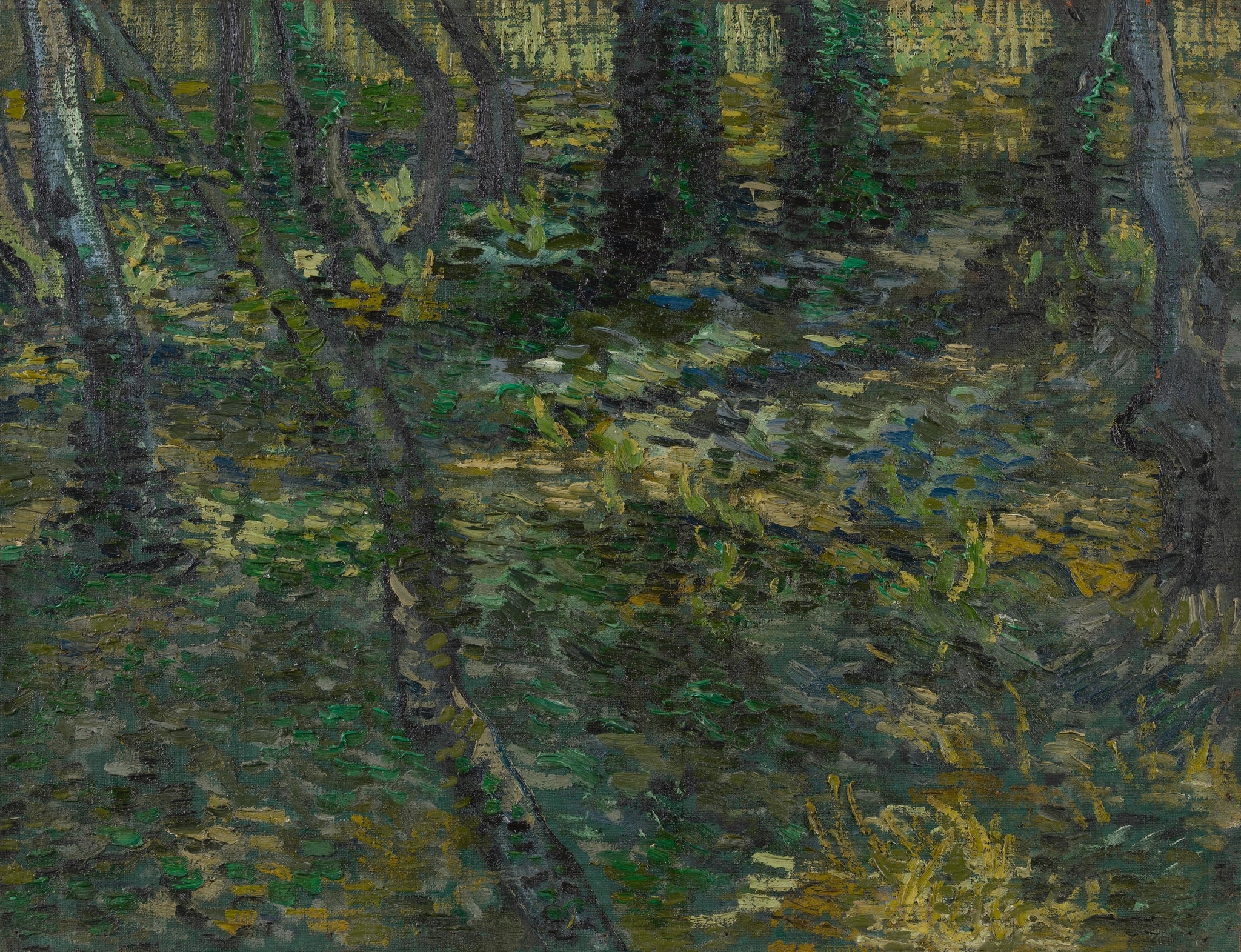
Van Gogh’s Undergrowth drops us to ground level, where slanting trunks and a woven mat of ivy become a living field of rhythm and light. Close cropping, diagonal shadows, and short, pulsing strokes turn the forest floor into a study of endurance and renewal rather than a scenic view.
💰

Market Value

$110-170 million

How much is Undergrowth worth?

Study Print Studio

Create a personal study print

Build a companion study sheet around the part of this painting that speaks to you most. Choose a detail, shape an interpretation, and walk away with something personal and display-worthy.

Fast Facts

Year
1889
Medium
Oil on canvas
Dimensions
73 x 92.3 cm
Location
Van Gogh Museum, Amsterdam
See all Vincent van Gogh paintings in Amsterdam
Undergrowth by Vincent van Gogh (1889) featuring Ivy carpet, Patches of dappled sunlight, Leaning tree trunks, Diagonal shadows

Click on any numbered symbol to learn more about its meaning

Meaning & Symbolism

Van Gogh builds Undergrowth around two interacting systems: diagonal trunks that lean across the surface like dark, calligraphic beams, and a densely tessellated ground of ivy rendered in short, varied strokes of green, blue, ocher, and gray. In the image, sunlight pools into small, irregular patches—cool greens edged by yellow‑ocher sparks—so that illumination arrives as flicker rather than flood. This decision rejects the horizon and canopy; the frame captures only knees‑high ferns, leaf litter, and bark, compressing depth until pattern takes precedence. The result is not a window onto a forest but a field that moves, a surface whose rhythmic facture carries meaning: the repeated marks beat like a pulse, while the diagonals stress uncertainty and motion. The museum record confirms this Saint‑Rémy garden corner with ivy and emphasizes how the close view and spotlights verge on abstraction; Van Gogh names it himself as “Trees with ivy in the garden of the asylum” in September 1889 12. By pushing the sous‑bois tradition toward an all‑over, vibrating weave, he asserts that painting’s structure—its orchestrated touches of pigment—is the bearer of feeling as much as the motif. Within that structure, the iconography is resolutely modest: ivy, trunks, shadows. Yet the modesty is the point. Ivy’s tenacity—its habit of gripping rough bark and thriving in shade—reads as a secular emblem of endurance without lapsing into programmatic symbolism; Van Gogh’s letters do not assign it a fixed meaning, but the picture makes endurance palpable through process: stroke gripping stroke, value tipping into value, dark giving way to glimmers of light 12. The diagonal shadows, especially those slanting from left to right across the center, stage a quiet drama: threat and shelter interleave, but the bright, broken passages perforate the gloom. In this way the image encodes a cycle of struggle and renewal appropriate to the artist’s asylum year, when he worked within strict bounds yet produced some of his most structurally inventive canvases 1. The piece also clarifies Van Gogh’s Post‑Impressionist stance: unlike Impressionism’s atmospheric breadth, he concentrates sensation into patterned units and strong armatures, a move the Met characterizes as advancing personal, structural expression beyond naturalistic description 3. That emphasis on surface and rhythm aligns Undergrowth with late works like Tree Roots in its anticipation of later Expressionist and abstract interests, though here the tenor remains vegetal and breathing rather than cataclysmic. Undergrowth therefore operates on two registers at once. Locally, it is a faithful register of specific effects—dappled light stepping across ivy, trunks banded with dark and sap‑green, small shoots catching straw‑yellow light. Structurally, it is a disciplined system: verticals and diagonals anchor a carpet of short, “nervous” strokes that keep the eye in continual transit, denying any single focal apex. That refusal of hierarchy enacts a democratic vision of nature, where the low—moss, sprigs, fallen leaves—claims as much pictorial authority as sky or vista. It is also a statement of method: meaning is made by repeated touch. Scholars have noted, in related sous‑bois, how fugitive pigments originally intensified violets and pinks; even allowing for such shifts, the intended chromatic vibration here is one of cool greens punctuated by ocher lights—an economy that heightens the sense of shade pierced by life 57. In sum, the meaning of Undergrowth is the persistence of growth under pressure, articulated through a modern, pulsating surface. Why Undergrowth is important is that it demonstrates, within the confines of Saint‑Rémy, how Van Gogh transformed a garden corner into a fully contemporary proposition about what painting can do: make endurance visible by turning light, color, and stroke into living structure 134.

Explore Deeper with AI

Ask questions about Undergrowth

Popular questions:

Powered by AI • Get instant insights about this artwork

💬 Ask questions about this artwork!

Interpretations

Formal Analysis

Read as an all‑over field, Undergrowth replaces horizon and sky with a tight weave of short, variegated strokes locked to diagonal and vertical armatures. This sous‑bois syntax modernizes Barbizon precedents (forest interiors by Corot, Rousseau, Diaz) by stripping away depth cues and concentrating experience into rhythmic facture. The long, calligraphic trunks provide a stabilizing scaffold while the tessellated ivy acts as a modulated ground, so that “light” appears as local contrasts—cool greens pricked by ochre sparks—rather than as atmospheric wash. The result is not topographical description but a surface system that maintains tension between pattern and perception, pushing the genre toward near‑abstraction while remaining legible as place 14.

Source: Van Gogh Museum; Van Gogh: Into the Undergrowth (Cincinnati Art Museum)

Technical/Material Lens

Late sous‑bois canvases are sensitive to pigment change: studies of the related Undergrowth with Two Figures show fading of red lakes that once pitched violets and pinks against greens. While a different work, this cautions that today’s cooler harmony in F746 may understate Van Gogh’s intended chromatic vibration—a livelier counterpoint of complementary hues activating the ivy’s field. The painting’s meaning thus partly rides on material aging: as lakes desaturate, the balance between trunk accents and groundcover shifts, tilting perception toward calm pattern and away from prismatic flicker. Interpreting F746 responsibly means integrating what we see now with technical insights about what was likely brighter, warmer, and more pulsing at the moment of completion 16.

Source: Van Gogh Museum; Technical pigment study (Analytical Chemistry/SAGE)

Historical Context

Made inside the Saint‑Rémy asylum, the picture converts restriction into method. Confined to the grounds, Van Gogh turns a “corner of the garden” into an immersive micro‑landscape, denying vistas to heighten local sensation. Letters confirm the subject—“Trees with ivy in the garden of the asylum”—and reveal a programmatic focus on trees, irises, and undergrowth during 1889. This context reframes the painting’s modest iconography as a discipline of attention: by elevating leaf litter and ivy to primary subjects, he models a humane, anti‑hierarchical landscape vision that resonates with broader Post‑Impressionist aims to channel subjective structure over detached naturalism 123.

Source: Van Gogh Letters; Van Gogh Museum; The Metropolitan Museum of Art (Heilbrunn Timeline)

Symbolic Reading

While Van Gogh avoided fixed allegory, period culture frequently associated ivy with fidelity and endurance. In F746 that association is enacted through process rather than program: strokes cling to one another as ivy grips bark, and light perforates shade without dissolving it. Such enacted symbolism suits the Saint‑Rémy year, where persistence under constraint became a lived studio condition. Caution is warranted—his letters don’t assign an emblematic meaning—but the painting makes endurance sensible through facture: a secular emblem built from repeated touch, diagonal strain, and intermittent illumination. The motif’s humility thereby carries ethical weight without lapsing into didactic code 12.

Source: Van Gogh Museum; Van Gogh Letters

Reception and Future Influence

Undergrowth contributes to a late Van Gogh trajectory that anticipates Expressionism and abstraction: the cropped trunks, planar weave, and percussive touch parallel tendencies culminating in Tree Roots (1890). Institutions frame this shift as a Post‑Impressionist move from optical reportage toward personal, structural expression—color and stroke organized as feeling. In F746 the balance remains vegetal and breathing rather than catastrophic, yet its refusal of a focal apex and its insistence on surface pattern set terms later artists would radicalize. Seen this way, the work is both a garden study and a proposition about painting: sensation stabilized by armature into an energized, modern plane 35.

Source: The Metropolitan Museum of Art (Heilbrunn Timeline); Scholarship on Tree Roots

Related Themes

About Vincent van Gogh

Vincent van Gogh (1853–1890) developed a radical, emotion‑driven use of color after moving from Paris to Arles in 1888, seeking southern light and an artists’ community. In Arles he created the Sunflowers series to decorate the Yellow House ahead of Gauguin’s visit. His late work fused impasto, high chroma, and symbolic motifs that shaped modern painting [2][5].
View all works by Vincent van Gogh

More by Vincent van Gogh
Café Terrace at Night by Vincent van Gogh

Café Terrace at Night

Vincent van Gogh (1888)

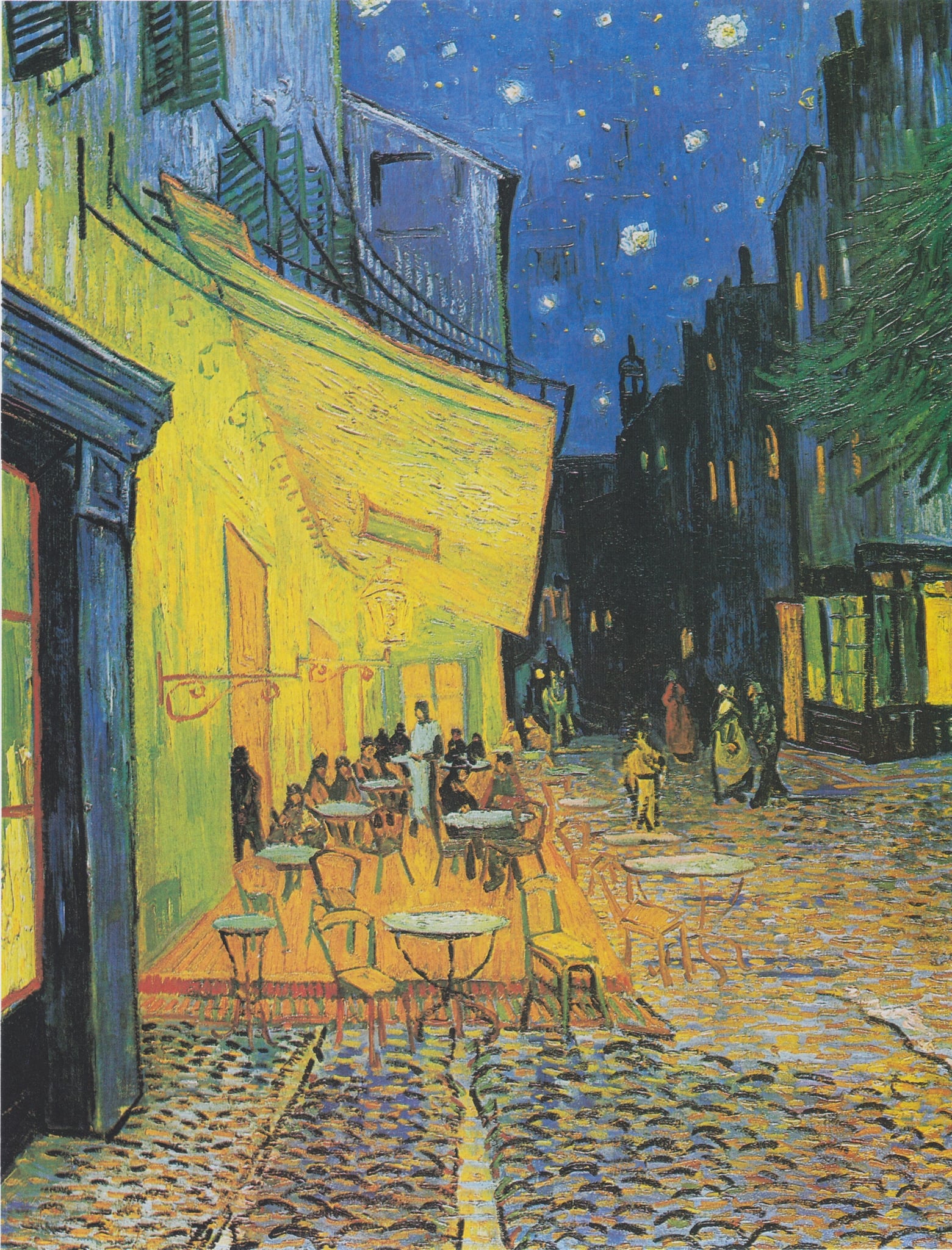
In Café Terrace at Night, Vincent van Gogh turns nocturne into <strong>luminous color</strong>: a gas‑lit terrace glows in yellows and oranges against a deep <strong>ultramarine sky</strong> pricked with stars. By building night “<strong>without black</strong>,” he stages a vivid encounter between human sociability and the vastness overhead <sup>[1]</sup><sup>[2]</sup>.
Red Cabbages and Onions by Vincent van Gogh

Red Cabbages and Onions

Vincent van Gogh (1887)

In Red Cabbages and Onions, Vincent van Gogh turns everyday produce into a drama of <strong>complementary color</strong> and <strong>restless brushwork</strong>. Hot red contours cinch violet cabbages and pale yellow bulbs against a cool, striated blue table, while a mustard‑yellow patch in the upper right tilts the space and sharpens the chromatic clash. The result asserts ordinary food as a locus of <strong>resilience</strong> and <strong>experimentation</strong> <sup>[1]</sup><sup>[2]</sup>.

Irises by Vincent van Gogh

Irises

Vincent van Gogh (1889)

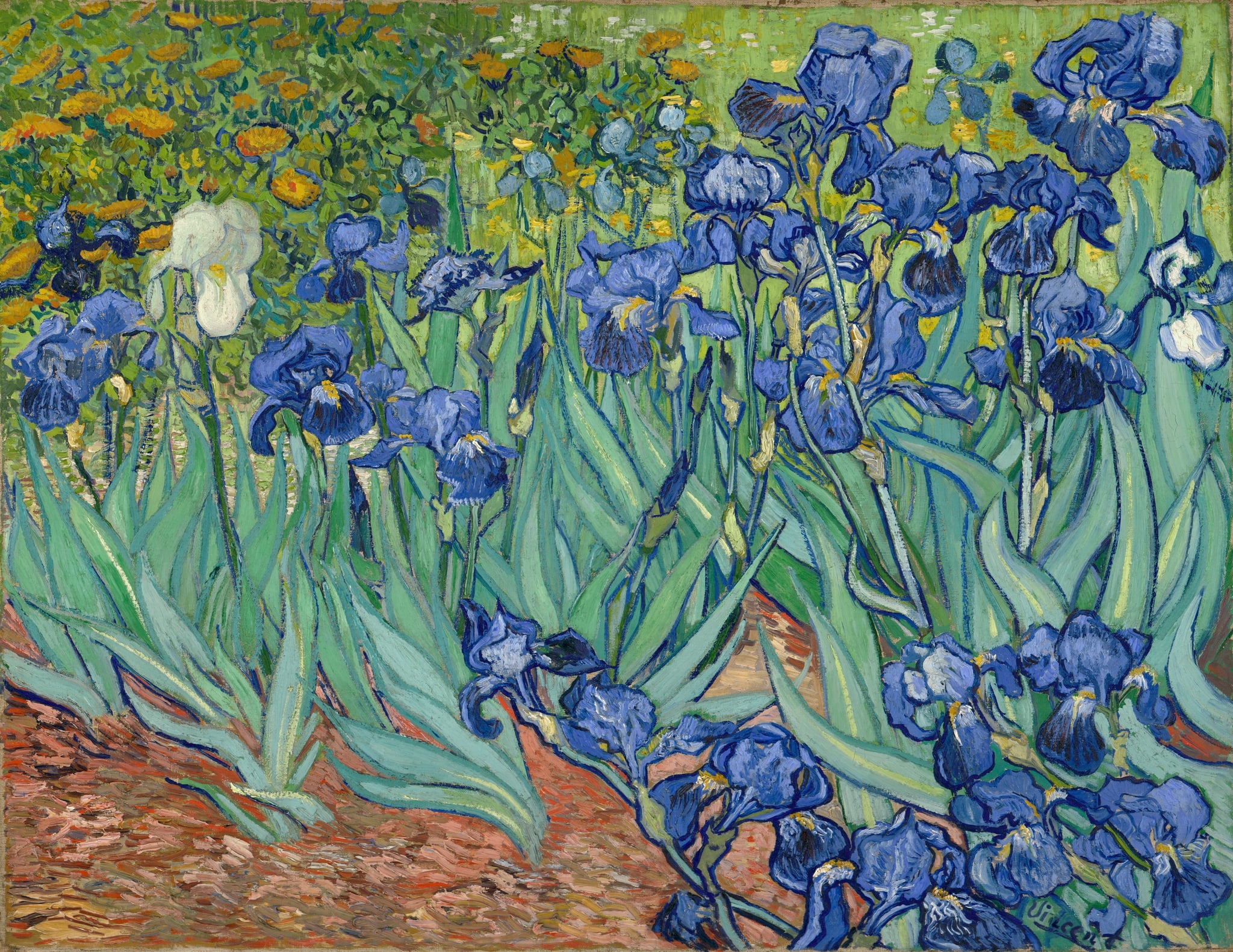
Painted in May 1889 at the Saint-Rémy asylum garden, Vincent van Gogh’s <strong>Irises</strong> turns close observation into an act of repair. Dark contours, a cropped, print-like vantage, and vibrating complements—violet/blue blossoms against <strong>yellow-green</strong> ground—stage a living frieze whose lone <strong>white iris</strong> punctuates the field with arresting clarity <sup>[1]</sup><sup>[2]</sup>.
Sunflowers by Vincent van Gogh

Sunflowers

Vincent van Gogh (1888)

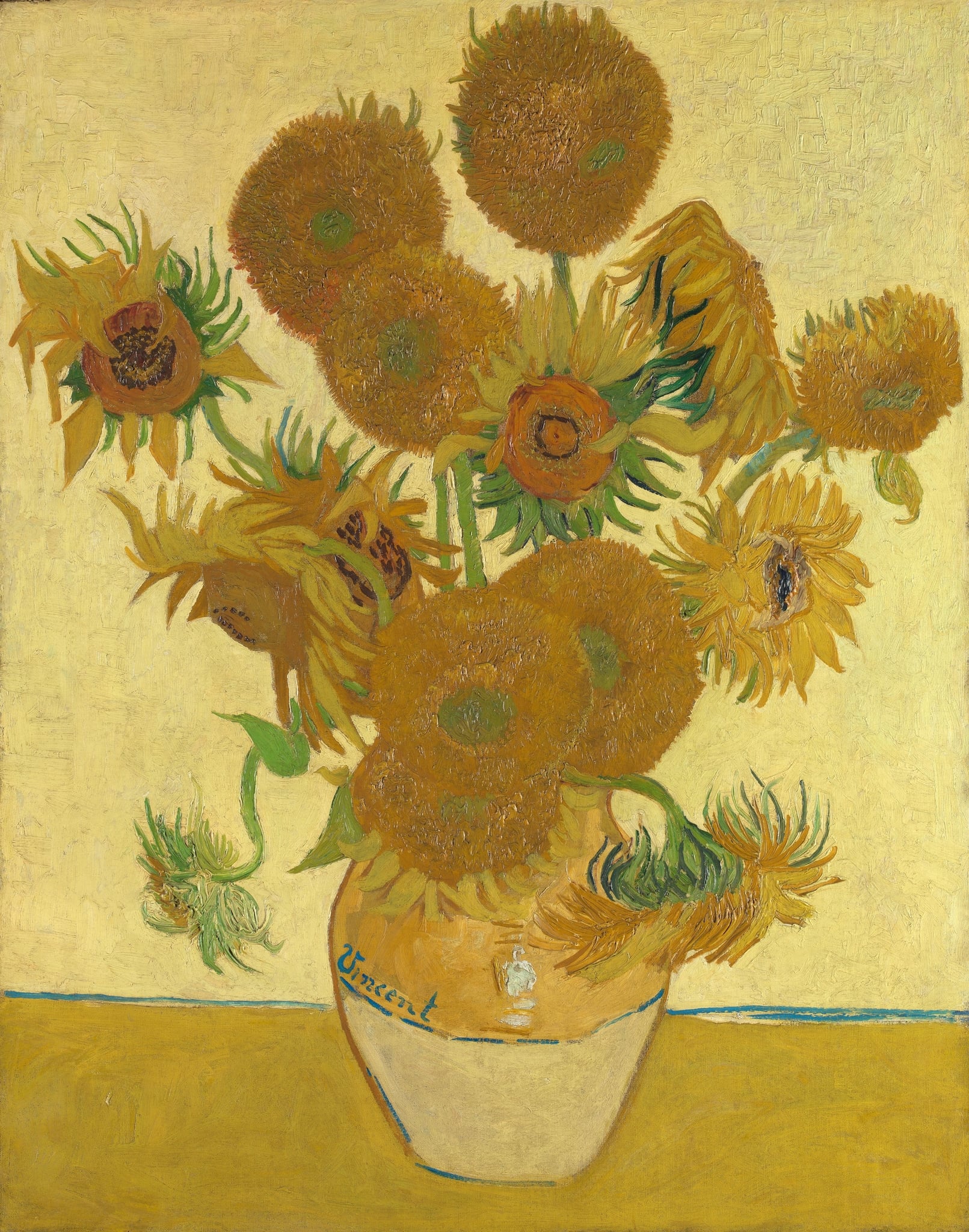
Vincent van Gogh’s Sunflowers (1888) is a <strong>yellow-on-yellow</strong> still life that stages a full <strong>cycle of life</strong> in fifteen blooms, from fresh buds to brittle seed heads. The thick impasto, green shocks of stem and bract, and the vase signed <strong>“Vincent”</strong> turn a humble bouquet into an emblem of endurance and fellowship <sup>[1]</sup><sup>[2]</sup>.

Garden with Courting Couples: Square Saint-Pierre by Vincent van Gogh

Garden with Courting Couples: Square Saint-Pierre

Vincent van Gogh (1887)

In Garden with Courting Couples: Square Saint-Pierre, Vincent van Gogh turns a small Montmartre park into a stage where <strong>spring</strong>, <strong>intimacy</strong>, and <strong>urban leisure</strong> converge. Short, shimmering strokes fuse pink chestnut blossoms, curving paths, and paired figures into one pulse of <strong>renewal</strong> and <strong>togetherness</strong> <sup>[1]</sup><sup>[2]</sup>.

In the Café: Agostina Segatori in Le Tambourin by Vincent van Gogh

In the Café: Agostina Segatori in Le Tambourin

Vincent van Gogh (1887 (Jan–Mar))

Van Gogh casts Agostina Segatori at a tiny, tambourine‑like café table, turning Le Tambourin into a <strong>stage of modern life</strong>. Cool greens and greys make the red <strong>flame‑plume hat</strong> and the foaming <strong>beer</strong> flare, while folded arms and a set‑aside <strong>parasol</strong> register private fatigue amid public display <sup>[1]</sup><sup>[2]</sup><sup>[3]</sup>.