How Much Is Wheatfield under Thunderclouds Worth?
Last updated: June 2, 2026
Quick Facts
- Methodology
- comparable analysis
Wheatfield under Thunderclouds (1890) is a major late Auvers double‑square landscape by Vincent van Gogh, held by the Van Gogh Museum. Benchmarking against the artist’s top auction results and adjusting for the work’s rarity, period, scale, and canonical status supports a hypothetical fair‑market value of $130–180 million.
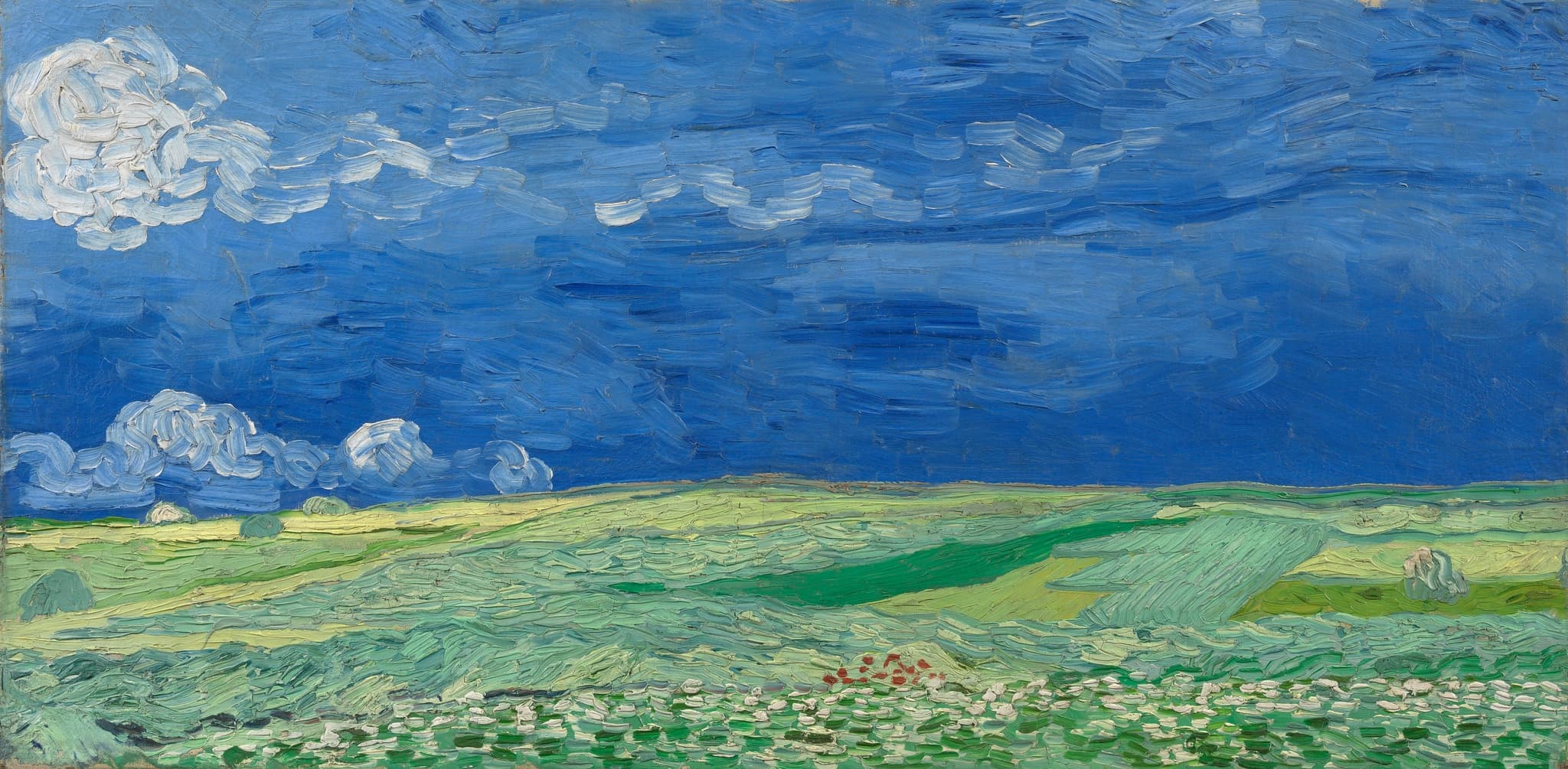
Wheatfield under Thunderclouds
Vincent van Gogh, 1890 • Oil on canvas
Read full analysis of Wheatfield under Thunderclouds →Valuation Analysis
Conclusion: Wheatfield under Thunderclouds should be valued at $130–180 million on a hypothetical fair‑market basis. This panoramic, double‑square canvas from July 1890 sits at the apex of Van Gogh’s late Auvers production and is held by the Van Gogh Museum, underscoring its art‑historical primacy and market scarcity [1].
Work significance and format: Executed in the final weeks of the artist’s life, the painting exemplifies Van Gogh’s grand, horizontal “double‑square” format (ca. 50 × 100 cm), a hallmark of his culminating wheatfield series. The sweeping horizon and advancing storm capture the distilled drama of his last landscapes, closely related in spirit and period to other late Auvers fields in museum collections. The work’s dimensions (50.4 × 101.3 cm) and catalogue status place it squarely within this celebrated corpus [1][5].
Market anchors and comparables: The modern auction benchmark for Van Gogh is Orchard with Cypresses (1888) at $117,180,000 (Christie’s, Nov 9, 2022) [2]. Strong, first‑rate landscapes from 1889 have realized $81,312,500 (Laboureur dans un champ, 2017) and $71,350,000 (Cabanes de bois parmi les oliviers et cyprès, 2021) [3][4]. In 2024, two Paris‑period works sold around $33 million, confirming continued depth even in a cooler macro environment [6]. A late Auvers double‑square wheatfield—rarer and more canonical than most offered works—merits a premium to these benchmarks, supporting a range that would challenge the current artist record under peak conditions.
Rarity, provenance, and demand: Monumental Auvers wheatfields seldom, if ever, appear on the open market; most reside in institutions. This painting’s unbroken family‑to‑foundation provenance and its place in the Van Gogh Museum’s core holdings attest to top‑tier quality and scholarship [1]. Such trophy‑level scarcity concentrates global demand and typically compresses bidding at the very high end when works of proximate stature emerge.
Assumptions and positioning: The estimate assumes sound, stable condition consistent with long‑term museum stewardship and best‑in‑class sale mechanics (marquee evening placement, comprehensive global marketing, and robust third‑party/house guarantees). Within these parameters, the $130–180 million band appropriately calibrates against the $117.18 million record while recognizing the late Auvers double‑square format’s exceptional significance and near‑zero supply [2][5][6].
Key Valuation Factors
Art Historical Significance
High ImpactPainted in July 1890 during Van Gogh’s final weeks, Wheatfield under Thunderclouds epitomizes the late Auvers period’s distilled intensity. Its panoramic, double‑square sweep and storm‑laden sky embody the artist’s culminating exploration of nature’s emotional charge. The painting is widely reproduced, deeply studied, and housed by the Van Gogh Museum, reinforcing its canonical stature within the oeuvre. While not as universally recognized as Sunflowers, it ranks among the most consequential landscapes of Van Gogh’s career. At market, this level of art‑historical centrality is a primary accelerator of demand, anchoring the work firmly in the top tier of the artist’s landscape production and justifying a valuation at or above recent landmark prices.
Rarity and Supply
High ImpactLate Auvers double‑square wheatfields are exceptionally scarce in private hands; the majority reside in museums, and this painting itself is institutionally held. For collectors targeting best‑in‑class Van Gogh landscapes, near‑zero available supply creates structural competition and supports outsized pricing when comparable quality surfaces. The absence of direct public sale history for this exact work does not diminish value; instead, museum‑level provenance and the series’ rarity increase desirability. In a trophy‑seeking market, scarcity premiums are pronounced, particularly for emblematic subjects tied to the artist’s final months, narrowing the likely outcome range toward the upper end of the artist’s established auction benchmarks.
Format, Scale, and Aesthetic Appeal
Medium ImpactThe elongated, approximately 50 × 100 cm double‑square format is integral to Van Gogh’s late vision, delivering a cinematic horizon and monumental field. This scale commands presence in large contemporary interiors and institutional galleries alike. The stormy palette is less decorative than sun‑drenched Arles scenes, but connoisseurs typically prize the psychological charge and gestural force of these late landscapes. The format’s association with masterworks like Wheatfield with Crows amplifies its appeal. Overall, the size and compositional ambition contribute materially to value, though the darker tonality may slightly narrow the pool of purely decorative buyers compared with bright‑yellow Sunflowers or Provence harvest scenes.
Market Comparables and Liquidity
High ImpactRecent, well‑documented results establish a robust pricing corridor for top Van Gogh landscapes: $117.18m for Orchard with Cypresses (1888), $81.31m for Laboureur dans un champ (1889), and $71.35m for Cabanes de bois parmi les oliviers et cyprès (1889). Even in a cooler 2024 environment, Paris‑period works achieved ~$33m, signaling sustained depth for quality examples. Against this backdrop, a late Auvers double‑square wheatfield—a rarer, more canonical subject—should command a premium relative to most St‑Rémy comparables and plausibly test or exceed the 2022 record under peak sale conditions. This evidence underpins the $130–180 million range and frames upside potential in a highly competitive marquee auction.
Sale History
Wheatfield under Thunderclouds has never been sold at public auction.
Vincent van Gogh's Market
Vincent van Gogh is the quintessential blue‑chip Modern master, with deep, global demand and a long history of record‑setting sales. The current auction record is $117,180,000 for Orchard with Cypresses (Christie’s, Nov 2022). Multiple major works have traded between $70–80+ million over the past decade, including Laboureur dans un champ (2017) and Cabanes de bois parmi les oliviers et cyprès (2021). Fresh, first‑rate material remains tightly held, and supply scarcity drives competition when exceptional examples surface. While broader market conditions have been mixed since 2022, the high end continues to absorb canonical works by Van Gogh at strong prices, with recent mid‑eight‑figure results for quality paintings confirming persistent depth among top collectors.
Comparable Sales
Orchard with Cypresses (Verger avec cyprès), 1888
Vincent van Gogh
Same artist; prime late-1880s landscape with turbulent sky and cypresses; trophy-scale, canonical subject; current auction record for Van Gogh.
$117.2M
2022, Christie's New York
~$128.0M adjusted
Laboureur dans un champ (Ploughman in the Field), 1889
Vincent van Gogh
Same artist; immediately pre‑Auvers period (St‑Rémy); field-and-sky landscape closely aligned in mood and motif to the Auvers wheatfields.
$81.3M
2017, Christie's New York
~$106.8M adjusted
Cabanes de bois parmi les oliviers et cyprès, 1889
Vincent van Gogh
Same artist; late-1880s St‑Rémy landscape with olive trees/cypresses and expressive sky; strong market proxy for major Van Gogh landscapes.
$71.3M
2021, Christie's New York
~$83.1M adjusted
L’Allée des Alyscamps, 1888
Vincent van Gogh
Same artist; prime Arles-period, large-scale landscape from a celebrated series; long-standing high benchmark for Van Gogh landscapes.
$66.3M
2015, Sotheby's New York
~$90.8M adjusted
Nature morte, Vase aux marguerites et coquelicots, 1890
Vincent van Gogh
Same artist; same Auvers (1890) final-months period as Wheatfield under Thunderclouds; subject differs (still life) but key for pricing late‑Auvers output.
$61.8M
2014, Sotheby's New York
~$85.2M adjusted
Portrait of Dr. Gachet, 1890
Vincent van Gogh
Same artist and year (Auvers, 1890); iconic late work establishing the upper market ceiling for the period.
$82.5M
1990, Christie's New York
~$202.1M adjusted
Current Market Trends
Impressionist and Post‑Impressionist masters continue to benefit from a flight to quality: best‑in‑class, institutionally provenanced works attract robust bidding, while middling examples are price‑sensitive. Trophy lots with strong marketing, third‑party guarantees, and global exposure remain highly liquid and can set or challenge artist records. Recent seasons show consistent absorption for blue‑chip names, albeit with selectivity and wider dispersion between top and mid‑tier outcomes. Within this context, a canonical, late Van Gogh of panoramic scale would be positioned to elicit intense competition from a concentrated pool of UHNW buyers and institutions, particularly if timed within marquee evening sales in New York or London.
Study print
Study this painting as a print
Pair the full artwork with a museum-style study sheet focused on one meaningful detail.
Sources
- Van Gogh Museum – Wheatfield under Thunderclouds (collection page)
- Christie’s – Visionary: The Paul G. Allen Collection sale results (includes Van Gogh record)
- The Art Newspaper – Christie’s Impressionist & Modern sale (Van Gogh $81.31m result)
- Christie’s – November 2021 Evening Sales results (Van Gogh $71.35m result)
- Wikipedia – Wheatfield Under Thunderclouds
- Christie’s Press – 20th Century Evening Sale totals $413.3m (includes Van Gogh $33.2m)