Wheatfield under Thunderclouds

by Vincent van Gogh

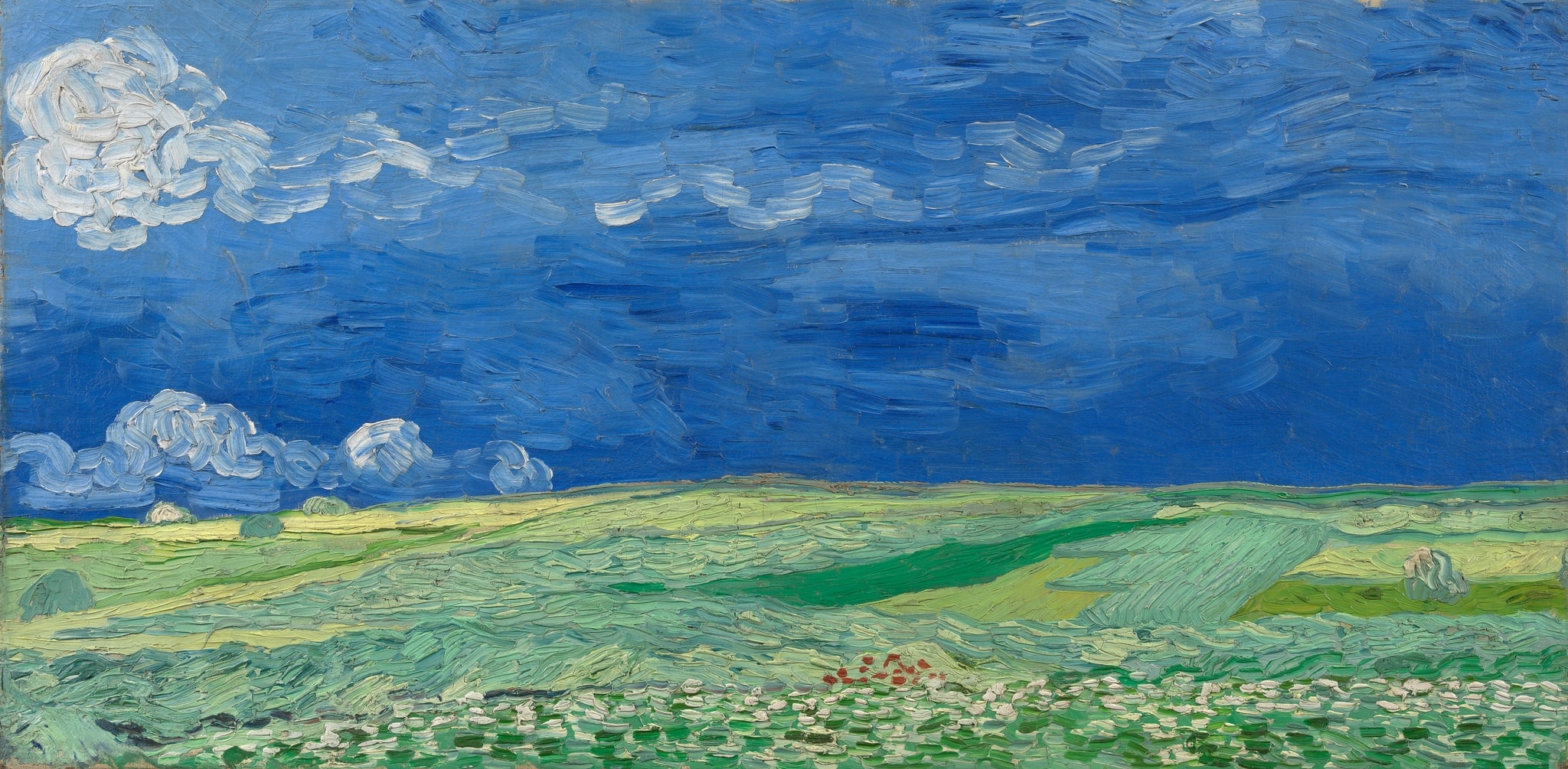
A panoramic sweep of land and sky pits a wind‑combed wheatfield against an immense, thunder‑laden blue. Van Gogh uses a radically simple two‑band design and dense impasto to stage a confrontation between turbulence and endurance [1][2].

Study Print Studio

Create a personal study print

Build a companion study sheet around the part of this painting that speaks to you most. Choose a detail, shape an interpretation, and walk away with something personal and display-worthy.

Fast Facts

Year
1890
Medium
Oil on canvas
Dimensions
50.4 × 101.3 cm
Location
Van Gogh Museum, Amsterdam
See all Vincent van Gogh paintings in Amsterdam
Wheatfield under Thunderclouds by Vincent van Gogh (1890) featuring Wheatfield/green field, Red poppies, Thunderclouded blue sky, Haystacks

Click on any numbered symbol to learn more about its meaning

Meaning & Symbolism

Van Gogh engineers the painting as a binary drama: earth versus sky. The horizon rides unusually low, compressing the cultivated world into a narrow, vibrating strip while ceding nearly two‑thirds of the canvas to storm‑packed blue. In the foreground, short ridged strokes knit pale blossoms and stalks into a living skin; a small cluster of red poppies flares near center‑right, a human‑scaled accent that does not break the field’s anonymity. Far back, a few haystacks punctuate the band of land but remain provisional, almost swallowed by the sky. The clouds, dragged in looping, creamy sweeps, refuse calm; their stacked forms accumulate like visible pressure. Everything essential is said with two planes and a handful of accents, a late Auvers strategy that the museum links to Van Gogh’s unusually elongated, double‑square canvases meant to amplify grandeur and compress meaning 1. This structure enacts the psychology Van Gogh declared in his July 1890 letter: the canvases of “immense stretches of wheatfields under turbulent skies” convey both loneliness and what he found fortifying in nature 2. The image takes him at his word. The sky’s dense ultramarines and slate blues, scumbled with cold whites, project menace and melancholy; their brushwork moves laterally yet repeatedly stalls, as if weather were gathering its will. Below, the field answers with springy, directional strokes that surge forward, a choreography of sap‑greens, citron, and yellow‑greens that assert vitality. The slight tilt of darker green patches reads as wind passing across furrows—motion that is not panic but persistence. The poppies and blossoms operate as lifelines, fragile yet bright, registering the field’s capacity to bloom even as the storm bears down. The painting’s refusal of roads, figures, or a narrative path keeps the confrontation elemental, distilling experience to scale, color, and pressure 13. Why Wheatfield under Thunderclouds is important emerges from this balance. It is not a prologue to catastrophe; it is a demonstration of how landscape can hold contradictory truths at once. The panoramic format turns the composition into a mental horizon, a threshold where despair and consolation meet. Scholars have cautioned against reading Van Gogh’s final weeks as pure fatalism; the letter anchors a more complex charge, and this canvas stages it with rigor 23. The wheatfield’s forward thrust acts like a counterweight to the sky’s mass, asserting continuity—labor, growth, seasonal return—against the sublime’s threat. In doing so, Van Gogh reaches a late synthesis of Post‑Impressionist aims: color as carrier of feeling, touch as thought, nature as the clearest language for interior states 4. The result is a landscape that speaks declaratively: storms come, and life presses on. The painting’s authority lies in how simply—and how monumentally—it says so 123.

Explore Deeper with AI

Ask questions about Wheatfield under Thunderclouds

Popular questions:

Powered by AI • Get instant insights about this artwork

💬 Ask questions about this artwork!

Interpretations

Formal Analysis: Double‑Square as Engine of Meaning

The “double‑square” format isn’t just panoramic; it’s a formal device that recalibrates weight and tempo across the canvas. By ceding roughly two‑thirds to sky, Van Gogh creates a top‑heavy equilibrium in which the field must visually counterbalance atmospheric mass. The two‑band architecture invites near‑abstract reading: chromatic zones behave like arguments, not descriptions. Low horizon, lateral cloud bands, and pressed verticals in the wheat generate a cross‑rhythm that keeps the surface tense yet legible. This is a late strategy for condensing motif to structure—letting breadth, compression, and proportion themselves carry expression. The result is a landscape that works like a proportional thesis on mood, with format doing as much psychological work as color or iconography 14.

Source: Van Gogh Museum; The Met Heilbrunn Timeline

Psychological Landscape: Ambivalence Without Fatalism

Van Gogh’s letter anchors an emotional spectrum—“sadness, extreme loneliness,” yet also what is “healthy and fortifying.” The painting operationalizes that paradox through brushwork that alternates between stall and surge: clouds accrue in arrested sweeps, while wheat advances in elastic, directional strokes. The absence of paths or figures intensifies solitude without narrativizing doom; instead, the scene performs ambivalence as a stable condition. This resists the biographical myth of pure despair in July 1890. Following scholars who caution against one‑note readings, the canvas articulates a poised psyche: meteorological pressure above, somatic resilience below. It is less a suicide note than a test of how much contradiction a single image can bear and still cohere 23.

Source: Van Gogh Letters (Jansen/Luijten/Vermeeren); Martin Bailey, The Art Newspaper

Material Poetics: Touch as Weather, Paint as Time

Technique here behaves like weather reporting. Scumbled whites over ultramarine thicken into humid air; stacked, creamy arcs read as pressure fronts. In the field, short ridged strokes (loaded then broken) transmit gusts across furrows, their impasto catching light like glints on stalks. The speed of execution characteristic of Auvers—dozens of canvases in weeks—gives marks a temporal charge: they feel contemporaneous with fleeting effects, as if the surface were a time‑slice rather than a view. This is Post‑Impressionism’s credo sharpened: color as affective vector, touch as cognition. Van Gogh exploits the viscosity of oil to interleave percept and mood, making material facture the primary index of atmosphere and inner weather 14.

Source: Van Gogh Museum; The Met Heilbrunn Timeline

Environmental-Historical Reading: Agrarian Continuity vs. Atmospheric Drama

The wheatfield is not neutral ground; it encodes cultivation, labor, and seasonal return. Even without figures, the tilled regularity and ripening chroma imply human cycles—sowing, growth, harvest—set against meteorological volatility. In this light, the painting stages a negotiation between the durational time of agriculture and the episodic time of storms. That the field visually pushes forward, meeting the viewer, reads as a claim for persistence rooted in work and cycle, not in spectacle. Van Gogh’s own words about the countryside’s “healthy and fortifying” power support this ecological ethic: nature’s threat is real, but so is its continuity, to which human labor belongs. The composition therefore models resilience as practice, not sentiment 124.

Source: Van Gogh Museum; Van Gogh Letters; The Met Heilbrunn Timeline

Historiography & Myth: Titles, Pairings, and the ‘Last Painting’ Problem

This canvas sits inside a tangle of reception narratives. Editors of the Van Gogh Letters identify it (F778) with one of the “wheatfields under turbulent skies” mentioned around 10 July 1890, likely paired with Wheatfield with Crows; other attributions exist but lack the same evidentiary weight. Title variants—Wheatfield under Clouded Sky vs. Wheatfield under Thunderclouds—reflect translation drift more than meaning change. Crucially, recent scholarship pushes back on sensational claims about any single “last painting,” urging contextual readings of the Auvers double‑squares as a group experiment in expressive landscape. Attending to documents and object data replaces fatalistic teleology with method and sequence, restoring the work’s exploratory tenor 123.

Source: Van Gogh Letters (annotated); Van Gogh Museum; Martin Bailey, The Art Newspaper

Related Themes

About Vincent van Gogh

Vincent van Gogh (1853–1890) developed a radical, emotion‑driven use of color after moving from Paris to Arles in 1888, seeking southern light and an artists’ community. In Arles he created the Sunflowers series to decorate the Yellow House ahead of Gauguin’s visit. His late work fused impasto, high chroma, and symbolic motifs that shaped modern painting [2][5].
View all works by Vincent van Gogh

More by Vincent van Gogh
Café Terrace at Night by Vincent van Gogh

Café Terrace at Night

Vincent van Gogh (1888)

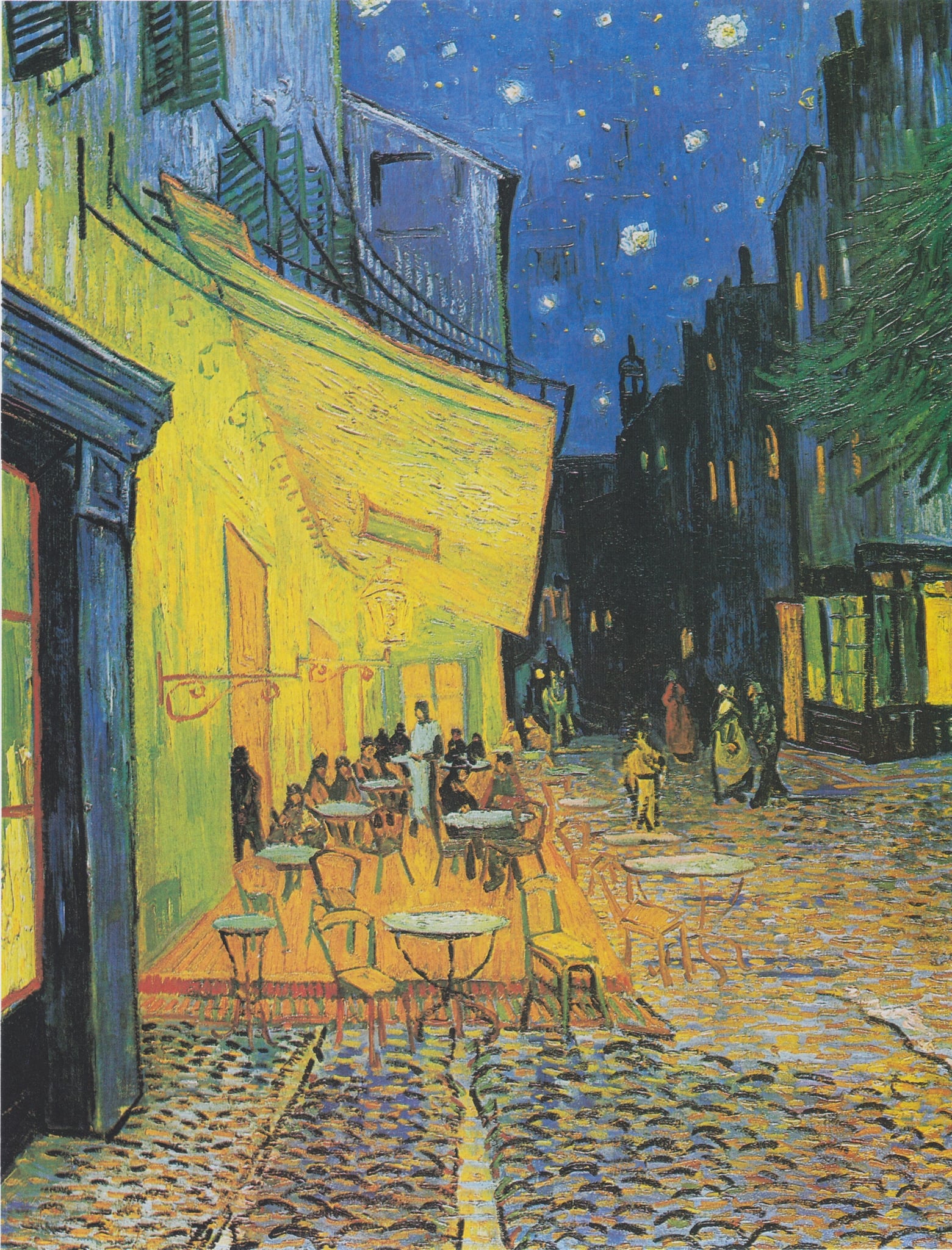
In Café Terrace at Night, Vincent van Gogh turns nocturne into <strong>luminous color</strong>: a gas‑lit terrace glows in yellows and oranges against a deep <strong>ultramarine sky</strong> pricked with stars. By building night “<strong>without black</strong>,” he stages a vivid encounter between human sociability and the vastness overhead <sup>[1]</sup><sup>[2]</sup>.
Red Cabbages and Onions by Vincent van Gogh

Red Cabbages and Onions

Vincent van Gogh (1887)

In Red Cabbages and Onions, Vincent van Gogh turns everyday produce into a drama of <strong>complementary color</strong> and <strong>restless brushwork</strong>. Hot red contours cinch violet cabbages and pale yellow bulbs against a cool, striated blue table, while a mustard‑yellow patch in the upper right tilts the space and sharpens the chromatic clash. The result asserts ordinary food as a locus of <strong>resilience</strong> and <strong>experimentation</strong> <sup>[1]</sup><sup>[2]</sup>.

Irises by Vincent van Gogh

Irises

Vincent van Gogh (1889)

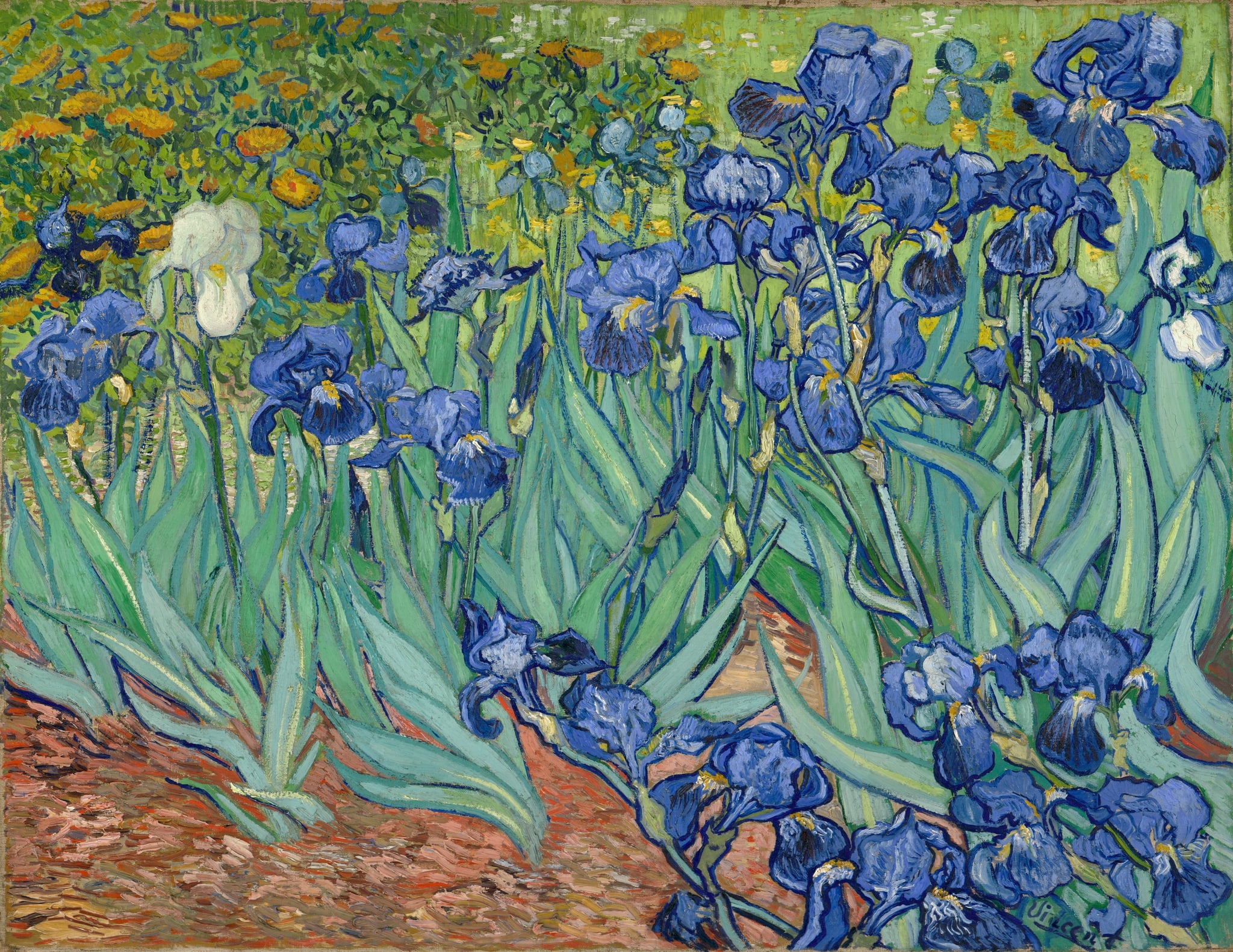
Painted in May 1889 at the Saint-Rémy asylum garden, Vincent van Gogh’s <strong>Irises</strong> turns close observation into an act of repair. Dark contours, a cropped, print-like vantage, and vibrating complements—violet/blue blossoms against <strong>yellow-green</strong> ground—stage a living frieze whose lone <strong>white iris</strong> punctuates the field with arresting clarity <sup>[1]</sup><sup>[2]</sup>.
Sunflowers by Vincent van Gogh

Sunflowers

Vincent van Gogh (1888)

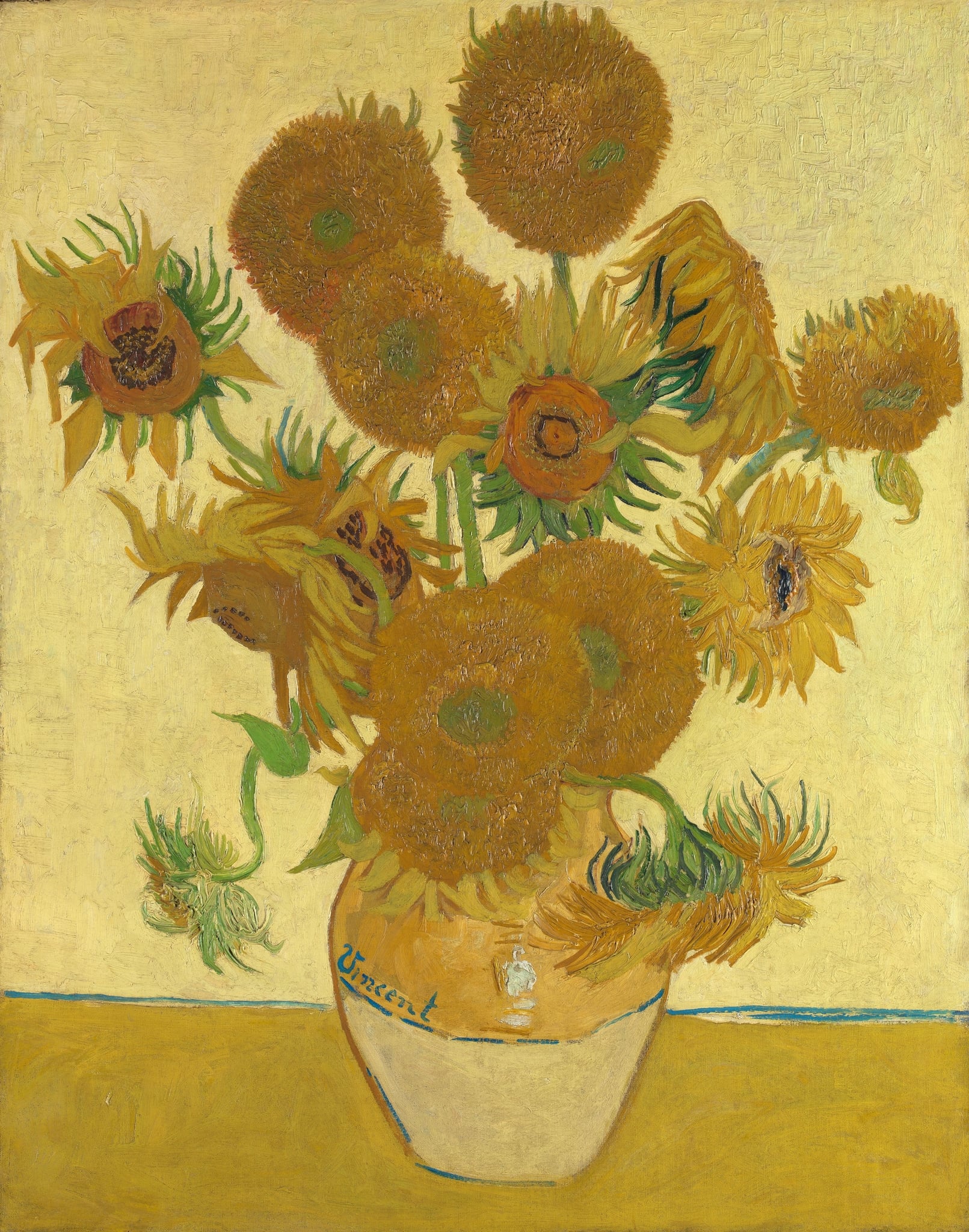
Vincent van Gogh’s Sunflowers (1888) is a <strong>yellow-on-yellow</strong> still life that stages a full <strong>cycle of life</strong> in fifteen blooms, from fresh buds to brittle seed heads. The thick impasto, green shocks of stem and bract, and the vase signed <strong>“Vincent”</strong> turn a humble bouquet into an emblem of endurance and fellowship <sup>[1]</sup><sup>[2]</sup>.

Garden with Courting Couples: Square Saint-Pierre by Vincent van Gogh

Garden with Courting Couples: Square Saint-Pierre

Vincent van Gogh (1887)

In Garden with Courting Couples: Square Saint-Pierre, Vincent van Gogh turns a small Montmartre park into a stage where <strong>spring</strong>, <strong>intimacy</strong>, and <strong>urban leisure</strong> converge. Short, shimmering strokes fuse pink chestnut blossoms, curving paths, and paired figures into one pulse of <strong>renewal</strong> and <strong>togetherness</strong> <sup>[1]</sup><sup>[2]</sup>.

In the Café: Agostina Segatori in Le Tambourin by Vincent van Gogh

In the Café: Agostina Segatori in Le Tambourin

Vincent van Gogh (1887 (Jan–Mar))

Van Gogh casts Agostina Segatori at a tiny, tambourine‑like café table, turning Le Tambourin into a <strong>stage of modern life</strong>. Cool greens and greys make the red <strong>flame‑plume hat</strong> and the foaming <strong>beer</strong> flare, while folded arms and a set‑aside <strong>parasol</strong> register private fatigue amid public display <sup>[1]</sup><sup>[2]</sup><sup>[3]</sup>.