Two ways to make vision visible
Both artists replace story with seeing. Manet edits modern life into charged, present‑tense images that position us as spectators inside the scene; Cézanne rebuilds what he sees into an enduring order of color‑planes and measured relations. The deepest shared ground is their insistence that a truthful picture can show its own construction. The decisive difference is what that construction is for: Manet’s ethics of spectatorship vs Cézanne’s logic of perception.
Comparison frame: How do Manet’s edited instants and Cézanne’s constructed durations re-teach us to see?
Quick Comparison
| Topic | Édouard Manet | Paul Cézanne |
|---|---|---|
| Core aim | Stage modern looking and its social consequences in the present tense. | Make Impressionism solid: test and stabilize visual relations over time. |
| Time and viewpoint | Edited instants; mirrors and crops that implicate our position. | Cumulative, multi‑view seeing; purposeful misalignments. |
| Primary arenas | Cafés, fashion, beaches, press‑shaped history scenes. | Still lifes as labs, card players, Mont Sainte‑Victoire. |
| How space is built | Flat/indeterminate grounds, high horizons, strategic blacks. | Constructive brushstroke; warm–cool modulation; color‑planes. |
| Viewer’s role | Implied witness—complicity, distance, or refusal to look. | Patient comparator—assemble structure from sequential looks. |
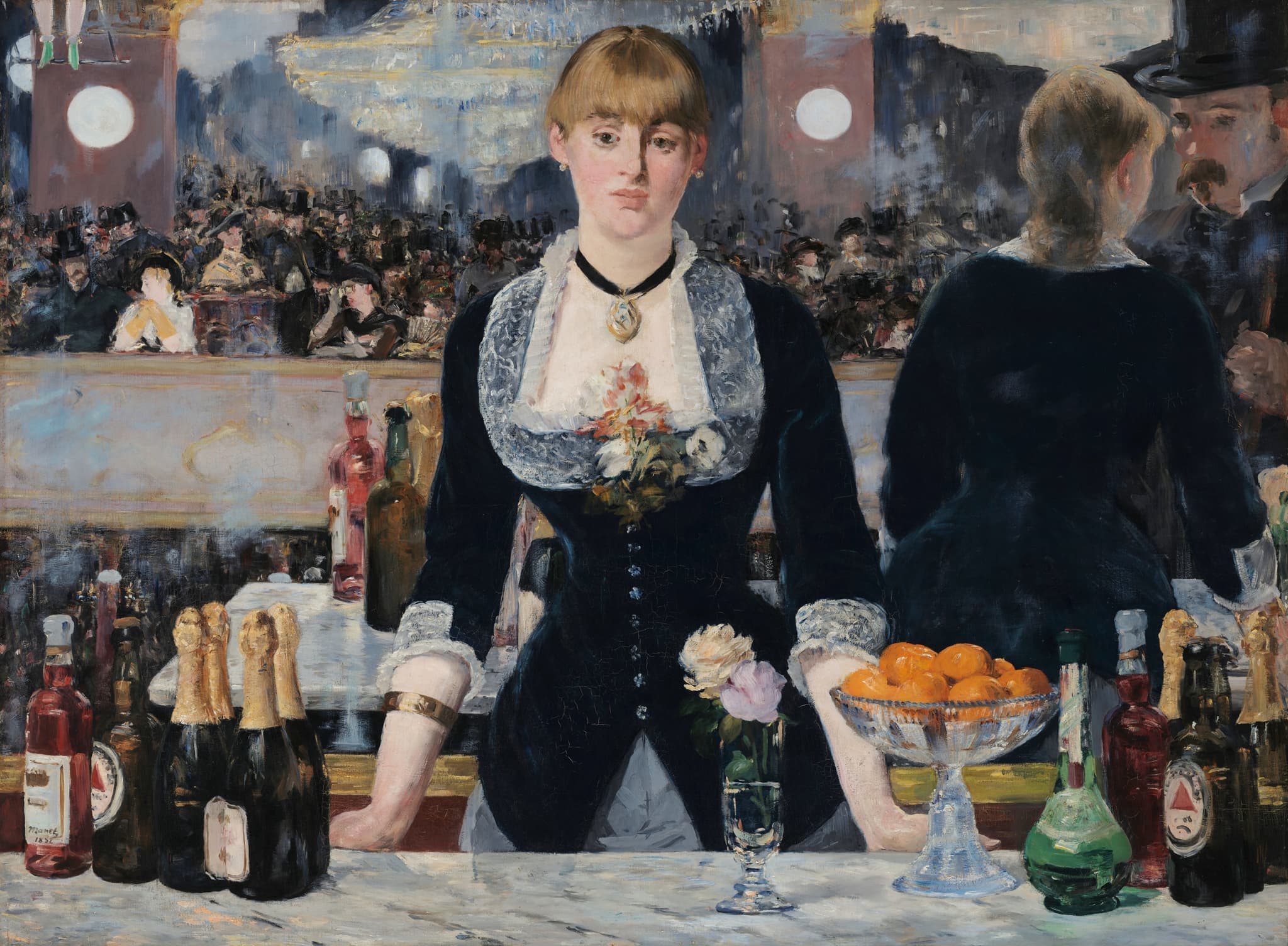
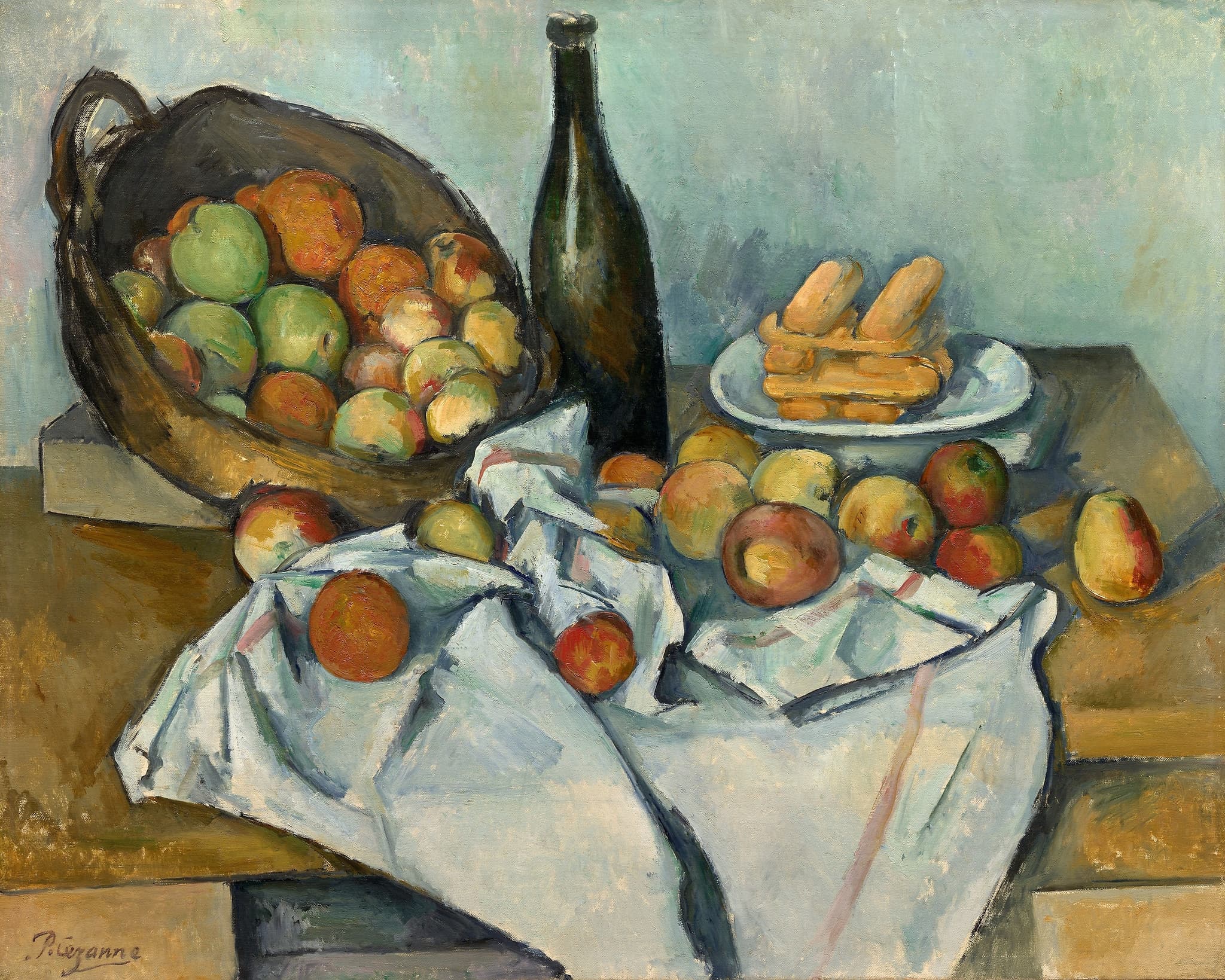
| Signature refusal of a single view | Bar mirror and urban cropping (A Bar at the Folies‑Bergère). | Skewed tabletops and leaning bottles (The Basket of Apples). |
| Legacy | Ethics of modern spectatorship; editing as a pictorial method. | Framework for Cubism’s analysis; durable structure after Impressionism. |
Shared Ground
Manet and Cézanne share a modern ambition: replace narrative with seeing. Both treat painting as a device for examining how attention is organized, how space is constructed, and how an image can be true while openly built. Their subjects are pointedly ordinary—a crowd at a concert, a boy in uniform, fruit on a table, peasants at cards—yet their formats are serious. Manet scales modern life to the size and authority of grand painting (Music in the Tuileries; The Fifer; the Maximilian canvases). Cézanne elevates still life, landscape, and rural leisure to the status of testing grounds (The Basket of Apples; The Card Players; Mont Sainte‑Victoire). In both cases, hierarchy gives way to inquiry.
They also make construction legible. Manet’s high horizons, blunt value contrasts, and japoniste cropping pull scenes flat and fragment them into bands (On the Beach), while his interiors and mirrors declare the studio’s role in staging the modern image. Cézanne’s short, largely parallel strokes accumulate into planes; warm–cool shifts build volume where theatrical chiaroscuro once ruled. Purposeful misalignments—a tilted basket, a bottle that will not sit square—map the eye’s movement across time rather than a fixed vantage. For both, the goal is not illusion but credibility: a picture of the world that also shows how looking was organized to make it. That is their essential shared ground: painting becomes a clear, durable model of perception, whether the motif is a bar counter or a tabletop of apples.
Decisive Difference
Manet’s construction serves the ethics of spectatorship. He edits modern life into present‑tense fragments that stage how images position viewers: a bar mirror that dislocates where we stand, a firing squad whose rifles align with the horizon, a boxed‑in café table that turns leisure into a small theater. A Bar at the Folies‑Bergère makes the viewer complicit in the social optics of attraction and exchange. The Execution of Emperor Maximilian cools atrocity into procedure and seats us shoulder‑to‑shoulder with the shooters. Even in quiet interiors like Plum Brandy, props and cropping create an interval of suspended action that asks what kind of looking is permitted, withheld, or judged. Manet’s present tense is ethical: the picture is a place where seeing has consequences.
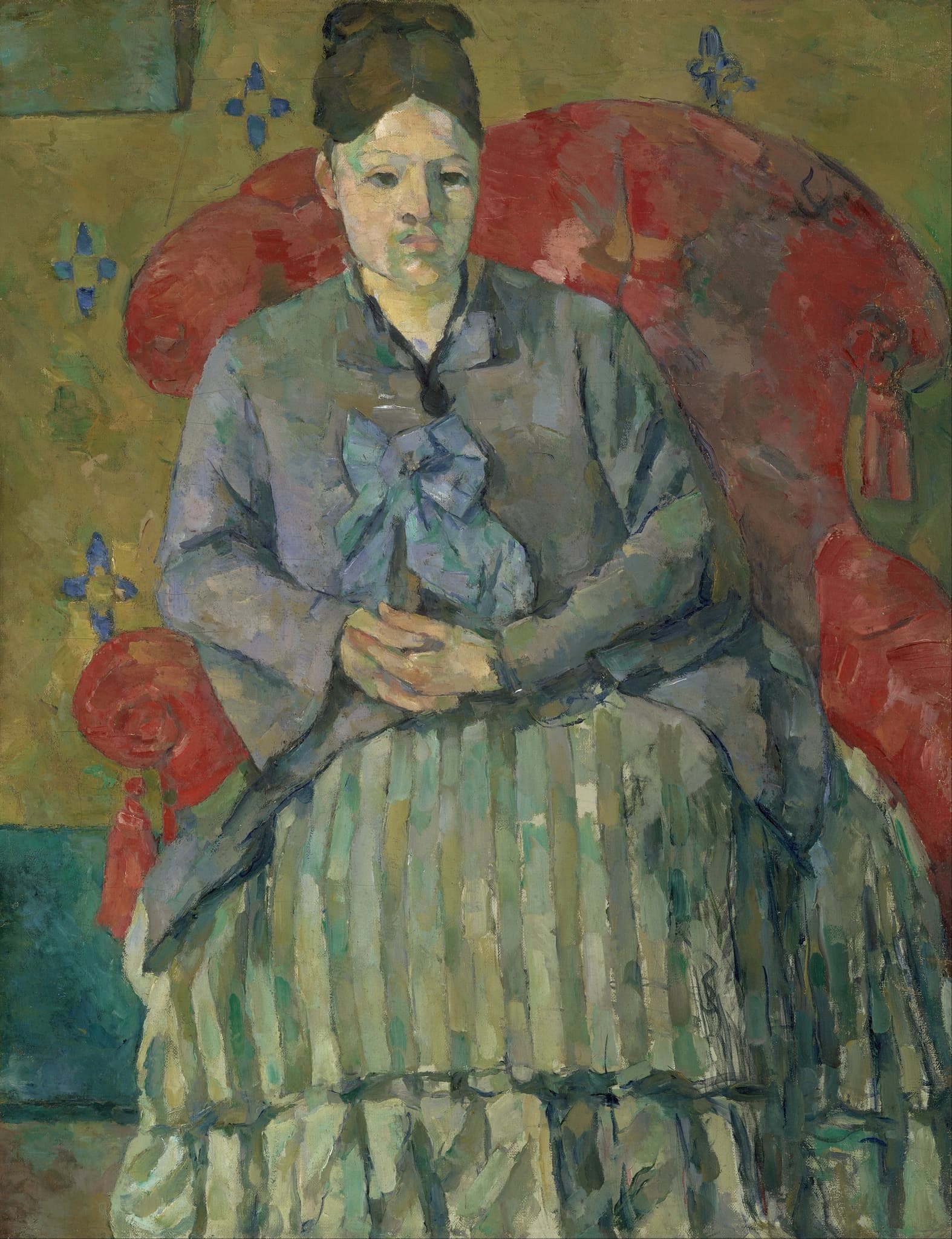
Cézanne’s construction serves the logic of perception. He replaces single‑view description with slow, additive seeing: forms built by color, relations tested until they hold. The Basket of Apples denies a single, stable tabletop so the eye must reconcile multiple moments of sight; Madame Cézanne in a Red Armchair turns likeness into interlocking warm–cool masses; Mont Sainte‑Victoire treats mountain and air as equivalent planes in a durable order. His oft‑stated aim to make Impressionism “solid and durable” is realized not by tightening finish but by letting structure emerge from patient calibration. If Manet dramatizes the now of looking, Cézanne constructs the time in looking. That is the decisive difference: Manet models how images implicate us; Cézanne models how perception coheres.
Paired Works
Mirror vs Tabletop: Why refuse a single view?
Focus question: Both deny a stable viewpoint; is it to dramatize social looking (Manet) or to model accumulated perception (Cézanne)?
A Bar at the Folies‑Bergère vs The Basket of Apples
Manet’s bar is a social diagram. The mirror slips the barmaid’s reflection off to the right and inserts a gentleman where our body would be, so the picture makes us feel the dislocations of urban looking—seduction, transaction, and display folded into one glance. The cropped marble, scattered bottles, and trapeze‑like feet at the top edge pin us to a specific, bustling now. The “errors” are rhetorical: they turn a room into a machine that positions the viewer.
Cézanne’s tabletop is a perceptual diagram. The basket tilts, the bottle leans, the plate reads from two angles, and the front edge of the table kinks: multiple sightings stitched into one surface. These “purposeful errors” force the eye to do the work that perception does in time—compare, correct, and integrate. Where Manet’s dislocation implicates us socially, Cézanne’s implicates us cognitively. Both refuse a single view, but for different ends: one to stage the ethics of spectatorship, the other to model how vision coheres.
Urban pause vs built poise
Focus question: What holds a figure steady: narrative props in public space (Manet) or calibrated color masses (Cézanne)?
Plum Brandy vs Madame Cézanne in a Red Armchair
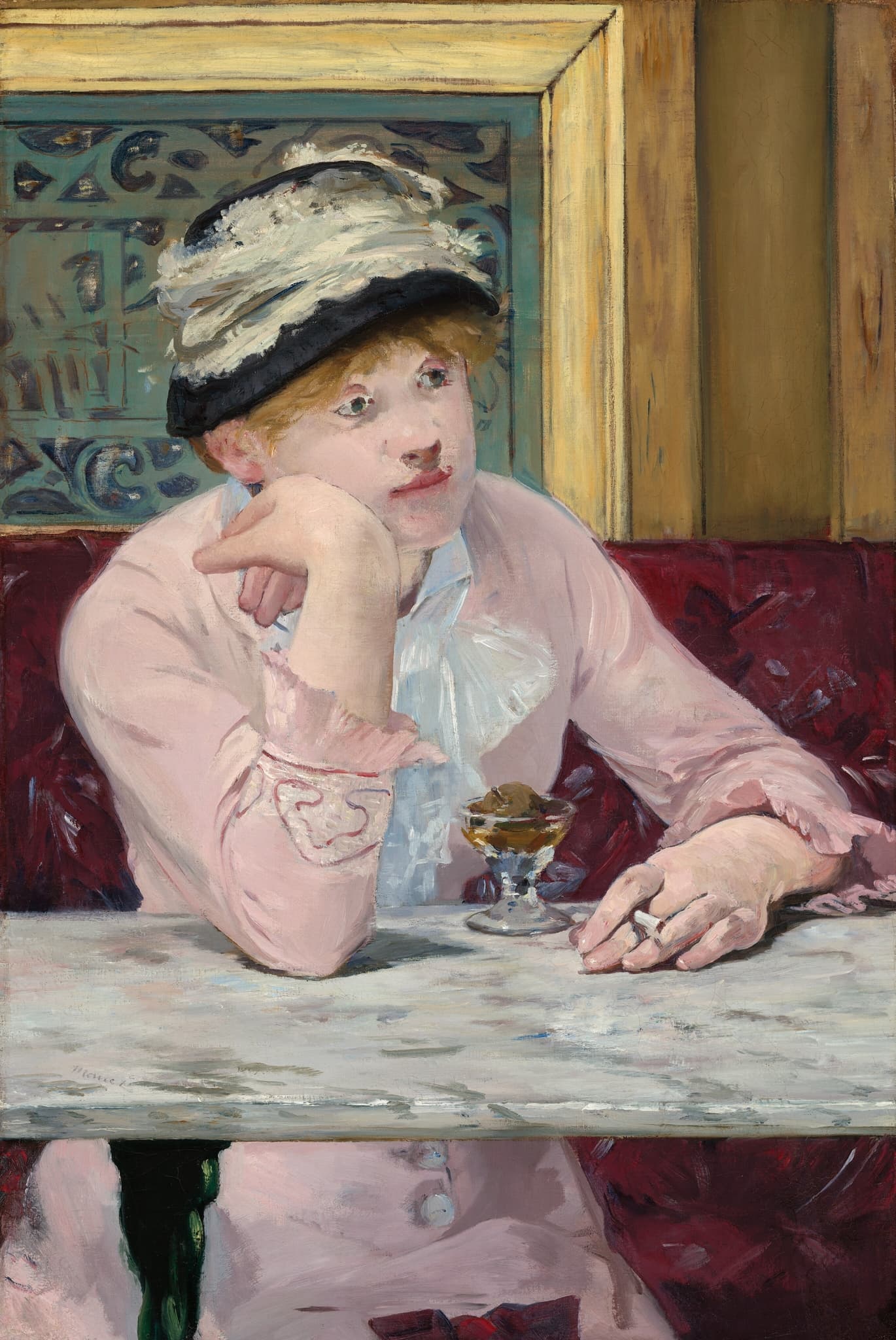
Plum Brandy composes an urban interval: a marble edge blocks us, a red banquette boxes the sitter, an unlit cigarette and a glass with a preserved plum mark suspended time. The cropping and props signal a public place but drain it of anecdote. Manet’s restraint keeps judgment in check; the scene becomes a diagram of modern self‑containment, built from edited fragments that put our own looking on hold.
Madame Cézanne turns likeness into structure. The armchair’s saturated reds advance as one mass; the jacket’s blue–greens and the wallpaper’s blues counter and lock them in. Small accents (a tassel, a bow) recalibrate the whole red field, so poise emerges from color relations, not from storytelling. Space tightens (tilted baseboard, compressed depth) until the sitter reads as an architectural presence. Manet stabilizes a mood with staged objects; Cézanne stabilizes a person with constructed color.
Planes that compress vs planes that funnel
Focus question: How does each painter steer attention in landscape without relying on deep perspective?
On the Beach vs The House of the Hanged Man
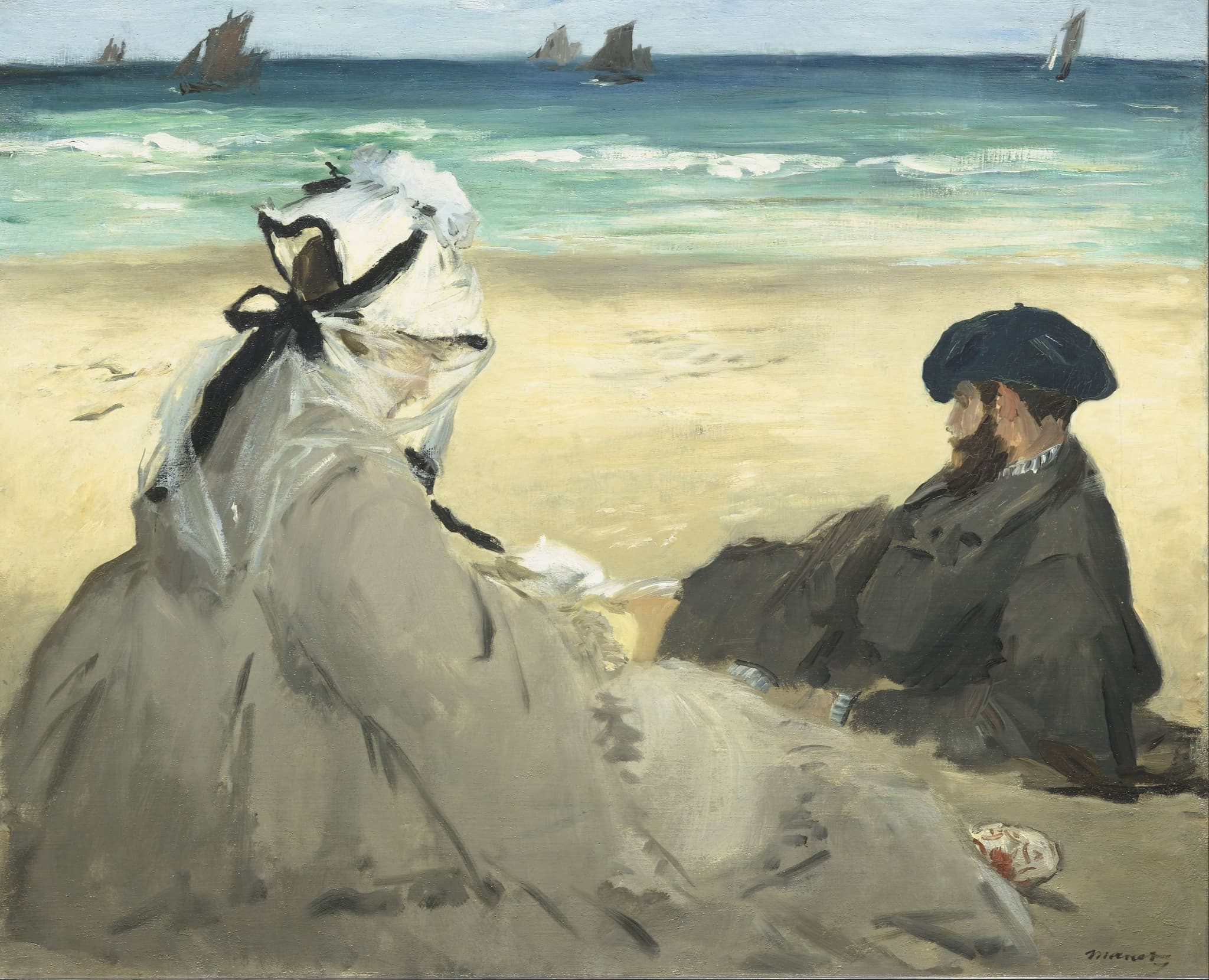
Manet compresses. A high horizon and banded sea flatten depth; japoniste cropping trims the figures and shores into graphic fields. Wind-flecked whites scud across veil and surf, and actual sand in the paint anchors a plein‑air immediacy. The result is a calm, modern screen of planes where two absorbed figures sit before a sea that reads almost like a color panel—a present‑tense pause in open air.
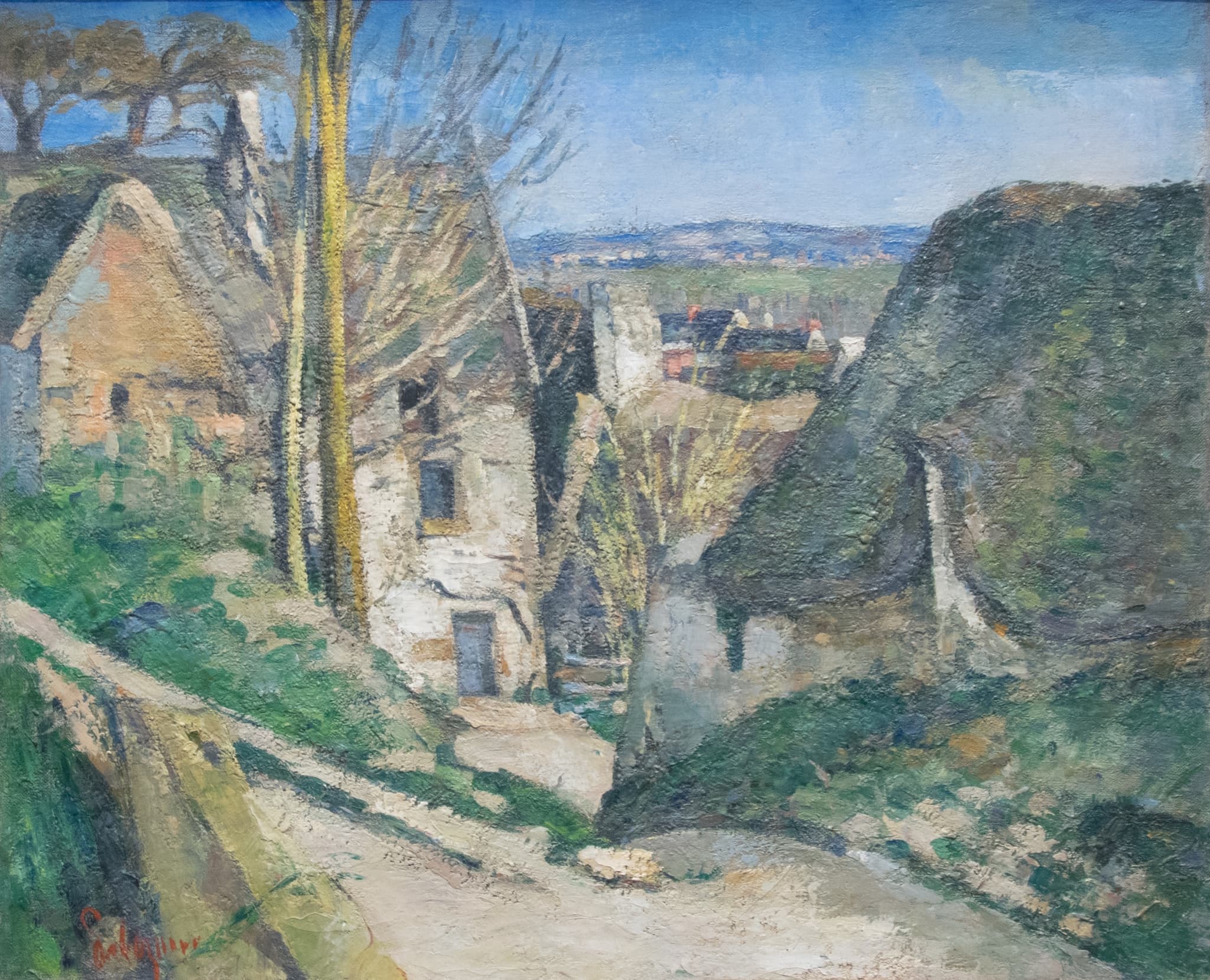
Cézanne funnels. Paths, roofs, and laddered trees drive the eye toward a narrow, shadowed V that withholds a destination. Blocky, masoned strokes turn houses and banks into interlocking planes; cool greens and slates build a sober, engineered unease. Depth is not a vista but a pressure system that halts and releases attention. Both painters steer seeing with planes, but Manet compresses the world into a poised screen while Cézanne builds a structure that carries tension.
Witness vs equilibrium
Focus question: When painting bears modern seriousness, is it ethical positioning (Manet) or structural poise (Cézanne)?
The Execution of Emperor Maximilian vs The Card Players by Paul Cézanne | Equilibrium and Form
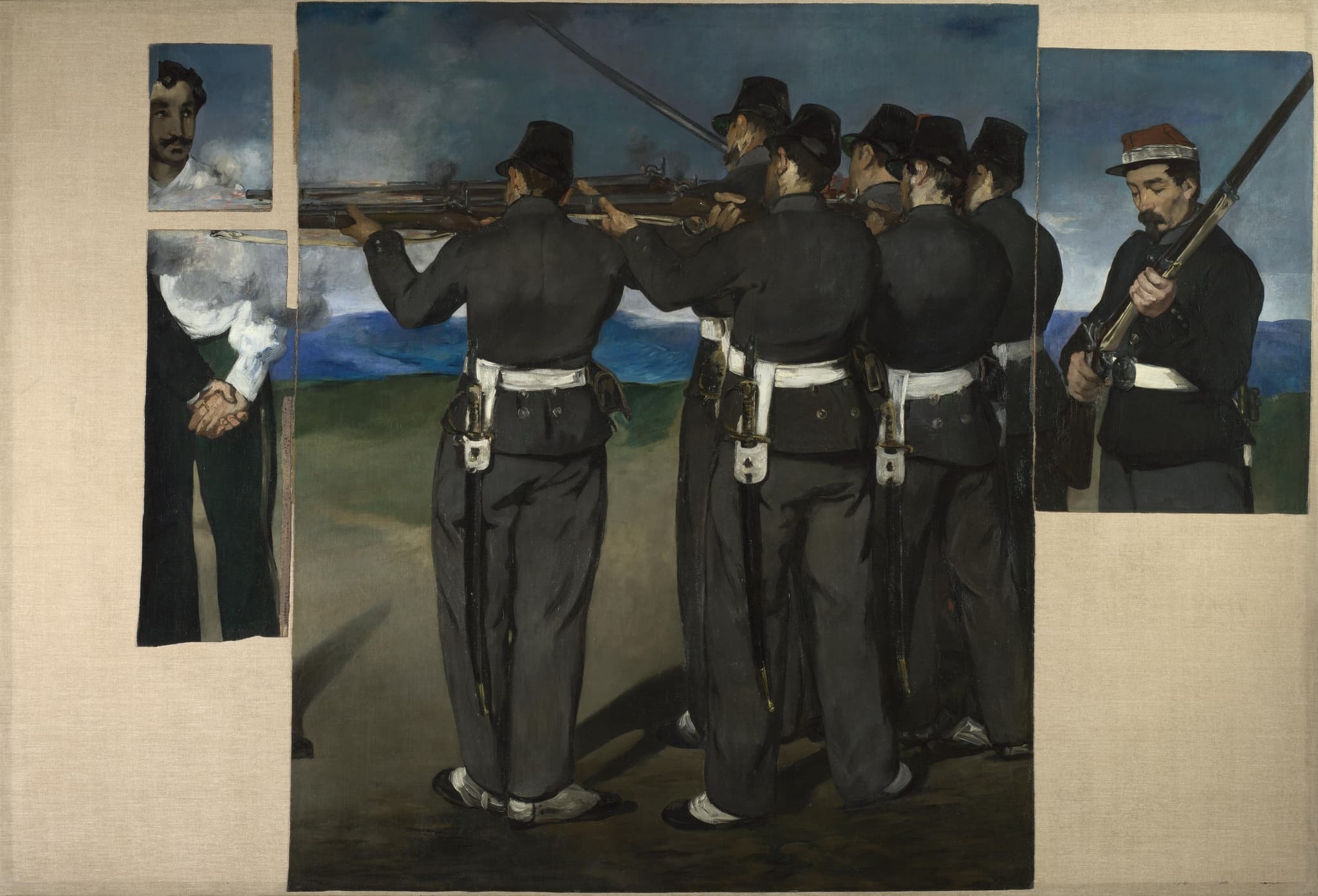
Manet’s Maximilian places us with the firing squad. Gray coats form a barricade; rifles line up with the horizon; a loader coolly prepares the final shot. The flattened light, pieced canvas, and press-derived edits make looking itself political: administrative death rendered without theatrics. The painting asks where we stand when images witness state violence.
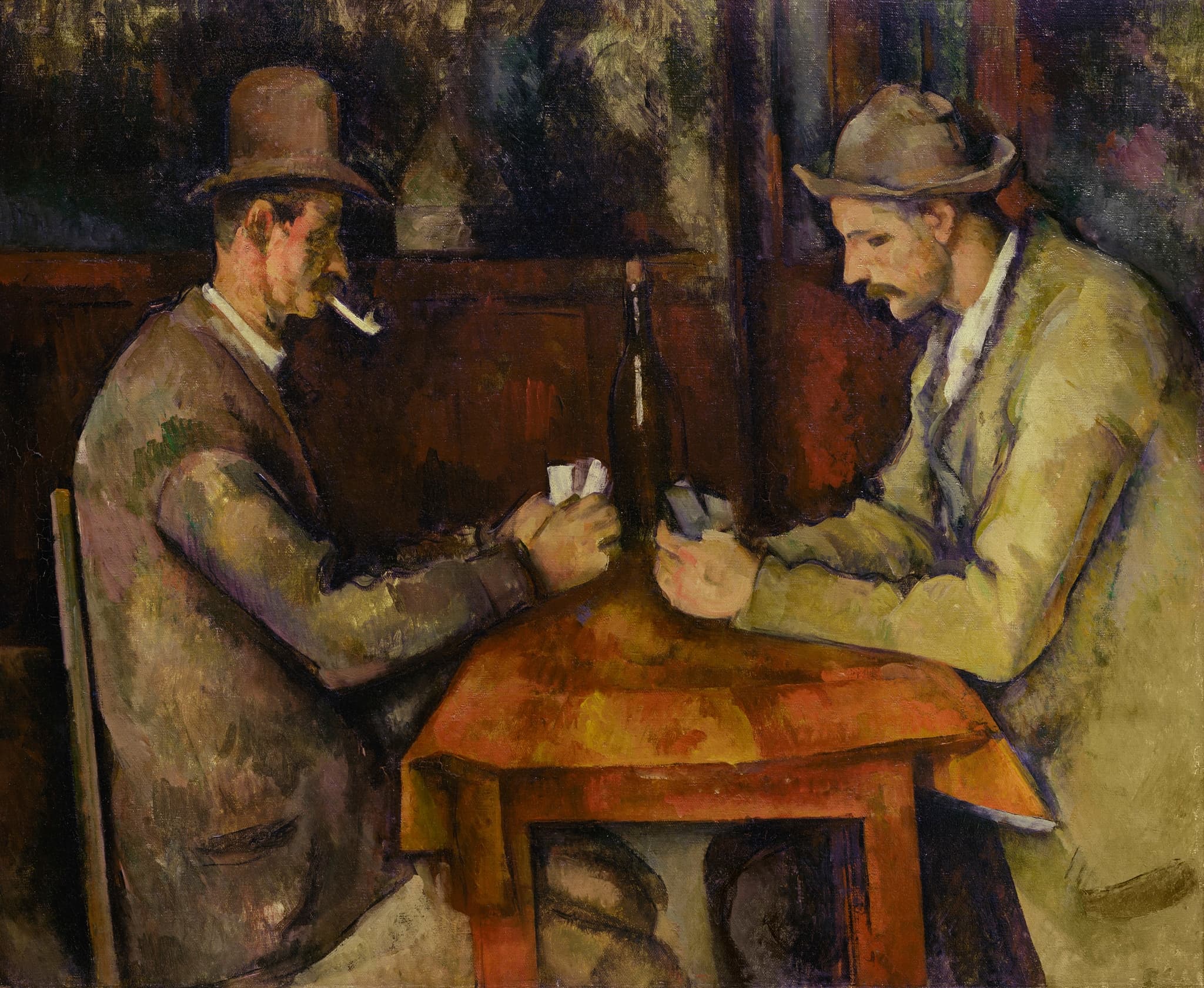
Cézanne’s Card Players converts a rural game into a human still life. Two laborers lean inward across an orange‑brown table while a dark bottle rises as a vertical axis that mediates their focus. Ornament and anecdote fall away; coats and hats become weighty planes held in equilibrium. The seriousness here is structural, not moralizing: concentration forged by measured relations. Manet turns vision into witness; Cézanne turns it into balance.
Why This Comparison Matters
Putting Manet beside Cézanne clarifies two durable paths for modern painting. One path, Manet’s, treats a picture as a staged encounter in real time: cropping, mirrors, and edits articulate how images include, exclude, and implicate us. The other, Cézanne’s, treats a picture as a constructed order: apples, sleeves, and mountain facets become instruments for testing how perception coheres across moments. Both reject academic finish in favor of legible making, and both elevate ordinary things to high stakes.
Understanding this split helps decode later art. Manet’s ethics of spectatorship runs forward to photography, cinema, and political image-making. Cézanne’s structural method underwrites Fauvism and Cubism, and more broadly any painting that treats color and plane as first principles. The comparison shows not a contest but complementary tools: how to look at images, and how images teach us to look.
Related Links
Sources
- Courtauld Gallery – A Bar at the Folies‑Bergère
- Smarthistory – Cézanne, The Basket of Apples
- National Gallery of Art – Manet: Works (incl. The Plum)
- Museum of Fine Arts, Boston – Madame Cézanne in a Red Armchair
- Musée d’Orsay – On the Beach (Sur la plage)
- National Gallery, London – Manet: The Execution of Emperor Maximilian
- The Met – Paul Cézanne (1839–1906) essay
- MoMA – Paul Cézanne artist page (programmatic aims)
- Merleau‑Ponty – Cézanne’s Doubt (phenomenology of perception)
- National Gallery, London – Music in the Tuileries Gardens
- Getty Museum – Late Manet / Jeanne (Spring)
- Smarthistory – Cézanne, Mont Sainte‑Victoire