Precision with opposite aims
Both artists paint inner life with exacting realism: Kahlo externalizes injury and identity; Dalí renders hallucination with photographic polish so the irrational looks plausible. Their shared clarity supports very different purposes. Kahlo stabilizes embodied truth and asks for witness; Dalí destabilizes visual certainty and trains the eye to doubt.
Comparison frame: How do Frida Kahlo and Salvador Dalí use high‑precision realism to change what “seeing” can hold—Kahlo to stabilize embodied truth, Dalí to destabilize visual certainty?
Quick Comparison
| Topic | Frida Kahlo | Salvador Dali |
|---|---|---|
| What precision is for | To stabilize embodied facts—pain, identity, treatment—so they can be acknowledged. | To destabilize certainty—engineer optical doubles so seeing becomes suspect. |
| Typical composition | Frontal, symmetrical, shallow stage; reciprocal gaze. | Deep, crystalline space with raking light; stage-like horizons. |
| Doubling strategy | Physiological/biographical doubles (shared arteries, clamps). | Paranoiac-critical doubles (reflections, profile/landscape hybrids). |
| Key props/icons | Medical instruments, corsets, ex-voto logic, Tehuana dress. | Melting watches, ants/grasshopper, crutches, Catalan cliffs. |
| Viewer’s role | Witness—ethical recognition of an embodied reality. | Co-conspirator—toggle readings and complete the image. |
| Relation to Surrealism | Adjacent; rejects “dream” label in favor of “my reality.” | Central; “hand‑painted dream photographs” to systematize confusion. |
| Sense of time | Endurance and aftermath; the gaze fixes time. | Liquefied, suspended, reversible; time behaves like matter. |
Shared Ground
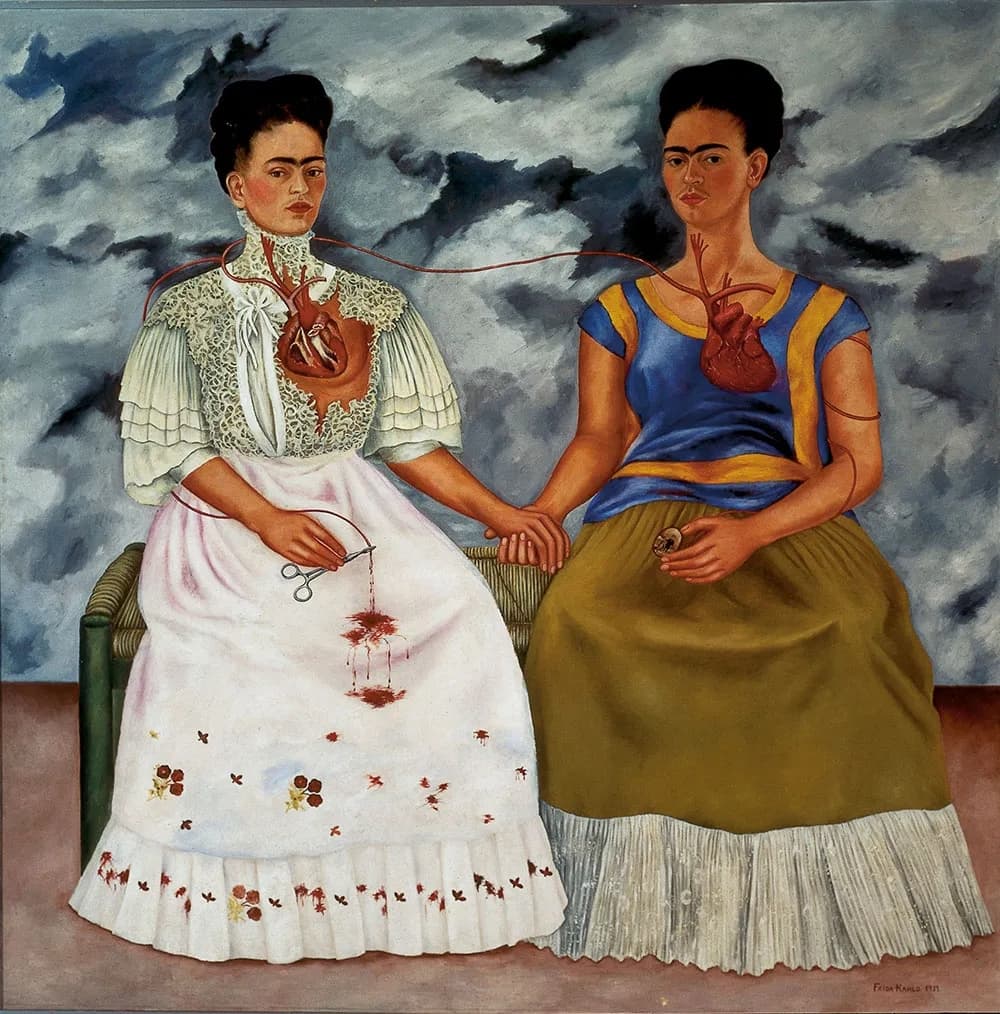
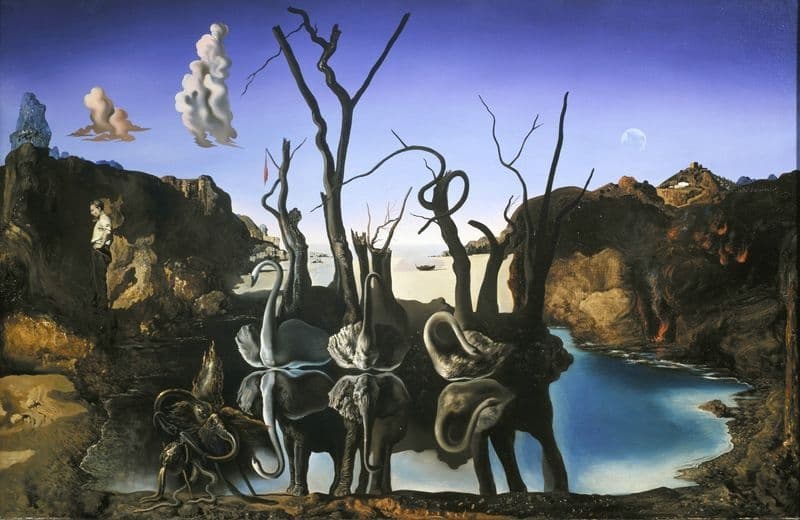
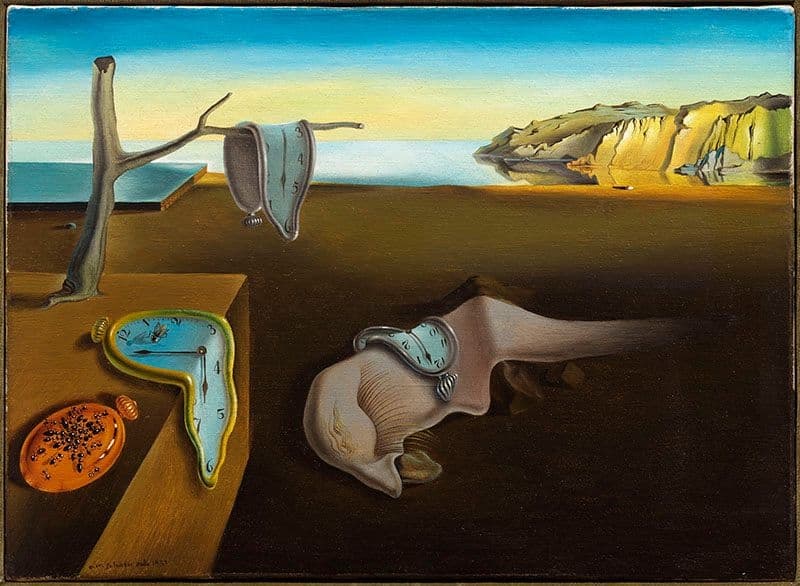
Frida Kahlo and Salvador Dalí share an unusual commitment: they make inner states legible through almost forensic clarity. Each insists that psychological truth requires technical exactitude. Kahlo’s bodies are diagrammed with clinical specificity—the hemostat that clamps a severed artery in The Two Fridas, the rigid corset and countable nails mapping pain in The Broken Column. Dalí paints impossibilities with photographic finish—the soft watches and ant‑ridden case in The Persistence of Memory, or the swans whose reflections become elephants—so that doubt arrives only after the eye has trusted what it sees.
Autobiography is anchored in place and tradition for both. Kahlo adapts Mexican ex‑voto conventions—frontal address, compressed narrative—to monumentalize lived experience; dress and adornment (Tehuana vs European) stage cultural identity as argument. Dalí secures his dream logics in the recognizable geology of the Catalan coast (Portlligat/Cap de Creus), a real stage that lends credibility to metamorphosis. This grounding keeps fantasy accountable to the world it claims to interpret.
Doubling and metamorphosis are central engines. Kahlo literalizes a split self with two open hearts joined by one bloodstream; Dalí forces double readings through reflections and profile/landscape hybrids. In both, the canvas becomes a test bench for how perception constructs identity: a viewer learns to read arteries and clamps as evidence in Kahlo, and to accept swans-as-elephants as a perception the mind cannot unsee in Dalí. Their shared ground is this wager that precision—rather than blur—best conveys the unstable truths of the inner life.
Decisive Difference
Kahlo uses painting to stabilize perception around embodied facts. She rejected the dream label, calling her work “my own reality,” and structures images so that injury, treatment, and divided identity are seen steadily, not guessed at. Frontality, a shallow stage, and a reciprocal gaze make the viewer answerable: we are not invited to solve a riddle but to witness. Instruments are named and pictured precisely—the artery is clamped, the corset straps bite—so meaning accrues through verifiable detail. The effect is ethical as much as visual: she enlarges what counts as reality until it includes chronic pain, disability, and plural identity without conceding agency.
Dalí, by contrast, weaponizes precision to destabilize perception. His “hand‑painted dream photographs” and paranoiac‑critical method construct contexts where forms must read as two things at once. The lake in Swans Reflecting Elephants is a machine for doubles; the soft/hard dialectic of melting watches and ant‑swarmed metal makes categories buckle. Seeing becomes an active, unstable construction: you toggle between images and participate in the confusion he aims to “systematize.” Where Kahlo asks for recognition of an embodied truth, Dalí trains suspicion toward the reliability of sight itself. The decisive difference is their endgame for realism: Kahlo’s exactitude clarifies and binds; Dalí’s exactitude unmoors and multiplies.
Paired Works
Double vision, opposite ethics
Focus question: What kind of double is being made, and what work does it ask the viewer to do?
The Two Fridas vs Swans Reflecting Elephants
Kahlo’s doubling is physiological and biographical. Two frontal Fridas sit under a charged sky, their opened chests revealing hearts linked by a single artery. One in European dress clamps a severed vessel with a hemostat while blood stains the skirt; the other in Tehuana dress steadies a locket and the shared pulse. Everything reads with clinical legibility: instruments, blood flow, and dress do the explanatory work, while the clasped hands and reciprocal stares stabilize the scene. The viewer becomes a witness to a structured, survivable split self.
Dalí’s doubling is optical and compulsory. Three swans before a thicket turn into elephants in the water’s mirror; necks become trunks, bodies become ears, trees become legs. He paints the lagoon, cliffs, and sky with such stillness that the second image feels inevitable once seen. The viewer is required to toggle between readings—grace and gravity at once—becoming complicit in the image’s instability. Same subject—two-in-one—but opposite tactics: Kahlo resolves division into a readable system; Dalí produces a perceptual trap the eye cannot un-spring.
Structure vs. time
Focus question: How do the artists re-engineer what holds a life together—bones or minutes?
The Broken Column vs The Persistence of Memory
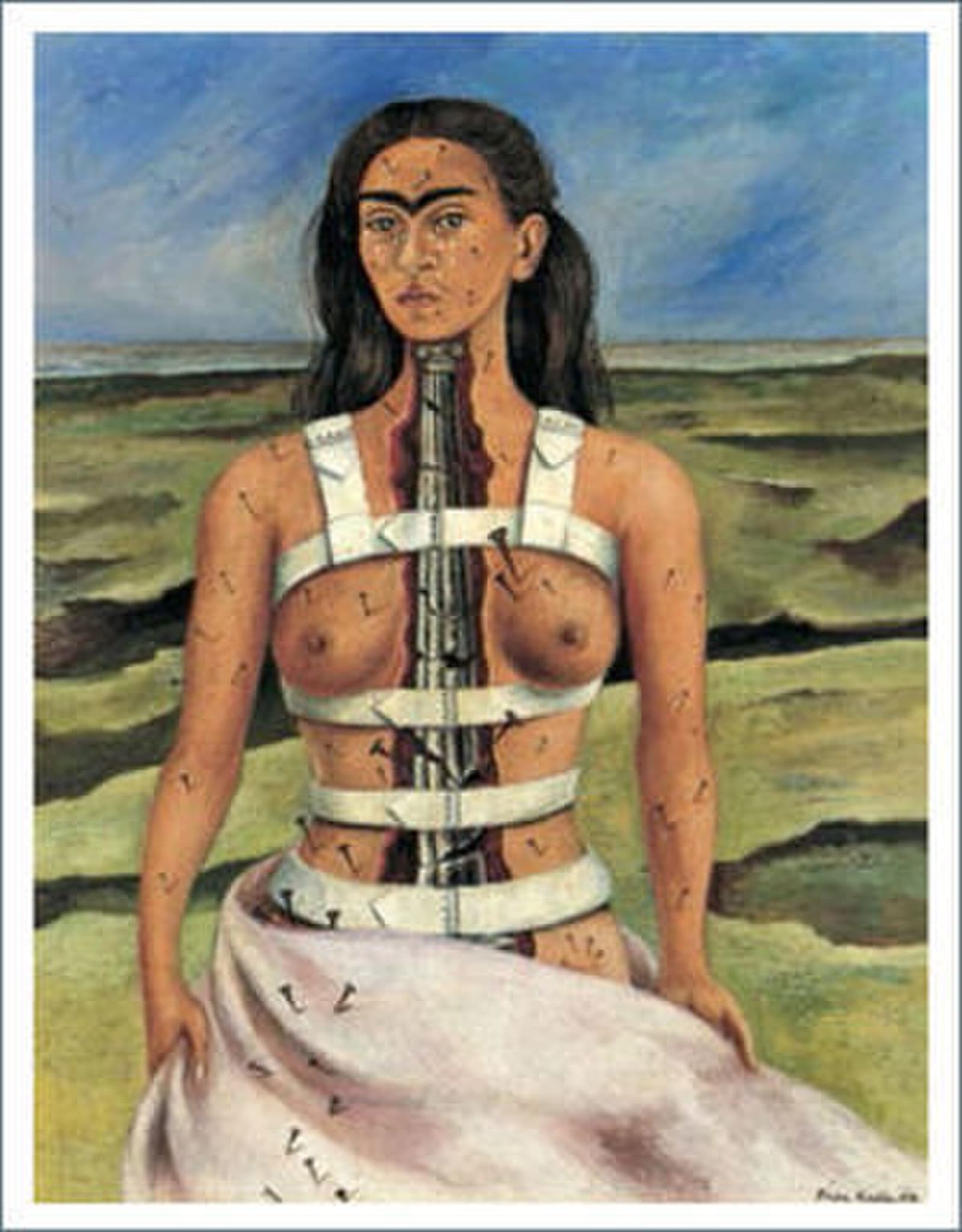
Kahlo substitutes architecture for anatomy: her torso splits to reveal an Ionic column in place of a spine, cracked and splinted from throat to pelvis. A rigid medical corset binds the body; nails puncture the skin in a countable map of distributed pain. The barren, fissured ground echoes the body’s rupture, yet the frontal pose and steady gaze arrest panic. Structure—however damaged—remains the painting’s argument, and the viewer reads endurance through specific supports.
Dalí liquefies the instrument that structures modern life: clock time. Pocket watches droop over a platform, branch, and sleeping biomorph; numerals persist, function fails. Ants consume the lone hard watch; long shadows freeze a moment that never arrives. Time is treated like matter—bent, pooled, eaten—so that certainty decays in front of us. Kahlo fixes structure to secure recognition; Dalí softens time to unseat it. Both use immaculate craft against empty space, but one holds the gaze steady while the other suspends it in lucid doubt.
The body as confession machine
Focus question: When the body speaks, does the image steady it or let it unravel?
The Broken Column vs The Great Masturbator
Kahlo’s body is open yet composed. Tears are small, the corset is exact, and the nails distribute sensation like data points. The message is firm: this is what pain looks like when named and faced. The eye meets hers; the painting regulates how suffering will be seen, converting diagnosis into witness.
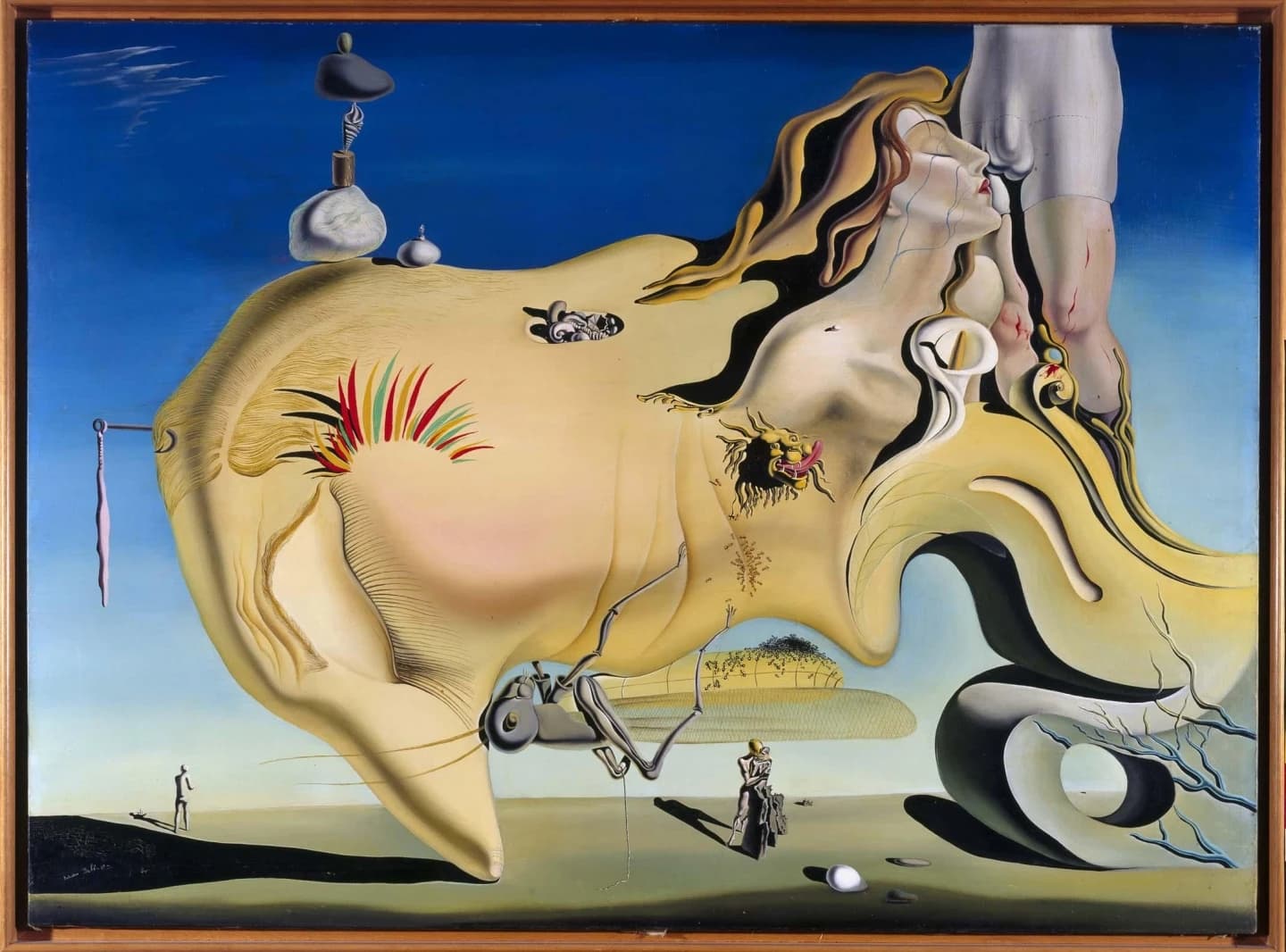
Dalí’s body is a slumped biomorphic head bristling with emblems: ants and a grasshopper at the mouth (decay and phobia), a lion’s tongue (threatened desire), crutches that prop a yielding form, a pristine egg that promises renewal. Lids are shut; the scene turns inward. Rather than stabilize, the picture proliferates symptoms and supports, staging eros as a system of dread. Compare the gazes—returned versus closed—and the role of props—medical brace versus Surreal crutches and vermin. Kahlo codifies suffering to hold it; Dalí externalizes compulsion to make us watch it morph.
Why This Comparison Matters
This pairing clarifies two durable uses of realism in modern art. Kahlo shows how exact depiction can widen reality to include chronic pain, treatment, and plural identity without reducing a person to a case. Her steadiness models an ethics of looking: facts of the body and biography deserve recognition at full scale. Dalí shows how the same exactness can expose perception itself as a constructor of meaning. His doubles and soft/hard paradoxes train viewers to hold incompatible readings and to notice how vision manufactures certainty.
Once you see the split—stabilize versus destabilize—you can read both artists with more precision. A hemostat is not a prop; it is a claim about control. An ant is not decoration; it is a timed signal of decay. The comparison also equips viewers for broader questions: when should images demand witness, and when should they cultivate doubt? Kahlo and Dalí give clear, opposite answers—both indispensable for understanding how art teaches us to see.
Related Links
Sources
- MoMA Collection: Salvador Dalí, The Persistence of Memory
- MoMA Magazine: Debunking the relativity myth around the melting clocks
- MoMA Learning: Surrealism ("hand‑painted dream photographs")
- Smarthistory: Frida Kahlo, The Two Fridas
- Smarthistory: Frida Kahlo—Introduction (ex‑votos, frontality, identity)
- Brooklyn Museum: Frida Kahlo—medicalized imagery, corsets, surgeries
- Fundació Gala‑Salvador Dalí: Paranoiac‑critical method
- Smithsonian/Tuchman: Kahlo—“I paint my own reality”