Order built over time vs color as conviction
Both painters turned away from copying nature to make perception itself visible. They worked in series and used brushwork as structure, not finish. Here the shared ground is clear—yet the split is decisive: Cézanne builds durable order through comparative looking, while Van Gogh forges immediacy by charging color until nature and feeling coincide.
Comparison frame: How do Cézanne and Van Gogh rebuild seeing: Cézanne by constructing a measured harmony “parallel to nature,” and Van Gogh by charging color so that nature and feeling become one?
Quick Comparison
| Topic | Paul Cézanne | Vincent van Gogh |
|---|---|---|
| Core aim (stated) | A harmony ‘parallel to nature’; sensations constructed into stable relations. | Color states truth (“night without black”); nature equals feeling. |
| How form is built | Warm–cool modulation, planes, and small viewpoint shifts measured over time. | Complementary chords, impasto, and directional strokes that fuse matter and mood. |
| Space | Compressed depth; stacked middle grounds; interlocking sky–object planes. | High horizons, pulled‑forward paths; panoramic “double‑square” sweeps. |
| Sense of time | Accumulated looking; sequential glances reconciled on one surface. | Intensified present; feeling stated at once through chroma and touch. |
| Brushwork | Short, constructive strokes that laminate volume. | Impastoed, directional marks that give everything a shared pulse. |
| Color’s job | Builds solidity and comparative order; temperature = structure. | Declares conviction; complements carry mood and symbolic weather. |
| Serial method | Tables, Mont Sainte‑Victoire, bathers tested across variants. | Sunflowers, wheatfields, cottages, nocturnes, late Auvers panoramas. |
| Portrait goal | Equilibrium and structural poise. | Chromatic empathy; psychological weather made visible. |
Shared Ground
Paul Cézanne and Vincent van Gogh share a generative premise: painting does not copy appearances; it makes perception legible. Both turn the canvas into a site where seeing is constructed—through relations of color, touch, and motif—rather than transcribed as a single instant. Each works serially from a narrow set of subjects so that difference across versions becomes meaning. Cézanne returns to tabletop ensembles and to Mont Sainte‑Victoire; van Gogh cycles through sunflowers, wheatfields, cottages, and nocturnes, culminating in the wide Auvers panoramas. Seriality lets the viewer watch decisions harden into method.
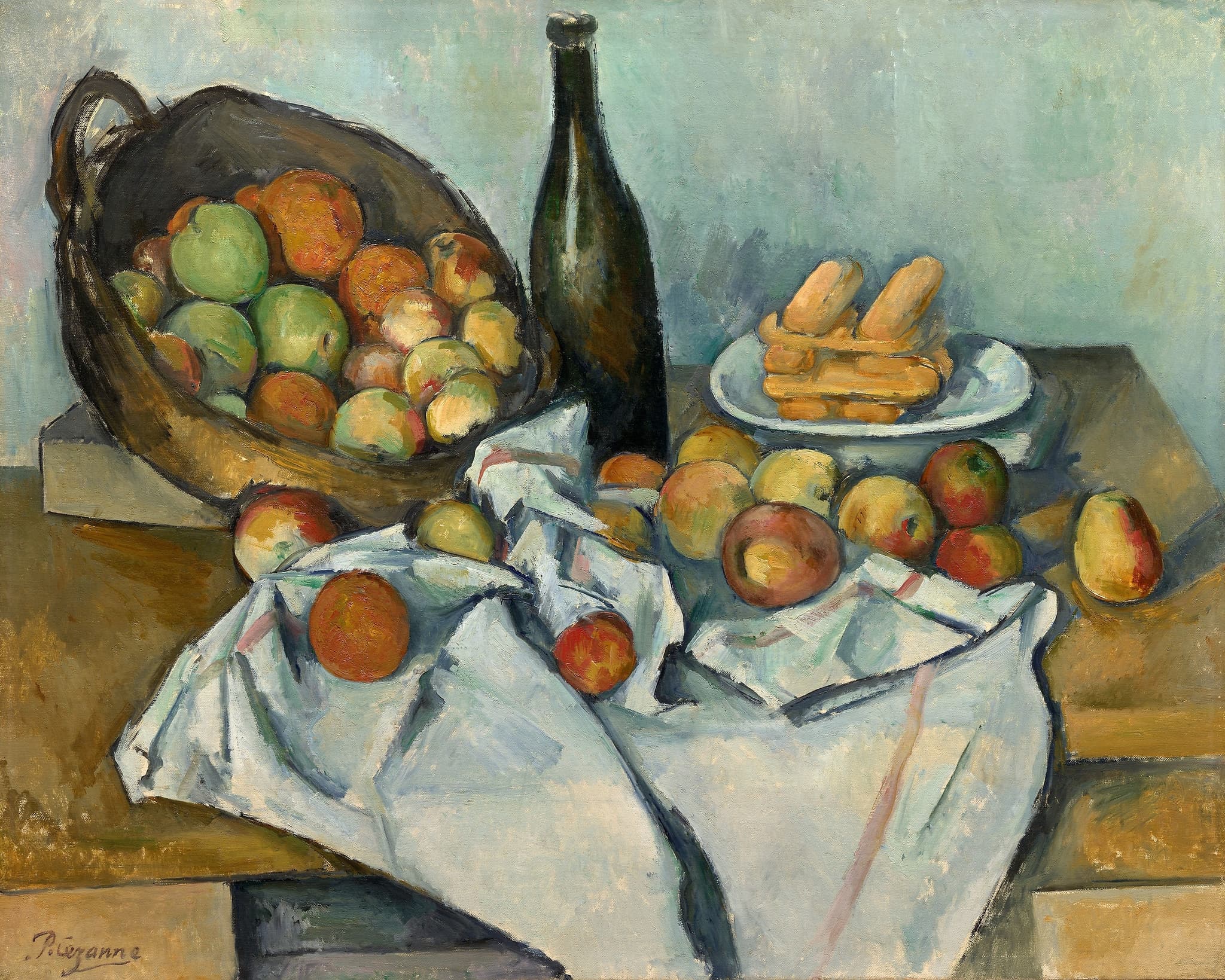
In both, brushwork organizes structure. Cézanne’s short, “constructive” strokes build planes and volumes—the bottle, apples, and folding cloth in The Basket of Apples, or the faceted mountain and sky in Mont Sainte‑Victoire. Van Gogh’s impastoed, directional marks give wheat, sky, stone, and foliage a single pulse of energy—the bouquet in Sunflowers reads by temperature and texture; Wheatfield with Crows moves as one organism under a pressurized sky.
Both artists also write candidly about their aims. Cézanne insists that painters concretize sensations and seeks a harmony that stands “parallel to nature.” Van Gogh states programs in letters—painting night without black, or making wheatfields under turbulent skies express loneliness and strength—so their pictures can be read against explicit intentions. Taken together, they reposition modern painting around procedure: motif as laboratory, touch as the unit of form, and color as a builder of reality rather than a cosmetic veil.
Decisive Difference
Where they diverge is how a picture earns truth. For Cézanne, truth is constructed through measured comparison. He replaces single‑point depiction with a web of relations—planes, warm–cool shifts, and subtle viewpoint changes—so that the picture becomes a durable order “parallel to nature.” In letters he compresses this into a scaffold of cylinder, sphere, and cone. Still lifes such as The Basket of Apples accept axial tilts and misaligned edges because they register sequential looking; Sainte‑Victoire canvases bind mountain, fields, and sky into interlocking modules. The result is a slow proof: sensation stabilized into form.
For Van Gogh, truth is declared by color as conviction. Complements and impasto don’t transcribe optical light so much as state an equivalence between outward nature and inward feeling. In 1888 he vows to paint “night without black”; in July 1890 he writes of wheatfields under turbulent skies that express “sadness, extreme loneliness,” yet also what is “healthy and fortifying” in the countryside. Works from Café Terrace at Night to Wheatfield with Crows enact this stance: high horizons, forking paths, and charged blues‑against‑yellows that make weather a protagonist. If Cézanne’s picture is built by comparison over time, Van Gogh’s is struck like a chord. One makes order endure; the other makes feeling immediate—two distinct answers to what a modern painting is for.
Paired Works
Still life rebuilt two ways
Focus question: What does stability look like when it is built by relations (Cézanne) versus by chroma (Van Gogh)?
The Basket of Apples vs Sunflowers
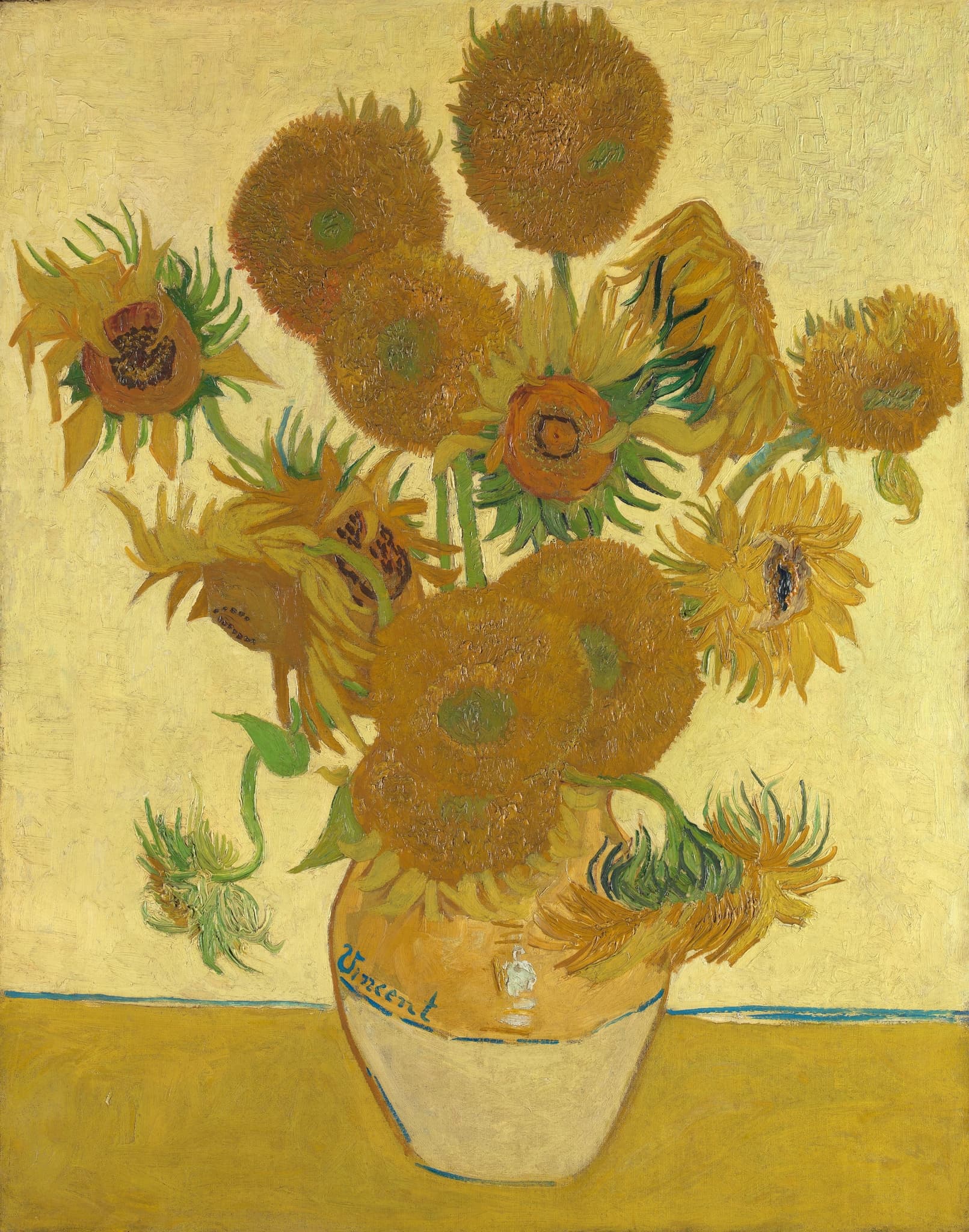
Cézanne’s tabletop is a calculus of relations: the front and back edges refuse to align, a bottle lists, a plate is seen from two vantage points, and the cloth buckles into planes. Warm–cool shifts model volume—the apples swell through modulated reds, greens, and ochres—so solidity emerges from measured difference. These “purposeful errors” register sequential looking stitched into one field. Van Gogh’s bouquet, by contrast, builds a world from a narrow register of yellows. Differences in temperature and impasto carry time and feeling: crisp lemon petals, shaggy seed heads, and drooping disks compress a life cycle inside one vase. Green shocks of stem and bract snap against the yellow field; the signature on the pot grounds the blaze in lived address. Cézanne constructs equilibrium through comparison; Van Gogh turns color into conviction. In one, stability is the sum of relations; in the other, it is a belief stated at full volume.
Landscape as principle vs landscape as weathered feeling
Focus question: How does each painter make landscape carry thought or feeling without anecdote?
Mont Sainte-Victoire vs Wheatfield with Crows
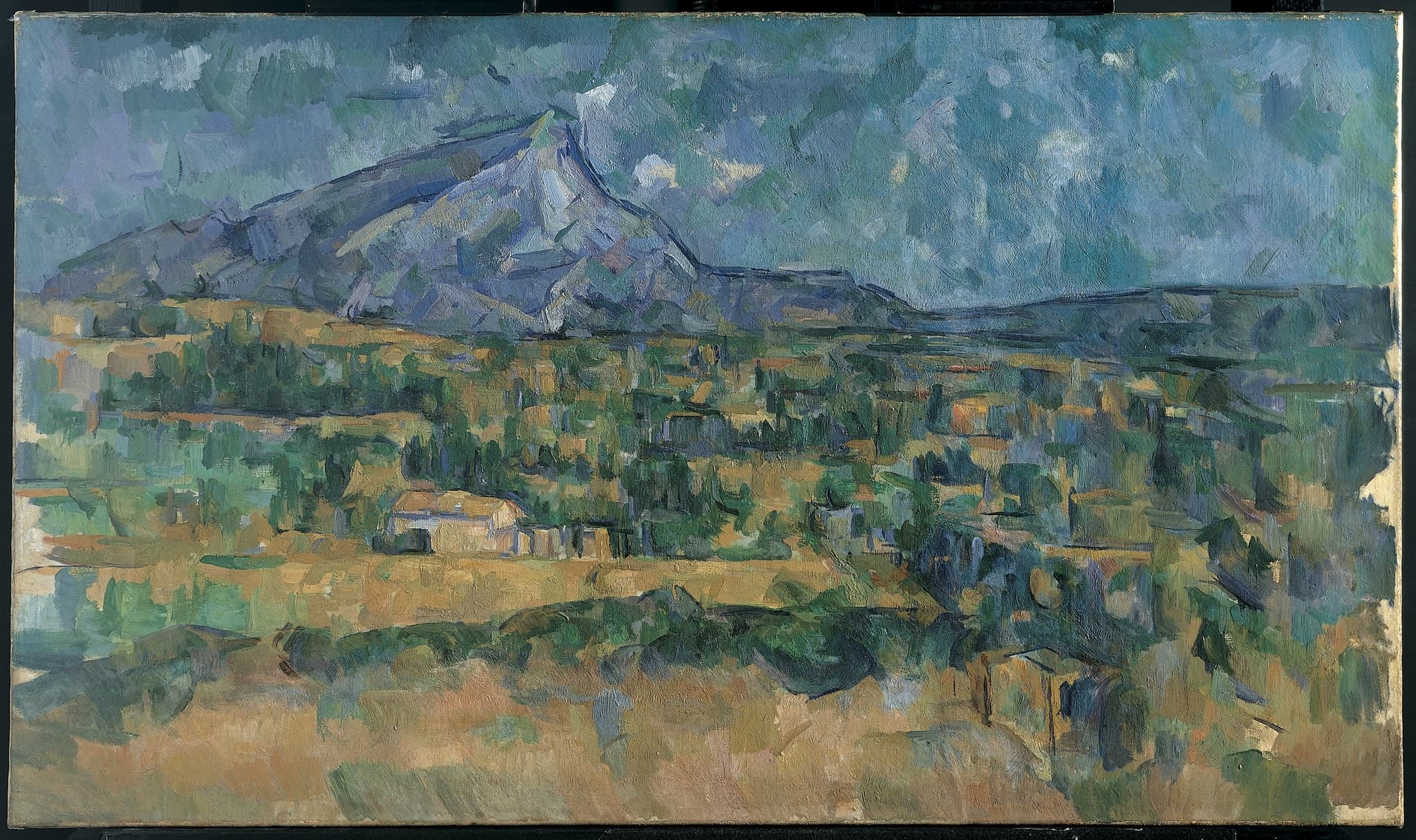
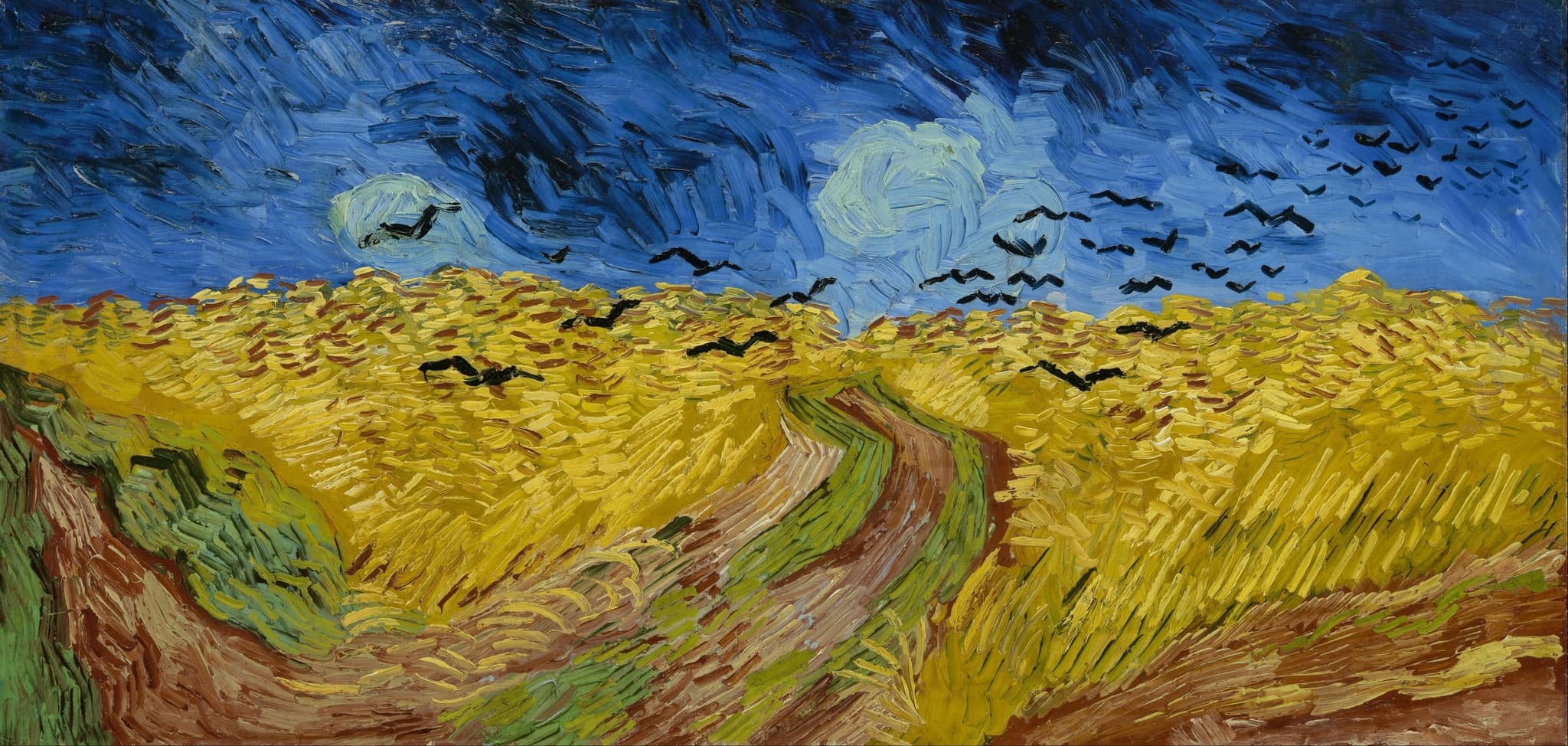
Cézanne facets Mont Sainte‑Victoire into coordinated planes: cool violet‑blues in the peak, ochres and greens tessellating the fields, a sky that answers the mountain’s angles. Depth comes from warm–cool modulation and stacking rather than theatrical diagonals; the massif reads as a principle—nature rebuilt as order. Van Gogh’s double‑square panorama raises the horizon and drives a forked path, leaning wheat, and a dark flock into collision beneath a cobalt sky. Blue–yellow complements and impasto turn weather into a palpable mood, matching his July 1890 aim to show both loneliness and what is “healthy and fortifying” in the countryside. The painting is not a last‑work confession but part of a late series testing scale and feeling. Put together, the pair clarifies the split: Cézanne makes landscape think; Van Gogh makes it feel, immediately and completely.
Portrait: structure vs chromatic empathy
Focus question: When likeness is secondary, what does a portrait make visible instead?
Madame Cézanne in a Red Armchair vs Portrait of Dr. Gachet
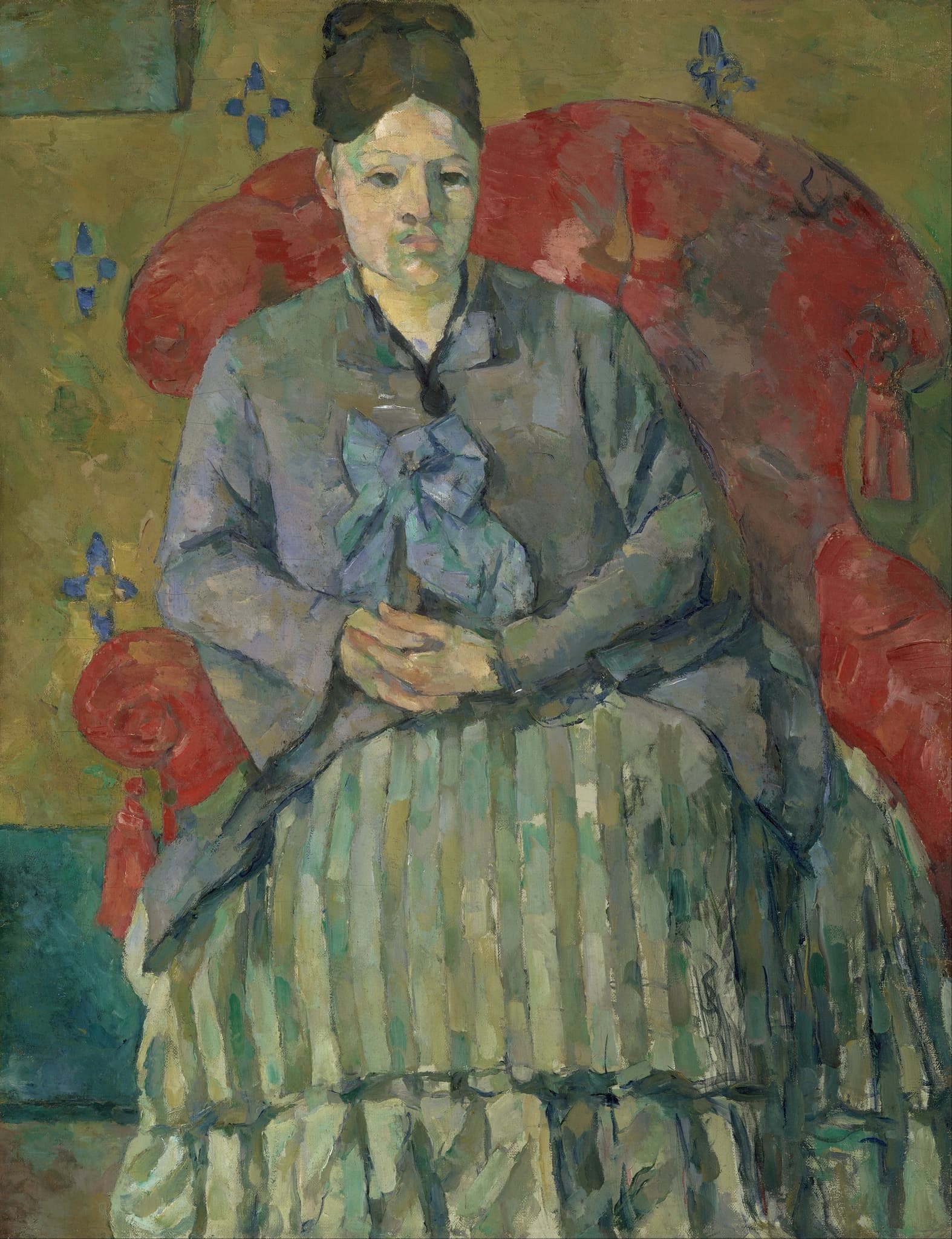
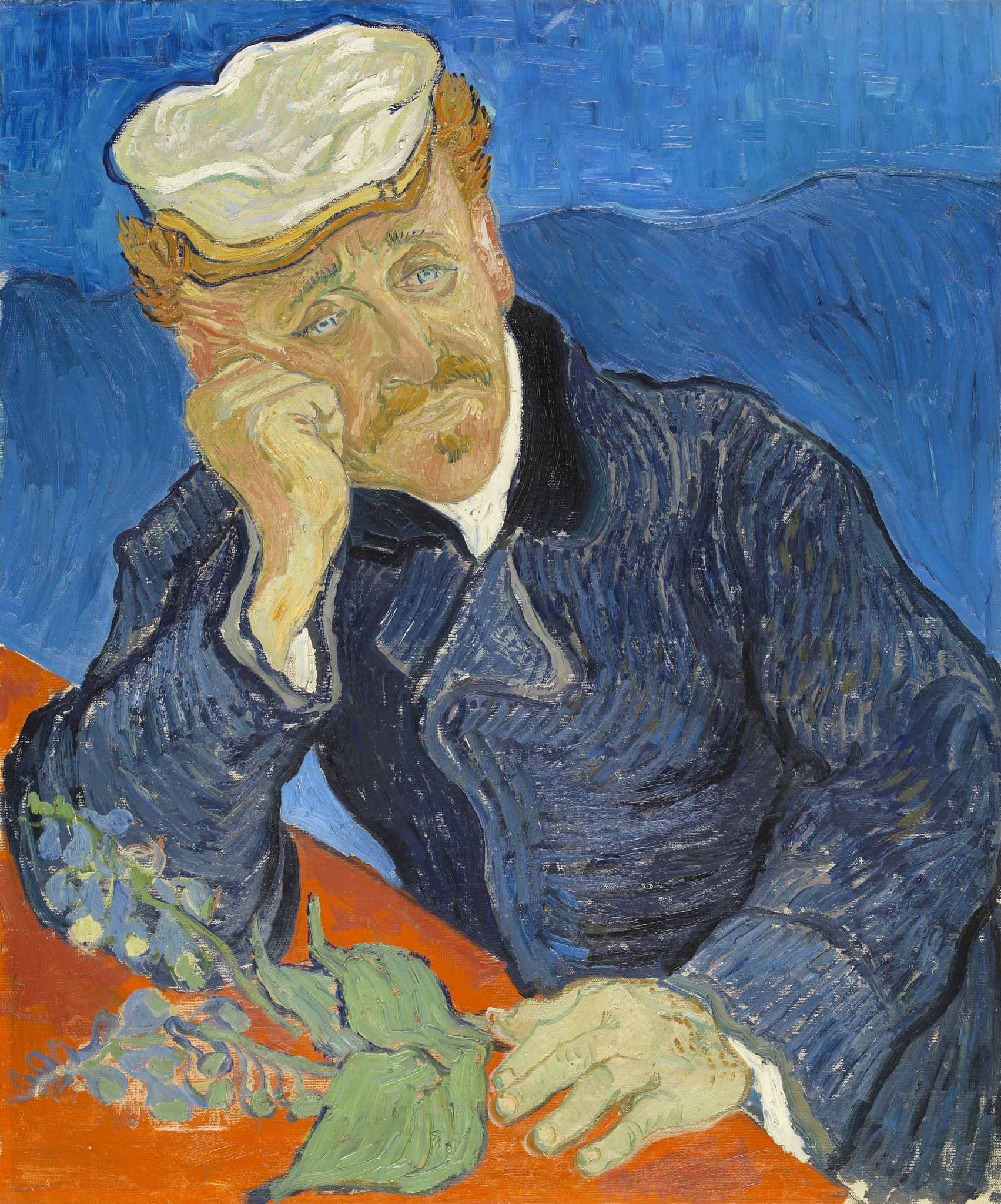
Cézanne opposes a saturated red armature to cool blue‑greens so the sitter reads as an architectural presence—volume and poise built from small, faceted strokes. Tilted baseboard, resistant wallpaper, and calibrated temperatures compress space until stability itself becomes the portrait’s subject. Van Gogh turns the table into a blazing orange counterweight against a sea of cobalt coat and ground; the hand to cheek, wavering outlines, and the foxglove sprig make care and fragility legible in color. Where Cézanne tests equilibrium—how warm and cool masses hold a figure steady—Van Gogh stages empathy as a chromatic clash that refuses collapse. Both reject finish and anecdote; one arrives at structure, the other at psychological weather.
Human order vs restless building
Focus question: How do geometry and color pressure organize human presence and place?
The Card Players by Paul Cézanne | Equilibrium and Form vs The Church at Auvers
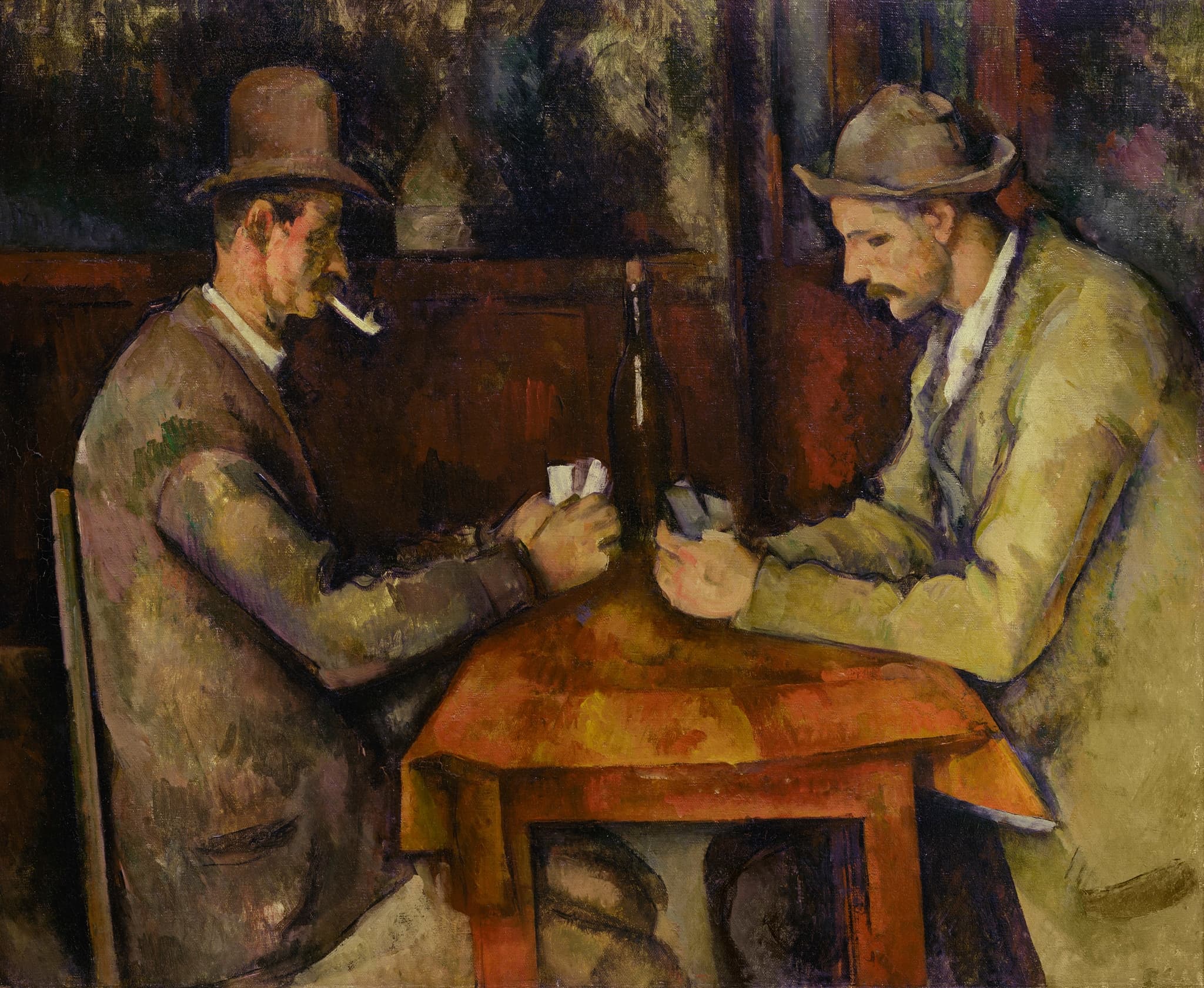
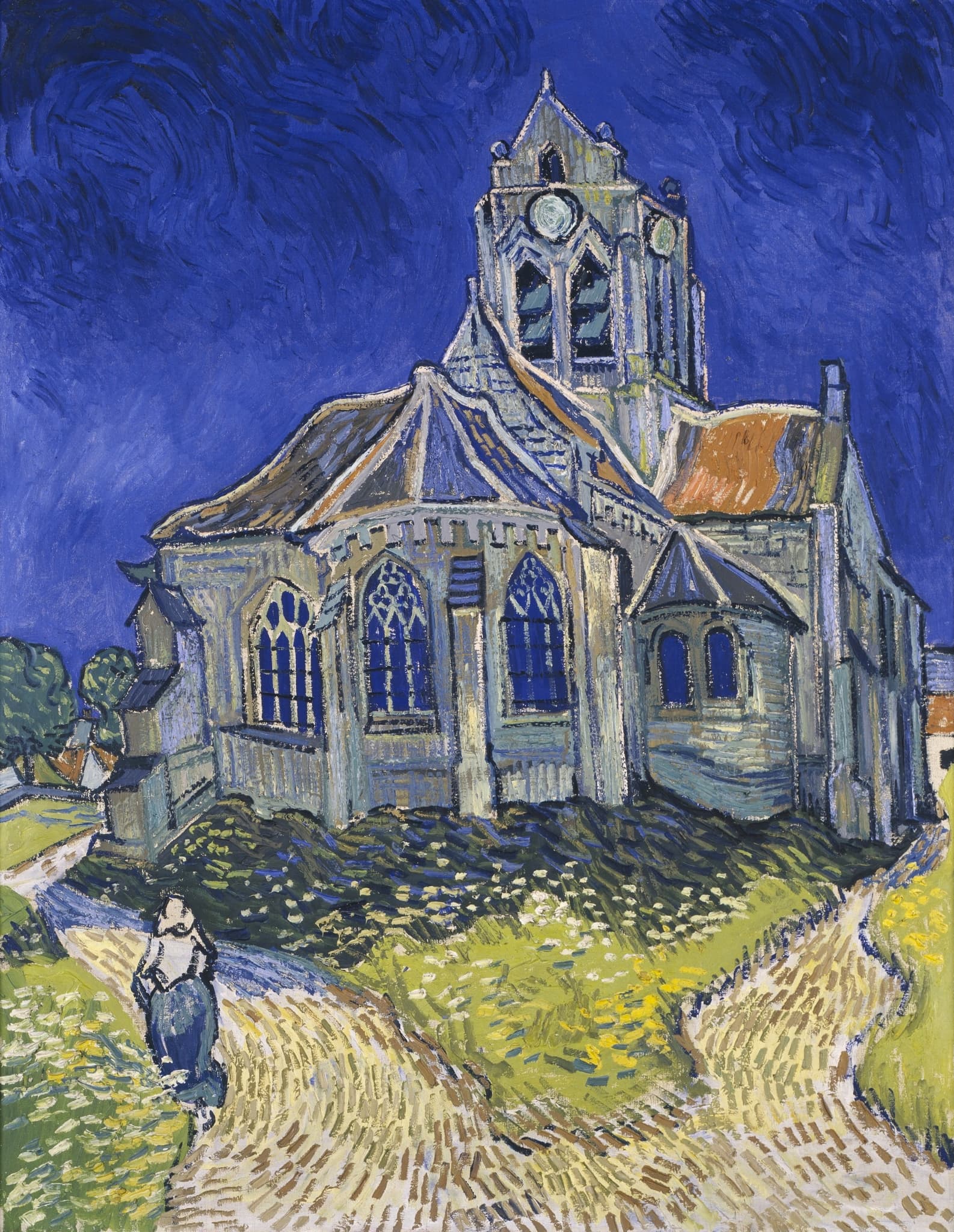
In The Card Players, two peasants and a table become a human still life. The dark bottle stands as a central axis; sleeves, hats, and cloth reduce to interlocking planes; warm and cool earths balance until attention itself feels monumental. Van Gogh’s church swells and tilts under a cobalt dome. Violet masonry and orange roof flashes fight the blue ground; forking sandy paths and a small passerby move light and life around a dark, unresponsive building. Cézanne reduces event to measured counterweights—equilibrium is the content. Van Gogh externalizes ambivalence through complements and contour—architecture as emotion. The pair shows how geometry can dignify presence while color can dramatize where meaning now resides.
Why This Comparison Matters
Putting Cézanne and Van Gogh side by side clarifies two durable models for modern painting. One says: build a world that can stand beside nature by testing relations until they hold—order as a hard‑won equilibrium. The other says: let color state conviction so directly that nature and feeling meet in the same stroke—immediacy as truth. Both move painting from depiction to construction, but they route that shift differently: through comparative measure or through chromatic belief.
For a viewer, this distinction sharpens looking. In Cézanne, attend to how warm and cool patches, small tilts, and repeated motifs slowly cohere. In Van Gogh, track how complements, impasto, and compressed horizons speed meaning forward. For later art, the fork is foundational: Cézanne’s method underwrites Cubism’s analysis; Van Gogh’s fuels Expressionism’s charge. Understanding the shared ground and decisive difference here provides a clear map for much of twentieth‑century painting—and a practical guide to how pictures make experience visible.
Related Links
Sources
- MoMA (Danchev), Letters of Paul Cézanne – selections incl. 15 Apr 1904
- Smarthistory, Cézanne: The Basket of Apples
- National Gallery, London – Farms near Auvers (double‑square format note)
- Van Gogh Letters – Letter 678 (Café Terrace; night without black)
- Van Gogh Letters – Letter 898 (July 1890; wheatfields under turbulent skies)
- Musée d’Orsay – The Church at Auvers
- Van Gogh Museum – Tree Roots identified as the last painting (research/education)
- Nelson-Atkins – Post‑Impressionism overview (constructive stroke)
- National Gallery Technical Bulletin – ‘Parallel to nature’ and Cézanne’s practice
- Maurice Merleau‑Ponty, “Cézanne’s Doubt” (phenomenology of vision)