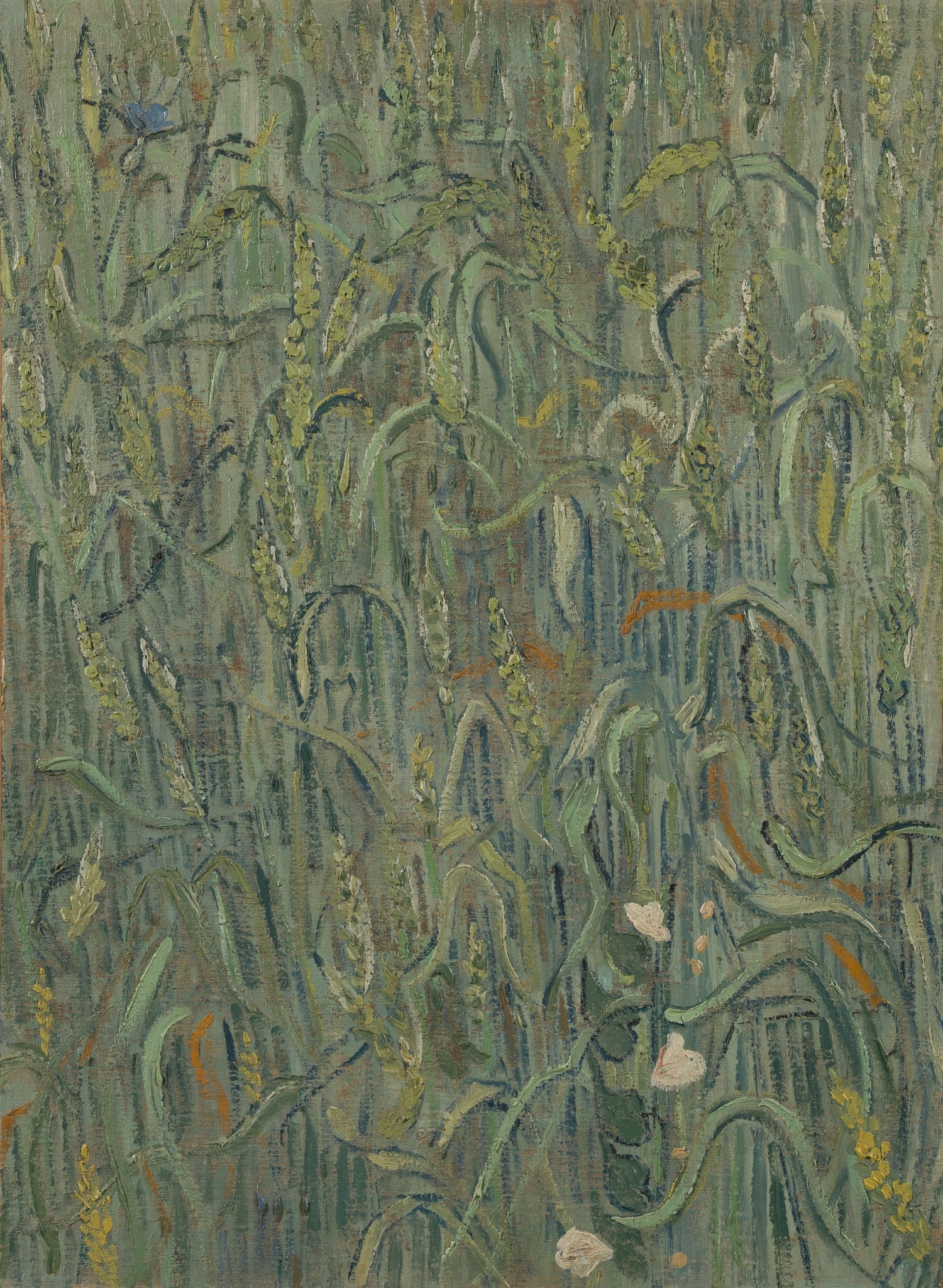
Blue cornflower Symbolism
In art, the blue cornflower often serves as a crisp note of wildness set against cultivated grain, its cool hue sharpening focus within a field’s dense textures. As a symbol, it can mark vitality, clarity, and resilience within agricultural cycles—qualities made legible in close studies of crops from the late nineteenth century.
Blue cornflower in Ears of Wheat
In Vincent van Gogh’s Ears of Wheat (1890), a single blue cornflower appears at the upper left within a horizonless tangle of grain rendered as an all-over surface of vibrating strokes. Its concentrated blue pierces the surrounding cool greens and blue-grays, functioning as a precise chromatic accent that asserts the presence of spontaneous wild growth amid cultivated wheat.
Paired compositionally with pale bindweed at the lower right, the cornflower helps “anchor the scene’s ecology,” identifying the field as a living community rather than a uniform crop. Within Van Gogh’s meditation on resilience and life’s cycles, the small flower reads as a resilient, clarifying note that underscores continuity and life within agricultural labor.