Ears of Wheat

by Vincent van Gogh

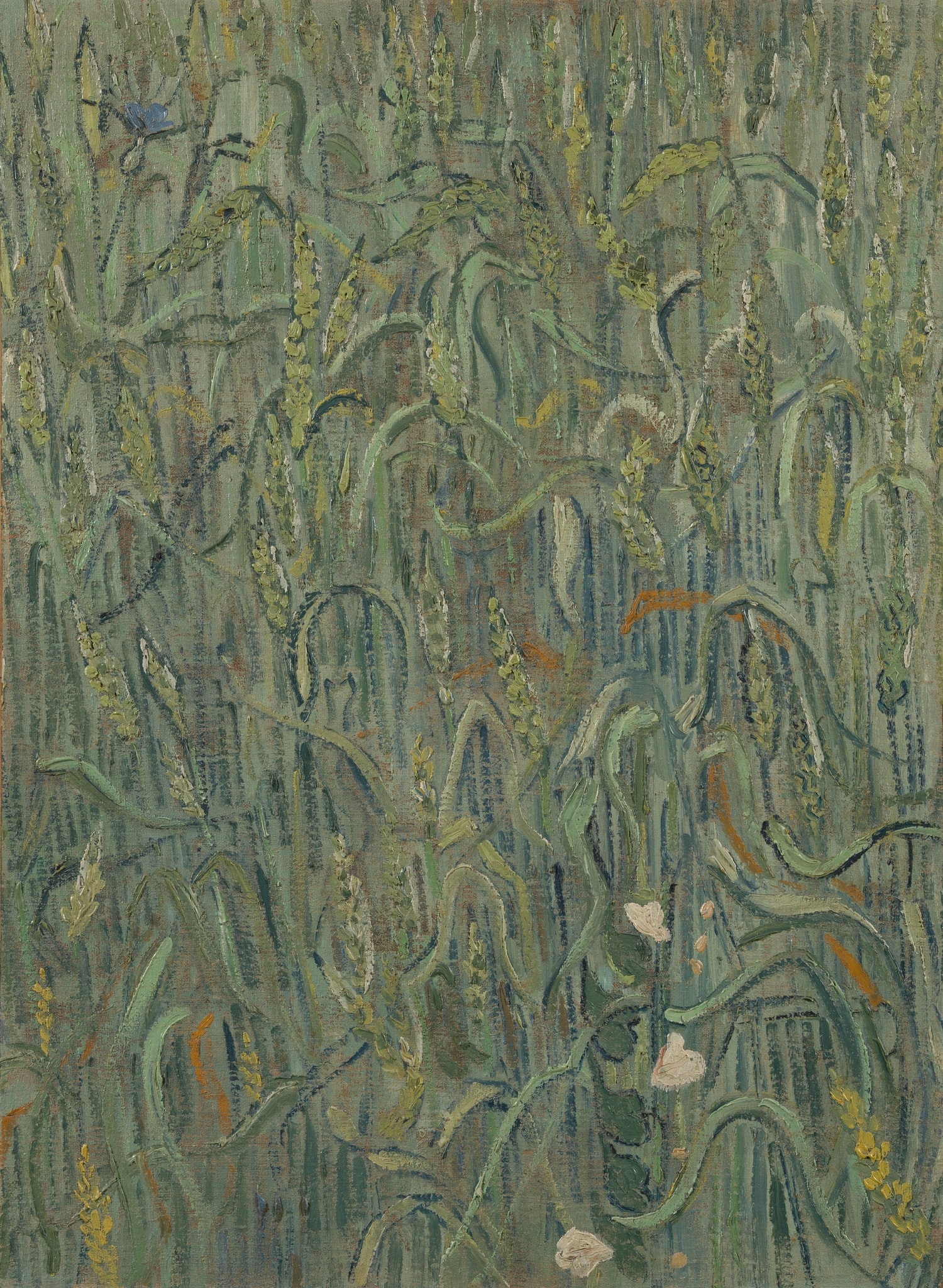
Ears of Wheat plunges the viewer into a close, horizonless tangle of grain, rendering a living field as an all‑over surface of vibrating strokes and looping leaves. Cool greens and blue‑grays are pricked by ocher and rusty orange, while a blue cornflower at upper left and pale bindweed at lower right anchor the scene’s ecology [1][2]. Van Gogh turns a humble crop into a meditation on resilience and life’s cycles.
💰

Market Value

$25-50 million

How much is Ears of Wheat worth?

Study Print Studio

Create a personal study print

Build a companion study sheet around the part of this painting that speaks to you most. Choose a detail, shape an interpretation, and walk away with something personal and display-worthy.

Fast Facts

Year
1890
Medium
Oil on canvas
Dimensions
64 x 48 cm
Location
Van Gogh Museum, Amsterdam
See all Vincent van Gogh paintings in Amsterdam
Ears of Wheat by Vincent van Gogh (1890) featuring Blue cornflower, Wheat ears (seed heads), Pale bindweed (convolvulus), Looping wheat leaves

Click on any numbered symbol to learn more about its meaning

Meaning & Symbolism

Van Gogh composes Ears of Wheat as a ground‑level immersion, cropping away horizon and sky so that the field becomes a continuous fabric of stalks and leaves. The dense, stacked touches—laid like bristles along the vertical shafts—interlock with longer, looping strokes that trace the weight and bend of the foliage. This dual tempo establishes a visual equivalence for wind and growth; the image does not depict motion so much as embody it. The palette leans to cool blue‑greens and blue‑grays, allowing small shocks of ocher and rusty orange to read as ripening seed heads that catch stray light. A blue cornflower flickers at the upper left and pink bindweed curls along the lower right; these accents, specified by the artist in a June 1890 letter, are not incidental decoration but coordinates that fix the viewer’s nearness within a specific patch of field 12. The surface, knitted by interleaved strokes, becomes a kind of woven plane—what later critics would recognize as an all‑over structure anticipating modernist patterning—yet it remains rooted in observed botany: heavy stalks, ribbon‑like leaves, ears just turning yellow 124. Within this formal net, the symbolism of wheat—central across Van Gogh’s career—quietly exerts pressure. He repeatedly cast grain as a figure for human life, its sowing and reaping standing for the cycle of growth, labor, death, and renewal; in related works he names the reaper an image of death and humanity the wheat that is cut 5. In Ears of Wheat no figure appears, but the close vantage and agitated facture internalize that drama: the viewer meets the crop at the moment of becoming, where green tips warm toward harvest and the field murmurs with latent force. The painting’s refusal of distant perspective denies the consolations of overview; instead, it proposes intimacy and attention as ethical stances. This is the late Auvers method—working fast, outdoors, and in series under Dr. Gachet’s watch—through which Van Gogh sought steadiness after the Saint‑Rémy year, turning nearby motifs into vehicles for order and feeling 34. The result here is both intimate and monumental: a humble stand of grain scaled to the size of experience itself. By fusing meticulous close‑looking (the identifiable cornflower and bindweed), tactile brushwork that suggests the “soft rustle” of ears in the wind, and the crop’s existential charge, Van Gogh demonstrates how paint can convert a patch of field into a statement about endurance and the restless energy of life 14. In that synthesis lies the meaning of Ears of Wheat and the reason it matters: it is a late, lucid proof that his art could make nature’s rhythms legible as human truth.

Explore Deeper with AI

Ask questions about Ears of Wheat

Popular questions:

Powered by AI • Get instant insights about this artwork

💬 Ask questions about this artwork!

Interpretations

Formal Analysis

Van Gogh engineers a tension between meticulous mimesis and near-abstract all-over design. Short, bristling touches lock into longer calligraphic sweeps, creating a woven surface that reads as both “observed botany” and decorative field. The cool blue‑greens modulated by ochre tips enact a chromatic counterpoint that suggests wind as much as leaf. This is not simply motion depicted; it is motion materialized by facture, where stroke density and vector serve as proxies for pressure and sway 14. Seen alongside Auvers works like Green Wheat Fields, this painting clarifies how Van Gogh converts landscape into an integrated rhythmic system—pattern first, motif second—anticipating modernist surface unity while remaining tethered to place-specific flora 14.

Source: National Gallery of Art (Washington)

Botanical/Phenomenological Reading

The named cornflower and bindweed function as phenomenological anchors: coordinates that fix the viewer’s nearness within a particular plot of field. Van Gogh explicitly itemizes these species in his June 1890 letter, pairing them with a color program designed to evoke the “soft rustle” of ears in wind—an appeal to embodied memory as much as sight 12. Their placement (upper-left flicker, lower-right curl) triangulates the gaze at ground level, transforming flora into wayfinding elements. This specificity counters any drift toward pure pattern by insisting on the lived, local ecology of Auvers: heavy stalks, ribbon leaves, ears “just turning yellow.” The result is a sensory map where botanical cues choreograph looking and situate the body in space 12.

Source: Van Gogh Museum; Van Gogh’s Letters

Spiritual/Existential Symbolism

Across Van Gogh’s oeuvre, wheat carries an existential charge: sowing and reaping figure the cycle of life, labor, death, and renewal. In related writings, he equates the reaper with the image of death and humanity with the wheat being cut—an allegory that shadows this horizonless field 5. Ears of Wheat removes the personified agent but internalizes the drama: ripening tips foreshadow their own harvest, and the viewer witnesses becoming already tinged with ending. The absence of sky denies transcendental escape; meaning is immanent, worked into matter and season. The painting thus reads as a quiet theodicy of growth, where endurance arises from cycles rather than consolation, locating spiritual truth in the grain’s fate and return 15.

Source: Van Gogh Museum (Wheatfield with a Reaper)

Therapeutic Practice and Method

Painted weeks after leaving Saint‑Rémy and under Dr. Gachet’s general care, the close‑range, serial method at Auvers acted as a stabilizing routine: fast execution outdoors, near at hand, transforming nearby motifs into order and feeling 13. The ground‑level crop enforces attentional discipline—no vistas, only tasks of looking: stacking, looping, calibrating greens against ochres. Such disciplined repetition carries a therapeutic cast, aligning manual rhythm with psychic regulation. Contemporary accounts of the period stress both astonishing productivity and the search for steadiness; Ears of Wheat exemplifies this by suturing method to mood, where facture is a coping technology that organizes sensation and restores agency through work 138.

Source: Van Gogh Museum; JAMA Humanities

Display, Seriality, and Early Modernist Surface

Recent Auvers scholarship frames these tight-cropped canvases within ambitions for decorative ensembles and serial display. The painting’s horizonless, knitted plane reads as a panel that could join others—gardens, wheatfields, undergrowth—into immersive suites, a curatorial thesis underscored by the Orsay’s 2023–24 exhibition 16. In this context, the all-over, woven surface is not only a perceptual effect but a display strategy: a modular unit in a larger visual fabric. Such seriality prefigures modernist concerns with pattern, repeat, and wall-scaled fields while remaining rooted in site-specific observation. Ears of Wheat becomes both a complete image and a tile in a broader scheme, mediating between private vision and public presentation 16.

Source: Musée d’Orsay (Van Gogh in Auvers‑sur‑Oise)

Reception and the ‘Up Close’ Lens

When shown in “Van Gogh: Up Close” (2012), critics underscored the painting’s nose‑to‑stalk scrutiny: a clinically observant yet rhythmic surface that collapses distance into texture. This reception history matters because it repositions Ears of Wheat from a pastoral vignette to an experiment in proximal seeing, aligning it with modern photographic and cinematic framings that excerpt the world rather than survey it 7. Viewers and curators alike read the painting as a manifesto of attention—how detail can generate monumentality without recourse to horizon or figure. The exhibition context thus sharpened the work’s legacy: not a minor study, but a keystone in understanding Van Gogh’s late grammar of nearness and pattern 17.

Source: Philadelphia Museum of Art/National Gallery of Canada exhibition; Philadelphia Inquirer

Related Themes

About Vincent van Gogh

Vincent van Gogh (1853–1890) developed a radical, emotion‑driven use of color after moving from Paris to Arles in 1888, seeking southern light and an artists’ community. In Arles he created the Sunflowers series to decorate the Yellow House ahead of Gauguin’s visit. His late work fused impasto, high chroma, and symbolic motifs that shaped modern painting [2][5].
View all works by Vincent van Gogh

More by Vincent van Gogh
Café Terrace at Night by Vincent van Gogh

Café Terrace at Night

Vincent van Gogh (1888)

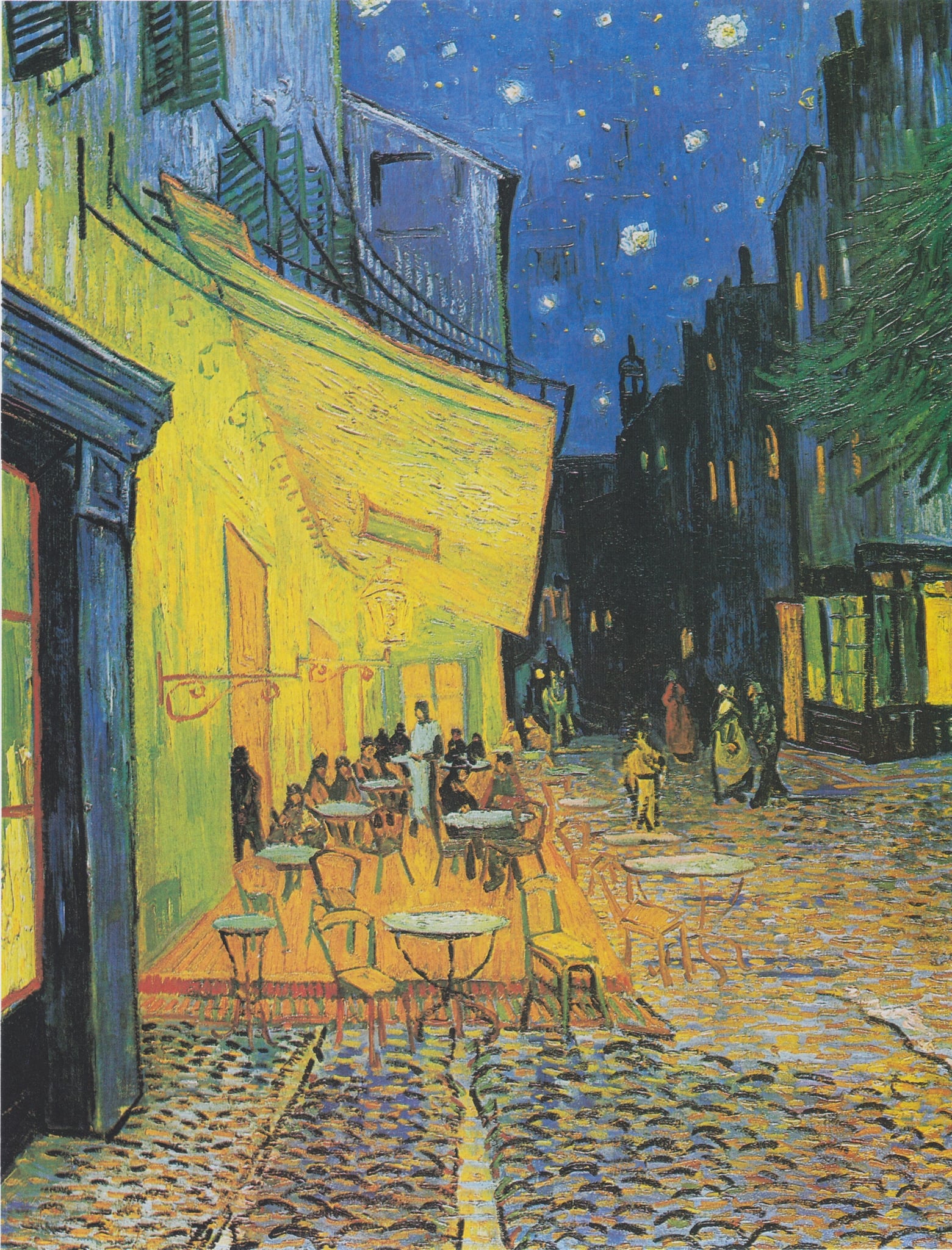
In Café Terrace at Night, Vincent van Gogh turns nocturne into <strong>luminous color</strong>: a gas‑lit terrace glows in yellows and oranges against a deep <strong>ultramarine sky</strong> pricked with stars. By building night “<strong>without black</strong>,” he stages a vivid encounter between human sociability and the vastness overhead <sup>[1]</sup><sup>[2]</sup>.
Red Cabbages and Onions by Vincent van Gogh

Red Cabbages and Onions

Vincent van Gogh (1887)

In Red Cabbages and Onions, Vincent van Gogh turns everyday produce into a drama of <strong>complementary color</strong> and <strong>restless brushwork</strong>. Hot red contours cinch violet cabbages and pale yellow bulbs against a cool, striated blue table, while a mustard‑yellow patch in the upper right tilts the space and sharpens the chromatic clash. The result asserts ordinary food as a locus of <strong>resilience</strong> and <strong>experimentation</strong> <sup>[1]</sup><sup>[2]</sup>.

Irises by Vincent van Gogh

Irises

Vincent van Gogh (1889)

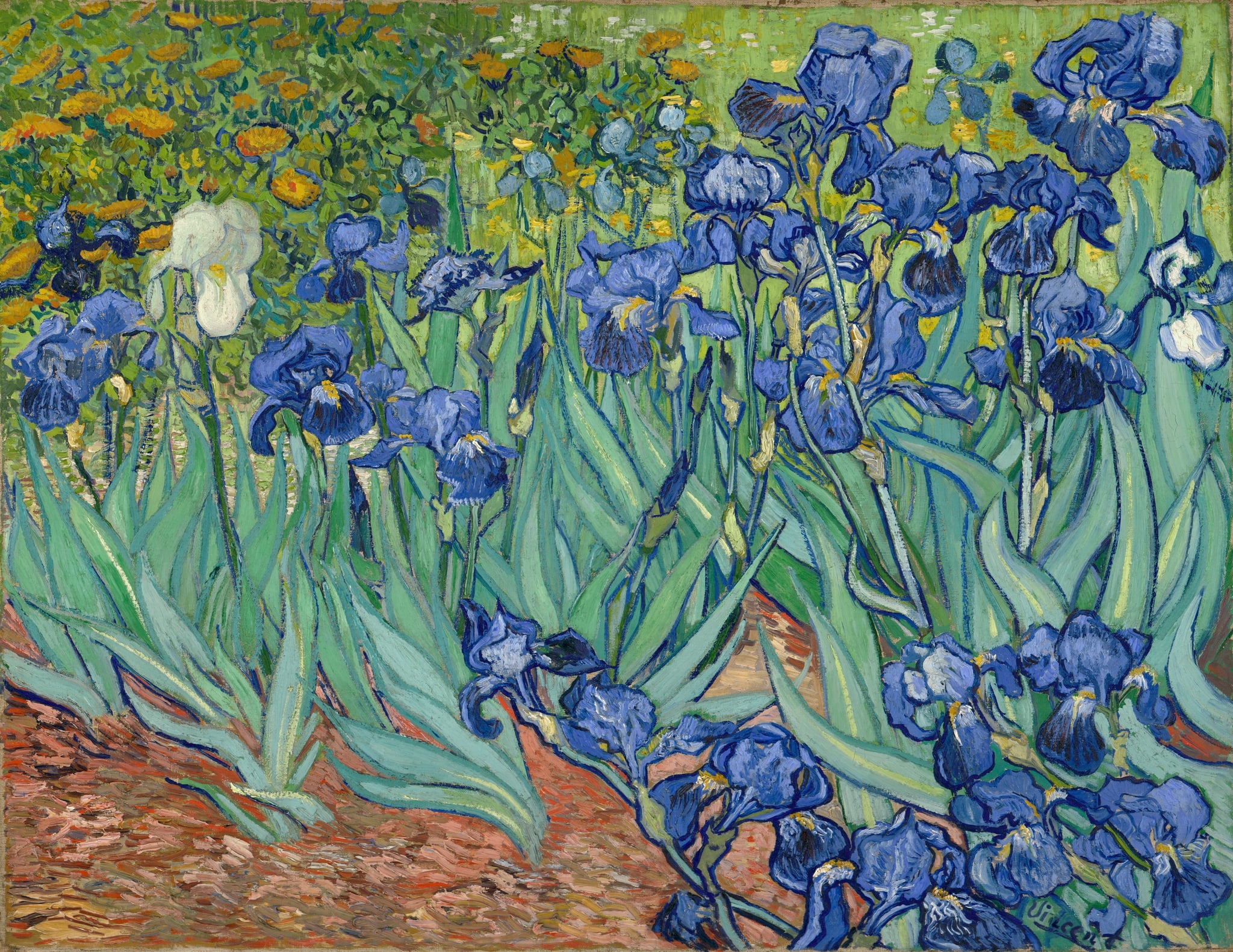
Painted in May 1889 at the Saint-Rémy asylum garden, Vincent van Gogh’s <strong>Irises</strong> turns close observation into an act of repair. Dark contours, a cropped, print-like vantage, and vibrating complements—violet/blue blossoms against <strong>yellow-green</strong> ground—stage a living frieze whose lone <strong>white iris</strong> punctuates the field with arresting clarity <sup>[1]</sup><sup>[2]</sup>.
Sunflowers by Vincent van Gogh

Sunflowers

Vincent van Gogh (1888)

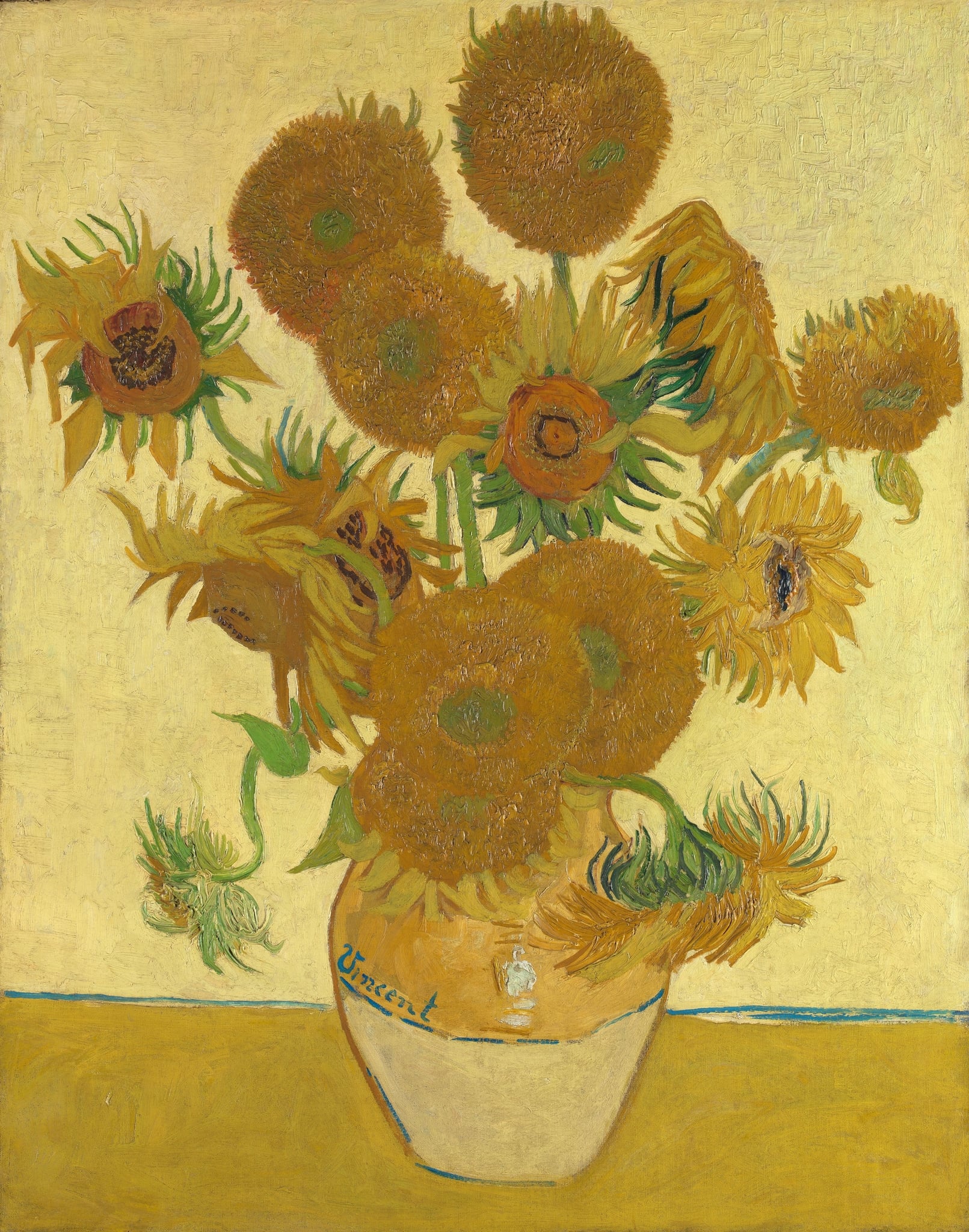
Vincent van Gogh’s Sunflowers (1888) is a <strong>yellow-on-yellow</strong> still life that stages a full <strong>cycle of life</strong> in fifteen blooms, from fresh buds to brittle seed heads. The thick impasto, green shocks of stem and bract, and the vase signed <strong>“Vincent”</strong> turn a humble bouquet into an emblem of endurance and fellowship <sup>[1]</sup><sup>[2]</sup>.

Garden with Courting Couples: Square Saint-Pierre by Vincent van Gogh

Garden with Courting Couples: Square Saint-Pierre

Vincent van Gogh (1887)

In Garden with Courting Couples: Square Saint-Pierre, Vincent van Gogh turns a small Montmartre park into a stage where <strong>spring</strong>, <strong>intimacy</strong>, and <strong>urban leisure</strong> converge. Short, shimmering strokes fuse pink chestnut blossoms, curving paths, and paired figures into one pulse of <strong>renewal</strong> and <strong>togetherness</strong> <sup>[1]</sup><sup>[2]</sup>.

In the Café: Agostina Segatori in Le Tambourin by Vincent van Gogh

In the Café: Agostina Segatori in Le Tambourin

Vincent van Gogh (1887 (Jan–Mar))

Van Gogh casts Agostina Segatori at a tiny, tambourine‑like café table, turning Le Tambourin into a <strong>stage of modern life</strong>. Cool greens and greys make the red <strong>flame‑plume hat</strong> and the foaming <strong>beer</strong> flare, while folded arms and a set‑aside <strong>parasol</strong> register private fatigue amid public display <sup>[1]</sup><sup>[2]</sup><sup>[3]</sup>.